The Troubled Legacy of Rui Pereira: From Toronto’s Kingsway to the Battle for Westwood’s Bruin Theatre

LOS ANGELES — When Rui Pereira arrived in Los Angeles this summer to spearhead the revival of Westwood’s historic Bruin Theatre, he was positioned as a savior of celluloid. A Canadian exhibitor with nearly two decades of experience, Pereira promised to restore the 1937 Art Deco landmark to its former glory. However, the curtain had barely risen on his Californian debut before a shadow from his past in Toronto began to loom over the marquee.
What was intended to be a celebratory restoration has instead devolved into a firestorm of controversy. Allegations of racism, antisemitism, unauthorized film screenings, and a history of physical and legal altercations have followed Pereira across the border. As the Los Angeles film community grapples with these revelations, a clearer picture is emerging of a man whose career is defined as much by toxic disputes as by his devotion to 35mm film.

Main Facts: A Pattern of Conflict
The controversy surrounding Pereira is not rooted in a single isolated incident but in a documented history spanning seventeen years. Since taking over Toronto’s single-screen Kingsway Theatre in 2009, Pereira has been the focal point of numerous legal battles and public outcries.
The current crisis was ignited when two key volunteers for the Bruin Theatre project resigned after social media users linked inflammatory posts from the Kingsway Theatre’s accounts to Pereira’s new L.A. venture. These posts included rhetoric widely condemned as antisemitic and racist. While Pereira initially dismissed the outcry as "dishonest and disingenuous," he later admitted to The Hollywood Reporter that certain comments regarding Jewish people were "offensive" and stated he "must take responsibility."

However, the rot appears to go deeper than social media conduct. An extensive investigation involving more than 25 sources, court records from two countries, and box-office data reveals a pattern of behavior that includes:
- Physical Altercations: Allegations of assault involving former business partners.
- Licensing Piracy: Evidence of dozens of film screenings conducted without the authorization of rights holders.
- Discrimination: Public disputes with customers and critics that have led to accusations of racial profiling.
- Financial Instability: Reports of unpaid debts and "abysmal" box office performance compared to industry standards.
A Chronology of Turbulence (2009–2026)
2009: The Kingsway and the Cracked Eye Socket
Pereira’s tenure at the Kingsway Theatre began with a violent rupture. Rick Ross, president of the technology company SwitchWorks, invested roughly $200,000 to help Pereira renovate the theater. Within months, the partnership collapsed.

In June 2009, Ross recorded a 28-minute confrontation during which a voice attributed to Pereira is heard shouting, "I don’t give a shit about your documents. You are nothing." The dispute turned physical in July 2009. Ross alleges that Pereira attacked him in front of a theater audience, eventually kicking him down a flight of stairs. Ross provided documentation of a cracked eye socket and substantial facial bruising. The matter resulted in a "peace bond"—a Canadian preventive order—and an out-of-court settlement.
2012: The Humber Cinema Lockout
In 2011, Pereira expanded his footprint by reopening the Humber Cinema in Toronto. The venture lasted less than a year. Landlord Claude Bitton locked Pereira out of the building, alleging thousands of dollars in unpaid rent. What followed was a "hijacking" accusation from Pereira and a messy legal battle over theater equipment. The dispute alienated members of the Toronto film press, including journalist Sean Patrick Kelly, who described Pereira as a "notorious bully" who holds long-standing grudges.

2017: The Backpack Incident and Racial Profiling
In March 2017, the Kingsway became the center of a national conversation on discrimination in Canada. Black actress Oluniké Adeliyi was refused entry to a screening because she declined to surrender her backpack to management. The situation escalated when Pereira called the police, identifying Adeliyi to dispatchers as a "dangerous" Black woman. Adeliyi described the experience as "dehumanizing." While Pereira argued the policy was universal, the incident left a permanent stain on the theater’s reputation.
2023–2025: Social Media and the "Zionazi" Rhetoric
Following the October 7 attacks on Israel, the Kingsway’s social media accounts—personally managed by Pereira—began posting aggressive content targeting Jewish critics and Zionism. In one instance, the account told a critic to "Go back to Poland" and described a swastika painted on a Jewish family’s home as a "proper symbol."

Freelance journalist Corey Atad, who is Jewish, became a frequent target of Pereira’s vitriol after excluding the Kingsway from a list of Toronto’s best cinemas. Atad noted that Pereira’s rhetoric often sought to distinguish between "legitimate" and "illegitimate" Jews based on their political views—a trope widely recognized as antisemitic.
2026: The Bruin Takeover and the Aldanmaz Dispute
As Pereira moved into the L.A. market, his penchant for legal conflict remained. He is currently embroiled in a dispute with Canadian film archivist Peter Aldanmaz over 60 film prints and two projectors. Pereira alleges theft; Aldanmaz, in turn, has sought a peace bond against Pereira, citing a fear of personal injury or property damage.

Supporting Data: The Business of Shadow Screenings
One of the most damaging findings in the investigation involves Pereira’s business practices regarding intellectual property. IndieWire identified 55 advertised screenings of 17 different films at the Kingsway that rights holders say were never authorized.
Bret Berg of the American Genre Film Archive (AGFA) confirmed that Pereira ignored chain-of-title documentation, claiming films were "effectively abandoned" if they didn’t appear in a specific (and now defunct) Ontario regulatory database. Berg noted that no other theater in Canada had ever used such a justification to bypass licensing fees. "It would have cost us more money to get a lawyer in Canada than we would ever make," Berg said, explaining why many independent distributors feel powerless against such tactics.

Furthermore, Comscore data paints a grim picture of the Kingsway’s financial health. Between 2009 and 2026, the theater reported a total box office of $4.22 million—an average of $247,000 per year. Industry executives described these numbers as "dreadful" and "abysmal," raising questions about how the operation remained solvent for nearly two decades.
Official Responses: Denials and Admissions
Rui Pereira’s responses to these allegations have been inconsistent. In an initial August 26 statement, he told IndieWire, "There are no controversies and any attempt to generate them is dishonest and disingenuous." He further claimed that his accusers were "misleading" and that their claims had no basis in legal proceedings.

However, when confronted by The Hollywood Reporter with specific screenshots of his social media posts, Pereira shifted his tone. He acknowledged that the posts were "offensive" and admitted he "must take responsibility." Despite this, he continues to deny all accusations of racism and licensing fraud, characterizing the scrutiny as "blowback" from his screenings of Palestinian films—an assertion debunked by the fact that many of the controversial posts predated those screenings.
The owners of the Bruin Theatre building issued a brief statement: "The owners of the Bruin Theater condemn, without reservation, all comments of hate." Notably, they did not explain why they chose to lease the historic site to an operator with such a well-documented history of public conflict.

Implications: The Future of Westwood
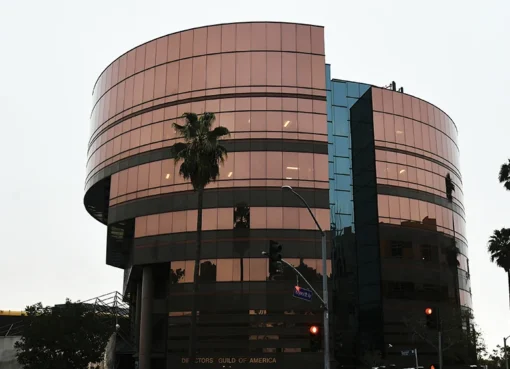
The turmoil at the Bruin Theatre comes at a sensitive time for the Westwood neighborhood. Directly across the street, a $25 million restoration of the Westwood Village Theatre (now known as Directors Village) is underway, led by a coalition of high-profile filmmakers and the nonprofit American Cinematheque.
The contrast between the two projects is stark. While Directors Village represents a transparent, community-backed effort to preserve cinema, the Bruin’s current management is shrouded in litigation and hostility.

For the Los Angeles film community, the Pereira saga serves as a cautionary tale. It raises vital questions about the vetting process for the custodians of cultural landmarks. If a historic theater is "saved" by an operator who alienates the community through hate speech and unethical business practices, has it truly been saved?
As it stands, Pereira has directed IndieWire and its representatives not to return to the Bruin Theatre or approach his staff. He maintains that he is the only authorized voice for the project. However, with distributors now vowing to never book films at the Bruin as long as he is involved, the theater’s ambitious revival may be over before it truly begins. The conflict, it seems, will be the only thing showing in Westwood this fall.