
The Unfulfilled Promise of Azadmere: A Deep Dive into a HârnWorld Supplement’s "Dwarven Beef" Deficit
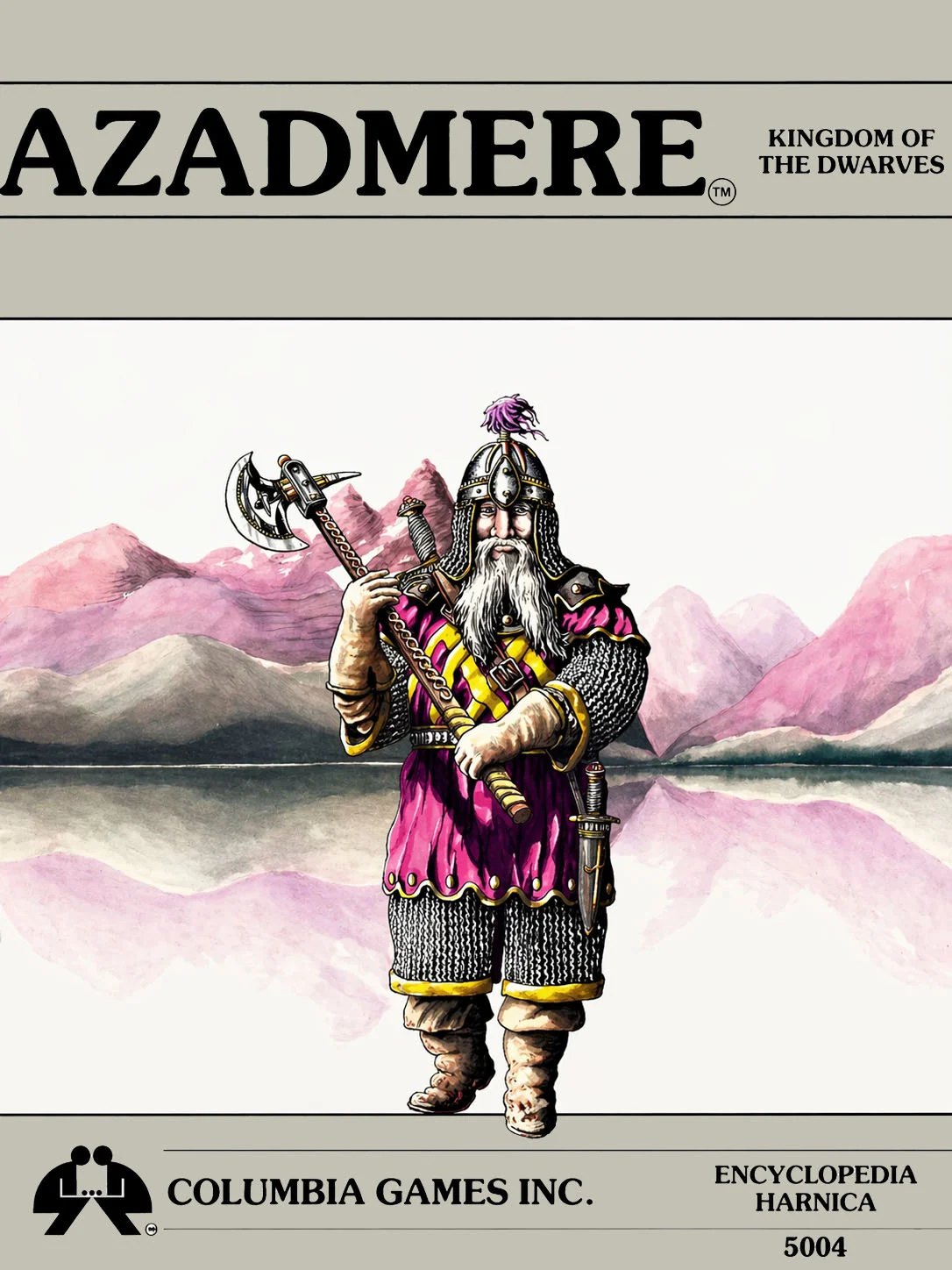
Originally published October 9th, 2001, and revisited with two decades of perspective, a critical review of the HârnWorld supplement Azadmere offers timeless lessons in tabletop role-playing game (TTRPG) design, particularly concerning the delicate balance between breadth and depth. The central question posed by the reviewer, "Where’s the dwarven beef?", resonates even today, highlighting the enduring desire among game masters (GMs) and players for rich, immersive content that truly brings fantasy worlds to life.
Main Facts: A Kingdom Underserved
Azadmere, a supplement for the acclaimed HârnWorld setting, sought to illuminate the ancient dwarven kingdom and its surrounding cultural tapestry. Published by Columbia Games, Inc., and penned by N.R. Crossby, Tom Dalgliesh, and Edwin King, the 40-page book was structured around four Encyclopedia Hârnica articles: Azadmere (10 pages), Khuzdul (4 pages), Habe (6 pages), and Zerhun (10 pages). Accompanying these were essential player and common maps for the kingdom, towns, and cities described.
The core promise of the supplement was to provide a detailed look into Azadmere, a civilization predating human presence on Hârn by millennia. However, the review, initially published on RPGNet, identified a profound and pervasive issue: a critical lack of substantive detail. Despite the high quality of its cartography, the supplement was criticized for spreading its focus too wide, attempting to cover an entire kingdom, its central city, a distinct dwarven culture, and two supporting settlements within its modest page count. This ambitious scope ultimately led to a superficial treatment of each subject, leaving the reader with a sense of disappointment rather than discovery. The maps, while "fantastic" and "gorgeous," stood as hollow shells without the accompanying narrative depth to populate them with life, politics, and the tangible essence of dwarven existence.
Chronology: A Review’s Enduring Relevance from 2001 to Today
The original review of Azadmere first saw the light of day on October 9th, 2001. This temporal marker is crucial for understanding the context of TTRPG publishing and player expectations at the turn of the millennium. The early 2000s marked a significant period for the industry, with the ascendance of Dungeons & Dragons 3rd Edition and a burgeoning independent TTRPG scene. Players and GMs were increasingly sophisticated in their demands, moving beyond simple dungeon crawls to seek richer world-building and more detailed campaign settings.
HârnWorld itself, known for its meticulously detailed and realistic medieval fantasy setting, had already cultivated a fanbase that prized depth and verisimilitude. Against this backdrop, Azadmere was expected to deliver content commensurate with HârnWorld‘s established reputation for granular detail and historical plausibility. The review reflects this expectation, articulating a desire for content that would not only describe locations but truly immerse the GM in the socio-political, economic, and cultural fabric of Azadmere.
Fast forward to today, over two decades later, and the insights from this review remain remarkably pertinent. The challenges of creating TTRPG supplements that are both comprehensive and concise continue to plague publishers. The "breadth versus depth" dilemma is a constant negotiation in game design. The reviewer’s lament over the superficiality of Azadmere’s description serves as a timeless case study, reminding designers that even excellent maps require a soul – a vibrant narrative, compelling NPCs, and tangible adventure hooks – to truly elevate a supplement from a mere collection of data points to an indispensable campaign resource. The review’s subsequent reflection by the author, recalling a persistent hunt for a robust dwarven city supplement for his D&D 3rd Edition campaign, underscores the enduring demand for such material and the difficulty in finding truly satisfying examples. His eventual nod to DL4: Dragons of Desolation‘s geomorphs, even if initially encountered incomplete, highlights the power of modular, evocative design when detailed narratives fall short.
Supporting Data: Unpacking the "Dwarven Beef" Deficiency
The review systematically dissects each article within Azadmere, revealing a consistent pattern of insufficient detail that collectively undermines the supplement’s potential.
The Kingdom and City of Azadmere: A Broad Stroke, Not a Deep Etch
The titular article, spanning a mere 10 pages, attempts to encapsulate the entirety of the Kingdom of Azadmere, focusing primarily on its capital city. The reviewer points out that less than a single page is dedicated to discussing Azadmere’s millennia-spanning history, its intricate government, its complex economics, and its unique religious practices. This extreme brevity is a critical failing.
Consider the implications for world-building: "Azadmere is ancient, predating human civilization on Hârn by several millennia." This single sentence, while evocative, cries out for expansion. What cataclysms did they witness? What empires rose and fell before humanity even appeared? How did this ancient lineage shape their worldview, their architecture, their very language? A detailed history could have provided countless adventure hooks, ancient grudges, forgotten lore, and powerful artifacts.
The symbiotic relationship between the dwarves and the arriving Jarin humans is another fascinating, yet underexplored, concept. The dwarves focused on mining and craft, while humans farmed the land. This division of labor, leading to human families being adopted into dwarven clans and the eventual construction of an "Outer City" for humans outside the forbidden "Inner City" (within the mountain), is a rich vein for social commentary, political intrigue, and cultural clashes. What tensions arose from this integration? How did dwarven traditions adapt? What unique societal norms emerged in this mixed community? The article provides the skeleton of this narrative but none of the flesh, leaving GMs to invent the entire socio-political dynamic from scratch.
Following this anemic overview, the article shifts to a full-page map of the Outer City, accompanied by two pages of "extremely brief" keys for every building. While the maps are lauded for their quality and sensible design, the lack of descriptive text is a glaring omission. A building key should not merely identify a structure as "Tavern" or "Armory"; it should offer glimpses into its character. What does the "Rusty Pickaxe Tavern" smell like? Who frequents it? What rumors might be overheard there? What unique dwarven ales are served? Without such details, the buildings remain abstract shapes on a map, devoid of the personality that brings a city to life.
The treatment of the Inner City is even more perfunctory. Four pages are dedicated to maps revealing its three primary levels, yet the description is condensed into a single page. This imbalance is staggering. The very heart of the dwarven kingdom, its ancient mountain stronghold, is reduced to a series of unlabeled corridors and rooms, stripped of its grandeur and mystery. The one-page chart detailing clans and their assets, while useful, cannot compensate for the absence of narrative. GMs are left with magnificent blueprints but no instructions on how to build the living, breathing city upon them.
The reviewer’s personal disappointment stemmed from his search for a robust dwarven city resource. His frustration—the "uh, did you forget to print something?" feeling—is palpable and entirely justified. A supplement focused on a major city should provide enough descriptive detail to immerse the GM, to spark their imagination, and to minimize the burden of inventing every sensory detail, NPC interaction, and political nuance. Azadmere offers the framework but conspicuously omits the soul, the "dwarven beef" that defines such a setting.
Khuzdul: The Whispers of a Culture, Not Its Roar
The four-page Khuzdul article, intended to illuminate dwarven history, culture, religion, and economics, fares no better. The reviewer notes that it provides "the lightest coverage seemingly possible," often repeating information already presented in the Azadmere article. This redundancy further highlights the supplement’s struggle for original, in-depth content.
For a distinct fantasy race like dwarves (Khuzdul in HârnWorld), their culture is a cornerstone of their identity. Rich dwarven lore typically delves into their legendary craftsmanship, their martial prowess, their deep-seated sense of honor and grievance, their intricate social hierarchies, their reverence for the earth, and their unique relationship with magic or runes. A dedicated article on Khuzdul culture should be a treasure trove of such details. It should explore their language beyond mere vocabulary, perhaps touching on grammar, common idioms, or the poetic structure of their sagas. It should delve into their festivals, their rites of passage, their culinary traditions, and their distinct philosophies on life, death, and eternity.
The comparison to the Harndex entry for Khuzdul (a single page in a general encyclopedia) is damning. A standalone supplement should expand upon such an entry by a significant margin, providing an order of magnitude more information. Instead, the Azadmere article is described as merely "expanded by approximately a factor of 5. Maybe." This suggests that it functions more as an extended outline or a slightly fleshed-out encyclopedia entry rather than a comprehensive cultural guide. For a GM seeking to portray a nuanced and believable dwarven society, this article offers little more than rudimentary scaffolding.
Habe & Zerhun: Glimmers of Success Amidst Broader Failure
The final two articles, Habe and Zerhun, offer a slight improvement, particularly Zerhun. This dwarven fort, guarding the southern reaches of the kingdom, receives 10 pages of description, which the reviewer finds "fairly complete." This observation is crucial, as it inadvertently exposes the core flaw of the entire supplement: if a mere fort and its supporting small town require 10 pages for adequate description, then dedicating the same page count to an entire dwarven kingdom and its capital city (estimated to be 30 times larger in population) is inherently insufficient. This direct comparison underscores the misallocation of resources and the fundamental misunderstanding of scale within the supplement’s design. Zerhun likely benefits from its limited scope, allowing for more specific details about its defenses, its garrison, its daily routines, and the strategic importance of its location.
Habe, a small town and the oldest Jarin (human) settlement in Azadmere, also receives a more adequate, though "still a little lighter than it probably should be," treatment. The maps of Habe’s keep are deemed "valuable," suggesting they offer enough tactical and descriptive detail to be useful for GMs. Conversely, the maps of the inn are considered "less so," perhaps indicating they are too generic or lack unique, evocative features. Even in these slightly better sections, the overall impression remains one of missed opportunities and a consistent struggle to provide robust, ready-to-use content.
Official Responses (or Perceived Intent): A Design Philosophy Under Scrutiny
In the absence of direct official responses to a two-decade-old review, one must infer the publisher’s and authors’ intent based on the product itself. The design choices evident in Azadmere suggest a philosophy that prioritized breadth over depth. It appears the goal was to provide an overview of several key locations and cultural aspects within the Azadmere region, rather than a deep dive into any single one. This approach might have been driven by several factors:
- Providing a Framework: Publishers sometimes aim to provide GMs with a foundational framework upon which they can build their own campaigns. This approach assumes GMs prefer to populate detailed maps with their own narratives, NPCs, and conflicts. However, a paid supplement is generally expected to provide more than just a bare framework; it should offer compelling content that inspires and reduces GM prep time, not increase it.
- Page Count Limitations: Economic constraints often dictate page count. If the intention was to cover four distinct Encyclopedia Hârnica articles, perhaps 40 pages was deemed the maximum feasible, necessitating a compromise on depth for each subject. This highlights a critical decision point in supplement design: is it better to thoroughly cover one or two subjects, or superficially touch upon many? The review clearly advocates for the former.
- HârnWorld’s Modular Nature: HârnWorld is known for its modular design, with many individual supplements detailing specific aspects of the world. It’s possible Azadmere was envisioned as one piece of a larger puzzle, where future supplements would expand upon its content. However, a standalone product should still offer a satisfying experience on its own merits, which Azadmere failed to do for its primary subject.
The reviewer’s retrospective commentary, added years after the original publication, provides a crucial layer of "official response" from the critic himself. His continued hunt for a "great dwarven city supplement" and his eventual appreciation for the Dragons of Desolation geomorphs (despite an initial incomplete encounter) reveal that the need for well-executed dwarven content remained unmet for years. This suggests that Azadmere was not an isolated case of superficiality but rather indicative of a broader industry challenge in delivering truly immersive cultural and urban settings for fantasy races. The discovery of Dragons of Desolation‘s geomorphs, designed to be assembled into a sprawling dwarven city, points to an alternative design philosophy: provide tools that enable GMs to construct their own detailed environments, while ensuring those tools are rich with evocative potential.
Implications: Lessons in TTRPG Design and Consumer Expectations
The Azadmere review, despite its age, offers profound implications for TTRPG supplement design and the evolving relationship between publishers and consumers.
The Breadth vs. Depth Conundrum: A Timeless Challenge
The most salient lesson from Azadmere‘s shortcomings is the critical importance of balancing breadth and depth. While a broad overview might seem appealing for covering more ground, it often comes at the cost of immersion and utility. GMs typically seek supplements that provide tangible, actionable content – not just maps and outlines, but descriptions that paint vivid pictures, NPCs with motivations, plot hooks that spark adventure, and cultural details that lend authenticity. Azadmere‘s attempt to be a "jack of all trades" resulted in it being a "master of none," failing to do justice to any of its chosen subjects. Future designers should critically assess their page count and prioritize fewer, more thoroughly developed subjects over a wide but shallow spread.
The Power of Evocative Description: Beyond the Blueprint
Maps, no matter how "fantastic" or "gorgeous," are merely blueprints. It is the descriptive text that breathes life into them, transforming lines and labels into vibrant, sensory experiences. The reviewer’s desire to know "what these rooms on the map look like," "more about the people who live here," and "more about the politics" highlights the fundamental need for narrative detail. A good supplement doesn’t just show where; it describes what it’s like to be there. It appeals to the senses, provokes emotion, and inspires stories. This means detailing the sounds, smells, textures, and atmospheres of locations, describing the daily lives and unique customs of inhabitants, and outlining the political factions and social dynamics that create conflict and opportunity.
Setting Expectations: What Do GMs Truly Want?
The review serves as a powerful reminder of consumer expectations. GMs invest in supplements to enhance their campaigns, save preparation time, and inject fresh ideas. When a product falls short, offering only a skeleton where a fully fleshed-out body was anticipated, it leads to disappointment. Publishers must clearly articulate what a supplement aims to achieve: Is it a high-level overview, a detailed deep-dive, or a collection of tools for GM customization? Managing these expectations upfront can mitigate dissatisfaction. In Azadmere‘s case, the promise of a dwarven kingdom and city was implicitly understood by the reviewer as a promise of rich detail, a promise that went unfulfilled.
The Enduring Quest for Quality Dwarven Content
The reviewer’s personal quest for a great dwarven city supplement, spanning years and leading him to reflect on Dragons of Desolation, underscores a persistent niche in the TTRPG market. Dwarven civilizations, with their inherent themes of craftsmanship, tradition, subterranean grandeur, and often melancholy pride, hold a powerful allure for many players and GMs. The fact that finding truly satisfying content in this vein remained a challenge for so long, even decades after Azadmere‘s release, speaks to the difficulty of capturing the essence of such a civilization in a playable, immersive format. It demands a designer’s understanding of both cultural depth and practical utility for adventure.
In conclusion, Azadmere stands as a poignant case study. While the quality of its components, particularly its maps, was high, the fundamental flaw lay in what was not there – the "dwarven beef" that would have transformed a collection of articles into an indispensable resource. Its lessons about the perils of superficiality, the necessity of evocative description, and the critical balance between breadth and depth remain as relevant today as they were over twenty years ago, serving as a guiding light for both creators and consumers in the vibrant world of tabletop role-playing games.

Leave a Comment