The Unvarnished Truth: William Howard Russell and the Unmasking of Bull Run’s Chaos
Byline: [Your Name/Journalism Department]
Date: [Current Date]
The Dawn of Modern War Reporting: A Renowned Correspondent Faces America’s Unraveling
In the annals of journalism, few figures loom as large or as controversially as William Howard Russell. A staff writer for the esteemed The Times of London, Russell began his illustrious career as a reporter in 1842, quickly establishing himself as a formidable voice in international affairs. His dispatches from some of the 19th century’s most defining global events – from the harrowing Great Potato Famine in Ireland to the brutal realities of the Crimean War and the complexities of the Sepoy Mutiny of 1857 in India – had not only captivated a vast transatlantic audience but also cemented his reputation as the world’s first true war correspondent. By early 1861, as the United States teetered on the brink of an unprecedented civil conflict, The Times dispatched Russell to America, tasking him with chronicling the unfolding drama. His subsequent account of the Union retreat at the First Battle of Bull Run would not only become one of the most significant primary sources on the event but would also irrevocably shape his legacy on both sides of the Atlantic.
A Nation on Edge: Russell’s American Sojourn and the Road to War
Russell’s arrival in the United States coincided with a nation grappling with its very identity. He was received with a deference befitting his international stature, first by President Abraham Lincoln in Washington, D.C., and subsequently by Confederate President Jefferson Davis in Charleston, South South Carolina. This unique access afforded him an unparalleled perspective on the burgeoning conflict, allowing him to interview key figures such as General Irvin McDowell, who would soon command the Union forces at Bull Run, and William H. Seward, the U.S. Secretary of State. Russell was even present for the pivotal surrender of Fort Sumter in April 1861, witnessing firsthand the catalyst that ignited the full fury of the American Civil War.
His prior, often groundbreaking, dispatches from the Crimean War had made him a household name, creating a fervent readership that eagerly awaited his observations on America’s internal strife. People across the Atlantic, many of whom had become ardent fans through his vivid descriptions of battles and political maneuvering, looked forward to whatever he might write as the American Civil War began. This immense anticipation underscored the profound influence Russell wielded, as his words had the power to shape international opinion and historical understanding.
July 21, 1861: The Illusion of Victory Shattered at Bull Run
The summer of 1861 brought with it a palpable tension, mixed with an almost naive optimism, particularly in the Union capital. As Union forces prepared to march on Richmond, the Confederate capital, the general sentiment in Washington D.C. was one of swift victory and a rapid conclusion to the conflict. This misplaced confidence manifested in a surreal spectacle at the First Battle of Bull Run, or First Manassas, on July 21, 1861. A throng of civilians—U.S. Senators, their families, and other prominent citizens—traveled from Washington in carriages, on horseback, or on foot to Centreville, near Manassas, eager to witness what they believed would be a decisive Union triumph. They arrived with picnic baskets and opera glasses, confident that Richmond would be in Union hands by day’s end, creating an almost festive, yet deeply inappropriate, atmosphere on the periphery of a burgeoning battlefield.
Russell, ever the keen observer, positioned himself to capture the unfolding drama. His initial observations painted a picture of sensory overload, where the tranquil Virginia landscape was violently juxtaposed with the cacophony of war.
The sounds which came upon the breeze, and the sights which met our eyes, were in terrible variance with the tranquil character of the landscape.
The woods, far and near, echoed to the roar of cannon and thin, frayed lines of blue smoke marked the spots whence came the muttering sound of rolling musketry, the white puffs of smoke burst high above the treetops, and the gunners’ rings from shell and howitzer marked the fire of the artillery.
Clouds of dust shifted and moved through the forest and, through the wavering mists of light blue smoke and the thicker masses which rose comingling from the feet of men and the mouths of cannon, I could see the gleam of arms and the twinkling of bayonets.
From his vantage point, Russell observed the peculiar behavior of the civilian onlookers.
On the hill beside me there was a crowd of civilians on horseback, and in all sorts of vehicles, with a few of the fairer, if not gentler, sex. A few officers and some soldiers, who had straggled from the regiments in reserve, moved about among the spectators, and pretended to explain the movements of the troops below, of which they were profoundly ignorant.
Despite the grandeur of the spectacle, Russell’s journalistic instinct led him to a more sober assessment.
The cannonade and musketry had been exaggerated by the distance and by the rolling echoes of the hills and, sweeping the position narrowly with my glass, from point to point, I failed to discover any traces of close encounter or very severe fighting.
The spectators, however, were caught in a wave of fervent, almost theatrical, excitement.
The spectators were all excited, and a lady with an opera glass who was near me was quite beside herself when an unusually heavy discharge roused the current of her blood – “That is splendid. Oh, My! Is not that first-rate? I guess we will be in Richmond this time tomorrow.”
These, mingled with coarser exclamations, burst from the politicians who had come out to see the triumph of the Union arms. I was particularly irritated by constant applications for the loan of my glass. One broken-down-looking soldier, observing my flask, asked me for a drink, and took a startling pull, which left little between the bottom and utter vacuity.
“Stranger, that’s good stuff and no mistake. I have not had such a drink since I come South. I feel now as if I’d like to whip ten Seceshers [secessionists]…”
Even amidst the boisterous optimism, Russell’s skepticism remained.
Notwithstanding all the exultation and boastings of the people at Centreville, I was well convinced no advance of any importance, or any great success had been achieved, because the ammunition and baggage wagons had never moved, nor had the reserves received any orders to follow in the line of the army…
Suddenly, a wave of jubilation swept through the crowd, fueled by a premature and ultimately false report of Union victory.
Loud cheers suddenly burst from the spectators as a man dressed in the uniform of an officer, whom I had seen riding violently across the plain in an open space below, galloped along the front, waving his cap and shouting at the top of his voice. He was brought up by the press of people round his horse close to where I stood.
“We’ve whipped them on all points,” he cried. “We have taken all their batteries. They are retreating as fast as they can, and we are after them.”
Such cheers as rent the welkin! The Congressmen shook hands with each other and cried out, “Bully for us. Bravo, didn’t I tell you so.” The Germans uttered their martial cheers and the Irish hurrahed wildly. At this moment, my horse was brought up the hill and I mounted and turned towards the road to the front…
The Retreat and Panic: Witnessing a Union Rout
Russell, sensing a shift in the battle’s tide, rode towards the front, a decision that would place him directly in the path of one of the Union Army’s most humiliating moments. His initial impression of a victorious pursuit quickly dissolved into a terrifying realization of impending disaster.
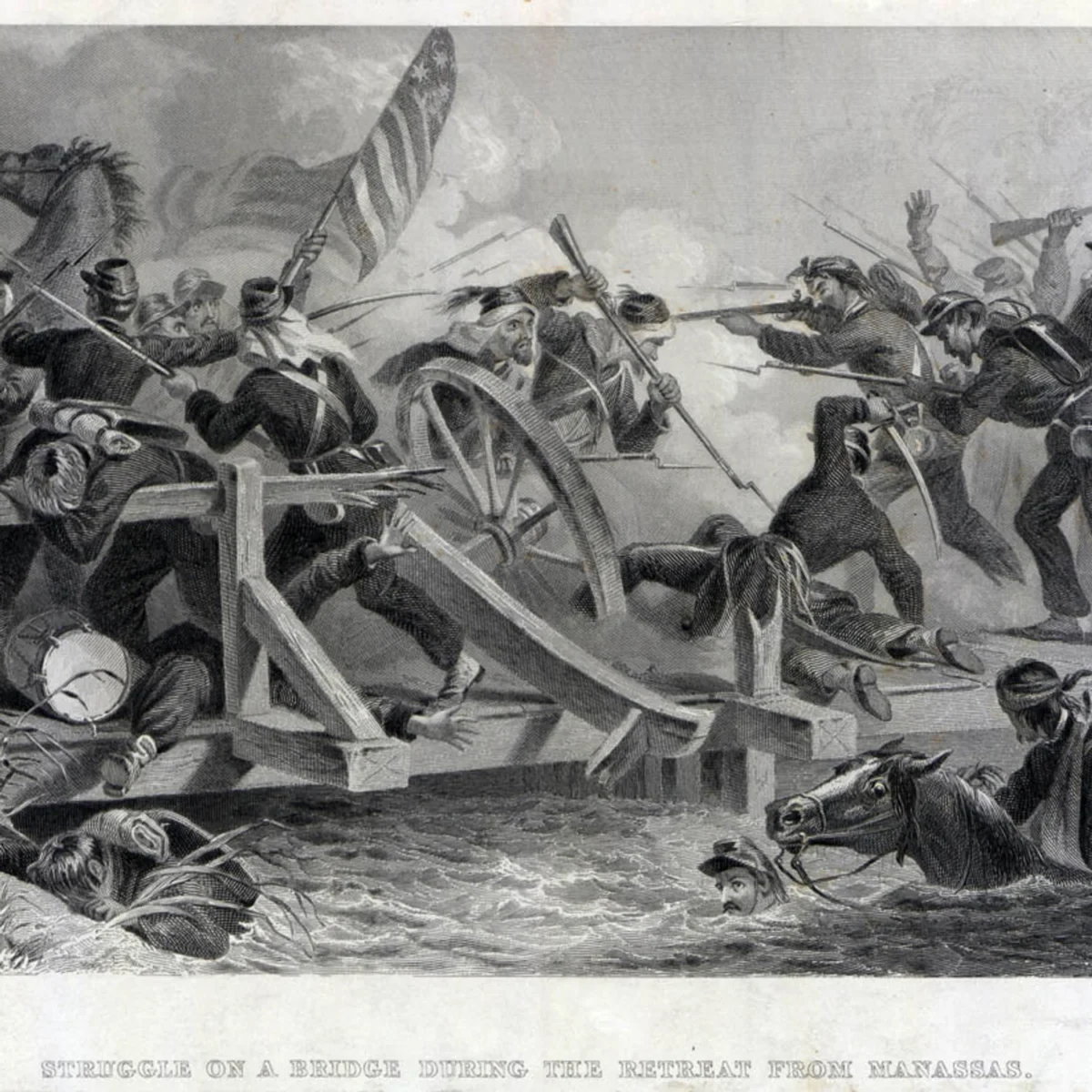
I had ridden between three and a half and four miles, as well as I could judge, when I was obliged to turn for the third and fourth time into the road by a considerable stream, which was spanned by a bridge, towards which I was threading my way, when my attention was attracted by loud shouts in advance, and I perceived several wagons coming from the direction of the battlefield, the drivers of which were endeavoring to force their horses past the ammunition carts going in the contrary direction near the bridge; a thick cloud of dust rose behind them, and running by the side of the wagons were a number of men in uniform whom I supposed to be the guard.
My first impression was that the wagons were returning for fresh supplies of ammunition. But, every moment, the crowd increased, drivers and men cried out with the most vehement gestures, “Turn back! Turn back! We are whipped.”
They seized the heads of the horses and swore at the opposing drivers. Emerging from the crowd, a breathless man in the uniform of an officer, with an empty scabbard dangling by his side, was cut off by getting between my horse and a cart for a moment.
“What is the matter, sir? What is all this about?”
“Why, it means we are pretty badly whipped, that’s the truth,” he gasped, and continued.
The confusion rapidly escalated, transforming into a full-blown panic.
By this time, the confusion had been communicating itself through the line of wagons toward the rear, and the drivers endeavored to turn round their vehicles in the narrow road, which caused the usual amount of imprecations from the men and plunging and kicking from the horses.
The crowd from the front continually increased; the heat, the uproar, and the dust were beyond description; and these were augmented when some cavalry soldiers, flourishing their sabers and preceded by an officer, who cried out, “Make way there – make way there for the General,” attempted to force a covered wagon, in which was seated a man with a bloody handkerchief round his head, through the press.
Russell continued his desperate search for clarity amidst the growing chaos.
I had succeeded in getting across the bridge with great difficulty before the wagon came up, and I saw the crowd on the road was still gathering thicker and thicker. Again, I asked an officer, who was on foot, with his sword under his arm, “What is all this for?”
“We are whipped, sir. We are all in retreat. You are all to go back.”
“Can you tell me where I can find General McDowell?”
“No! Nor can anyone else.”
The realization of a general rout began to sink in, even as the immediate threat seemed disproportionate to the scale of the panic.
A few shells could be heard bursting not very far off, but there was nothing to account for such an extraordinary scene. A third officer, however, confirmed the report that the whole army was in retreat and that the Federals were beaten on all points, but there was nothing in this disorder to indicate a general rout.
Russell then described the harrowing scene of disorganized retreat, a stark contrast to the earlier confidence.
All these things took place in a few seconds. I got up out of the road into a cornfield, through which men were hastily walking or running, their faces streaming with perspiration, and generally without arms, and worked my way for about half a mile or so, as well as I could judge, against an increasing stream of fugitives, the ground being strewed with coats, blankets, firelocks, cooking tins, caps, belts, bayonets, asking in vain where General McDowell was.
Again, I was compelled by the condition of the fields to come into the road; and having passed a piece of wood and a regiment which seemed to be moving back in column of march in tolerably good order, I turned once more into an opening close to a white house, not far from the lane, beyond which there was a belt of forest.
Two fieldpieces, unlimbered near the house, with panting horses in the rear, were pointed towards the front, and along the road beside them there swept a tolerably steady column of men mingled with field ambulances and light baggage carts, back to Centreville.
The danger intensified as confused reports of enemy cavalry reached the fleeing troops.
I had just stretched out my hand to get a cigar light from a German gunner, when the dropping shots which had been sounding through the woods in front of us suddenly swelled into an animated fire. In a few seconds, a crowd of men rushed out of the wood down towards the guns, and the artillerymen near me seized the trail of a piece and were wheeling it round to fire when an officer or sergeant called out, “Stop! Stop! They are our own men!” and in two or three minutes the whole battalion came sweeping past the guns at the double, and in the utmost disorder.
Some of the artillerymen dragged the horses out of the tumbrils [cart harnesses] and for a moment the confusion was so great I could not understand what had taken place; but a soldier whom I stopped, said, “We are pursued by their cavalry; they have cut us all to pieces…”
With no alternative, Russell was swept along by the current of panic.
There was nothing left for it but to go with the current one could not stem…
The scene became one of utter desperation and abandonment.
On arriving at the place where a small rivulet crossed the road, the throng increased still more. The ground over which I passed going out was now covered with arms, clothing of all kinds, accoutrements thrown off and left to be trampled in the dust under the hoofs of men and horses.
The runaways ran alongside the wagons, striving to force themselves in among the occupants, who resisted tooth and nail. The drivers spurred and whipped and urged the horses to the utmost of their bent…
Russell’s attempts to calm the panicked soldiers proved utterly futile.
As I rode in the crowd with men clinging to the stirrup leathers or holding on by anything they could lay hands on, so that I had some apprehension of being pulled off, I spoke to the men and asked them over and over again not to be in such a hurry.
“There is no enemy to pursue you. All the cavalry in the world could not get at you.” [I said]
But I might as well have talked to the stones.
The War Correspondent’s Evolving Role and Public Expectation
Russell’s direct, unvarnished reporting from the front lines represented a radical departure from earlier forms of news dissemination. Before his time, war news often came days or weeks later, heavily filtered through official channels, or gleaned from second-hand accounts. Russell, by contrast, placed himself in the thick of the action, risking his life to provide immediate, eyewitness narratives. The Times of London, with its vast global reach and influential readership, served as the perfect platform for this new brand of journalism. His celebrity status, forged in the fires of the Crimean War where his reporting on the abysmal conditions of British troops led to significant reforms, meant that his words carried immense weight. The public, both British and American, hung on his every dispatch, eager for an authentic glimpse into the unfolding American conflict. This eagerness, however, also set the stage for the profound backlash that would follow his Bull Run report.
Official Responses and the Northern Outcry
When Russell’s article, titled “The Battle of Bull Run,” appeared in The Times in August 1861, it ignited a firestorm. While the Confederate South, buoyed by its unexpected victory, embraced the detailed account of Union disarray, the Union North reacted with a fury that bordered on disbelief. Scholar Joseph L. Gardner notes the stark contrast in reception: "The Confederate South loved the article, but the Union North, not so much."
The piece was not merely a description of a military defeat; it was a brutal exposé of the "disgraceful conduct of the troops" as they fled the field. Russell’s unflinching portrayal shattered the North’s illusions of martial prowess and a swift, glorious victory. His vivid descriptions of panic, discarded arms, and soldiers abandoning their posts were a profound blow to national pride. The article implied a lack of discipline and courage within the ranks, a narrative that many in the North found intolerable, particularly given their initial confidence and the festive atmosphere surrounding the battle. The Union government and press quickly moved to discredit Russell, accusing him of exaggeration, bias, or even outright fabrication. He became known derisively as "Bull Run Russell," a moniker that underscored the deep resentment his honest reporting had engendered.
The impact on Russell’s personal standing in America was immediate and severe. When he published his memoirs of his coverage of the Civil War in 1863, they went largely unread in America, a testament to the lingering animosity. This American ostracization stood in stark contrast to his continued high regard in Europe, where his reputation as an incisive and courageous journalist remained undiminished.
Implications and Russell’s Enduring Legacy
Russell’s controversial Bull Run dispatch had profound implications, both for the Union war effort and for the nascent field of war journalism. For the North, the article served as a harsh, undeniable reality check. It stripped away the romanticized notions of warfare and the illusion of a quick victory, forcing a sober re-evaluation of military strategy, training, and leadership. The "disgraceful conduct" Russell observed spurred calls for greater discipline and professionalization within the Union Army, ultimately contributing to the transformation of a largely amateur force into a formidable fighting machine. It underscored that the war would be long, costly, and brutal, fundamentally altering public perception and governmental approach to the conflict.
Furthermore, Russell’s experience at Bull Run highlighted the complex ethical dilemmas inherent in war reporting. His commitment to reporting what he saw, even when it was unpopular or damaging to national morale, set a precedent for journalistic integrity. It raised fundamental questions about the role of the press during wartime: Should journalists prioritize truth, even if it might aid the enemy or demoralize one’s own side? Or should they temper their reports for the sake of national unity and propaganda? Russell’s unflinching account, despite its immediate cost to his reputation in America, cemented the idea that a journalist’s primary duty was to bear witness and report objectively, no matter how uncomfortable the truth might be. This dedication to factual reporting, even under immense pressure, laid crucial groundwork for the professional standards of modern war correspondents.
Today, though his reputation suffered in America in August 1861 and for years afterward, Sir William Howard Russell—knighted in 1895 in recognition of his extraordinary contributions to journalism—is widely recognized as one of the most important journalists of the 19th century and a groundbreaking war correspondent. His firsthand account of the Union retreat from the battlefield of Bull Run remains one of the most significant primary sources on the event, providing invaluable insight into the chaos, human drama, and strategic missteps that characterized the opening major engagement of the American Civil War. His legacy is not just one of a reporter present at pivotal moments, but of a journalist who, through courage and commitment to truth, fundamentally reshaped how the world understood war.