The Vision of Wearable Displays: A Deep Dive into the XREAL a01 and the Future of Mobile Cinema
The landscape of personal entertainment is undergoing a quiet but persistent transformation. For decades, the "bigger is better" philosophy dominated the television and monitor industries, leading to the ubiquity of 75-inch 4K panels in living rooms. However, a parallel movement in Extended Reality (XR) is attempting to shrink the hardware while expanding the perceived canvas. At the forefront of this movement is XREAL, a company that has carved out a niche by focusing on "wearable displays" rather than fully autonomous spatial computers.
With the release of the XREAL a01 earlier this year, the company continues to test the appetite of consumers for a tethered, screen-mirroring experience. While it lacks the sophisticated onboard processing of the Apple Vision Pro or the experimental AR capabilities of Meta’s Orion, the a01 offers a more accessible, albeit limited, gateway into the world of head-mounted media.
Main Facts: The XREAL a01 at a Glance
Released in May 2024, the XREAL a01 is positioned as an entry-level entry into the "smart glasses" category, though "wearable monitor" is perhaps a more accurate descriptor. Priced at approximately $300, it represents a significantly lower barrier to entry than its more famous competitors in the XR space.
Technical Specifications and Design
The core of the a01 experience lies in its dual mini-OLED panels. These screens deliver 1080p resolution per eye and can reach a peak brightness of 1,600 nits. This level of brightness is crucial for maintaining image clarity in various lighting conditions, particularly since the glasses are designed to be used in environments ranging from darkened bedrooms to brightly lit airplanes.
Unlike standalone VR headsets, the a01 has no internal battery or processor. It relies entirely on a USB-C connection to a host device—such as a laptop, a Steam Deck, or a smartphone—for both power and data. This design choice keeps the glasses relatively lightweight and comfortable for extended wear, but it introduces a "tethered" reality that defines (and sometimes limits) the user experience.
The Value Proposition
XREAL markets the a01 primarily as a gaming and media consumption tool. By projecting an image directly in front of the wearer’s eyes, the company claims to simulate the experience of viewing a 147-inch screen. For gamers using handheld consoles like the ASUS ROG Ally or the Steam Deck, the a01 serves as a massive portable upgrade to a 7-inch built-in screen. For movie buffs, it promises a private cinema experience that can fit in a coat pocket.
Chronology: The Evolution of XREAL and the a01
To understand where the a01 fits, one must look at XREAL’s trajectory. Originally known as Nreal, the company gained notoriety for its "Light" and "Air" models, which were among the first to successfully miniaturize AR technology into a form factor that resembled traditional sunglasses.

- Early 2020s: Nreal (now XREAL) focuses on "Nebula," an AR environment that allowed users to pin multiple virtual windows in space.
- May 2024: XREAL releases the a01, a streamlined model designed to capitalize on the growing handheld gaming market. It moves away from complex AR features in favor of a reliable, high-quality "plug-and-play" display.
- Late 2024: The company announces the "Beam Pro," a secondary $200 hardware puck designed to alleviate some of the connectivity and power-drain issues inherent in the a01’s tethered design.
- Future Outlook: XREAL shifts focus toward "Project Aura," a partnership with Google and Samsung to integrate Android XR, signaling a move from simple screen mirroring to a fully realized spatial operating system.
Supporting Data: Performance and User Experience Analysis
The efficacy of the XREAL a01 is best measured through the lens of its primary use case: high-fidelity media consumption.
Visual Fidelity
In testing scenarios—such as streaming high-contrast films like David Lynch’s Wild at Heart—the dual OLED panels demonstrate exceptional color vibrancy and deep blacks. The 1,600-nit peak brightness allows for a "drive-in movie" sensation even when the wearer is in a room with ambient light. Because the screens are positioned so close to the eyes, the 1080p resolution feels denser than a standard 1080p monitor, though it lacks the "Retina" quality of 4K displays.
The Portability Factor
One of the most significant advantages of the a01 is its weight. Compared to the Snap Spectacles or the Meta Quest 3, which can feel front-heavy and cause neck strain after an hour of use, the a01 is lightweight enough for a cross-country flight. However, this portability is hampered by connectivity hurdles. Users with older iPhones (pre-iPhone 15) must use a series of adapters to convert Lightning ports to USB-C, a workaround that adds bulk and cost to an otherwise sleek setup.
The Thermal Challenge
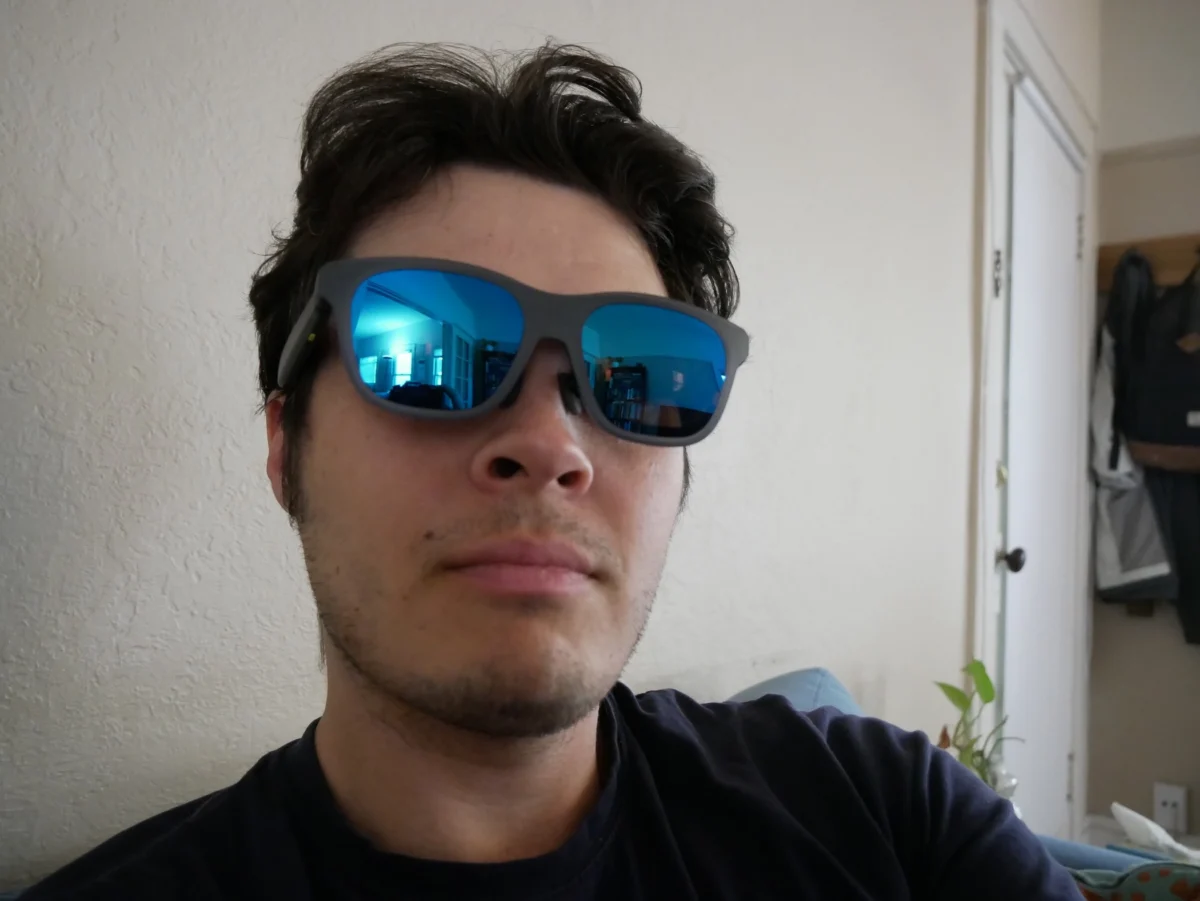
A recurring issue in the smart glasses industry is heat management. Because the a01 lacks active cooling (fans), the electrical processing required to drive high-brightness OLEDs generates heat that dissipates through the frame. Users have reported a "tingling" or warming sensation on the bridge of the nose and around the brow after 30 to 45 minutes of use. While not dangerous, this thermal buildup remains a "well-known defect" of the current form factor, as noted by industry analysts.
Official Responses and Market Positioning
XREAL has been transparent about the a01’s role as a "wearable display" rather than a full AR computer. In various marketing communications, the company emphasizes the concept of "spatial entertainment."
Addressing the Redundancy Problem
One of the primary criticisms of the a01 is the "redundancy problem": why wear glasses to watch a movie that is already playing on the laptop or phone screen used to power them? XREAL’s official stance is that the glasses offer immersion and privacy. By mirroring the screen, the glasses allow a user to lie flat on their back or sit in a cramped airplane seat while perceiving a massive cinematic screen, rather than squinting at a small device held at an awkward angle.
To further address this, XREAL introduced the Beam Pro. This $200 device acts as a dedicated "compute node" and streaming hub. It allows users to download content directly to the puck, freeing up their phone and solving the "dual-screen" redundancy. However, this raises the total cost of the "optimal" XREAL setup to roughly $500, moving it closer to the price of a mid-range VR headset or a high-end tablet.

Implications: The Road to Android XR and Project Aura
The XREAL a01 is ultimately a bridge technology. It solves the immediate problem of portable screen size but fails to address the larger desire for a truly "smart" wearable. The industry is now looking toward the next phase of this evolution: Project Aura.
The Shift to Android XR
The most significant implication for XREAL’s future is its partnership with Google and Samsung. Project Aura, the successor to the current line, will be powered by Android XR. This is a critical pivot for several reasons:
- Native Ecosystem: Unlike the a01, which simply mirrors a screen, Aura will have access to the Google Play Store. This means apps like YouTube, Netflix, and Disney+ will run natively on the glasses.
- Spatial Interaction: Aura will include native hand tracking, removing the need for a physical controller or a tethered phone to navigate menus.
- The Compute Puck: Future models will likely utilize a "puck" (similar to the Beam Pro) that can be tucked into a pocket, providing power and processing without requiring a constant connection to a smartphone.
The Cinephile’s Dilemma
Despite the technical marvel of fitting a 147-inch screen into a pair of glasses, the a01 highlights a fundamental tension in the home theater market. For the "cinephile," a 55-inch or 65-inch 4K OLED TV remains the gold standard for comfort and shared experience. Smart glasses, by their nature, are a solitary endeavor.
As the industry moves forward, the success of devices like the a01 will depend on whether they can transition from being a "niche accessory for gamers" to a "essential tool for travelers." The current hardware proves that the display technology is ready; the vibrant colors and impressive brightness are undeniable. However, until the "heat on the nose" and "tethered redundancy" issues are solved, these devices will likely remain a secondary choice for the average consumer.
Conclusion
The XREAL a01 is an ambitious, affordable piece of hardware that succeeds in its primary mission: delivering a high-quality visual experience in a portable form factor. While it grapples with the physical limitations of current-gen wearables—namely heat and connectivity—it serves as a vital proof-of-concept. As XREAL moves toward its collaboration with Google and Samsung, the lessons learned from the a01 will be instrumental in defining whether the future of cinema is something we sit in front of, or something we wear on our faces. For now, the a01 is a fascinating, if imperfect, glimpse into a world where your favorite film is always just a USB-C cable away.