Apple TV+ Plunges into the Matrix: First ‘Neuromancer’ Teaser Hints at an Ambitious Adaptation
Cupertino, CA – The long-awaited screen adaptation of William Gibson’s seminal 1984 cyberpunk novel, Neuromancer, has taken a significant step forward with the release of its first official teaser trailer by Apple TV+. The brief, enigmatic preview offers fans a tantalizing glimpse into what promises to be one of the most ambitious and closely watched genre series in recent memory, confirming key aesthetic choices and hinting at a narrative scope that may extend beyond the confines of the original novel.
For decades, Neuromancer stood as a literary Everest for filmmakers, widely considered "unfilmable" due to its dense, experimental narrative style and the once-daunting technical requirements needed to visualize Gibson’s groundbreaking concepts of cyberspace. Now, with Apple TV+ having established itself as a surprising haven for critically acclaimed, high-concept science fiction, the prospect of a faithful and expansive adaptation feels more tangible than ever before.
A Cryptic Glimpse: Decoding the Teaser
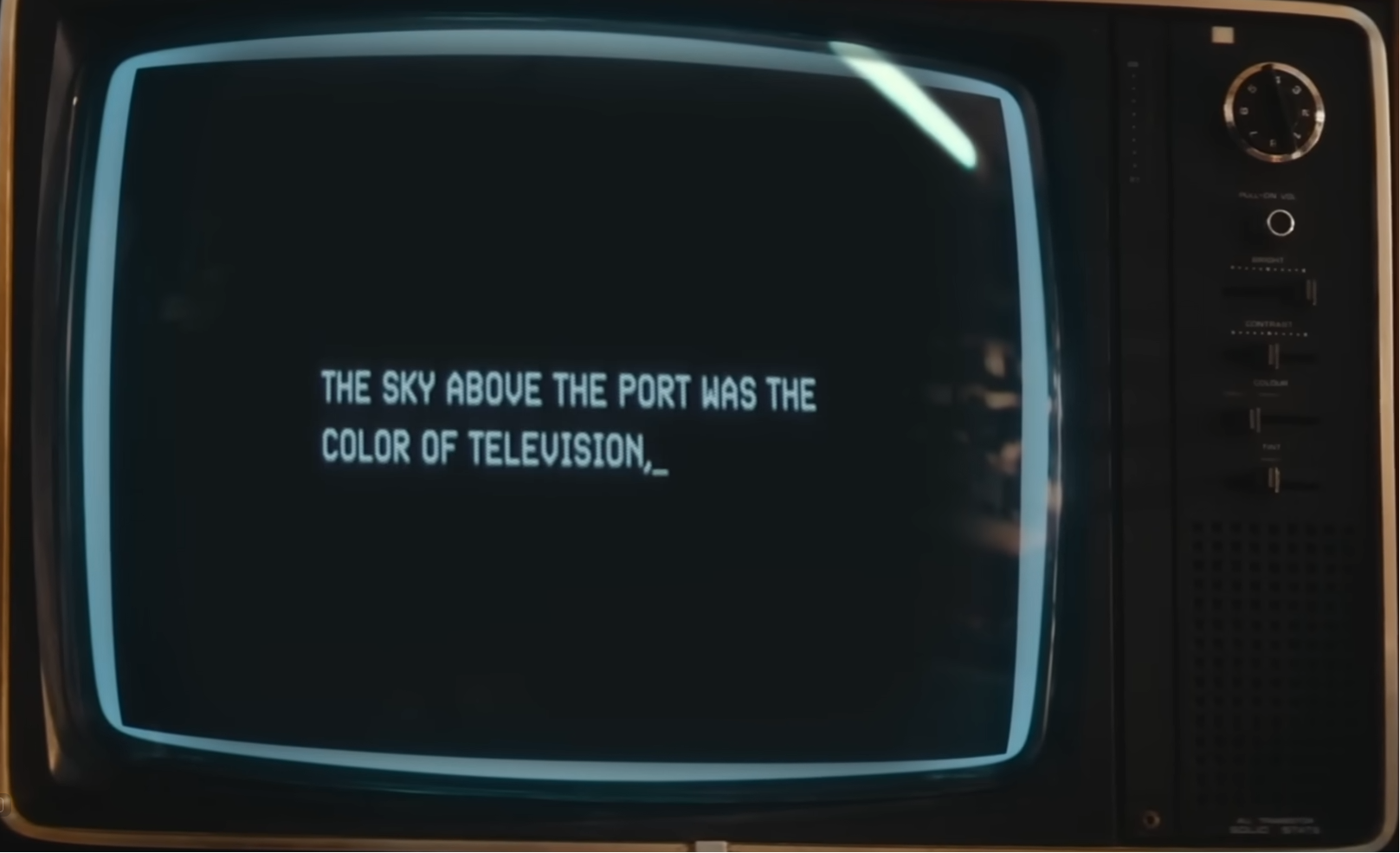
The newly released teaser is, by design, a minimalist affair. It opens with the iconic, almost mournful prose that begins Gibson’s novel: "The sky above the port was the color of television, tuned to a dead channel." This text flickers across a retro-styled monitor, immediately establishing a key visual motif – the raw, somewhat crude, yet deeply evocative technology that defines Neuromancer‘s world. Following this evocative line, the screen cuts to a brief, blurry, and largely indistinct shot of an interior setting, leaving much to the imagination but confirming the series’ commitment to a rough, analogue aesthetic.
The accompanying description for the teaser offers only a sparse, yet highly intriguing, piece of information: "42 years ago, William Gibson introduced the world to Neuromancer. Now, the next chapter is loading." This phrase, "the next chapter," has immediately ignited speculation among fans and critics alike. While the show’s previously released official description — "A hacker and an assassin are thrust into a web of high-stakes crime as they take aim at a corporate dynasty" — suggests a narrative closely adhering to the core plot of the first novel, the "next chapter" wording implies a potential willingness to explore beyond Neuromancer‘s original conclusion. This could mean either an expansion within the first season itself or a long-term plan to adapt the subsequent novels in Gibson’s "Sprawl trilogy," Count Zero and Mona Lisa Overdrive, a prospect that remains unconfirmed but highly anticipated.
Beyond the narrative hints, the teaser’s visual language is a significant takeaway. The deliberate choice to feature chunky, retro-futuristic technology, rather than a sleek, ultra-modern interpretation of cyberpunk, is a crucial decision. This rough-around-the-edges aesthetic was a defining characteristic of Gibson’s original vision, deeply influencing the popular notion of cyberpunk worldbuilding. By embracing this, the adaptation signals a respect for the source material’s foundational elements, which often prioritized function and gritty realism over polished futurism.
The Long Road to the Matrix: A Chronology of Influence and Obstacles
William Gibson’s Neuromancer arrived in 1984, a watershed moment that irrevocably altered the landscape of science fiction. Penned by a then-relatively unknown author, the novel exploded onto the scene, winning the Hugo Award, the Nebula Award, and the Philip K. Dick Award – an unprecedented sweep for a debut novel. Gibson didn’t just write a story; he crafted a lexicon, popularizing terms like "cyberspace," "the matrix," "ICE" (Intrusion Countermeasures Electronics), and "console cowboy," which quickly permeated popular culture and influenced everything from film to video games to music.
The novel introduced readers to Henry Dorsett Case, a down-on-his-luck hacker whose central nervous system has been damaged, preventing him from "jacking in" to cyberspace. He’s offered a chance at redemption by a mysterious employer, Armitage, and his razor-girl bodyguard, Molly Millions, embarking on a high-stakes mission against powerful artificial intelligences and corporate empires. Gibson’s prose was a dizzying blend of noir, high-tech jargon, and philosophical musings, creating a sensory overload that was both thrilling and disorienting. It was a vision of a future both alluring and terrifying, where humanity’s relationship with technology had become symbiotic, often at a steep cost.
Given its immense impact and iconic status, it’s no surprise that Neuromancer has been a coveted property for adaptation for decades. However, its very strengths proved to be its greatest impediments. The novel’s non-linear narrative, its deep dive into the abstract world of cyberspace, and its reliance on internal monologue and sensory description made it notoriously difficult to translate visually. Early attempts to bring it to the big screen were numerous and often fell apart under the weight of expectation, technical limitations, or budgetary concerns.
One of the most persistent efforts involved director Vincenzo Natali (Cube, Splice), who was attached to the project for over a decade. Natali famously developed a script and even concept art, frequently discussing the monumental challenges of adapting the book. He spoke about the difficulty of making cyberspace visually compelling without resorting to generic sci-fi tropes, and how to maintain the novel’s philosophical depth while crafting a coherent film narrative. Other names, such as Chris Cunningham (renowned for his innovative music videos) and Joseph Kahn (Torque), were also associated with the project at various points. Each attempt ultimately succumbed to the perceived "unfilmable" nature of the source material, leaving fans to wonder if Gibson’s vision would ever truly make it to the screen. The sheer density of its world-building, the complex interplay of human and artificial intelligence, and its groundbreaking depiction of a virtual reality without the benefit of modern CGI capabilities often meant that previous attempts simply couldn’t justify the scale and cost.
Apple TV+’s Sci-Fi Sanctuary: Supporting Data for Success
The current landscape, however, is significantly different. The rise of streaming services, particularly those willing to invest heavily in prestige television, has opened new avenues for ambitious adaptations. Apple TV+ has, against initial expectations, carved out a distinct and impressive niche for itself as a destination for high-quality, thought-provoking science fiction and fantasy.
The platform boasts a growing roster of critically acclaimed genre series that demonstrate its commitment to complex narratives and significant production values. Shows like Foundation, which tackles Isaac Asimov’s sprawling and famously difficult-to-adapt saga, showcase Apple’s willingness to commit to intricate world-building and long-form storytelling. Severance provides a chillingly relevant exploration of corporate dystopia and identity, echoing themes present in Neuromancer. Silo, based on Hugh Howey’s post-apocalyptic novels, demonstrates their ability to build suspense and mystery within a tightly constructed, visually distinctive world. Even For All Mankind, an alternate history space drama, underlines Apple’s dedication to meticulous detail and grand narratives.
This track record positions Apple TV+ as an ideal home for Neuromancer. The series format allows for the necessary breathing room to explore Gibson’s intricate plot, multifaceted characters, and profound themes without the constraints of a two-hour film. The platform’s reputation for high production values suggests that the visual demands of cyberspace and the gritty sprawl of Gibson’s world can finally be realized with the fidelity they deserve.
Furthermore, the enduring relevance of cyberpunk themes in today’s world – with advancements in AI, the increasing power of tech corporations, concerns about surveillance, and the blurred lines between digital and physical existence – makes Neuromancer particularly resonant. A well-executed adaptation could tap into this cultural zeitgeist, attracting both long-time fans and new audiences.
Creative Minds and Familiar Faces: Official Responses and Vision
The creative team assembled for Apple TV+’s Neuromancer is headed by Graham Roland (Dark Winds, Jack Ryan) as showrunner and J.D. Dillard (Sweetheart, Devotion) serving as co-creator and set to direct the pilot episode. Roland’s experience with complex narratives and Dillard’s visual flair suggest a potent combination.
Crucially, William Gibson himself is deeply involved in the production, serving as an executive producer and creative consultant. This level of involvement from the author is often a reassuring sign for fans, indicating a commitment to preserving the essence of the source material. Gibson has historically been cautious about adaptations of his work, and his active participation implies a belief in this team’s ability to bring his vision to life authentically while potentially allowing for necessary expansions or updates for a modern audience. His input will be invaluable in navigating the delicate balance between faithfulness and adaptation.
The cast, though still relatively small given the early stage of promotion, features compelling choices. Callum Turner (Fantastic Beasts series, Masters of the Air) steps into the role of Case, the disillusioned hacker. Briana Middleton (The Tender Bar, Sharper) will portray Molly Millions, the enigmatic "razor-girl." Veteran actor Mark Strong (Kingsman series, Tinker Tailor Soldier Spy) is cast as Armitage, the mysterious benefactor, while Clémence Poésy (Harry Potter series, The Tunnel) takes on the role of Lady 3Jane, a pivotal character in the narrative. These actors bring a mix of established talent and rising stars, promising strong performances for the iconic roles.
The teaser’s messaging, while minimal, directly addresses the novel’s legacy and its "next chapter." This dual approach – acknowledging the original’s place in history while signaling forward momentum – suggests a production keenly aware of the reverence fans hold for the book, while also being confident in its ability to expand and innovate. The choice of a series over a film allows for a deeper dive into character motivations, the intricacies of the Matrix, and the sprawl of Chiba City, giving proper weight to Gibson’s intricate world.
Beyond the Sprawl: Implications for the Future
The implications of a successful Neuromancer adaptation are vast, both for Apple TV+ and for the science fiction genre at large. If the series lives up to its immense potential, it could solidify Apple TV+’s reputation as the premier destination for ambitious, high-quality genre storytelling, drawing in new subscribers and further cementing its critical standing.
The mention of "the next chapter" also strongly hints at Apple’s long-term vision for the series. Should the first season resonate with audiences and critics, the adaptation of Count Zero and Mona Lisa Overdrive – the other two novels in the Sprawl trilogy – becomes not just a possibility, but a strong likelihood. This would allow the creative team to build a sprawling narrative universe, exploring the further evolution of Gibson’s themes and characters over multiple seasons. Such a commitment would be a significant undertaking, but one that could yield a foundational pillar for the streaming service.
Moreover, a successful Neuromancer could set a new benchmark for adapting "unfilmable" literary works, potentially paving the way for other complex sci-fi novels to receive the high-budget, long-form treatment they deserve. It could reinvigorate interest in classic cyberpunk literature, introducing a new generation to the genre’s origins and prompting a re-evaluation of its enduring themes.
While the teaser notably refrains from offering a concrete release date, the current reports of the show being in post-production, combined with the release of promotional material, strongly suggest that the rumored late 2026 debut remains on track. Regardless of its exact premiere, Neuromancer is poised to be one of the most talked-about series of its year, a monumental undertaking that could finally deliver on the decades-long promise of bringing William Gibson’s revolutionary vision to the screen. The sky above the port may be the color of television, tuned to a dead channel, but for Neuromancer fans, the future on Apple TV+ is looking very much alive.