The Visual Evolution of Matt Lesniewski: A Comprehensive Review of ‘Faceless and the Family’
The landscape of independent comic books is often defined by creators who push the boundaries of visual storytelling, prioritizing the "graphic" in graphic novels. Among the most prominent rising voices in this movement is Matt Lesniewski, whose latest work, Faceless and the Family, published by Oni Press, marks a significant milestone in his artistic trajectory. Following the critical success of his previous works, Lesniewski returns with a sprawling, surrealist odyssey that blends high-concept science fiction with gritty, character-driven drama. While the work is not without its narrative hurdles, it stands as a testament to the power of idiosyncratic illustration in the modern era.
Main Facts: The Genesis and Execution of ‘Faceless and the Family’
Faceless and the Family is a prestige graphic novel written and illustrated by Matt Lesniewski, released under the banner of Oni Press with a retail price of $29.99. The book represents a culmination of five years of stylistic evolution for Lesniewski, who first garnered significant industry attention in 2019 with his Eisner-nominated debut, The Freak.
The core premise of the book is centered on a world that is as geographically bizarre as it is socially stratified. The setting is a small planet shaped like a colossal human hand floating in the vacuum of space. This world is divided into two primary zones: "The Palm," a desolate, impoverished region inhabited by those on the fringes of society, and "The Finger Cities," gleaming metropolises where the wealthy and powerful reside.
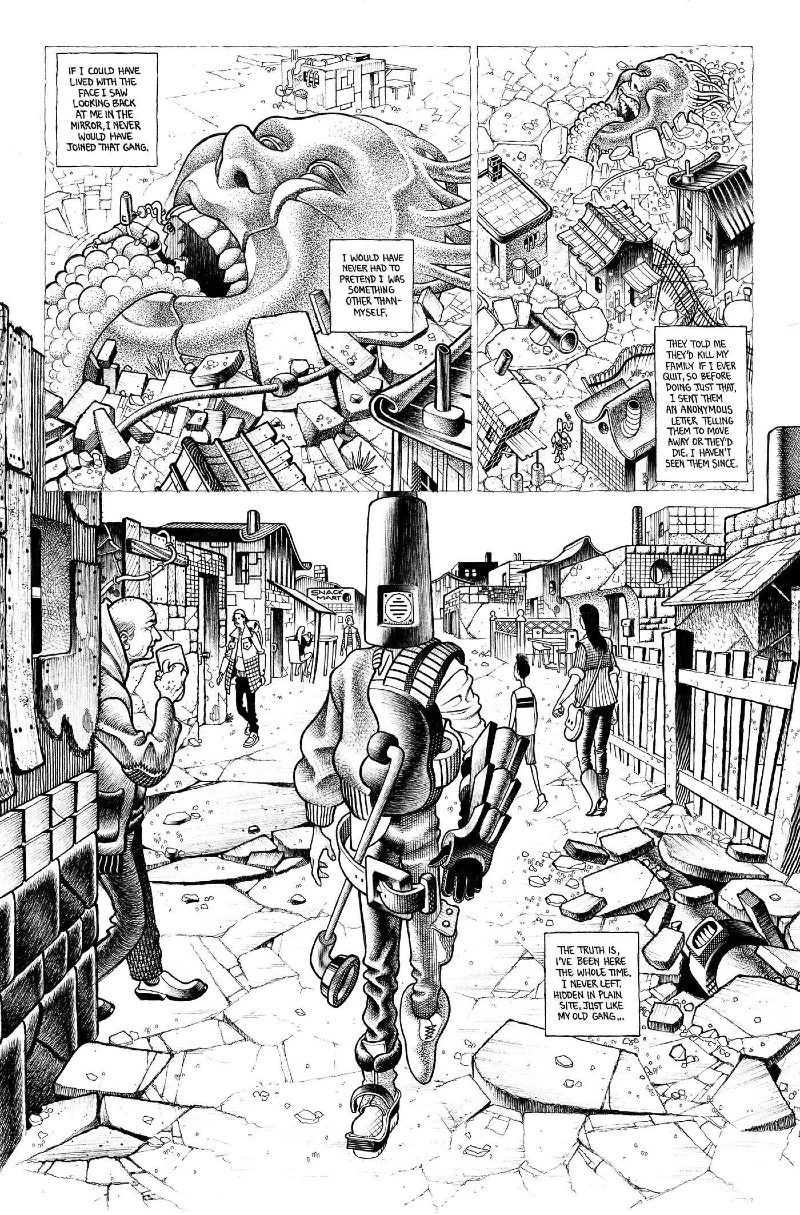
The protagonist, known only as "Faceless," is a man burdened by a violent past. Formerly a member of a brutal gang, Faceless has spent a decade in hiding, concealing his identity behind a makeshift mask fashioned from a segment of heavy industrial piping. The narrative follows his desperate quest to reach the Finger Cities, where he hopes to undergo reconstructive surgery to permanently alter his appearance and reunite with his long-lost biological family. Along the way, he forms an alliance with four fellow outcasts, creating a "found family" that serves as the emotional anchor of the story.
Chronology: From ‘The Freak’ to a Hand-Shaped World
To understand the significance of Faceless and the Family, one must look at the chronological development of Matt Lesniewski as a creator.

2019: The Arrival of ‘The Freak’
Lesniewski burst onto the scene with The Freak (published by AdHouse Books), a work that showcased a startlingly detailed, grotesque, and hyper-textured art style. Critics immediately drew comparisons to the legendary Jean "Moebius" Giraud and the intricate architectural violence of Geoff Darrow. The book was a "silent" or near-silent success, relying heavily on visual cues to convey a sense of existential dread and physical deformity.
2020–2023: Refinement and Expansion
In the years following his debut, Lesniewski contributed to various anthologies and refined his technique. His work began to move away from purely grotesque imagery toward a more structured, geometric surrealism. During this period, the seeds for Faceless and the Family were sown. He sought to create a world that was not just a backdrop for a character study but a character in its own right—a world that reflected the physical and psychological scars of its inhabitants.
2024: The Release of ‘Faceless and the Family’
Partnering with Oni Press, a publisher known for supporting auteur-driven projects (such as Scott Pilgrim and Gender Queer), Lesniewski released Faceless and the Family. This work marks his most ambitious project to date, featuring a denser plot and a more complex ensemble cast than his previous efforts.
Supporting Data: Artistic Techniques and World-Building Analysis
The primary draw of Faceless and the Family is undoubtedly its visual presentation. Lesniewski utilizes a black-and-white palette that emphasizes texture over color, creating a "smorgasbord" of traditional comic book techniques.
Visual Influences and Aesthetics
While early comparisons to Moebius and Darrow remain valid, Faceless introduces a wider array of influences. There are clear echoes of:

- The Yellow Submarine (1968): Seen in the psychedelic, liquid-like movement of the figures and the use of impossible geometry.
- 1980s Dark Fantasy Cartoons: Reminiscent of the gritty, often frightening aesthetics of The Last Unicorn or Heavy Metal.
- Manga (Gekiga style): The use of intense speed lines and high-contrast shading suggests an influence from the more mature, realistic manga movement of the 1960s and 70s.
Technical Mastery
Lesniewski’s pages are characterized by an obsessive level of detail. He employs stippling (the use of small dots to create value) and crosshatching (overlapping sets of parallel lines) to give objects an immense sense of weight and volume. The "industrial piping" worn by Faceless is rendered with such tactile precision that the reader can almost feel the cold, rusted metal.
Furthermore, the character design is a masterclass in visual storytelling. Each of the four outcasts Faceless meets has a silhouette and facial structure that tells a story of hardship. Despite the surrealist setting—featuring earth-borne warts that pop to release monsters and sentient machinery—the human emotion is grounded in the "naturalism" of their expressions. Lesniewski manages to etch sadness, loss, and flickering hope onto faces that are often distorted by the harsh environment of the Palm.
Geography as Social Commentary
The choice of a hand-shaped planet is not merely a visual gimmick. It serves as a literal representation of social hierarchy. The "Palm" is the base, the foundation that supports the fingers but is also stepped upon. The "Finger Cities" represent the reach of ambition and the isolation of the elite. This spatial storytelling allows Lesniewski to explore themes of class struggle without needing to rely solely on dialogue.
Official Responses and Critical Reception
The industry response to Faceless and the Family has been largely positive, though critics have noted a disparity between the book’s visual genius and its narrative execution.
The Oni Press Partnership
Oni Press has positioned the book as a "must-read" for fans of "unconventional and visionary" storytelling. In official press releases, the publisher has highlighted Lesniewski’s ability to create "immersive worlds that could only come from a singular mind." The decision to publish the work in a large-format, high-quality edition reflects the publisher’s confidence in the book’s status as a visual art piece.

Critical Critique: The Dialogue/Art Disconnect
Professional reviewers, including Matthew Amuso of DoomRocket, have pointed out a recurring issue in Lesniewski’s transition from artist to writer-artist. While the art is sophisticated and nuanced, the dialogue is often described as "clunky" or "on-the-nose."
Common criticisms include:
- Expository Dialogue: Characters have a tendency to state their internal feelings and motivations directly, rather than allowing the reader to infer them through action or visual subtext.
- Overstuffed Plotting: The book introduces numerous subplots, cults, and gangs that some argue distract from the central emotional journey of the "Family."
- Theme Saturation: Themes of self-acceptance and the definition of family are stated explicitly, which can sometimes diminish the "visual punch" of the art.
Despite these narrative critiques, the consensus remains that the book is a "7/10" or higher achievement, primarily because the visual experience is so singular that it compensates for the linguistic shortcomings.
Implications: The Future of the "Formidable Cartoonist"
The publication of Faceless and the Family has several implications for both Matt Lesniewski’s career and the broader indie comic market.
The Rise of the "Auteur" Artist
Lesniewski represents a growing trend of "total creators" who handle every aspect of the creative process. As the tools for comic creation become more accessible, the industry is seeing a shift toward idiosyncratic styles that do not conform to the "house styles" of major publishers like Marvel or DC. Faceless proves that there is a dedicated market for high-concept, visually demanding work that requires the reader’s full attention.

Evolution of Narrative Style
For Lesniewski personally, this book serves as a "bright future" indicator. The transition from the near-silent The Freak to the lore-heavy Faceless and the Family shows an artist willing to take risks and experiment with world-building. Industry analysts suggest that if Lesniewski can "hone his concepts to the essentials" and allow his art to carry more of the narrative weight, he is on track to become one of the most influential cartoonists of the decade.
Impact on Genre Blending
Faceless and the Family successfully blurs the lines between Western, Sci-Fi, and Body Horror. Its success may encourage other creators to move away from rigid genre tropes in favor of more "dream-logic" storytelling. The book suggests that modern readers are willing to navigate "messy" creative processes if the resulting world is sufficiently immersive and heartfelt.
In conclusion, Faceless and the Family is a landmark work of visual imagination. While it grapples with the growing pains of a creator finding his voice as a writer, its artistic achievements are undeniable. It is a tangible, heavy, and deeply felt exploration of what it means to be an outcast in a world that literally and figuratively points a finger at those who do not fit in. For those who value the comic book as an art form, Matt Lesniewski’s latest offering is an essential, if imperfect, addition to the shelf.