
The Spark and Scars of Southern Africa: How Diamonds and Gold Forged a Nation and a Legacy of Segregation

Johannesburg, South Africa – The seemingly innocuous discovery of a diamond in Griqualand in 1867 set in motion a chain of events that would irrevocably transform the landscape, economy, and social fabric of Southern Africa. What began as a glimmer of geological fortune rapidly escalated into a full-blown imperial scramble, attracting vast European financial investment, waves of immigrants, and ultimately laying the brutal foundations for a system of racial segregation that would endure for over a century. The subsequent discovery of massive gold deposits in Witwatersrand in 1886 only intensified this dramatic reshaping, solidifying Britain’s dominance and etching an indelible mark on the region’s history.
Main Facts
The discovery of diamonds in 1867 near the Orange River and gold in 1886 in the Witwatersrand basin fundamentally altered the trajectory of Southern Africa. Prior to these finds, the region held primarily strategic interest for Britain as a maritime stopover. However, the immense mineral wealth ignited an unprecedented influx of capital and people, triggering a rapid and often violent expansion of British colonial power. This led to the annexation of Griqualand and the Boer republics of Transvaal and Orange Free State, the subjugation of powerful indigenous kingdoms like the Zulu, and ultimately culminated in the Anglo-Boer Wars. The insatiable demand for cheap labour in these mines not only reshaped local economies and cultures but also systematically dismantled African self-sufficiency, establishing discriminatory practices that evolved into the apartheid system of the 20th century. By 1910, Britain had consolidated its control, forming the Union of South Africa, a state built upon the exploitation of its rich mineral resources and its human capital.
A Continent Transformed: A Chronological Account
Early 19th Century: A Strategic Outpost, Not a Prize
In the early 19th century, Southern Africa’s primary allure for European powers, specifically the British, was its strategic location. The Cape Colony, established by the British in 1806, and the Cape of Good Hope served as crucial maritime waypoints for ships traversing between Britain and its burgeoning empire in Asia, particularly British India. This strategic interest, however, was not without local challenges. The British presence contended with both indigenous African populations and the Boers – White settlers of Dutch and French Huguenot descent, known for their agricultural lifestyle and their distinct Afrikaans language.
The 1830s witnessed a significant demographic shift as over 14,000 Boers embarked on the "Great Trek." This mass migration was spurred by a combination of factors: the British outlawing of slavery, which impacted Boer farming practices, and increasing population pressure on land and resources around the Cape. Seeking new territories, Boers like Andries Waterboer laid claims to lands above the Orange River, including the Griqua territory, claims recognized by the British in 1834 but fiercely disputed by local Tlhaping chiefs. Meanwhile, the British expanded their own colonial footprint, founding Natal in 1843, while the Boers carved out two independent republics: Transvaal in 1852 and the Orange Free State in 1854. Until this point, the economic bedrock of these colonies remained modest, rooted in agriculture and trade, with no hint of the mineral riches lying beneath the surface.
The Spark: Diamonds in Griqualand (1867)

This tranquil, albeit tense, equilibrium shattered in 1867. The discovery of diamonds in Griqualand heralded a new era. The very first significant rough diamond was serendipitously found in Hopetown, initially dismissed as a child’s plaything before its true value was recognized in Grahamstown (Makhanda). Richard Southey, the colonial secretary to the Cape government, famously grasped the stone and declared with profound foresight: "Gentlemen, this is the rock on which the future success of South Africa will be built." For White investors, colonialists, and workers, his words proved uncannily accurate, promising untold wealth and opportunity. For Black Africans, however, the discovery would usher in an age of dispossession and systemic oppression.
Kimberley and the Diamond Rush (1870s)
The initial finds were merely a precursor. In 1870, even richer diamond deposits were unearthed at what would become Kimberley, named after the British Earl and colonial secretary. These new discoveries, particularly on the farm of Johannes Nicolas de Beer, along the Orange, Harts, and Vaal rivers, triggered an unprecedented diamond rush. The region quickly became a magnet for fortune-seekers from across the globe. Wizened prospectors from the goldfields of Australia and California mingled with ambitious British entrepreneurs, desperate dreamers, and a significant criminal element, all drawn by the lure of instant wealth. The scale of the boom was staggering: within five years of the initial Griqualand discovery, annual diamond exports surged to over £1.6 million, an astronomical sum equivalent to £170 million in today’s currency. By 1890, South Africa had become, by far, the world’s largest producer of diamonds.
The Big Hole and the Rise of Monopolies
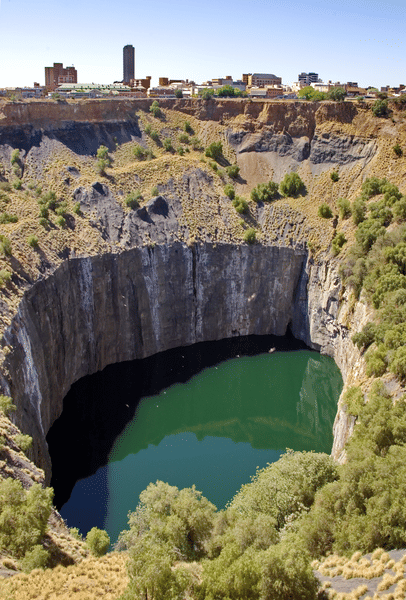
Kimberley rapidly transformed into a sprawling mining town, centered around a gargantuan human-made crater that became known simply as the Big Hole. The author Anthony Trollope, visiting in 1877, vividly described it: "It is as though you were looking into a vast bowl, the sides of which are as smooth as should be the sides of a bowl, while round the bottom are various marvellous incrustations among which ants are working with the usual energy of the ant-tribe…You look down and see the swarm of black ants busy at every hole and corner with their picks moving and shovelling the loose blue soil." This image of relentless human industry underscored the brutal reality of diamond extraction.
Initially, diamond claims were numerous, with 3,588 individual claims existing in 1871. However, the nature of deep-earth mining, requiring significant capital for machinery and drainage, soon favored consolidation. By 1881, the number of claims had plummeted to just 71, reflecting a rapid shift towards large-scale corporate control. Among the most astute and ruthless of these consolidating figures was Cecil John Rhodes (1853-1902). A former cotton farmer who arrived in Kimberley in 1871, Rhodes shrewdly amassed his fortune by cornering the market on essential mining pumps, critical for preventing flooding. He then orchestrated the formation of De Beers Consolidated Mines Ltd., effectively achieving a near-total monopoly, controlling approximately 90% of the world’s diamonds by 1890. This unprecedented market dominance allowed De Beers to meticulously control diamond output to maintain high prices and, critically, to drive down labour costs, introducing restrictive practices like the compound system for Black African miners to prevent theft, a stark early manifestation of racial segregation.

British Imperial Expansion and Boer Resentment
The interior of Southern Africa, once a peripheral interest, now became a central focus for the British government. Griqualand, renamed West Griqualand, was declared a Crown Colony in 1871 and subsequently annexed by the Cape Colony in 1873. This blatant British takeover of the diamond-rich Kimberley mines bred deep resentment among the Boers of Transvaal and the Orange Free State, who viewed it as a direct affront to their sovereignty. Indigenous Griqua chiefs, whose ancestral lands were being systematically ravaged by massive open-pit mines, also protested vehemently, their land court victories proving utterly meaningless against the colonial juggernaut. The era of the individual prospector was over, replaced by the dominance of large corporations capable of financing the increasingly expensive machinery required to dig ever deeper into the earth.
Gold at Witwatersrand and the Intensification of Conflict (1886)
The geopolitical stakes soared even higher with the discovery of massive gold deposits in Witwatersrand, Transvaal, in 1886. This find dwarfed the economic impact of diamonds. By 1890, gold exports from South Africa reached £10 million, quickly making it the leading export. This figure surged to £25 million by 1905, and between £45 and £50 million (equivalent to £5 billion today) by 1910. By 1915, South Africa was producing an astonishing 40% of the world’s gold.
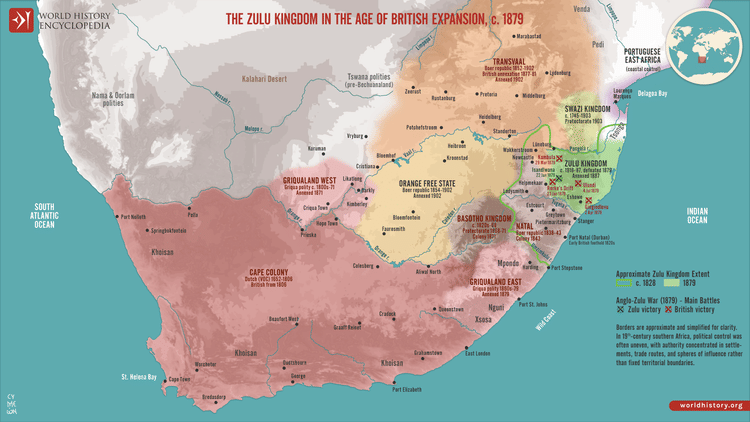
This newfound wealth intensified British determination to consolidate control over Southern Africa. The new Colonial Secretary, Sir Michael Hicks Beach, championed the idea of a federation uniting the Cape Colony and Natal with the two Boer republics. The Boers, however, deeply distrusted British motives, fearing the loss of their hard-won independence. A Pedi attack on the Boers provided the pretext the British needed, leading to the annexation of Transvaal in January 1877, under the guise of guaranteeing regional security. The British vision of a unified South Africa, safeguarding its lucrative mines, took another significant step forward with the defeat of the formidable Zulu Kingdom in 1879. Zululand subsequently became a Crown Colony in 1887 and was absorbed into Natal in 1897. Further territorial acquisitions followed rapidly, including the Basutoland Protectorate (modern Lesotho) in 1884, the Bechuanaland Protectorate (modern Botswana) in 1885, Swaziland in 1893, and Pondoland in 1894, creating a patchwork of British-controlled territories.
Rhodes’ Political Ascendancy and Empire Building
The immense wealth generated by diamonds and gold fueled the imperialist ambitions of figures like Cecil Rhodes. Despite his often unkempt appearance, Rhodes’ singular driving force was an insatiable desire for British global domination. Kimberley became the headquarters of the British South Africa Company, which Rhodes founded in 1889. His political power grew alongside his economic might, culminating in his appointment as Prime Minister of the Cape Colony in 1890. With a royal charter in hand, Rhodes embarked on his grand project of empire-building north of the Limpopo River, creating Rhodesia (modern Zimbabwe, Zambia, and Malawi) at the direct expense of the Mashona and Matabele peoples, ruling his namesake state as a virtual dictator. His mistaken belief that similar mineral riches lay further north spurred aggressive expansion, though such discoveries never materialized on the scale of Kimberley or Witwatersrand.
The Anglo-Boer Wars and the Union of South Africa
As the 19th century drew to a close, British imperial ambitions clashed violently with Boer aspirations for independence. Two brutal conflicts, the First Anglo-Boer War (1880-81) and the Second Anglo-Boer War (1899-1902), ensued. British victory in the second, larger conflict finally realized the long-held colonial dream of a unified South Africa. In 1910, the Union of South Africa was formed, comprising the Cape Colony, Natal, Transvaal, and the Orange Free State, along with territories like Zululand, Tongaland, and Griqualand. This new dominion represented the culmination of decades of strategic maneuvering, military conquest, and economic exploitation, all driven by the dazzling allure of subterranean riches.
Economic and Societal Transformation: Supporting Data and Official Responses
The "effects of this mining boom in South Africa were truly phenomenal and all-embracing," as historian A. Adu Boahen noted. Exports surged dramatically, with diamonds initially accounting for one-third of the total, later surpassed by gold. By 1890, £10 million worth of gold was exported annually; this figure swelled to £25 million by 1905 and reached between £45 and £50 million by 1910 (equivalent to £5 billion today). By 1915, South Africa was responsible for 40% of the world’s gold output. The mines created a massive demand for labour, attracting an estimated 50,000 people to the diamond industry alone in the 1870s. This combination of abundant capital and an insatiable need for cheap labour reaped immense rewards, but these benefits were overwhelmingly concentrated at the apex of the capitalist pyramid, benefiting a select few.
The Genesis of Racial Segregation
The demand for a permanent, exploitable supply of cheap labour proved to be the most profound and devastating consequence. As historian R. Reid observed, this need "shaped social and economic policy in South Africa through the twentieth century, and around which much racial ideology was formed." The racialized policies implemented in the mining sector were a precursor to the systemic discrimination that would later define apartheid. Black African miners were confined to segregated compounds, a system ostensibly designed to prevent diamond theft but effectively serving to control and dehumanize the workforce. Their wages were a pittance compared to their White counterparts, with White miners earning, on average, more than ten times the wage of a Black miner.
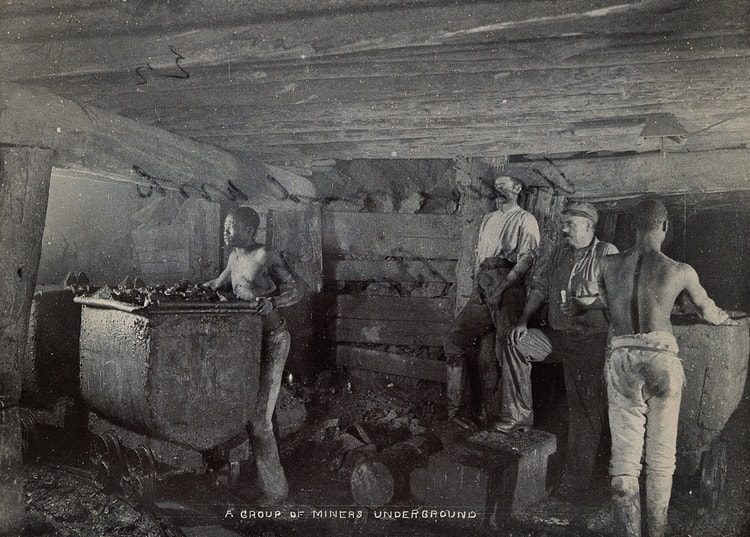
Official responses to the mining boom included legislation explicitly designed to enforce this racial hierarchy and secure labour. The Mines and Works Act of 1911, for instance, legally excluded Africans from skilled mining jobs, reserving these for White workers. Even more impactful was the Natives Land Act of 1913, which drastically curtailed African land ownership, forcibly removing land from indigenous communities and effectively coercing them into becoming wage labourers in the mines, with no alternative means of subsistence. These legislative acts were not isolated incidents but integral components of a deliberate strategy to create a racialized economic structure that benefited White colonialists and businesses.
Urbanization, Infrastructure, and Environmental Impact
The mining boom fueled rapid urbanization and infrastructure development, unprecedented in scale and speed for other African colonies. Kimberley, for example, exploded into a town of over 50,000 residents. This growth attracted settlers from across Southern Africa and beyond, initially creating a lucrative market for local foodstuffs, which saw some African peasant farmers prosper. However, this prosperity was short-lived as colonial laws privileged White settlers, enabling them to acquire land and farm on a larger, more competitive scale, displacing indigenous farmers.
The need to transport minerals and supplies led to a dramatic expansion of infrastructure. In 1860, Southern Africa possessed a mere 3 kilometers (1.8 miles) of railway and virtually no roads suitable for wheeled vehicles. By 1889, this had mushroomed to 3,300 km (2,050 miles) of railway, further expanding to 75,000 km (46,600 miles) of roads by 1914. These vast transport networks, built largely with cheap African labour, further disrupted traditional farming communities and accelerated the process of urbanization. The environmental cost was also significant, with severe deforestation resulting from the tremendous quantities of wood required as fuel for mining operations and growing settlements. For the Griqua people and other indigenous communities, the discovery of that first milky-white stone in 1867 ultimately brought profound and lasting suffering, overshadowing any fleeting benefits.
Lasting Implications and Legacy
The mineral wealth of Southern Africa, particularly gold and diamonds which eventually accounted for 75% of the region’s exports, had far-reaching and destructive consequences. As R. Reid eloquently summarized, these finds "would dramatically alter the balance of power, transforming southern African history and bringing about a veritable economic revolution which would ultimately destroy African self-sufficiency and lead to the creation of a capitalist economy by the end of the nineteenth century. It would lead, too, to the destruction of African political independence, at least temporarily."
The Seeds of Apartheid
The mining boom did more than just create a capitalist economy; it fundamentally reshaped the relations between settlers and indigenous Africans, laying the critical groundwork for the system of racial segregation that would become known as apartheid. The discriminatory labour practices, the compound system, the wage disparities, and the land acts were not incidental but deliberate policies designed to ensure a constant supply of cheap, controlled African labour for the mines. This entrenched racial hierarchy permeated every aspect of society, establishing a rigid social order based on race that would not be formally dismantled until the late 20th century. The echoes of these early policies continued to reverberate through South African society for generations, shaping political discourse, economic inequality, and social injustice.
The Cullinan Diamond: A Symbol of Wealth and Exploitation
Even today, the diamond mines of South Africa continue to yield sparkling gems. However, none have ever surpassed the legendary 3,000-plus carat Cullinan Diamond, discovered in Cullinan in 1905. This colossal stone was meticulously cut into two magnificent diamonds: the 530-carat Cullinan I, famously known as the Star of Africa, now prominently set in the royal sceptre of the British Crown Jewels housed in the Tower of London; and the 317-carat Cullinan II, the Second Star of Africa, which adorns the Imperial State Crown, used at the coronations of British monarchs. These jewels stand as potent, glittering symbols of the immense wealth extracted from the Southern African earth, tangible reminders of a tumultuous era that saw vast riches flow into imperial coffers, while simultaneously sowing the seeds of profound social division and enduring hardship for the region’s indigenous peoples. The story of Southern Africa’s diamonds and gold is thus a complex narrative of economic revolution, imperial ambition, and the tragic birth of a system of racial oppression, whose legacy continues to be grappled with today.



Leave a Comment