The Weight of Silence: A Deep Dive into Mollie Ray’s ‘giant’ and the Visual Language of Illness
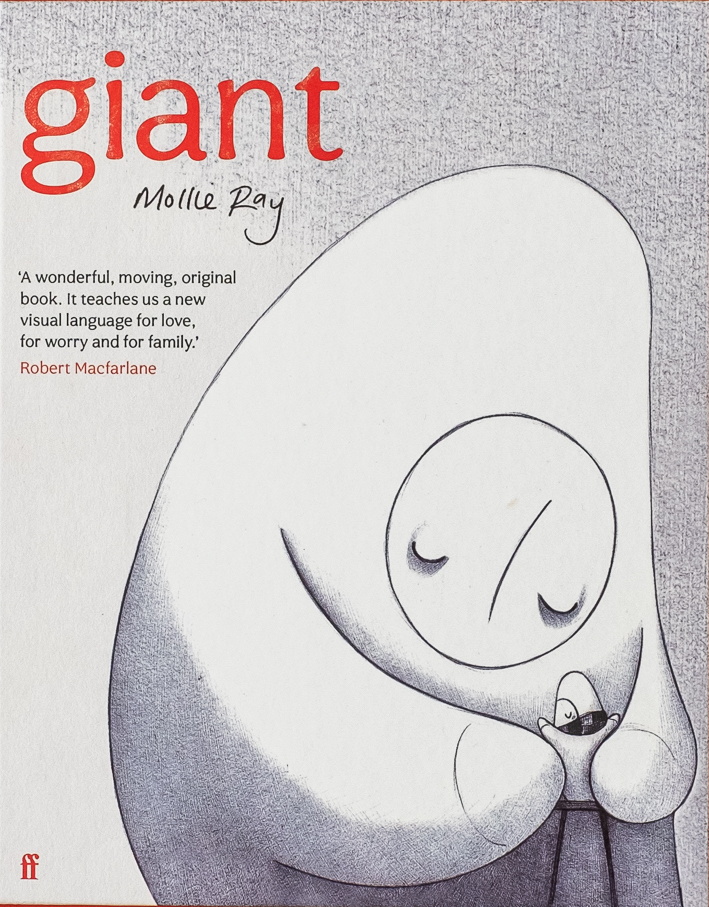
In the evolving landscape of contemporary graphic literature, few works manage to capture the visceral, often unspeakable experience of familial trauma with the poise of Mollie Ray’s giant. Published by Faber & Faber in 2025, giant is a silent graphic novel that eschews dialogue entirely, relying instead on the evocative power of ballpoint pen illustrations to navigate the turbulent waters of a terminal health crisis. By transforming a medical diagnosis into a literal, physical manifestation—a child who grows too large for their own home—Ray creates a universal metaphor for the way illness consumes the space, energy, and psyche of a family unit.
Main Facts: The Technical and Narrative Foundation of ‘giant’
At first glance, giant appears to be a whimsical tale of magical realism. However, as the narrative unfolds, it reveals itself to be a profound entry into the genre of "Graphic Medicine"—a field where comics are used to explore healthcare, illness, and the patient experience. The book’s most immediate and striking feature is its medium: it was drawn entirely in "biro" (the British term for ballpoint pen). This choice of tool is significant; the ballpoint pen is a humble, everyday instrument, yet in Ray’s hands, it achieves a level of depth and texture usually reserved for charcoal or fine-line ink.
The story follows a close-knit family whose lives are upended when one of the children undergoes a mysterious transformation. While the specific nature of the illness—cancer—is not explicitly named until the end credits, the visual cues of medical intervention are unmistakable. The book’s silence is not a lack of content but a deliberate narrative strategy. By removing text, Ray forces the reader to inhabit the emotional state of the characters, where words often fail and only the "too big" emotions remain.
Chronology: From Domestic Harmony to the ‘Giant’ in the Room
The narrative structure of giant is meticulously paced, mirroring the slow-motion car crash that often accompanies a major medical diagnosis.
The Prelude: A House of Cards
The story opens with a sense of warmth and homecoming. A young artist—implied to be the protagonist and a stand-in for Ray herself—returns home after graduating from school. The initial pages are filled with symbols of stability: a wall of family photos, a bustling family dinner, and quiet evening activities like knitting and reading.
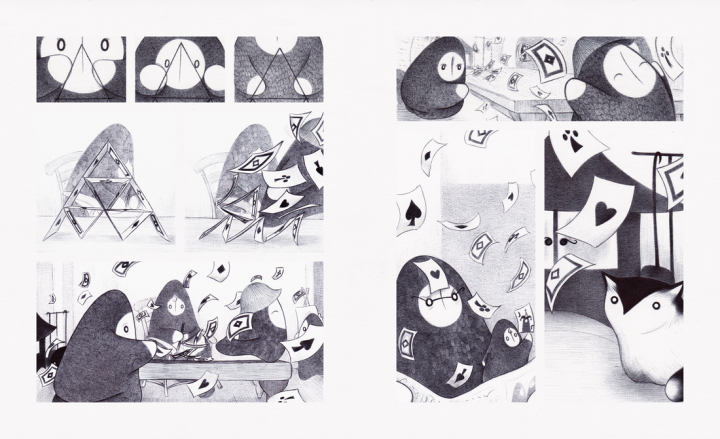
A pivotal moment occurs during a game involving a house of cards. This motif serves as a masterstroke of foreshadowing. As the cards tumble and swirl across the panels, they represent the inherent fragility of the family’s current peace. Ray uses a stray "spade" card to subtly guide the reader’s eye from one page to the next, a clever piece of visual navigation that hints at the "digging" and "burying" of emotions to come.
The Transformation
The transition from normalcy to crisis happens overnight. In the morning, one of the children has grown to an enormous size—a "giant" who can barely fit within the confines of their bedroom. This physical growth serves as a brilliant metaphor for a tumor or a systemic illness; it is an unwanted, invasive presence that cannot be ignored and demands that the entire household rearrange itself around its needs.
The Diagnostic Limbo
The middle act of the book captures the agonizing "waiting period" that defines the early stages of a health crisis. Ray illustrates the passage of time through recurring imagery: an envelope containing test results that seems to travel through endless pages, and the slow, rhythmic drip of an IV bag. The pacing here is intentional; time feels both stagnant and terrifyingly fast. The family members are shown in various states of distress, their bodies hunching into "kidney bean" shapes—a visual representation of the weight they are carrying.
Solidarity and Struggle
As the treatment progresses, the family’s support system is put to the test. One of the most poignant sequences involves the artist sibling shaving their head in a gesture of solidarity. The book does not shy away from the darker moments of the journey, including a scene where the patient collapses in the bathroom. Even here, Ray finds a way to include the family’s animal companions, showing the family cat providing silent comfort to the afflicted child.
Supporting Data: Visual Semantics and Artistic Composition
The emotional resonance of giant is bolstered by Ray’s specific artistic choices. The characters are rendered with rounded, pear-shaped bodies and tiny legs, reminiscent of Russian matryoshka dolls. This design choice makes them appear both sturdy and vulnerable, emphasizing their humanity through simplified, relatable forms.
The Power of Shading
The use of biro allows for a unique type of "heavy shading." Ray builds up layers of ink to create deep blacks and varying shades of grey, giving the domestic spaces a sense of claustrophobia as the "giant" grows. The texture of the pen on the page adds a tactile quality to the reading experience, suggesting the labor and persistence required to survive such a trial.
Key Visual Motifs
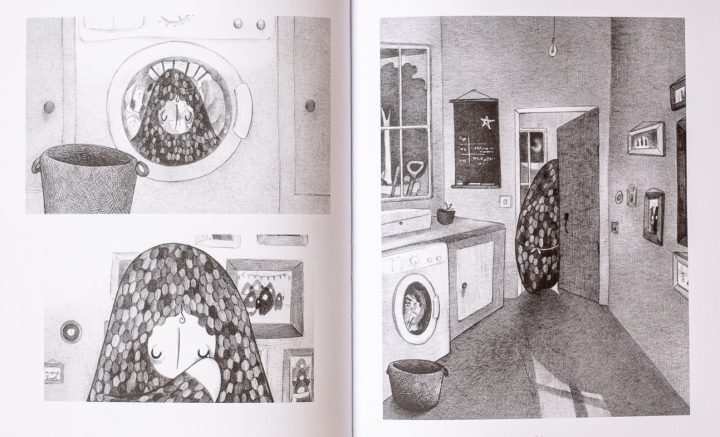
- The Washing Machine Reflection: On page 68, Ray captures the mother’s grieving face reflected in the circular window of a washing machine. It is a quiet, devastating observation of how life’s mundane chores continue even when one’s world is falling apart.
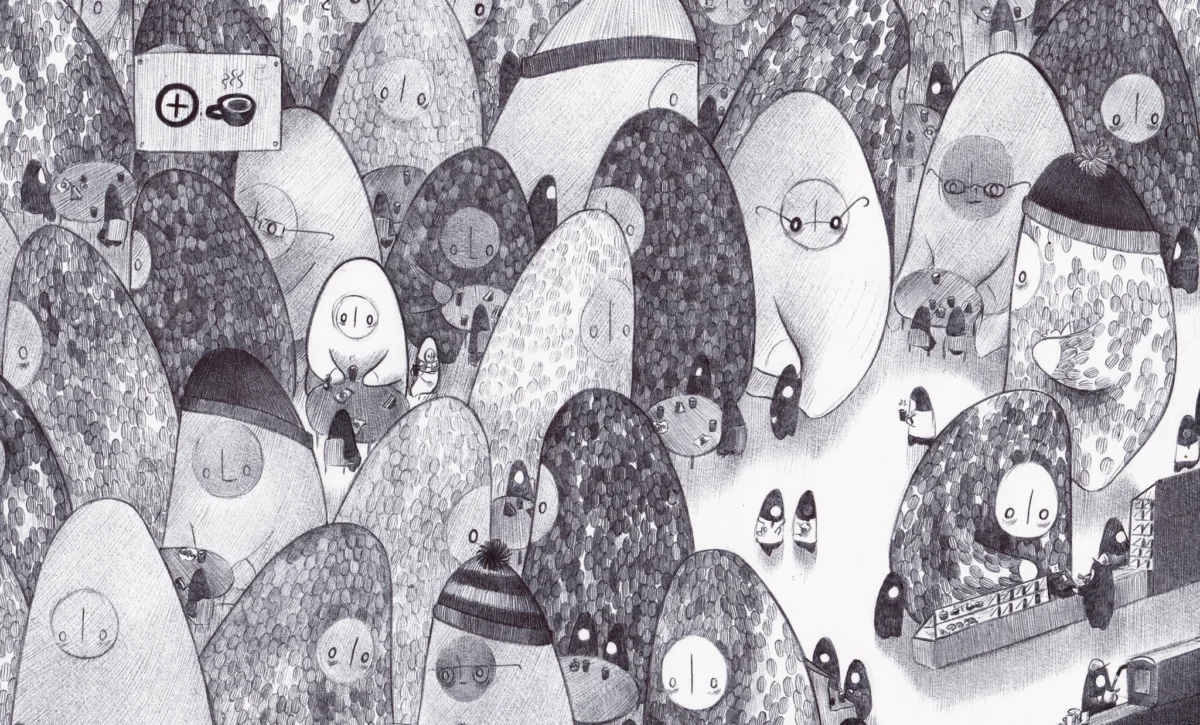
- The Hospital Cafeteria: Pages 156-157 feature a rare double-page spread crowded with figures. Unlike the intimate family scenes, this spread shows a sea of strangers in a hospital cafeteria. Each face tells a story of its own, reminding the reader—and the characters—that they are part of a vast, silent community of the "hard-hit."
- The House of Cards (Reprise): Throughout the book, the scattered cards are perpetually picked up and restacked. This represents the family’s resilience; though their structure is fragile and easily toppled, they continue to rebuild it, over and over again.
Official Responses and Creative Intent
While giant is a work of fiction, its roots in reality are made clear in the book’s concluding pages. Mollie Ray’s decision to withhold the specific diagnosis of cancer until the end allows the story to function as a universal allegory for any family setback—be it chronic illness, mental health struggles, or grief.
Critical reception within the graphic novel community has praised Ray for her "deceptively detailed" work. Early reviews from outlets like The Comics Journal highlight the book’s ability to convey "sadness and turmoil" without the crutch of dialogue. By informing the reader in the back pages that the work was "drawn in biro," Ray also invites a secondary appreciation for the technical feat of the book, positioning it as a triumph of patience and craftsmanship.
The publisher, Faber & Faber, has marketed the book not just as a comic, but as a "life-affirming" piece of literature. This positioning is crucial, as it elevates the work from a simple story about illness to a broader meditation on the "emotional spectrum" of human existence.
Implications: The Role of Silent Narratives in Processing Trauma
The success of giant carries significant implications for the future of visual storytelling and patient advocacy.
Silence as a Universal Language
By removing language, Ray bypasses the barriers of translation and literacy. giant can be understood by anyone, regardless of their native tongue. This makes the book a powerful tool for international audiences dealing with the universal experience of illness. Furthermore, the silence mirrors the "speechlessness" that many families feel when faced with a terminal diagnosis. It validates the feeling that some experiences are simply beyond the reach of words.
The "Giant" Metaphor in Medical Education
In the context of Graphic Medicine, giant provides a new way for medical professionals to understand the "burden of care." The literal growth of the patient into a giant illustrates how a diagnosis can physically and emotionally crowd out the other members of a family. For medical students and practitioners, Ray’s work offers a window into the domestic reality of their patients—the parts of the story that happen after they leave the clinic.
The Resilience of the Human Spirit
Ultimately, giant is a testament to the endurance of the family unit. The recurring image of the house of cards suggests that while life is inherently unstable, the act of "picking up the cards" is what defines us. Ray’s work suggests that even in the face of a "giant" problem, the small, quiet acts of solidarity—shaving a head, feeding a cat, or sitting in a hospital cafeteria—are the things that hold the structure together.
In conclusion, Mollie Ray’s giant is more than just a beautifully illustrated book; it is a profound exploration of the weights we carry and the silent bonds that sustain us. Through the humble medium of a ballpoint pen, Ray has mapped the vast territory of the human heart, proving that sometimes, the loudest stories are the ones told without a single word.