
The Zero-Sale Paradox: Why 1.4 Billion Windows Users Ignored an Indie Hit
By [Your Name/Journalist Title]
In the hyper-competitive landscape of digital game distribution, developers often measure success by conversion rates, click-throughs, and "wishlist" tallies. However, for Martin Nerurkar, the developer behind the critically acclaimed indie title Nowhere Prophet, a recent audit of platform performance revealed a statistic that was as baffling as it was sobering: zero.
Despite being available on the Microsoft Store—a marketplace baked into an operating system with an estimated 1.4 billion monthly active users (MAU)—the game failed to move a single unit on that specific storefront over a multi-year period. This revelation, shared by Nerurkar in August 2022, has reignited a fierce industry debate regarding the viability of the Microsoft Store as a retail destination and the overshadowing influence of the Xbox Game Pass ecosystem.
I. Main Facts: The Disparity of the Digital Shelf
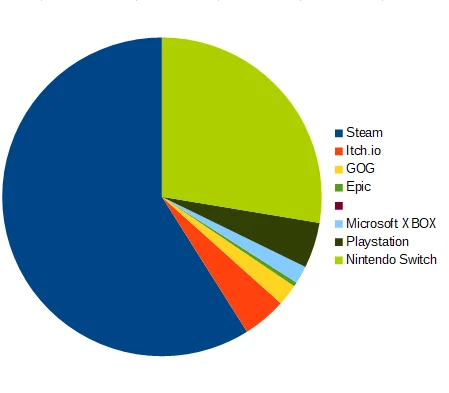
The story began when Martin Nerurkar, founder of Sharkbomb Studios, shared a revenue breakdown of Nowhere Prophet, a unique "dustpunk" deck-building roguelike. The game, which features a striking art style and deep tactical gameplay, had found a respectable audience elsewhere. According to Nerurkar’s estimates, the game had sold approximately 20,000 copies across various platforms including Steam, GOG, itch.io, and consoles.
However, the Microsoft Store for PC remained a literal vacuum. In a follow-up to his initial data sharing, Nerurkar noted, "If you’re wondering why the Microsoft Store isn’t on this graph, that’s because we haven’t made a single sale there in this entire time."
The juxtaposition is staggering. On one hand, you have Steam—the entrenched market leader—and various niche platforms that successfully converted users into paying customers. On the other, you have a storefront pre-installed on nearly every PC in the world, backed by one of the wealthiest corporations in history, which failed to facilitate even a solitary transaction for a well-reviewed title.
Key Data Points:
- Game: Nowhere Prophet (Sharkbomb Studios).
- Total Estimated Sales: ~20,000 units.
- Microsoft Store Sales: 0 units.
- Windows Ecosystem Reach: 1.4 billion Monthly Active Users.
- Primary Competitor: Steam (Valve Corporation).
II. Chronology: The Journey of Nowhere Prophet
To understand how a game ends up with zero sales on a major platform, one must look at the lifecycle of the product and the evolution of the storefront in question.
2019: Launch and Critical Success
Nowhere Prophet launched in mid-2019 to positive reviews. Critics praised its fusion of Slay the Spire-style card mechanics with a tribal convoy management system reminiscent of The Oregon Trail. It quickly found a home on Steam, where the "Very Positive" user rating helped sustain long-tail sales.
2020–2021: Platform Expansion and Game Pass
During this period, Sharkbomb Studios sought to maximize the game’s reach. This included porting the game to consoles and making it available on the Microsoft Store. Crucially, Nowhere Prophet was also included in the Xbox Game Pass library for a period.
Game Pass, Microsoft’s subscription service, allows users to play hundreds of games for a monthly fee. While this provided Nowhere Prophet with high visibility and a surge in players (often referred to as "reach"), it appears to have fundamentally altered the "buy-to-play" psychology of the Microsoft Store user base.
August 2022: The Statistical Revelation
By August 2022, after years of availability, Nerurkar reviewed the final sales figures. While the game had generated significant revenue through Steam and the upfront fees associated with Game Pass, the "Retail" side of the Microsoft Store—where a user clicks "Buy" for $24.99—had remained untouched.
III. Supporting Data: The Identity Crisis of the Microsoft Store
The failure of the Microsoft Store to convert Windows users into buyers is not an isolated incident, but rather a symptom of a broader structural issue. Nicholas Lovell, founder of Gamesbrief and a veteran analyst of game business models, argues that the Microsoft Store suffers from a profound identity crisis.
The App Store vs. The Game Launcher
The Microsoft Store was originally conceived as a centralized hub for "Universal Windows Platform" (UWP) apps—safe, sandboxed applications like calculators, weather apps, and basic productivity tools. When Microsoft attempted to pivot the store into a high-end gaming destination to compete with Steam, it faced several hurdles:

- User Intent: Users generally open the Microsoft Store to update pre-installed Windows components, not to browse for $60 AAA titles or $20 indie gems.
- The "Game Pass" Cannibalization: Microsoft’s aggressive push for Game Pass has conditioned its most active users to never buy games individually. If a game is on the Microsoft Store, users expect it to be "free" via their subscription. If it isn’t in Game Pass, they often default to Steam, where their existing library and social circle reside.
- Technical Friction: Historically, the Microsoft Store was plagued by technical issues, including difficult-to-access installation folders, issues with modding, and a UI that many found inferior to the specialized environments of Steam or the Epic Games Store.
The 1.4 Billion Fallacy
While Microsoft frequently touts its 1.4 billion MAU figure, the "footfall" is misleading. Unlike a physical mall where people walk past shop windows, the vast majority of Windows users interact with the OS without ever opening the Store app. For many, the Store is "bloatware" to be ignored rather than a curated shopping experience.
IV. Official Responses and Industry Sentiment
While Microsoft has not issued a specific statement regarding the Nowhere Prophet zero-sale anomaly, the company’s actions in 2021 and 2022 suggest an internal acknowledgment of these failings.
The Windows 11 Overhaul
With the launch of Windows 11, Microsoft completely redesigned the Store. They loosened restrictions, allowing developers to submit standard Win32 apps (rather than just UWP), and even allowed third-party storefronts like the Epic Games Store and Amazon Appstore to be integrated within it. This was a clear admission that the previous "closed" model was not attracting developers or customers.
The "Game Pass First" Strategy
Microsoft’s gaming leadership, including Phil Spencer, has been transparent about the fact that Game Pass is the center of their ecosystem. In various earnings calls, Microsoft has emphasized "player engagement" over "unit sales." For an indie developer, this creates a binary reality: either you are on Game Pass and receive a lump-sum payment, or you are on the Microsoft Store and likely invisible.
Developer Sentiment
The sentiment among the indie community following Nerurkar’s tweet was one of weary agreement. Many developers reported similar experiences, noting that while the Microsoft Store is "easy" to publish to once a console version exists, the actual return on investment (ROI) for the PC storefront specifically is often negligible without a Game Pass deal.
V. Implications: The Future of Indie Distribution
The case of Nowhere Prophet serves as a cautionary tale for the "all-platforms" approach to game publishing. It highlights several emerging truths about the 2024 digital economy:
1. The Death of the Generalist Storefront
Specialization is winning. Steam succeeds because it is a dedicated "hobbyist" environment. Itch.io succeeds as a "creator" hub. The Microsoft Store, by trying to be everything to everyone—a place for a Netflix app, a spreadsheet tool, and a hardcore roguelike—ends up being a destination for no one.
2. The "Subscription Trap" for Indies
For small studios, Game Pass is a double-edged sword. It provides guaranteed capital and massive exposure, but it may effectively kill the "retail" value of the game on that platform. If a developer cannot secure a Game Pass deal, the data suggests that listing on the Microsoft Store may be a wasted effort in terms of marketing and maintenance.
3. The Power of "Ecosystem Lock-in"
The 1.4 billion Windows users are not "Microsoft customers" in the same way that 130 million Steam users are "Valve customers." Operating system dominance does not equate to marketplace dominance. Users have shown a fierce loyalty to their libraries; if a player has 500 games on Steam, they are unlikely to buy their 501st game on a different, less-functional storefront just because it came pre-installed on their taskbar.
4. Discoverability Remains the Final Boss
Even with a "potential footfall" of over a billion people, Nowhere Prophet remained undiscovered on the Microsoft Store. This underscores that discoverability is not about the number of users on a platform, but the quality of the algorithms and the intent of the audience.
Conclusion
The "Zero-Sale Paradox" of Nowhere Prophet is a stark reminder that in the digital age, visibility is not a byproduct of scale—it is a result of design. As Microsoft continues to evolve its gaming strategy, the challenge remains: can it turn a utilitarian OS component into a vibrant marketplace? Until the Microsoft Store can define what it wants to be, it will likely remain a ghost town for indie developers, regardless of how many billions of users are technically "standing in the building."
For developers like Martin Nerurkar, the lesson is clear: focus on where the players are actually shopping, not just where the computers are running.




Leave a Comment