
Uncanny Magazine Defies Industry Headwinds with Historic Award Season, Championing Community-Driven Speculative Fiction
FOR IMMEDIATE RELEASE
[City, State] – [Date] – In an era marked by widespread economic uncertainty and a challenging landscape for independent publishing, Uncanny Magazine stands as a testament to resilience, community, and the enduring power of speculative fiction. The acclaimed digital magazine has recently garnered an unprecedented number of nominations across the most prestigious awards in the Science Fiction and Fantasy (SF/F) genre – including the Hugo, Nebula, Aurora, and British Science Fiction Association (BSFA) Awards – while simultaneously launching its milestone 70th issue. This remarkable success story is underpinned by a deep-seated belief in reader engagement and a vibrant, supportive community, proving that even amidst precariousness, passion can pave the way for phenomenal achievement.
The magazine’s co-publisher and Editor-in-Chief, Michael Damian Thomas, shared an deeply personal editorial reflecting on the journey from initial frustration with the current state of publishing to a renewed sense of hope, largely inspired by the unique, democratic nature of SF/F awards and the unwavering support of the Uncanny readership, affectionately known as "Space Unicorns." This blend of personal reflection and industry insight offers a compelling narrative of perseverance in a dynamic and often demanding creative field.
The Editorial Voice: Navigating Publishing’s Precariousness with Purpose
In a recent editorial, Michael Damian Thomas openly addressed the palpable anxieties pervading the publishing world, a sentiment he described as "overwhelmed by pessimism." His candid admission of venting frustrations in an earlier draft, following "bad magazine news," resonates with many creators and publishers grappling with the inherent uncertainties of the industry. The precariousness of independent publishing, particularly in the digital age, is a multifaceted challenge, encompassing fluctuating revenue streams, intense competition for reader attention, and the constant pressure to innovate while maintaining artistic integrity. Economic downturns, shifts in consumption habits, and the ever-evolving technological landscape all contribute to an environment where every setback can indeed "feel gigantic."
However, Thomas consciously steered his narrative away from despair, drawing inspiration from a profound personal source: the enduring positive spirit of his late daughter, Caitlin. This pivot underscores a vital message for the creative community: to actively channel optimism even when confronted with adversity. For Uncanny Magazine, this means focusing on the intrinsic strengths of the speculative fiction community and its unique mechanisms for recognizing and celebrating excellence. This deliberate choice to highlight sources of hope rather than dwell on challenges sets a powerful example for other independent ventures striving to thrive in similar environments.
The Power of Community: SF/F Awards as a Beacon of Hope
A central pillar of Uncanny Magazine‘s optimistic outlook, as articulated by Thomas, is the distinctive nature of Science Fiction and Fantasy awards. Unlike many mainstream literary accolades often decided by small, insular panels, the major SF/F awards are fundamentally grassroots, community-driven initiatives. This democratic foundation is a hallmark of the genre, empowering readers and creators alike to actively shape the narrative of what is considered valuable and groundbreaking.
The Hugo Awards, for instance, are decided by the members of the World Science Fiction Convention (Worldcon), a global gathering of fans. Similarly, the Nebula Awards are chosen by active members of the Science Fiction and Fantasy Writers Association (SFWA), representing a peer-recognition system. The Rhysling Awards, dedicated to speculative poetry, are adjudicated by members of the Science Fiction Poetry Association (SFPA). Even awards like the Locus Awards and Ignyte Awards leverage free online voting, extending participation to a broader audience.
This extensive volunteerism and direct involvement of the community—from administration to the crucial process of nominating and voting—is a rare and powerful phenomenon in any industry. It fosters a deep sense of ownership and collective investment in the genre’s evolution. As Thomas emphatically states, "In almost every instance, it’s our community that decides what we value and reward. We do it through reading and discussing all of these awesome works with each other." This participatory culture ensures that the awards truly reflect the collective appreciation and critical discernment of the genre’s most passionate advocates, transforming them into not just accolades, but also vibrant demonstrations of community solidarity and shared artistic vision.
A History of Resilience: The Enduring Spirit of SF/F Magazines
The notion of the "death of magazines," particularly within the speculative fiction sphere, is a recurring concern that Thomas observes has plagued the industry since at least the 1950s. Despite these perennial anxieties, SF/F magazines have consistently demonstrated remarkable resilience, adapting to new formats and evolving alongside their readership. Uncanny Magazine‘s current success stands as a powerful counter-narrative to these doomsayers, illustrating that a dedicated readership, combined with strategic financial models, can ensure the longevity of high-quality content.
Thomas attributes this enduring strength to the "Space Unicorns"—the magazine’s loyal community of readers and supporters. This community’s engagement extends beyond merely consuming content; it actively participates in its propagation and financial sustainment. Platforms like Patreon, Weightless Books Subscriptions, and yearly Kickstarter campaigns are not just revenue streams; they are tangible expressions of a community’s commitment to the art form. These mechanisms provide the crucial financial backbone that allows independent publications like Uncanny Magazine to commission new works, pay creators fairly, and maintain their editorial independence and high production values.
The editor’s unwavering commitment, despite navigating "massive life changes" (some of which are "very, very joyful!"), further underscores the dedication required to lead such a venture. His promise to "keep editing and publishing a magazine that values having this spectacular community" is a pledge that resonates deeply with those who understand the symbiotic relationship between content creators and their audience. As long as a vibrant community of readers exists—one that "love[s] and need[s] these stories, poems, essays, interviews, art, and podcasts"—Thomas firmly believes that Uncanny Magazine, and indeed SF/F magazines as a whole, will continue to flourish. This historical perspective, combined with a forward-looking strategy of community engagement and diversified financial support, paints a hopeful picture for the future of speculative fiction publishing.
A Season of Acclaim: Uncanny Magazine Dominates Major Award Shortlists
The collective spirit of the SF/F community has been vividly reflected in the recent award nominations, where Uncanny Magazine has emerged as a powerhouse, securing an extraordinary number of finalist spots across multiple prestigious awards. This unprecedented recognition highlights the magazine’s consistent commitment to publishing diverse, high-quality speculative fiction, poetry, and non-fiction.
Nebula Awards 2026: Early Recognition
The 2026 Nebula Awards, presented by the Science Fiction and Fantasy Writers Association (SFWA), were among the first to announce their finalists, showcasing Uncanny Magazine‘s strong presence. Two stories and two poems from the magazine earned coveted spots on the shortlist:
- Best Novelette: “The Life and Times of Alavira the Great as Written by Titos Pavlou and Reviewed by Two Lifelong Friends” by Eugenia Triantafyllou.
- Best Short Story: “Six People to Revise You” by J. R. Dawson.
- Best Poem: “Care for Lightning” by Mari Ness.
- Best Poem: “The Mourning Robot” by Angela Liu.
The Nebula Awards are particularly significant as they represent peer recognition, with active SFWA members voting for their favorites. Winners will be announced at the 2026 Nebula Conference and Awards, scheduled for June 3–7, 2026, at the Crowne Plaza Chicago O’Hare Hotel & Conference Center in Chicago, IL, with virtual attendance options available. This early recognition set a celebratory tone for Uncanny Magazine‘s award season.
BSFA Awards 2025: Transatlantic Acknowledgment
Following the Nebula announcement, Uncanny Magazine also received transatlantic acclaim with a nomination for the British Science Fiction Association (BSFA) Awards for work published in 2025.
- Best Short Fiction: “The Life and Times of Alavira the Great as Written by Titos Pavlou and Reviewed by Two Lifelong Friends” by Eugenia Triantafyllou.
The BSFA Awards, presented annually since 1970, are voted on by members of the British Science Fiction Association and attendees of Eastercon, the national Science Fiction convention. This nomination further solidifies Uncanny Magazine‘s international reputation for excellence in speculative short fiction.
Hugo Awards 2026: A Stellar Showcase
Perhaps the most extensive display of Uncanny Magazine‘s impact comes with its astounding seven finalist nominations for the 2026 Hugo Awards, widely considered the premier awards in the field of speculative fiction. The magazine itself, its editor, and numerous contributors are celebrated across multiple categories:
- Best Novelette:
- “Kaiju Agonistes” by Scott Lynch
- “When He Calls Your Name” by Catherynne M. Valente
- “The Millay Illusion” by Sarah Pinsker
- Best Short Story:
- “Six People to Revise You” by J. R. Dawson
- “10 Visions of the Future; or, Self-Care for the End of Days” by Samantha Mills
- Best Poem:
- “Care for Lightning” by Mari Ness
- “The Mourning Robot” by Angela Liu
- Best Semiprozine: Uncanny Magazine (Publisher/Editor-in-Chief Michael Damian Thomas, Managing Editor Monte Lin, Poetry Editor Betsy Aoki, and Podcast Producers Erika Ensign and Steven Schapansky)
- Best Editor Short Form: Michael Damian Thomas
The sheer breadth of these nominations, encompassing fiction, poetry, the publication itself, and its editor, underscores Uncanny Magazine‘s comprehensive excellence. The Hugo Awards are voted on by members of the World Science Fiction Convention. Winners will be announced at a live ceremony held at LAcon V, the World Science Fiction Convention, on August 30, 2026. Voting on the final ballot is set to begin in early May, with registration information available via the Los Angeles Worldcon website. The Uncanny team expressed being "honored, ecstatic, and overwhelmed" by this exceptional recognition.
Aurora Awards 2026: Canadian Excellence Honored
Adding to the growing list of accolades, Uncanny Magazine also secured two finalist spots for the 2026 Aurora Awards, which celebrate Canadian Science Fiction, Fantasy, and Horror works.
- Best Novelette/Novella: “The Lure of Stone” by Silvia Moreno-Garcia.
- Best Cover Art/Interior Illustration: Ejiwa “Edge” Ebenebe’s Listen To Me And I’ll Tell You A Story (from Uncanny Magazine Issue Sixty-Six).
The Aurora Awards are nominated by members of the Canadian Science Fiction and Fantasy Association. The online awards ceremony will be held on Sunday, August 9th, 2026, at 5 pm EDT, hosted by Mark Leslie Lefebvre and Elizabeth May Anderson. These nominations highlight Uncanny Magazine‘s commitment to showcasing diverse voices and artistic talent from across the global speculative fiction community.
Spotlight on Issue 70: A Fresh Collection of Speculative Fiction
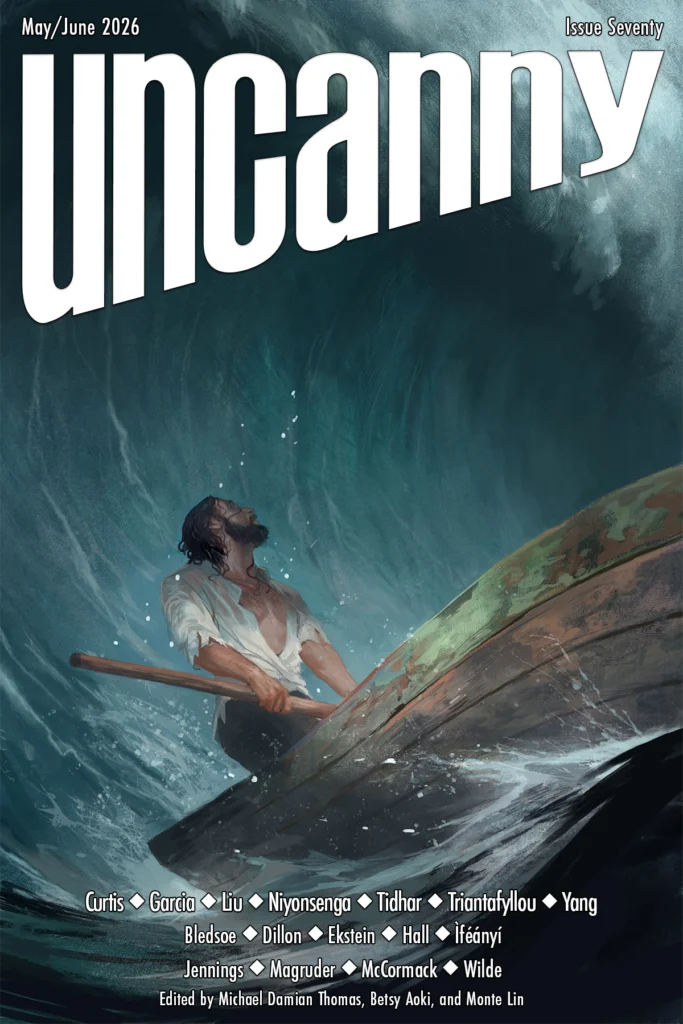
Amidst the flurry of award nominations, Uncanny Magazine continues its primary mission: to deliver exceptional speculative fiction to its readers. The release of Issue 70 exemplifies this ongoing commitment, presenting a rich tapestry of stories, essays, poetry, and interviews, all bound by the magazine’s signature blend of "beautiful and weird" content.
The phenomenal cover art, Ocean Swell by Julie Dillon, immediately captivates, setting the tone for the imaginative journeys within. The issue features a diverse array of new fiction, including:
- “The Snatchers” by Eugenia Triantafyllou
- “The Glass City” by AnaMaria Curtis
- “Extracted from an unravelled braid” by Aline-Mwezi Niyonsenga
- “Immigrant Girl from the End of the World” by Hannah Yang
- “Magical Girl Eater” by Angela Liu
- “#HumansOfMars” by Lavie Tidhar
- “Lincoln and the Harvester C-100” by R. S. A. Garcia
These stories traverse various subgenres, from poignant explorations of identity to inventive takes on classic tropes, showcasing the breadth of contemporary speculative storytelling.
Beyond fiction, Issue 70 offers provocative and compelling essays that delve into critical aspects of the genre and broader cultural themes. These include Una McCormack’s “The End of This Day’s Business—Or, My Life as Repetitive Epic,” Alex Bledsoe’s analysis of Hari’s character in filmed versions of Stanislaw Lem’s Solaris, Alex Jennings’s look at DC’s relaunched heroes, and Nilah Magruder’s insights on "Nature, Monsters, and the Responsibility of Larger Things."
The issue’s poetry section is equally rich, featuring "gorgeous and evocative" works such as “A Mermaid Looks at 40” by Fran Wilde, “Empty Music” by Prosper Ifeanyi, “Quorum” by Ceridwen Hall, and “electric in the silver stormchain that burst behind my wings” by S. R. Ekstein. Complementing the literary offerings, Caroline M. Yoachim conducts insightful interviews with AnaMaria Curtis and Angela Liu, providing readers with deeper perspectives into the creators’ processes and inspirations.
Further enriching the experience, The Uncanny Magazine Podcast offers audio versions of selected stories and poems from Issue 70, along with interviews. Episode 70A features “The Snatchers” read by Matt Peters and “A Mermaid Looks at 40” read by Erika Ensign, alongside Michael Damian Thomas interviewing Eugenia Triantafyllou. Episode 70B includes “Immigrant Girl from the End of the World” read by Erika Ensign and “Quorum” read by Matt Peters, with an interview between Thomas and Hannah Yang. This multimedia approach ensures accessibility and engagement for a wide audience.
The Future of Speculative Fiction and Uncanny Magazine: A Collective Endeavor
The remarkable success of Uncanny Magazine in the 2026 award season is not merely a collection of individual accolades; it is a powerful affirmation of the magazine’s core philosophy and the enduring vitality of the speculative fiction genre. In a world often characterized by fragmentation and commercial pressures, Uncanny Magazine stands as a beacon of community, quality, and artistic integrity.
The numerous nominations across the Hugo, Nebula, Aurora, and BSFA Awards validate the editorial vision of Michael Damian Thomas and his dedicated team, demonstrating their exceptional ability to identify and champion groundbreaking talent. More importantly, these achievements are a testament to the strength and engagement of the SF/F community itself—the readers, writers, artists, and volunteers who collectively nurture and sustain this vibrant artistic ecosystem.
As Michael Damian Thomas concluded in his editorial, his gratitude for the unwavering support of the "Space Unicorns" runs deep. The future of Uncanny Magazine, and indeed the broader landscape of independent speculative fiction publishing, hinges on this symbiotic relationship. By continuing to foster a sense of collective ownership and providing platforms for diverse and innovative voices, Uncanny Magazine is not just surviving but thriving, shining brightly as a testament to what can be achieved when a community comes together to celebrate the stories it loves. The message is clear: as long as there is a passionate readership, the fantastical worlds and profound narratives of speculative fiction will continue to find their home.
About Uncanny Magazine
Uncanny Magazine is an award-winning digital magazine publishing Science Fiction and Fantasy. Known for its "beautiful and weird" aesthetic, Uncanny features short stories, poetry, essays, and interviews from both established and emerging voices in the genre. It has been honored with multiple Hugo and Locus Awards for Best Semiprozine and is celebrated for its commitment to diversity and literary excellence.
Contact:
[Insert Press Contact Information Here, e.g., Michael Damian Thomas, Editor-in-Chief, Uncanny Magazine, [email protected]]
© 2026 Michael Damian Thomas
Uncanny Magazine Defies Industry Headwinds with Historic Award Season, Championing Community-Driven Speculative Fiction
FOR IMMEDIATE RELEASE
[City, State] – [Date] – In an era marked by widespread economic uncertainty and a challenging landscape for independent publishing, Uncanny Magazine stands as a testament to resilience, community, and the enduring power of speculative fiction. The acclaimed digital magazine has recently garnered an unprecedented number of nominations across the most prestigious awards in the Science Fiction and Fantasy (SF/F) genre – including the Hugo, Nebula, Aurora, and British Science Fiction Association (BSFA) Awards – while simultaneously launching its milestone 70th issue. This remarkable success story is underpinned by a deep-seated belief in reader engagement and a vibrant, supportive community, proving that even amidst precariousness, passion can pave the way for phenomenal achievement.
The magazine’s co-publisher and Editor-in-Chief, Michael Damian Thomas, shared a deeply personal editorial reflecting on the journey from initial frustration with the current state of publishing to a renewed sense of hope, largely inspired by the unique, democratic nature of SF/F awards and the unwavering support of the Uncanny readership, affectionately known as "Space Unicorns." This blend of personal reflection and industry insight offers a compelling narrative of perseverance in a dynamic and often demanding creative field.
The Editorial Voice: Navigating Publishing’s Precariousness with Purpose
In a recent editorial, Michael Damian Thomas openly addressed the palpable anxieties pervading the publishing world, a sentiment he described as "overwhelmed by pessimism." His candid admission of venting frustrations in an earlier draft, following "bad magazine news," resonates with many creators and publishers grappling with the inherent uncertainties of the industry. The precariousness of independent publishing, particularly in the digital age, is a multifaceted challenge, encompassing fluctuating revenue streams, intense competition for reader attention, and the constant pressure to innovate while maintaining artistic integrity. Economic downturns, shifts in consumption habits, and the ever-evolving technological landscape all contribute to an environment where every setback can indeed "feel gigantic."
However, Thomas consciously steered his narrative away from despair, drawing inspiration from a profound personal source: the enduring positive spirit of his late daughter, Caitlin. This pivot underscores a vital message for the creative community: to actively channel optimism even when confronted with adversity. For Uncanny Magazine, this means focusing on the intrinsic strengths of the speculative fiction community and its unique mechanisms for recognizing and celebrating excellence. This deliberate choice to highlight sources of hope rather than dwell on challenges sets a powerful example for other independent ventures striving to thrive in similar environments.
The Power of Community: SF/F Awards as a Beacon of Hope
A central pillar of Uncanny Magazine‘s optimistic outlook, as articulated by Thomas, is the distinctive nature of Science Fiction and Fantasy awards. Unlike many mainstream literary accolades often decided by small, insular panels, the major SF/F awards are fundamentally grassroots, community-driven initiatives. This democratic foundation is a hallmark of the genre, empowering readers and creators alike to actively shape the narrative of what is considered valuable and groundbreaking.
The Hugo Awards, for instance, are decided by the members of the World Science Fiction Convention (Worldcon), a global gathering of fans. Similarly, the Nebula Awards are chosen by active members of the Science Fiction and Fantasy Writers Association (SFWA), representing a peer-recognition system. The Rhysling Awards, dedicated to speculative poetry, are adjudicated by members of the Science Fiction Poetry Association (SFPA). Even awards like the Locus Awards and Ignyte Awards leverage free online voting, extending participation to a broader audience.
This extensive volunteerism and direct involvement of the community—from administration to the crucial process of nominating and voting—is a rare and powerful phenomenon in any industry. It fosters a deep sense of ownership and collective investment in the genre’s evolution. As Thomas emphatically states, "In almost every instance, it’s our community that decides what we value and reward. We do it through reading and discussing all of these awesome works with each other." This participatory culture ensures that the awards truly reflect the collective appreciation and critical discernment of the genre’s most passionate advocates, transforming them into not just accolades, but also vibrant demonstrations of community solidarity and shared artistic vision.
A History of Resilience: The Enduring Spirit of SF/F Magazines
The notion of the "death of magazines," particularly within the speculative fiction sphere, is a recurring concern that Thomas observes has plagued the industry since at least the 1950s. Despite these perennial anxieties, SF/F magazines have consistently demonstrated remarkable resilience, adapting to new formats and evolving alongside their readership. Uncanny Magazine‘s current success stands as a powerful counter-narrative to these doomsayers, illustrating that a dedicated readership, combined with strategic financial models, can ensure the longevity of high-quality content.
Thomas attributes this enduring strength to the "Space Unicorns"—the magazine’s loyal community of readers and supporters. This community’s engagement extends beyond merely consuming content; it actively participates in its propagation and financial sustainment. Platforms like Patreon, Weightless Books Subscriptions, and yearly Kickstarter campaigns are not just revenue streams; they are tangible expressions of a community’s commitment to the art form. These mechanisms provide the crucial financial backbone that allows independent publications like Uncanny Magazine to commission new works, pay creators fairly, and maintain their editorial independence and high production values.
The editor’s unwavering commitment, despite navigating "massive life changes" (some of which are "very, very joyful!"), further underscores the dedication required to lead such a venture. His promise to "keep editing and publishing a magazine that values having this spectacular community" is a pledge that resonates deeply with those who understand the symbiotic relationship between content creators and their audience. As long as a vibrant community of readers exists—one that "love[s] and need[s] these stories, poems, essays, interviews, art, and podcasts"—Thomas firmly believes that Uncanny Magazine, and indeed SF/F magazines as a whole, will continue to flourish. This historical perspective, combined with a forward-looking strategy of community engagement and diversified financial support, paints a hopeful picture for the future of speculative fiction publishing.
A Season of Acclaim: Uncanny Magazine Dominates Major Award Shortlists
The collective spirit of the SF/F community has been vividly reflected in the recent award nominations, where Uncanny Magazine has emerged as a powerhouse, securing an extraordinary number of finalist spots across multiple prestigious awards. This unprecedented recognition highlights the magazine’s consistent commitment to publishing diverse, high-quality speculative fiction, poetry, and non-fiction.
Nebula Awards 2026: Early Recognition
The 2026 Nebula Awards, presented by the Science Fiction and Fantasy Writers Association (SFWA), were among the first to announce their finalists, showcasing Uncanny Magazine‘s strong presence. Two stories and two poems from the magazine earned coveted spots on the shortlist:
- Best Novelette: “The Life and Times of Alavira the Great as Written by Titos Pavlou and Reviewed by Two Lifelong Friends” by Eugenia Triantafyllou.
- Best Short Story: “Six People to Revise You” by J. R. Dawson.
- Best Poem: “Care for Lightning” by Mari Ness.
- Best Poem: “The Mourning Robot” by Angela Liu.
The Nebula Awards are particularly significant as they represent peer recognition, with active SFWA members voting for their favorites. Winners will be announced at the 2026 Nebula Conference and Awards, scheduled for June 3–7, 2026, at the Crowne Plaza Chicago O’Hare Hotel & Conference Center in Chicago, IL, with virtual attendance options available. This early recognition set a celebratory tone for Uncanny Magazine‘s award season.
BSFA Awards 2025: Transatlantic Acknowledgment
Following the Nebula announcement, Uncanny Magazine also received transatlantic acclaim with a nomination for the British Science Fiction Association (BSFA) Awards for work published in 2025.
- Best Short Fiction: “The Life and Times of Alavira the Great as Written by Titos Pavlou and Reviewed by Two Lifelong Friends” by Eugenia Triantafyllou.
The BSFA Awards, presented annually since 1970, are voted on by members of the British Science Fiction Association and attendees of Eastercon, the national Science Fiction convention. This nomination further solidifies Uncanny Magazine‘s international reputation for excellence in speculative short fiction.
Hugo Awards 2026: A Stellar Showcase
Perhaps the most extensive display of Uncanny Magazine‘s impact comes with its astounding seven finalist nominations for the 2026 Hugo Awards, widely considered the premier awards in the field of speculative fiction. The magazine itself, its editor, and numerous contributors are celebrated across multiple categories:
- Best Novelette:
- “Kaiju Agonistes” by Scott Lynch
- “When He Calls Your Name” by Catherynne M. Valente
- “The Millay Illusion” by Sarah Pinsker
- Best Short Story:
- “Six People to Revise You” by J. R. Dawson
- “10 Visions of the Future; or, Self-Care for the End of Days” by Samantha Mills
- Best Poem:
- “Care for Lightning” by Mari Ness
- “The Mourning Robot” by Angela Liu
- Best Semiprozine: Uncanny Magazine (Publisher/Editor-in-Chief Michael Damian Thomas, Managing Editor Monte Lin, Poetry Editor Betsy Aoki, and Podcast Producers Erika Ensign and Steven Schapansky)
- Best Editor Short Form: Michael Damian Thomas
The sheer breadth of these nominations, encompassing fiction, poetry, the publication itself, and its editor, underscores Uncanny Magazine‘s comprehensive excellence. The Hugo Awards are voted on by members of the World Science Fiction Convention. Winners will be announced at a live ceremony held at LAcon V, the World Science Fiction Convention, on August 30, 2026. Voting on the final ballot is set to begin in early May, with registration information available via the Los Angeles Worldcon website. The Uncanny team expressed being "honored, ecstatic, and overwhelmed" by this exceptional recognition.
Aurora Awards 2026: Canadian Excellence Honored
Adding to the growing list of accolades, Uncanny Magazine also secured two finalist spots for the 2026 Aurora Awards, which celebrate Canadian Science Fiction, Fantasy, and Horror works.
- Best Novelette/Novella: “The Lure of Stone” by Silvia Moreno-Garcia.
- Best Cover Art/Interior Illustration: Ejiwa “Edge” Ebenebe’s Listen To Me And I’ll Tell You A Story (from Uncanny Magazine Issue Sixty-Six).
The Aurora Awards are nominated by members of the Canadian Science Fiction and Fantasy Association. The online awards ceremony will be held on Sunday, August 9th, 2026, at 5 pm EDT, hosted by Mark Leslie Lefebvre and Elizabeth May Anderson. These nominations highlight Uncanny Magazine‘s commitment to showcasing diverse voices and artistic talent from across the global speculative fiction community.
Spotlight on Issue 70: A Fresh Collection of Speculative Fiction
Amidst the flurry of award nominations, Uncanny Magazine continues its primary mission: to deliver exceptional speculative fiction to its readers. The release of Issue 70 exemplifies this ongoing commitment, presenting a rich tapestry of stories, essays, poetry, and interviews, all bound by the magazine’s signature blend of "beautiful and weird" content.
The phenomenal cover art, Ocean Swell by Julie Dillon, immediately captivates, setting the tone for the imaginative journeys within. The issue features a diverse array of new fiction, including:
- “The Snatchers” by Eugenia Triantafyllou
- “The Glass City” by AnaMaria Curtis
- “Extracted from an unravelled braid” by Aline-Mwezi Niyonsenga
- “Immigrant Girl from the End of the World” by Hannah Yang
- “Mag

Leave a Comment