Uncanny Magazine Launches Critical Year 13 Kickstarter Amidst Industry Challenges and Acclaim
FOR IMMEDIATE RELEASE
[CITY, STATE] – [Date, e.g., June 20, 2026] – Uncanny Magazine, the award-winning online publication known for its blend of science fiction, fantasy, and horror, is gearing up for its annual Kickstarter campaign, a crucial lifeline that determines its very existence. Set to launch on July 13, 2026, the "Uncanny Magazine Year 13: The Space Unicorn Believes in YOU!" campaign seeks to fund another year of thought-provoking stories, essays, and poetry, culminating in the landmark DIAMOND Issue #75, featuring exclusive fiction from past Uncanny award winners.
The campaign arrives at a pivotal moment for the independent speculative fiction publisher. While the magazine celebrates a cascade of prestigious award nominations, including an unprecedented showing at the upcoming Hugo Awards, it simultaneously grapples with significant financial headwinds and the deeply personal challenges faced by its Publisher and Editor-in-Chief, Michael Damian Thomas. The yearly Kickstarter, a tradition since 2014, has evolved from a funding mechanism into a vital referendum on the magazine’s future, relying heavily on the dedicated "Space Unicorn Ranger Corps" – its global community of readers and supporters.
The Annual Gauntlet: Uncanny Magazine‘s Kickstarter Tradition
Since its inception in 2014, Uncanny Magazine has embraced a unique, community-funded model, turning its annual Kickstarter into a high-stakes event. "Nobody would call a yearly referendum about whether or not your business should exist a stress-free process," states Michael Damian Thomas, reflecting on the intense preparation and anticipation that precedes each campaign launch. This year, on July 13, 2026, he will once again press the launch button, initiating the drive for "Uncanny Magazine Year 13: The Space Unicorn Believes in YOU!"
The consistency of Uncanny‘s output – delivering consistently high-quality, diverse speculative fiction and nonfiction – is a testament to the success of this model and the unwavering support it has garnered. Each year, the campaign offers a fresh array of "awesome backer rewards from some of the greatest creators in the universe," transforming the fundraising effort into an engaging, interactive experience for its community. However, this yearly cycle also underscores the inherent precarity of independent publishing, where continued operation is contingent on sustained public goodwill and financial backing.
The upcoming campaign is particularly ambitious, aiming not only to fund a full year of the magazine but also to celebrate a significant milestone: DIAMOND Issue #75. This special edition promises to be a collector’s item, featuring original fiction exclusively from authors who have previously won major awards for their stories published in Uncanny Magazine. This initiative highlights the magazine’s commitment to nurturing and showcasing top-tier talent within the speculative fiction landscape, cementing its reputation as a launchpad for critically acclaimed works.
Navigating a Precarious Publishing Landscape
The world of independent literary magazines, particularly within the speculative fiction genre, is perpetually on a tightrope walk. Recent years have seen numerous publications shutter their doors or drastically scale back operations, a stark reminder that even critically acclaimed ventures face immense pressure. Uncanny Magazine is no exception to these industry-wide challenges.
"Many magazines have closed recently, and many others have been in precarious shape," Thomas observes. This year, the magazine faced a significant financial blow with the complete loss of subscription revenue previously derived from a major online retailer. This change has shifted an even greater burden onto the direct support of its readership, making the forthcoming Kickstarter campaign more critical than ever before. The "goodwill and generosity of the Space Unicorn Ranger Corps" are not just appreciated; they are foundational to the magazine’s continued viability.
Adding to the professional pressures, Michael Damian Thomas is navigating a deeply personal and emotionally challenging period. "I live in a very strange time in my life right now," he shares candidly. He continues to grieve the loss of his late daughter, Caitlin, a profound personal sorrow that shadows his daily life. Concurrently, his "amazing and supportive wife, Kirsty, and our kids are on the other side of the Atlantic," marking the first time in many years he will not be physically with Kirsty for at least a portion of the crucial Kickstarter period. Furthermore, his personal income derived from Uncanny remains modest, adding another layer of financial stress to an already demanding endeavor.
Despite these formidable personal and professional hurdles, Thomas’s belief in Uncanny Magazine‘s mission remains resolute. "But!! I still believe in Uncanny Magazine," he emphasizes. "I feel these stories, essays, poems, interviews, covers, and podcasts are important to people. As the world darkens, having these pieces there for the folks who need them is vital." This conviction is the driving force behind his relentless dedication, positioning Uncanny not merely as a source of entertainment, but as a cultural touchstone providing solace, insight, and imaginative escape in turbulent times. The magazine’s commitment to paying its creators and staff fairly for their work is a core principle, a practice directly enabled by the community’s financial support. "Every cent helps Uncanny Magazine pay its creators and staff. YOU make Uncanny Magazine possible, Space Unicorns," Thomas passionately reminds his audience.
A Beacon of Excellence: Recent Accolades and Editorial Evolution
Despite the operational challenges, Uncanny Magazine continues to garner widespread critical acclaim, a testament to its editorial vision and the quality of its published works. The period leading up to the Year 13 Kickstarter has been particularly rich with award nominations and significant editorial advancements.
Editorial Leadership: Monte Lin’s Expanded Role
In a move signaling a strategic strengthening of its editorial team, Uncanny Magazine announced that its Managing Editor, Monte Lin, will also assume the role of Nonfiction Editor. Lin, who will continue his duties as Managing Editor, has been an integral part of Uncanny since joining as Assistant Editor in September 2021, and has served as Managing Editor since May 2022, a tenure during which he has already secured two prestigious Hugo Awards.
This expanded role leverages Lin’s proven track record and deep understanding of the magazine’s ethos. "Monte will bring amazing amounts of thoughtfulness, organization, experience, and vision to the nonfiction editing," the announcement stated, expressing confidence that he "will continue Uncanny‘s tradition of publishing provocative, thoughtful, and passionate essays." Lin’s dual role is expected to further elevate the magazine’s nonfiction offerings, which are celebrated for their critical engagement with speculative themes and their broader cultural relevance.
Shirley Jackson Awards Recognition
Uncanny Magazine has once again been recognized by the Shirley Jackson Awards, an esteemed accolade celebrating outstanding achievement in the literature of psychological suspense, horror, and the dark fantastic. "The Millay Illusion" by Sarah Pinsker has been named a finalist for the Best Novelette Shirley Jackson Award.
The Shirley Jackson Awards, established in 2007 with the permission of the author’s estate, are voted upon by a jury of professional writers, editors, critics, and academics. They recognize works published in the preceding calendar year across various categories, honoring the genre’s most unsettling and thought-provoking contributions. The 2025 Shirley Jackson Awards ceremony is scheduled to take place in-person on Saturday, July 11, 2026, at Readercon 35, the Conference on Imaginative Literature, in Burlington, Massachusetts. The ceremony will be hosted by Readercon 35 Guests of Honor P. Djèlí Clark and David Gerrold.
Theodore A. Sturgeon Memorial Award Finalists
Further demonstrating its impact on the field, Uncanny Magazine has seen two of its stories become finalists for the Theodore A. Sturgeon Memorial Award, an award recognizing the best science fiction short fiction of the year. "Six People to Revise You" by J. R. Dawson and "The Shadow on the Nest" by Alaya Dawn Johnson have both earned this distinguished nomination.
Adding to the magazine’s pride, Uncanny Magazine Managing Editor Monte Lin also secured a Sturgeon Memorial Award finalist spot for his story "his love’s ashes on his tongue," published in The Deadlands. The Sturgeon Award, established in 1987 by James Gunn, Founding Director of the Gunn Center for the Study of Science Fiction at the University of Kansas, and the heirs of Theodore Sturgeon, is a significant honor within the science fiction community. The winner is slated to be announced later this summer and will be presented with their award and a cash prize as a guest of honor at the annual Sturgeon Symposium in October.
Eugie Foster Memorial Award for Short Fiction
"When He Calls Your Name" by Catherynne M. Valente, a story that has garnered multiple nominations, is also a finalist for the 2026 Eugie Foster Memorial Award for Short Fiction. The Eugie Award, presented annually at Dragon Con, celebrates "the best in innovative fiction" and honors stories that are "irreplaceable, that inspire, enlighten, and entertain." The award seeks out works that are "beautiful, thoughtful, and passionate, and change us and the field," recognizing stories that are unique and become essential to speculative fiction readers. This nomination further underscores the profound impact and artistic merit of Uncanny‘s published works.
The Prestigious Hugo Awards: Uncanny‘s Strong Showing
The most comprehensive recognition of Uncanny Magazine‘s editorial excellence comes with its impressive slate of nominations for the 2026 Hugo Awards, widely considered the premier awards in science fiction and fantasy. With voting for the Hugos closing on August 8, 2026, at noon PDT, the magazine is urging its "Space Unicorns" to participate actively. All Uncanny Magazine materials relevant to the awards are readily available in the Hugo Award Packet and online.
Uncanny has secured an extraordinary seven nominations across fiction and poetry categories:
- Best Novelette:
- "Kaiju Agonistes" by Scott Lynch
- "When He Calls Your Name" by Catherynne M. Valente
- "The Millay Illusion" by Sarah Pinsker
- Best Short Story:
- "Six People to Revise You" by J. R. Dawson
- "10 Visions of the Future; or, Self-Care for the End of Days" by Samantha Mills
- Best Poem:
- "Care for Lightning" by Mari Ness
- "The Mourning Robot" by Angela Liu
Beyond individual works, Uncanny Magazine itself has once again been nominated for Best Semiprozine, recognizing the collective efforts of its dedicated team: Publisher/Editor-in-Chief Michael Damian Thomas, Managing Editor Monte Lin, Poetry Editor Betsy Aoki, and Podcast Producers Erika Ensign and Steven Schapansky. Additionally, Michael Damian Thomas has received a personal nomination for Best Editor-Short Form, a testament to his discerning eye and leadership in shaping the magazine’s acclaimed content. This breadth of nominations highlights the magazine’s consistent quality across all its offerings and its profound impact on the speculative fiction community.
Issue 71: A Glimpse into Uncanny‘s Latest Offering
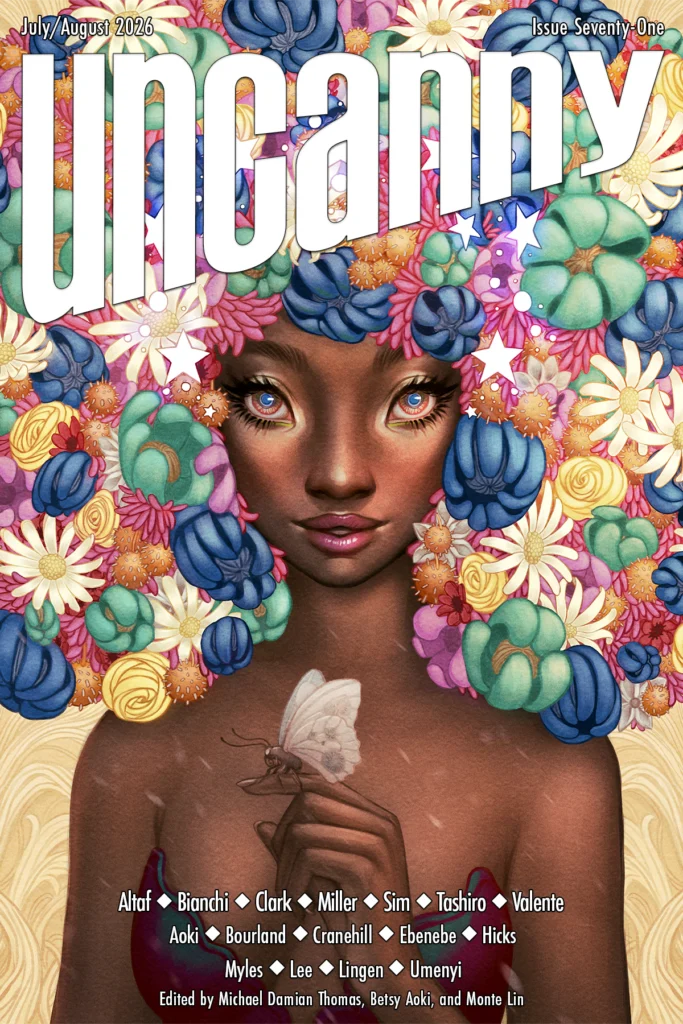
As the magazine navigates its critical fundraising period and celebrates its award nominations, it continues to deliver compelling content. Issue 71, released recently, exemplifies the diverse and high-quality speculative fiction, nonfiction, and poetry that Uncanny Magazine is renowned for.
The issue features the phenomenal cover art, Flower Crown, by Ejiwa “Edge” Ebenebe, setting a vibrant tone. New fiction includes a range of narratives: "Leavetaking" by Tia Tashiro, "Learning the Loom" by P. Djèlí Clark, "This Is Just Another Carnaval Love Story" by Jana Bianchi, "The Cinema of Babel" by Sam J. Miller, "Judar of the Island: A Story Told in Four Feasts" by Rida Altaf, and "A Hundred Ways the Story Ends" by Tara Sim. The issue also includes a captivating reprint, "White Lines on a Green Field" by Catherynne M. Valente, originally published in Subterranean Online, Fall 2011.
The nonfiction section, soon to be shaped by Monte Lin’s expanded editorial vision, features provocative and compelling essays: "The Strange Worlds Among Us—of Turing, Trans People, and the Road to Laniakea" by Ryka Aoki, "Doctor Who in an Exciting Adventure with AI Slop 1969 AD" by Lizbeth Myles, "This Is Not About AI" by Hana Lee, and "Middle-Aged Love: Rereading in Your Forties and Beyond" by Marissa Lingen. These essays delve into timely cultural discussions, technological impacts, and introspective literary analysis, reflecting Uncanny‘s commitment to intellectual engagement.
Poetry in Issue 71 offers gorgeous and evocative verses, with "Instructions for Becoming Fire" by Chisomaga Umenyi, "Six Views of a Speedster" by Gwendolyn Hicks, "I called the swan down" by Laura Cranehill, and "enough johnnie blue" by E. A. Bourland. The issue concludes with insightful interviews conducted by Caroline M. Yoachim, featuring discussions with P. Djèlí Clark and Rida Altaf about their respective stories.
Complementing the print content, The Uncanny Magazine Podcast episode 71A features "Leavetaking" by Tia Tashiro, read by Erika Ensign, alongside "Instructions for Becoming Fire" by Chisomaga Umenyi, read by Matt Peters, with Michael Damian Thomas interviewing Tia Tashiro. Episode 71B includes "The Cinema of Babel" by Sam J. Miller, read by Matt Peters, and "I called the swan down" by Laura Cranehill, read by Erika Ensign, followed by Michael Damian Thomas interviewing Sam J. Miller.
Implications for the Future: The Path Ahead
The success of the "Uncanny Magazine Year 13: The Space Unicorn Believes in YOU!" Kickstarter campaign is not merely about securing another year of publication; it carries profound implications for the speculative fiction community and the broader independent publishing landscape. A successful campaign ensures that Uncanny Magazine can continue its vital work of discovering, nurturing, and compensating new and established voices in the genre. It guarantees that the magazine can maintain its high standards of editorial quality, its commitment to diverse representation, and its role as a platform for stories that challenge, comfort, and inspire.
For its contributors, the Kickstarter’s success means continued opportunities for professional publication and fair payment, a critical factor in an industry often struggling with compensation. For its readership, it means the continued availability of "important" stories, essays, and poems that offer vital perspectives in a "darkening world." In an era where commercial pressures often dictate content, Uncanny‘s independent model allows it to prioritize artistic merit and thematic depth over market trends.
The ongoing accolades, particularly the extensive Hugo nominations, underscore the magazine’s significant cultural impact and its status as a leader in the field. However, these awards also serve as a stark reminder of the discrepancy between critical recognition and financial stability for many independent ventures. The "Space Unicorn Ranger Corps" stands as the bulwark against this precarity, embodying the power of community in sustaining artistic endeavors.
Ultimately, the Year 13 Kickstarter is more than a fundraising drive; it is an affirmation of a shared belief in the power of story and the necessity of independent platforms to tell those stories. Michael Damian Thomas’s unwavering dedication, despite personal hardship and industry challenges, reflects a deep-seated conviction that Uncanny Magazine fills a crucial void. Its continued existence relies on its community coming together, not just for themselves, but for "everybody else out there who doesn’t have the means to financially support the magazine."
As the campaign date approaches, the call to action is clear: "LET’S COME TOGETHER AND MAKE ANOTHER YEAR OF UNCANNY MAGAZINE!!!" The future of this celebrated publication, a true space unicorn in the literary cosmos, rests in the hands of its dedicated community.
###