
Unearthing the Deep Roots of Western Thought: A Review of Shan Winn’s "Heaven, Heroes, and Happiness"
By [Your Name/Journalist’s Name]
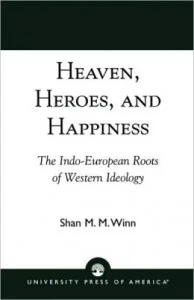
[City, State] – [Date] – In an age characterized by rapid change and a pervasive sense of modernity, the notion that our contemporary Western worldview is profoundly shaped by millennia-old ideologies can seem counterintuitive. Yet, it is precisely this enduring legacy that Shan Winn meticulously explores in his compelling new book, Heaven, Heroes, and Happiness: The Indo-European Roots of Western Ideology. Through a rigorous examination of linguistic, social, and mythological continuities, Winn offers a profound insight into how the Bronze Age and Iron Age Europeans — specifically the Proto-Indo-Europeans — laid the foundational stones for much of what we consider distinctively "Western."
The prevailing narrative often emphasizes the chasm between ancient and modern societies, highlighting technological advancements, shifts in governance, and evolving ethical frameworks. While these differences are undeniable and significant, Winn’s work argues for a powerful, often subconscious, thread of continuity that binds our present to a distant past. This book serves as an excellent introduction to Indo-European society and mythology, presenting a fascinating study of how fundamental aspects of their worldviews and ways of life have not merely survived but continue to resonate within the fabric of modern Western civilization. It is a recommended read for anyone seeking to understand the deep historical currents that have shaped our collective consciousness and societal structures.
Main Facts: Unveiling the Enduring Legacy
Shan Winn’s Heaven, Heroes, and Happiness posits that the Proto-Indo-Europeans, a prehistoric group of peoples who emerged from the Pontic-Caspian steppe, left an indelible mark on Western civilization far beyond mere linguistic heritage. These nomadic or semi-nomadic pastoralists, originating in what is now parts of Ukraine, Russia, and Kazakhstan during the Bronze Age, were among the first to utilize domesticated horses and wheeled carts. Their subsequent migrations across Eurasia, particularly into Europe, profoundly shaped the societies of the Celts, Slavs, Greeks, Romans, Germanics, and many others, establishing a common cultural and ideological bedrock.
Winn argues that the influence of these ancestral peoples extends to fundamental aspects of Western thought and societal organization. Chief among his examples is the pervasive tripartite hierarchical structure, which divided society into rulers/priests, warriors, and commoners (farmers, merchants, craftspeople). This specific social model, which might appear self-evident to many modern observers, is argued by Winn, following the groundbreaking work of Georges Dumézil, to be a uniquely Indo-European construct. This structure was not merely an organizational principle but was deeply embedded in their cosmology, mirroring the divine realm where gods and goddesses occupied roles closely tied to these three functions. The recurring significance of the number three in their mythologies, akin to the number seven in the ancient Middle East or four in many American Indian groups, further underscores this deep-seated ideological framework. Even in contemporary Western societies, though not strictly adhered to, this tripartite division remains a significant, albeit often unconscious, reference point for societal ordering.
Furthermore, Winn delves into the influence of Indo-European thought on religious developments. He highlights the figure of Zarathustra, the Iranian prophet of the second millennium BCE, whose teachings became the foundation of Zoroastrianism and exerted a profound influence on later monotheistic religions, notably Christianity. Zarathustra, himself a priest within an Indo-European society, drew upon existing Indo-European mythical themes, repurposing them into a new, revolutionary philosophical and theological system. This demonstrates how ancient ideological motifs provided the raw materials for future religious innovations that would shape billions of lives.
The book draws heavily from the scholarship of Georges Dumézil and Marija Gimbutas, two towering figures in Indo-European studies. While the reviewer readily accepts the robustness of Dumézil’s ideas concerning the centrality of tripartism, a critical eye is cast upon Winn’s largely uncritical acceptance of some aspects of Gimbutas’s theories, particularly her romanticized view of "Old Europe." This nuanced engagement with foundational scholarship enriches Winn’s narrative, even as it invites further academic discussion.
Chronology: The Journey of the Proto-Indo-Europeans
To fully appreciate the arguments presented in Heaven, Heroes, and Happiness, it is crucial to understand the chronological journey of the Proto-Indo-Europeans (PIE) and their subsequent cultural diffusion. The story begins in the vast Pontic-Caspian steppe, a sprawling grassland region stretching from modern-day Ukraine across southern Russia to Kazakhstan. Around 4500-2500 BCE, during the early to middle Bronze Age, this region witnessed the emergence of a distinctive cultural complex known as the Yamnaya culture, widely considered a strong candidate for the homeland of the PIE.
These early Indo-Europeans were primarily nomadic or semi-nomadic pastoralists. Their economic life revolved around herding cattle, sheep, and goats, which necessitated a mobile lifestyle to seek out fresh pastures. This pastoral existence fostered a culture of resilience, adaptability, and a strong emphasis on kinship and tribal structures. Crucially, the Yamnaya people were pioneers in two transformative technologies: the domestication of the horse for riding and the development of wheeled carts.
The domestication of the horse was a game-changer. It provided unprecedented mobility, enabling faster travel, more efficient herding, and a significant military advantage. The invention of the wheeled cart, conversely, facilitated the transportation of goods and people over long distances, making large-scale migrations and trade networks possible. These innovations were not merely technological; they profoundly influenced their social structures, their capacity for expansion, and their interaction with other cultures.
Beginning around 3000 BCE, the Proto-Indo-Europeans embarked on a series of significant migrations, often referred to as the Indo-European expansion. These movements were not always mass migrations of entire populations but often involved smaller groups, particularly warriors and elite strata, who spread their language, technologies, and ideological frameworks across vast swathes of Eurasia.
- Early European Migrations: One major branch moved westward into Central and Northern Europe, giving rise to cultures like the Corded Ware and later the Bell Beaker complex. These groups would eventually evolve into the ancestors of the Celtic, Germanic, Baltic, and Slavic peoples. Their arrival often involved the cultural assimilation or displacement of pre-existing Neolithic populations, leading to significant changes in social organization and belief systems.
- Southern European Expansion: Other groups ventured south, laying the linguistic and cultural foundations for the Italic peoples (ancestors of the Romans) and the Hellenic peoples (Greeks) in the Mediterranean basin.
- Eastern and Southern Migrations: Simultaneously, another significant wave moved eastward and southward into Anatolia (modern Turkey), giving rise to the Hittites and other Anatolian languages, and further into the Iranian Plateau and the Indian subcontinent, establishing the Indo-Iranian branch. These included the Aryans, whose Vedic culture profoundly influenced ancient India, and the various Iranian peoples, including the ancestors of the Persians and Medes.
By the end of the Bronze Age and into the Iron Age, the Indo-European linguistic family had become the most widespread in the world, encompassing nearly all of Europe (with exceptions like Basque and Finnish) and significant parts of Asia. This incredible geographical spread was accompanied by the diffusion of shared myths, social structures, and cosmological ideas, many of which Winn meticulously traces to illustrate the profound continuity he champions. Understanding this chronological and geographical sweep is essential to grasping how a single ancestral culture could have so fundamentally shaped the diverse tapestry of Western and parts of Asian civilization.
Supporting Data: Pillars of Indo-European Continuity
Winn’s central argument hinges on compelling "supporting data" that illustrates the deep continuity between ancient Indo-European thought and modern Western ideology. This data is primarily drawn from comparative mythology, linguistics, and social anthropology, building on the bedrock laid by pioneering scholars.
The Trifunctional Ideology: A Societal Blueprint
At the heart of Winn’s exposition is the Indo-European tripartite hierarchical structure, a concept extensively elaborated by Georges Dumézil. Dumézil’s trifunctional hypothesis posits that Proto-Indo-European societies and their descendant cultures organized their world – both human and divine – around three distinct functions:
- Sovereignty (First Function): This function encompassed the sacred, legal, and magical aspects of rule. It was associated with priests, kings, and the maintenance of cosmic and social order. In mythology, this often manifested in deities associated with law, wisdom, and magical power. Examples include the Roman Jupiter, the Norse Odin and Týr, and the Indian Varuna and Mitra. This function could further be divided into a juridical, sovereign aspect (e.g., Varuna, Týr) and a magical, priestly aspect (e.g., Mitra, Odin).
- Force/Warfare (Second Function): This pertained to the military class, warriors, and the defense of the community through strength and courage. Mythologically, this corresponded to deities of war, thunder, and martial prowess. Iconic examples include the Roman Mars, the Norse Thor, and the Indian Indra. These gods were often characterized by their strength, assertiveness, and role as protectors.
- Fertility/Prosperity (Third Function): This function encompassed the producers – farmers, herders, artisans, and merchants – responsible for the material well-being and fecundity of the society. In the divine realm, these were gods and goddesses associated with agriculture, wealth, love, and bountiful harvests. Examples include the Roman Quirinus, the Norse Freyr and Freyja, and the Indian Ashvins.
Winn, following Dumézil, argues that this trifunctional division was remarkably uniform across various Indo-European manifestations, from India to Ireland. It was not merely a convenient administrative arrangement but a profound ideological framework that underpinned their cosmology. The divine pantheons reflected this structure, with gods and goddesses occupying positions and roles that mirrored the societal divisions. The consistent recurrence of the number three in their myths, rituals, and sacred geography further underscores its symbolic power.
Even today, while modern Western societies are far more complex and fluid, the echoes of this tripartite structure can still be discerned. The separation of powers in government (executive, legislative, judicial), the distinct roles of the military, and the vast economic sector, while not direct historical descendants in a strict sense, align conceptually with these ancient divisions, suggesting a persistent underlying pattern in how we conceptualize societal organization.
Zarathustra and the Birth of Monotheistic Influences
Another powerful piece of supporting data comes from the religious innovations of Zarathustra (or Zoroaster), the ancient Iranian prophet whose teachings founded Zoroastrianism. Living sometime between 1200 and 600 BCE, Zarathustra operated within a society deeply rooted in Indo-European traditions. His philosophy, while revolutionary in its emphasis on monotheism (the worship of Ahura Mazda, the Wise Lord) and ethical dualism (the cosmic struggle between Asha/Truth and Druj/Falsehood, personified by Spenta Mainyu and Angra Mainyu), nevertheless utilized and reconfigured existing Indo-European mythical themes.
For instance, the concept of a cosmic struggle between good and evil, the notion of a final judgment, the division of spiritual entities into benevolent (Amesha Spentas) and malevolent (daevas), and the expectation of a savior figure (Saoshyant) all have parallels, albeit transformed, with earlier Indo-European mythic cycles. Winn illustrates how Zarathustra skillfully repurposed these "raw materials" to forge a new religious paradigm that would exert an extraordinary influence on later Abrahamic religions. Concepts like heaven and hell, angels and demons, the resurrection of the dead, and the ultimate triumph of good over evil, which are central to Judaism, Christianity, and Islam, are widely believed to have been profoundly shaped by Zoroastrianism. This demonstrates a potent continuity: ancient Indo-European themes, filtered through a prophetic vision, became foundational elements for belief systems that would define Western spirituality for millennia.
The Gimbutas Controversy: A Point of Critical Engagement
Winn’s reliance on the work of Marija Gimbutas, particularly her "Old Europe" hypothesis, is acknowledged by the reviewer as a point of contention. Gimbutas, a Lithuanian-American archaeologist, proposed that pre-Indo-European Europe (c. 7000-3500 BCE) was a peaceful, egalitarian, matrifocal (or matriarchal) agrarian society that worshipped a Great Goddess, valuing art and harmony. According to Gimbutas, this idyllic "Old Europe" was violently overthrown and subjugated by the "patriarchal, war-like" Indo-Europeans who arrived from the steppes, leading to the destruction of their peaceful way of life and the imposition of a male-dominated hierarchy.
The reviewer notes that while there might be some truth to the idea that pre-Indo-European societies were closer to this imagined way of life than the Indo-Europeans, Gimbutas "greatly overstates her case." Her stark dichotomy between a utopian "Old Europe" and a destructive "New Europe" (Indo-European) has been criticized for being overly simplistic and for projecting contemporary ideological desires onto the archaeological record. The reviewer suggests that Gimbutas’s vision "played directly into the unrealized hopes and dreams of mid-to-late-twentieth-century liberalism/progressivism," offering a supposedly historical model for a desired future.
Winn, according to the reviewer, "mostly accepts Gimbutas’s work uncritically," particularly regarding the assumption that any Indo-European goddess must be a holdover from Old Europe. This implies a belief that the Indo-Europeans were so "cartoonishly patriarchal" that they couldn’t have developed original female deities. However, the reviewer also points out Winn’s insightful passing reference to the "obvious, almost Zoroastrian dualism inherent in Gimbutas’s vision." This brief moment of critical reflection by Winn suggests an awareness of the strong, almost Manichaean, good-vs.-evil framework that underpins Gimbutas’s narrative, implicitly acknowledging its potential for oversimplification. This critical engagement, even if brief within Winn’s text, is crucial for a balanced understanding of the complex interactions between different ancient cultures.
Official Responses: Academic Discourse and Critical Reception
The "official response" to a work like Heaven, Heroes, and Happiness manifests primarily within the academic community and through critical reviews such as this one. Shan Winn’s engagement with the foundational scholarship of Georges Dumézil and Marija Gimbutas positions his book squarely within ongoing debates in Indo-European studies, archaeology, and comparative mythology.
Dumézil’s trifunctional hypothesis, while not without its critics, is largely accepted as a powerful analytical tool for understanding Indo-European social and mythological structures. Its ability to provide coherent explanations for patterns observed across diverse Indo-European cultures, from India to Ireland, has solidified its standing. Winn’s judicious application of Dumézil’s insights is therefore likely to be well-received by scholars who recognize the profound impact of this ideological framework. The clarity with which Winn demonstrates the enduring relevance of this structure to modern Western societies is a significant contribution, bridging the gap between ancient scholarship and contemporary understanding.
Conversely, Winn’s engagement with Marija Gimbutas’s "Old Europe" hypothesis places the book in more contested territory. Gimbutas’s work, while groundbreaking in bringing attention to pre-Indo-European cultures, has faced considerable scrutiny. Her emphasis on a uniformly peaceful, egalitarian, and matriarchal "Old Europe" has been criticized for lacking sufficient archaeological corroboration and for being influenced by the intellectual currents of the late 20th century, including feminist and New Age movements. Many scholars now view her interpretation as an oversimplification, suggesting that pre-Indo-European societies were likely more diverse and complex than her model allowed, possibly including warfare and hierarchical structures.
The reviewer’s critique of Winn’s "uncritical acceptance" of Gimbutas on certain points, particularly regarding the origin of goddesses, highlights a key area where the book might invite academic debate. While Winn’s overarching thesis about Indo-European continuity is robust, a more critical and nuanced engagement with the complexities and criticisms surrounding Gimbutas’s theories could have strengthened the book’s scholarly rigor in these specific areas. However, the reviewer’s observation that Winn does make a passing reference to the "dualism inherent in Gimbutas’s vision" suggests that the author is not entirely unaware of the problematic aspects, even if he chooses not to elaborate on them.
Overall, Heaven, Heroes, and Happiness appears poised to contribute significantly to public understanding of Indo-European studies. For a general audience and students, it offers an accessible yet comprehensive introduction to complex academic concepts, making them relevant to contemporary Western identity. For specialists, it serves as a valuable synthesis, prompting further discussion on the precise mechanisms and extents of cultural continuity, particularly in light of ongoing archaeological and linguistic discoveries that continue to refine our understanding of the Proto-Indo-Europeans. The book’s strength lies in its ability to synthesize vast amounts of data into a coherent narrative about the enduring power of ancient ideologies.
Implications: Reshaping Our Understanding of Western Identity
The implications of Shan Winn’s Heaven, Heroes, and Happiness extend far beyond the confines of academic discourse, offering a profound re-evaluation of Western identity and the very fabric of our modern societies. By meticulously tracing the ideological threads from the Bronze Age Proto-Indo-Europeans to the present day, Winn compels us to confront the deep historical roots that underpin our institutions, values, and even our subconscious thought patterns.
Firstly, understanding these continuities fosters a richer, more nuanced appreciation for our cultural heritage. It moves beyond a superficial understanding of history as a series of disconnected events and instead reveals a persistent, evolving narrative. The recognition that concepts like the tripartite division of society, the heroic ideal, or even the ethical dualism found in monotheistic religions have ancient Indo-European precursors can deepen our sense of connection to a vast, shared past. It reminds us that our present is not an isolated phenomenon but the latest iteration of enduring human endeavors to organize society, understand the cosmos, and grapple with existential questions.
Secondly, Winn’s work encourages a critical examination of inherited ideologies. If certain structural and conceptual frameworks have persisted for millennia, it prompts us to ask: Are these frameworks inherently beneficial, or do they carry baggage from different historical contexts? For instance, while the tripartite structure provided stability in ancient societies, its modern echoes might manifest in ways that perpetuate social inequalities or rigid class distinctions. By identifying the origins of these ideas, we gain the power to consciously evaluate and, if necessary, adapt or challenge them, rather than accepting them as natural or inevitable. This historical self-awareness is crucial for societal evolution and reform.
Moreover, in an increasingly globalized and interconnected world, understanding the distinct, yet often interwoven, roots of various civilizations becomes even more vital. Winn’s focus on the Indo-European contribution to Western ideology helps delineate a specific trajectory of cultural development while also implicitly inviting comparison with other foundational cultures (e.g., Semitic, East Asian, Mesoamerican). Recognizing these deep historical currents can foster both a deeper appreciation for unique cultural identities and a better understanding of common human experiences that transcend specific cultural expressions. It highlights how different groups, starting from distinct points, have independently or interactively developed sophisticated systems of thought and social organization.
Finally, Heaven, Heroes, and Happiness reinforces the enduring power of ideas. It demonstrates that long after specific languages have diverged, and empires have risen and fallen, certain fundamental conceptual models and mythological motifs can persist, shaping the intellectual and spiritual landscape for thousands of years. This book is not merely an archaeological or linguistic treatise; it is a testament to the resilience of human thought and the profound impact of ancestral legacies.
In conclusion, Shan Winn’s Heaven, Heroes, and Happiness is more than just a historical account; it is a lens through which to view the present with a newfound depth of perspective. By illuminating the Indo-European roots of Western ideology, the book offers an invaluable tool for understanding who we are, where we come from, and the subtle, yet powerful, forces that continue to shape our collective destiny. It is a highly recommended intellectual journey, promising to reshape perspectives on the very essence of Western identity and the continuous flow of human history.


Leave a Comment