
Unifying Humanity Through Myth: A Decade of Folklore Culminates in a Landmark Compilation
FOR IMMEDIATE RELEASE
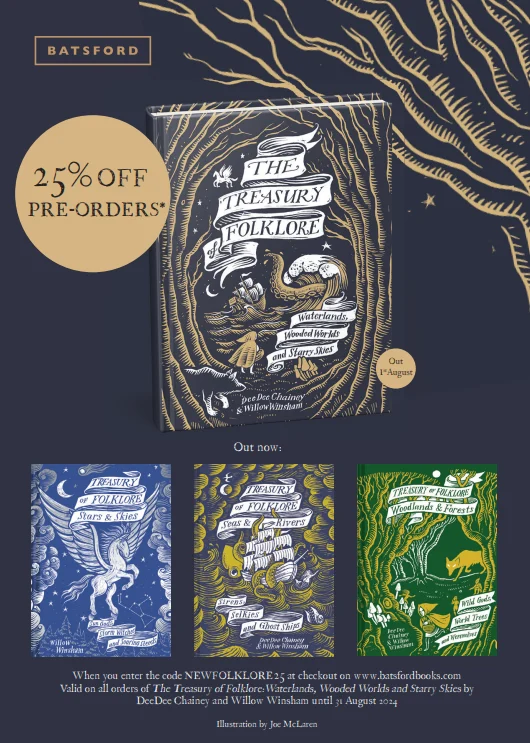
LONDON, UK – [Insert Current Date] – A decade-long journey into the heart of global myth-making culminates this August with the release of The Treasury of Folklore: Waterlands, Wooded Worlds and Starry Skies. This eagerly anticipated volume, available for pre-order now and set for release on August 1st, 2024, brings together the most captivating tales and profound insights from the acclaimed Treasury of Folklore series, fulfilling its authors’ original vision of a single, comprehensive compendium.
Initially conceived as a solitary book encompassing the diverse physical landscapes inhabited by humanity, the sheer volume and richness of unearthed material quickly necessitated a multi-volume approach. The series blossomed into three beloved titles: Seas and Rivers, Trees and Woodlands, and Stars and Skies. Now, publishers and authors alike are thrilled to present a meticulously curated collection that distils the essence of these works into one beautifully bound "hefty tome," designed to be both an invaluable resource and a cherished object.
Main Facts: A Grand Compendium of Shared Heritage
The Treasury of Folklore: Waterlands, Wooded Worlds and Starry Skies is not merely a collection of stories; it is a profound exploration of the universal human experience as reflected in myth and legend. Authors Dee Dee Chainey and Willow Winsham, whose initial inspiration stemmed from the vibrant #FolkloreThursday online community, embarked on a mission to understand how diverse cultures craft customs, beliefs, and narratives around their environments. Their findings, eloquently presented in this new compilation, reveal a striking truth: beneath the surface variations of dress, nomenclature for mythical beasts, and local customs, humanity shares fundamental fears, dreams, and an innate sense of wonder.
This special volume compiles favourite folklore passages directly from the three original books. Readers will rediscover enchanting tales and insightful analyses, presented with the distinctive original illustrations by Joe McLaren. The compilation is thoughtfully structured into three distinct sections, mirroring the environmental themes of the original series and offering a cohesive journey through the world’s mythical landscapes. While the book contains no new material, its unique presentation and consolidated format make it an essential addition for enthusiasts, scholars, and new readers alike. It promises to be a conversation starter, a source of connection, and a testament to the enduring power of storytelling.
Chronology: From Digital Spark to Tangible Treasure
The genesis of the Treasury of Folklore series began nearly a decade ago, ignited by the overwhelming outpouring of global folklore shared through the #FolkloreThursday hashtag. This digital phenomenon underscored a deep, universal yearning for connection through shared narratives and a widespread appreciation for cultural heritage. Inspired by this global dialogue, the authors, Dee Dee Chainey and Willow Winsham, recognized an opportunity to create something meaningful and lasting – a series that would not only document folklore but also illuminate the unifying universality of human experience across the globe.
Their initial ambition was grand: a single, all-encompassing volume that would traverse every type of physical landscape inhabited by humans, from the deepest oceans to the highest stars. However, as they delved into the vast ocean of global folklore, the sheer scale and richness of the material quickly became apparent. What could not be contained within a single binding soon expanded into three distinct and highly popular books: Seas and Rivers, Trees and Woodlands, and Stars and Skies. Each book explored specific geographical or celestial domains, offering readers a deep dive into the myths, legends, and beliefs associated with these powerful natural elements. The series garnered widespread acclaim, surprising and heartwarming the authors with its immense popularity and the enthusiastic reception from readers worldwide.
The idea of a compendium was eventually proposed, offering a compelling opportunity to revisit and finally realize the authors’ initial vision. The publishers recognized the intrinsic value in bringing together the most cherished and representative elements of the series into a singular volume. This undertaking involved a meticulous process of re-reading and curating, approaching familiar words with fresh eyes to select the most impactful and illustrative passages. The goal was to create a cohesive narrative that transcended individual landscapes and highlighted the interwoven tapestry of human myth-making across time and place. The result, a beautifully crafted volume with an appealing size, distinctive cover, and elegant cream paper, is described by its creators as nothing short of "blown away" and "utterly thrilled."

Supporting Data: Unearthing Universal Truths Through Diverse Lore
The Treasury of Folklore series, and now its definitive compilation, stands as a powerful testament to the common threads that bind humanity. The authors’ foundational quest for understanding revealed that despite superficial differences, we all share primal fears and dreams. Whether gazing into the ocean’s vast horizon, dreading the unknown around a campfire, or contemplating eternity under ancient stars, these universal sentiments resonate across cultures and time. The curated extracts in the new compilation beautifully illustrate this shared human condition.
Water Horses: Majestic and Malevolent Guardians of the Depths
Folklore surrounding bodies of water frequently embodies both allure and peril, reflecting humanity’s dual relationship with the unpredictable and life-giving element. The myth of the water horse, present in various forms across cultures, epitomizes this duality. These creatures, often depicted as magnificent yet treacherous, serve as powerful cautionary tales against recklessness and a personification of the dangers lurking beneath calm surfaces.
The Scottish Kelpie is perhaps the most renowned, though distinct from the each-uisge, which inhabits lakes and lochs. Kelpies, found in rivers, lure unwary travellers to a watery grave. Yet, folklore also offers glimpses of their potential, albeit fleeting, taming – a bridle marked with a cross might compel them to work, only for them to vanish or drag their rider back to the depths. The legend’s enduring power is vividly demonstrated by the colossal 30-meter Kelpies sculptures near Falkirk, a modern tribute to an ancient fear, and their appearances in contemporary literature by authors like Lari Don and J.K. Rowling. Intriguingly, such water horses are conspicuously absent from English folklore, highlighting regional specificities even within a broader cultural sphere.
Across the border in Wales, the Ceffyl Dwr filled this folkloric void well into the 19th century. While sometimes a shapeshifting spirit, in the south, it consistently appeared as an enchanting small horse, luring riders to their doom with impossible speed before vanishing. A curious exception granted immunity to clergymen, regardless of creed, allowing them safe passage where others perished – a fascinating intersection of ancient belief and religious reverence.
The Scandinavian Bäckahäst, or ‘brook horse,’ shares similar traits. Often seen in foggy conditions, this luminous, majestic creature beguiles riders, particularly children, before plunging back into the water, trapping its victims. Tales frequently depict children as victims, perhaps amplifying the sense of tragedy. A notable variant tells of boys saved from a Bäckahäst when one accidentally mispronounces a rhyme, uttering "Jesus Christ," a name the creature despises. This narrative, like many, often sees riders survive through wit or divine intervention, reinforcing the narrative’s moral or religious undertones. Like the Kelpie, the Bäckahäst could also be tricked into servitude, demonstrating a universal human desire to control or outsmart forces of nature.
Lords of the Wild: Shapeshifting Guardians of the Verdant Realm
The forest, a place of both sustenance and fear, is universally represented in folklore by powerful spirits and deities. These "Lords of the Wild" embody the untamed essence of nature, dictating the fortunes of those who venture into their domains.

Tapio, the Finnish king of the forest, also known as Metsähine or Hiisi, is depicted as a tall, thin figure with mossy eyebrows, a great beard, and the back of a gnarled tree, a true personification of the woodland itself. He is both protector and embodiment of the forest. Hunters once sought his blessing, pledging respect for the wilderness in return for a plentiful hunt. Tapio’s power extended to all forest creatures, granting success or cursing hunters to return empty-handed. His family, including benevolent wife Mielikki (or wrathful Kuurikki), son Nyrikki (who aids hunters with trail markers), and daughter Tulikki (who guides prey), highlights a complex, anthropomorphic relationship with nature.
The Leshy (or leshii, lyeshy) of Slavic folklore serves as a tutelary spirit, protector of trees and animals, particularly wolves or bears. A shapeshifter, the Leshy can alter its size from a blade of grass to a towering tree, and mimic any forest creature or human. Identifying features in human form include missing eyelashes or brows, shoes worn on the wrong feet, or clothing wrapped in reverse. They possess wild hair, cloven feet, and sometimes wings or a tail. Their terrifying bellows can whip up winds, sending creatures fleeing. Leshies are trickster figures, luring the lost deeper into the woods with shrieking laughter, clapping, or mimicked voices, sometimes tickling victims to death. They are also known to abduct women and children, inflict illness, and curse farms, prompting offerings of bread and tobacco or annual sacrifices to appease them.
Leshies, who may live alone or with their families (leshovikha and children), are not above internal conflict, engaging in club-wielding battles that rip up trees. Tales even recount a Vologda District Leshy frequenting taverns with his wolf pack, consuming vast amounts of vodka before gambling with squirrels. Protection from a Leshy, similar to many fae folk, involves turning clothes inside out or shoes on the wrong feet, which is said to provoke laughter and return the lost to their path. Swearing at them or making the sign of the cross are other methods of banishment. For those daring enough to summon a Leshy, the ritual involves arranging young trees in a circle, standing within it, free of Christian symbols, and calling out to the "grandfather of the forest." These intricate beliefs illustrate a deep cultural engagement with the wild, outlining both the dangers and the means of navigating them.
The Hare in the Moon: Cosmic Explanations and Moral Lessons
The enduring image of a rabbit or hare on the moon, a motif seen in the Sea of Tranquillity representing the rabbit’s head and the Seas of Fertility and Nectar as its ears, transcends numerous cultures, offering explanations for celestial phenomena and imparting moral lessons.
In the Buddhist Sasa-Jātaka, a hare, alongside an otter, jackal, and monkey, resolves to offer alms on a fast day. When the deity Sakka, disguised as an old man, tests them, the other animals offer food, but the hare, having only grass, nobly offers itself to the flames. For this ultimate act of faithfulness, Sakka saves the hare and places its image on the moon for all eternity, sometimes by extracting essence from a mountain to draw its form. This narrative of self-sacrifice is mirrored in other cultures, highlighting a universal appreciation for altruism.
A similar tale from Sri Lanka features a lost Buddha who, being hungry and poor, is offered the hare’s own body as sustenance. When Buddha lights a fire, the hare leaps in, only to be saved by Buddha’s powers and sent to the moon. In Japan, the rabbit, known as Tsuki no Usagi, sacrifices itself for a beggar (the Man in the Moon in disguise), who then takes the selfless creature to live with him on the moon. This popular Japanese tale is often shared with children during the Harvest Moon and Mid-Autumn Festival in September, embedding themes of compassion and generosity within cosmic storytelling.
A starkly contrasting narrative emerges from South Africa, where the hare is cast in a less benevolent light. Here, the flighty creature is responsible for humanity’s mortality. Moon sends Hare to deliver a message: just as the moon "dies" and returns each month, so too would humankind. However, Hare miscommunicates, telling people they would simply die. Enraged, Moon attacks Hare with a hatchet, scarring its lip. In retaliation, Hare lashes out, scarring Moon’s face, explaining the dark shapes visible on the moon today. This tale exemplifies how folklore can not only teach virtue but also explain the harsh realities of existence, often through the mischievous or flawed actions of mythical beings.

Official Responses: Authors’ Joy and a Publisher’s Commitment
The authors, Dee Dee Chainey and Willow Winsham, have expressed profound satisfaction and excitement regarding the release of The Treasury of Folklore: Waterlands, Wooded Worlds and Starry Skies. Their decade-long dedication to exploring global folklore has now culminated in a volume that perfectly encapsulates their original vision.
"When the idea was first suggested to bring out a compendium, we immediately knew that we had to take this opportunity to bring the folklore together as originally envisaged: in one volume," stated the authors. "Much work went on behind the scenes, reading through the words we already knew so well, with fresh eyes, as we worked out what to include and what to leave out, in the best way to bring it all together in one volume that spans our shared landscapes across time and place. To say we have been blown away by the end result is an understatement, and we are utterly thrilled to be able to share this beautifully bound volume with you. We love the size and the cover combining everything and the beautiful cream paper: it is a ‘hefty tome’ indeed."
This sentiment underscores not only their personal fulfillment but also the publisher’s commitment to delivering a high-quality product that honours the intellectual and aesthetic integrity of the original series. The decision to create this compilation reflects a recognition of the enduring demand for accessible, well-researched folklore that resonates with a broad audience. The positive reception of the initial three books demonstrated a clear appetite for stories that connect us to our past and to each other, making the compilation a natural and welcome progression.
Implications: A Legacy of Connection and Cultural Preservation
The release of The Treasury of Folklore: Waterlands, Wooded Worlds and Starry Skies carries significant implications for cultural preservation, interdisciplinary understanding, and the continued relevance of folklore in the modern world. In an increasingly fragmented global society, this compilation serves as a vital reminder of our shared human heritage. By highlighting universal themes of fear, wonder, sacrifice, and the profound connection between humanity and nature, the book fosters empathy and understanding across diverse cultural landscapes.
For scholars, the compendium offers a consolidated and beautifully presented resource, making the rich content of the original series more accessible for research and cross-cultural studies. For the general reader, it functions as a gateway into the fascinating world of folklore, encouraging a deeper appreciation for the stories that have shaped civilizations. Its physical attributes – the "hefty tome," the elegant binding, and the cream paper – elevate it beyond a mere collection of texts, transforming it into a cherished artifact, a collector’s item, and a striking addition to any bookshelf or coffee table. It is designed to spark conversations, inspire curiosity, and encourage further exploration into the vast realms of myth.
Moreover, the success of the Treasury of Folklore series and the creation of this compilation underscore the enduring power of storytelling in the digital age. While the #FolkloreThursday hashtag provided the initial spark, the tangible books have created a lasting legacy, demonstrating that while platforms may evolve, the human need for narrative, meaning, and connection remains constant. This volume is not just a compilation; it is a celebration of human creativity, resilience, and our shared journey through the landscapes of imagination.
The Treasury of Folklore: Waterlands, Wooded Worlds and Starry Skies is available for pre-order now and will be officially released on August 1st, 2024. Readers can secure a 25% discount by ordering directly from Batsford Books using the code NEWFOLKLORE25. This landmark publication invites all to embark on an extraordinary journey through the universal myths that define our world.


Leave a Comment