Unveiling the Enigma: A Deep Dive into Richard Stark’s Parker Novels
A new series of literary reviews kicks off, inviting readers into the stark, uncompromising world of one of crime fiction’s most iconic and brutal protagonists: Parker.
This week marks the beginning of an occasional new series of reviews dedicated to the seminal Parker crime novels, penned by the legendary Donald E. Westlake under his most celebrated pseudonym, Richard Stark. For those already acquainted with Parker, his very name evokes a visceral understanding of his singular place in the annals of hardboiled fiction. For the uninitiated, a rare literary treat awaits—an introduction to a character so compellingly amoral, so ruthlessly efficient, that he redefines the very essence of the anti-hero.
In subsequent installments, we will delve deeper into the specific reasons why Parker commands such respect within this august literary forum. But first, it is imperative to establish a foundational understanding of the character himself, his brilliant creator, and the profound impact he has had on the landscape of crime literature. This initial exploration will serve as a crucial primer, setting the stage for a journey into the dark heart of professional criminality.
The Dawn of a Dark Legend: Introducing Richard Stark’s Parker Series
The Parker series is a monumental achievement in crime fiction, spanning a remarkable period from 1962 to 2008. Over these decades, the prolific novelist Donald E. Westlake, writing as Richard Stark, meticulously crafted 24 novels featuring the master criminal known only as Parker. This body of work stands as a testament to Westlake’s versatility and genius, allowing him to explore the grittier, more nihilistic facets of human nature under the Stark moniker, distinct from his often humorous and intricate caper novels penned under his own name.
From the moment he burst onto the scene in 1962 with The Hunter, Parker solidified his position as an unparalleled force in the genre. He is not merely a character; he is a force of nature, a meticulously designed mechanism of crime and survival whose actions are governed by an unyielding logic of efficiency and self-preservation. The series offers a stark, unvarnished look at the criminal underworld, stripped of romanticism or moralizing, presenting a protagonist whose appeal lies precisely in his unlikability and unwavering competence.
Donald E. Westlake and the Birth of an Anti-Hero
The Architect of Shadows: Donald E. Westlake’s Prolific Career
Donald E. Westlake was a writer of extraordinary range and productivity, a true titan of American letters who seamlessly navigated genres from comedic caper novels to gritty crime thrillers, often publishing multiple books a year under various pseudonyms. While his own name became synonymous with witty, intricate plots and often bumbling protagonists, the name "Richard Stark" was reserved for something entirely different. It was under this nom de plume that Westlake unleashed Parker, a character so devoid of conventional morality and so relentlessly professional that he stands in stark contrast to nearly every other figure in Westlake’s extensive oeuvre.
The decision to use a pseudonym for Parker was a stroke of genius, allowing Westlake to create a distinct literary universe with its own rules and tone. The "Stark" persona was not merely a marketing gimmick; it was a creative liberation, enabling the author to delve into darker psychological territory and explore themes of amorality, retribution, and the mechanics of crime without diluting the expectations associated with his more lighthearted works. This dual identity allowed Westlake to truly master two distinct voices within the crime genre, cementing his legacy as one of its most innovative practitioners.
From Concept to Icon: The Chronological Span of the Series
The Parker saga commenced with The Hunter in 1962 and concluded with Dirty Money in 2008, a remarkable run that saw the character evolve subtly while retaining his core, unyielding nature. Across these 24 novels, Westlake, as Stark, meticulously charted Parker’s relentless pursuit of illicit gains and his brutal enforcement of his own pragmatic code. Each novel is a self-contained narrative, typically revolving around a single heist that inevitably goes awry, forcing Parker to adapt, improvise, and often unleash his terrifying capacity for violence.
The consistency of the character, combined with the ingenuity of the plotting, ensured that Parker remained a compelling figure throughout his long literary life. From the pulpy paperback origins to later, more sophisticated hardcovers, the series captivated readers with its tight prose, intricate planning, and the sheer, unadulterated tension that permeates every page.
Parker’s Genesis: The Hunter (1962) and The Man With the Getaway Face (1963)
The debut novel, The Hunter (also known as Point Blank in its film adaptation), immediately established Parker’s defining characteristics. It introduced readers to a man betrayed by his wife and former associates, embarking on a cold, methodical quest for retribution and his stolen share of a heist. The raw, visceral energy of this first book set the template for the entire series: Parker’s single-minded focus, his capacity for extreme violence, and his unwavering commitment to his own interests.
The second novel, The Man With the Getaway Face (Pocket Books, 1963), further cemented Parker’s legend, showcasing his adaptability and resourcefulness. These early entries were crucial in shaping reader expectations and defining the parameters of the Parker universe. They presented a protagonist who was not just a criminal, but a force of elemental power, driven by an internal logic that, while chilling, was undeniably fascinating.
Anatomy of a Master Criminal: Unpacking Parker’s Persona
A Figure of Granite and Threat: Parker’s Physicality and Psychological Impact
Parker is not merely a man; he is a physical manifestation of menace. His presence is described with a stark economy that speaks volumes: a big man, his face "chiseled out of granite," his hands "large and veiny and dangerous." This isn’t just descriptive flair; it’s fundamental to his character. His physicality is a weapon, an instrument of intimidation and control. The unforgettable anecdote of a low-level crook defending his compliance by stuttering, "But he had big hands, Mal! Big hands!!" perfectly encapsulates the primal fear Parker instills. His presence alone is often enough to bend others to his will, a silent promise of inevitable, overwhelming force. He moves through the world like a predator, assessing, calculating, and always ready to strike.
The Art of the Heist: Parker as a Meticulous Planner and Strategist
At his core, Parker is a master planner for heists. The narrative structure of most Parker novels often begins with a suggestion for a robbery brought to him, which he then meticulously dissects, drawing up the logistical arrangements with an engineer’s precision. His genius lies in his ability to anticipate variables, identify weaknesses, and construct a flawless blueprint for criminal enterprise.
However, even Parker, with all his foresight, cannot account for the inherent flaws of human nature. He assembles a "string" of fellow criminals to execute the job, a crew that ranges from almost as competent as himself to dangerously inept. It is this human element that inevitably introduces complications, leading to a recurring cycle of problems:
- Damage Control Mode: When a crew member "flakes out" or makes an "egregious mistake," Parker’s primary objective shifts to containing the fallout, minimizing losses, and salvaging the operation.
- Escape the Police Mode: Once the job is done, or if it goes disastrously wrong, Parker’s focus turns to evading law enforcement, a task at which he is supremely adept, possessing an uncanny ability to disappear.
- Track Down the Other Guy and Finish Him Off Mode: Perhaps Parker’s most chilling mode, this is activated when betrayal or severe incompetence jeopardizes his share or his life. His retribution is swift, brutal, and utterly without mercy, ensuring that no one ever crosses him twice.
Westlake’s creativity in devising these heist scenarios is remarkable. Parker’s targets are incredibly diverse, ranging from an armored car to a football game, a rare coin show to an Air Force base. In one particularly audacious exploit, he and his cohorts managed to rob an entire town simultaneously. This variety keeps the series fresh and showcases Westlake’s endless ingenuity in crafting believable, high-stakes criminal undertakings.
Beyond Morality: The Professional Ethos
One of the most defining and often misunderstood aspects of Parker is his complete lack of a conventional moral compass. He is a "consummate professional," and his actions are dictated solely by the requirements of the job. He is capable of extreme violence, even deadly force, but only when "the situation requires it." He never engages in violence for its own sake, but rather as a tool, a necessary means to an end. As the article points out, "He does as little, or as much, as necessary in any given situation."
This pragmatic approach to violence is crucial. Parker has "no ‘code,’" contrary to popular cinematic portrayals that often attempt to imbue criminal protagonists with a sense of honor or a moral boundary. If he spares an enemy, it’s not due to a sudden pang of conscience, but because "he knows of a good reason why killing someone wouldn’t be the best course of action at that moment." More often than not, that reason is purely logistical: "killing someone will bring more heat from the cops, as opposed to just tying someone up and stuffing them in a closet."
This absence of conventional morality presents a fascinating paradox for the reader. Parker is undeniably a "scary criminal," yet the individuals he clashes with are almost invariably "much worse." They are often petty, cruel, treacherous, or utterly incompetent, making Parker’s cold efficiency seem almost righteous by comparison. This dynamic leads to the provocative observation: "We root for Parker the way we might root for a shark to eat Hitler." It’s a paradoxical identification, a primal urge to see the efficient, dangerous force prevail over greater evils, even if that force is itself morally neutral.
The Unforgettable Ensemble: Parker’s World of Colorful Characters
A Glacier Among Volcanoes: Parker’s Stark Contrasts
Perhaps because Parker himself is so utterly mechanical and emotionally monochromatic, Westlake brilliantly surrounds him in each novel with a broad and vibrant cast of allies, enemies, bystanders, and general "weirdos." This dynamic creates a captivating narrative tension. Parker, a glacier in human form, must interact with these fiery, unpredictable personalities. "Great fun is had in watching Parker attempt to interact with each of them."
The "shark metaphor" is again particularly apt here. Engaging with Parker is often likened to "trying to have a conversation with Jaws." He has no interest in idle chatter, social pleasantries, or emotional bonding. His interactions are purely transactional, driven by his current objective. He is perpetually "busy deciding if your business is worth robbing, or perhaps if you should continue to live." This terrifying simplicity is what makes him so enthralling. He is not a likeable person, not someone one would ever wish to meet in a dark alley, but as a literary creation, he is "an absolutely enthralling character."

Parker’s Element: The Power of Action
Parker, like many great fictional figures, truly comes alive when he is in his element. The article draws a compelling parallel to Captain Jack Aubrey in Patrick O’Brian’s Master and Commander series. Both characters, when "idle," are "generally unsuccessful and unhappy." They are restless, prone to missteps, and ill at ease in the mundane world.
But when Parker is "in action," when he is planning, executing, or escaping a heist, he transforms. He is "in a class by himself; a force of nature." His focus is absolute, his decisions razor-sharp, and his movements precise. In these moments of high-stakes activity, he becomes irresistible, a spectacle of efficiency and brutal competence from which "you can’t look away." This intrinsic link between action and Parker’s true self is a key to his enduring appeal.
The Author’s Insight: Westlake on Parker’s Enduring Appeal
A Surprising Success: Westlake’s Initial Astonishment
Donald E. Westlake himself expressed considerable surprise at the initial popularity of Parker. In an interview with the University of Chicago Press, he recounted his bewilderment: "I was at first very surprised. He was the bad guy in the book. More than that, I’d done nothing to make him easy for the reader; no smalltalk, no quirks, no pets." This candid admission highlights Westlake’s deliberate crafting of an unsympathetic protagonist, a challenge to conventional narrative tropes.
The Uncompromising Vision: Maintaining Parker’s Starkness
Despite his surprise, Westlake quickly understood the unique appeal of his creation. He recognized that Parker’s power lay precisely in his uncompromising nature. "I told myself the only way I could (continue to write about him) is if I held onto what (the editor) seemed to like, the very fact that he was a compendium of what your lead character should not be." This became his guiding principle: "I must never soften him, never make him user-friendly, and I’ve tried to hold to that." This commitment to Parker’s core identity, resisting any temptation to humanize or redeem him, is a cornerstone of the series’ lasting power and critical acclaim. It ensured that Parker remained a distinct and unforgettable figure in a genre often populated by flawed but ultimately relatable heroes.
The Workman’s Goal: Parker as a Dedicated Professional
Westlake further illuminated Parker’s essence by describing him as "basically a workman, with the professional workman’s goal of getting the job done ably, efficiently, and without interruption." This simple yet profound statement captures the driving force behind all of Parker’s actions. He is not motivated by grand ideological goals, personal vendettas (unless directly tied to his money or survival), or a desire for fame. His motivation is purely professional: to execute the job, secure the score, and move on. This almost industrial approach to crime is what makes him so unique and, in a strange way, admirable within his own grim context.
A Literary Legacy Preserved: The University of Chicago Press Intervention
The Elusive Volumes: Historical Challenges in Acquisition
For many years, the Parker novels existed in a fragmented state, published by a multitude of different outfits over the decades. This publishing history, while a testament to their initial popularity, also made it "next-to-impossible" for new readers or dedicated collectors to acquire a complete set. Many of the books went "long out of print," relegated to the dusty shelves of antique bookstores and the exorbitant prices of rare book dealers. The pursuit of a full collection became a minor heist in itself, a challenge worthy of Parker’s own meticulous planning.
A Heist of Another Kind: The University of Chicago Press to the Rescue
Thankfully, this literary scarcity was addressed in 2008 when the University of Chicago Press stepped in, securing the rights to the "entire series (plus the related Alan Grofield novels)." This move by an academic press to champion a series of hardboiled crime novels was a significant endorsement of their literary merit and cultural importance. It signaled a recognition that these books were not just genre fiction, but works of enduring quality worthy of preservation and scholarly attention.
Renewed Accessibility: A Golden Age for Parker Fans
The intervention of the University of Chicago Press ushered in a golden age for Parker enthusiasts. They issued "new editions in paperback and on Kindle and Audible," making every single volume readily available to a global audience. No longer do aspiring readers have "to plan elaborate heists of antique and rare bookshops to get our fix of Parker."
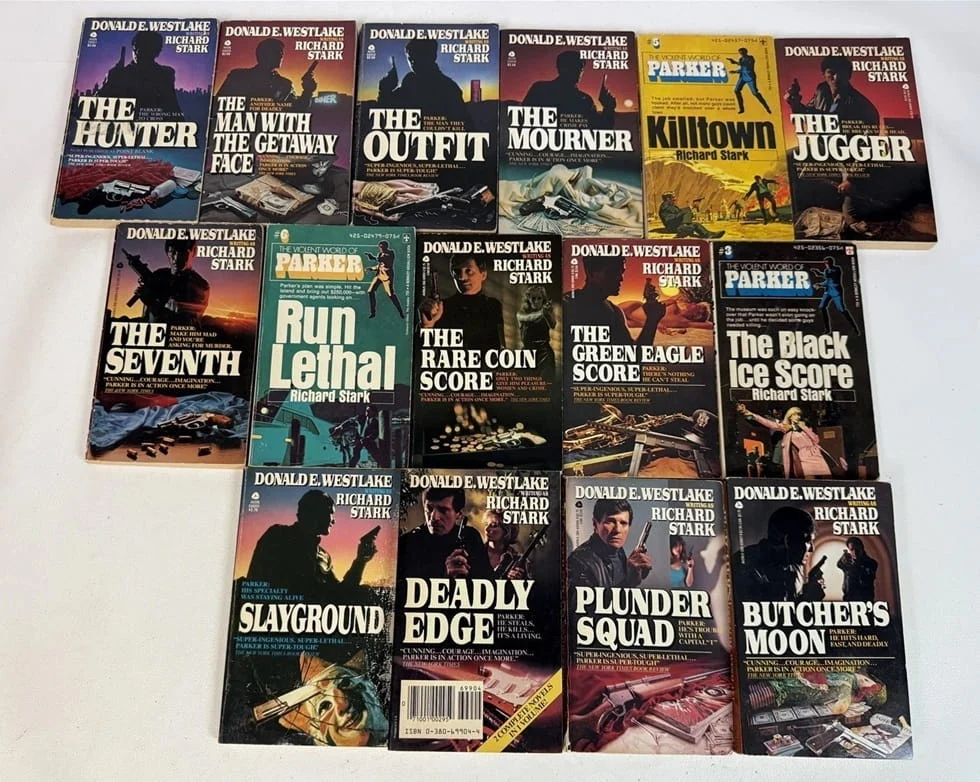
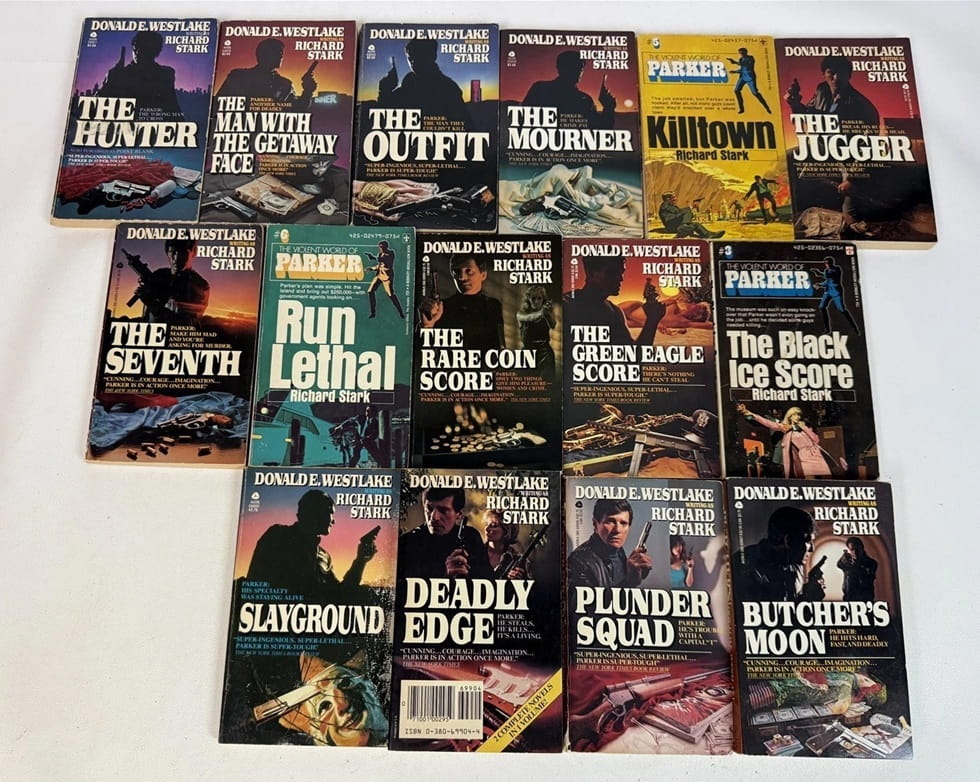
The image depicting "All 16 original series Parker novels, from University of Chicago Press" is a powerful visual reminder of this accessibility. We now live in a world where "you can easily acquire any or every book in the series easily." This ease of access is, as the article aptly concludes, "like an easy score for Parker and his cohorts, that’s too good an opportunity to pass up." It ensures that this seminal body of work will continue to captivate and challenge generations of readers.
Parker Beyond the Page: Adaptations and Analogies
Darwyn Cooke’s Masterful Visuals: Capturing the Essence
While Hollywood has largely struggled to adapt Parker faithfully, the late, great writer and artist Darwyn Cooke achieved a remarkable feat with his graphic novel adaptations of several Parker novels. Cooke, a master of noir aesthetics and dynamic storytelling, deeply understood the character. As he put it, "I love the notion of Parker. This guy who is smart enough to have this life set up in Miami and he just ventures out three or four times a year to do his thing. And then he comes back quietly, to live his life. Outside of all the stuff that everybody else has to deal with."
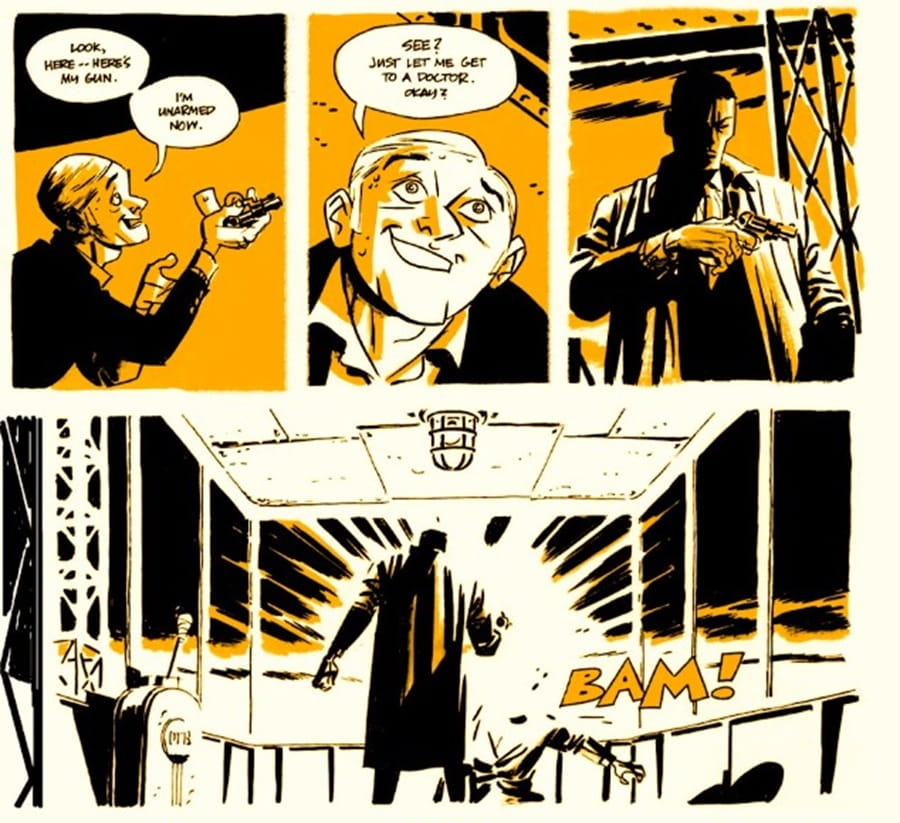
Cooke’s adaptations captured the brutal efficiency, the starkness, and the underlying logic of Parker’s world in a way that live-action films often could not. The graphic novel format allowed for a direct translation of Stark’s lean prose into equally lean, impactful visuals, preserving the character’s essential, unyielding nature without requiring a cinematic softening or moralization. His work stands as a testament to the fact that Parker can be successfully translated to another medium, provided the adapter truly grasps the core of the character.
Hollywood’s Conundrum: The Struggle to Translate Parker
The stark reality is that "Hollywood has never been able to make sense of it." Numerous attempts have been made to bring Parker to the silver screen, resulting in films like Point Blank (1967) and Payback (1999), among others. While some of these adaptations have achieved cult status or critical praise on their own terms, they invariably struggle with the fundamental essence of Parker.
The primary challenge lies in Parker’s amorality and his lack of a conventional "code." Mainstream cinema, particularly Hollywood, often feels compelled to imbue its protagonists, even anti-heroes, with some redeemable quality, a moral arc, or at least a justifiable motivation beyond pure self-interest. Parker resists this. He is not seeking redemption; he is seeking his money. He is not a reluctant hero; he is a ruthless professional. This inherent contradiction—an "absolutely enthralling character" who is "not a likeable person at all"—is difficult for the commercial imperatives of filmmaking to digest without fundamentally altering the character. Attempts to soften him, give him a love interest that humanizes him, or provide a sympathetic backstory inevitably dilute the very qualities that make him unique and compelling on the page.
"Parker the Barbarian!": A Comparative Analysis
The tantalizing hint of "Parker the Barbarian!" in the original article opens a fascinating avenue for comparative literary analysis. The comparison between Parker and a "sullen-eyed Cimmerian" like Conan the Barbarian might seem incongruous at first glance—one a sophisticated criminal mastermind, the other a sword-wielding warrior from a mythical age. Yet, beneath the surface, profound parallels emerge, highlighting the archetypal nature of Parker’s character.
Both Parker and Conan are, in their respective worlds, forces of nature. They operate outside the conventional moral and legal strictures of society, driven by a primal, pragmatic code of survival and self-interest. Conan lives by the strength of his sword and his wits, seeking treasure and power in a brutal, fantastical realm. Parker lives by the meticulous planning of his heists and the cold efficiency of his violence, navigating the equally brutal, albeit more mundane, underworld of modern crime.
Both characters share a profound aversion to idleness. As noted for Parker, "when he’s idle, he’s generally unsuccessful and unhappy." The same could be said for Conan. When not engaged in adventure, combat, or conquest, both become restless, prone to melancholy, and often find themselves in situations that breed trouble rather than prosperity. Their true nature, their mastery, manifests only when they are actively engaged in their chosen "work"—be it orchestrating a complex robbery or cleaving foes in battle.
Furthermore, both are supreme professionals in their chosen domains. Conan is an unparalleled warrior, capable of outthinking and outfighting any foe. Parker is an unparalleled criminal, capable of out-planning and outmaneuvering any obstacle, human or systemic. They are both masters of adaptation and survival, capable of responding to unexpected challenges with brutal effectiveness. Neither character seeks external validation or adheres to a societal "code" beyond what serves their immediate needs. Their ethics are internal, self-serving, and utterly pragmatic. They embody a raw, unvarnished form of individualism, making them compelling figures in their respective genres, admired not for their virtue, but for their sheer, undeniable competence and indomitable will. This "barbarian" quality—untamed, unsentimental, and utterly self-reliant—is a key to understanding Parker’s enduring, if unsettling, appeal.
Conclusion: The Undeniable Pull of the Professional Criminal
Richard Stark’s Parker novels are more than just crime fiction; they are a profound exploration of human nature at its most pragmatic and ruthless. Donald E. Westlake’s masterful creation stands as a singular achievement in the genre, a character so consistent, so uncompromising, and so utterly compelling that he transcends the page. He is the ultimate professional criminal, a man who lives by his own stark rules, navigating a world of betrayal and violence with cold, calculated precision.
The series’ enduring relevance lies in its unflinching portrayal of criminality, its intricate plotting, and the magnetic pull of a protagonist who is both terrifying and perversely admirable. Thanks to the dedicated efforts of the University of Chicago Press, these essential works are now readily accessible to a new generation of readers and cherished by long-time fans. To delve into the world of Parker is to confront the darker aspects of ambition and survival, to witness a force of nature in action, and to understand why, despite his amorality, Parker remains an absolutely enthralling character. It is an opportunity that no admirer of crime fiction should pass up.
Van Allen Plexico is a multi-award-winning author, member of the SFWA, and a Pulp Grandmaster. Among his many novels are the Harper & Salsa crime series, set in the Sixties and carrying something of the flavor of the Parker books, beginning with the 2018 Pulp Factory Award-Winning Best Novel of the Year, VEGAS HEIST. See all of his work at www.plexico.net.