William N. Copley’s Provocative "X-Rated" Series Takes Center Stage at Galerie Max Hetzler
Berlin, Germany – [Insert Date] – Galerie Max Hetzler is proud to present X-Rated (1972-1974), a significant solo exhibition dedicated to the groundbreaking paintings and works on paper by the late American artist William N. Copley. This marks the fourth presentation of Copley’s oeuvre at the esteemed Berlin gallery, offering an in-depth exploration of a pivotal period in his artistic development. The exhibition, which opened on [Insert Opening Date] and will run through April 22, 2026, shines a spotlight on Copley’s daring engagement with eroticism, sexuality, and the boundaries of artistic expression, challenging conventional norms with a signature blend of bold imagery, playful humor, and conceptual depth.
Copley’s artistic journey was as unconventional as his subject matter. Possessing an initial ambition to be a writer, his path to becoming a painter was shaped by a unique confluence of intellectual curiosity and fortuitous encounters. In the late 1940s, he co-founded and managed Copley Galleries in Beverly Hills alongside his brother-in-law, artist John Ployardt. This venture, dedicated to showcasing Surrealist art, provided Copley with intimate exposure to luminaries of the movement, including Man Ray, Max Ernst, and Marcel Duchamp. The influential dealer Alexander Iolas also played a crucial role, recognizing Copley’s burgeoning artistic potential and actively encouraging him to pursue his own creative practice. It was around the time of the gallery’s closure that Copley adopted the now-iconic moniker CPLY, debuting his first solo exhibition at a Los Angeles bookstore in 1951, shortly before relocating to France, a move that would profoundly influence his artistic trajectory.
Though a generation younger than the leading Surrealists, Copley’s work is deeply imbued with the movement’s conceptual and personal ethos. His distinctive style, characterized by bold black outlines and a self-taught figurative approach, draws parallels to the aesthetics of comic strips and Pop Art. However, Copley approached the canvas with a distinctly literary sensibility. He employed narrative strategies that not only embodied Surrealist principles but also served as a driving force behind the structural evolution of his compositions. Like many Surrealists, Copley recognized humor, psychology, and eroticism as fundamental elements of the creative process. Yet, his exploration of overtly sexual themes transcended the more playful eroticism often found in the work of his peers, delving into a more direct and provocative territory.
The Genesis of "X-Rated": A Bold Exploration of Eroticism
The exhibition at Galerie Max Hetzler centers on Copley’s prolific "X-Rated" series, created between 1972 and 1975. This potent body of work first garnered public attention in 1974 with an eponymous exhibition at the New York Cultural Center. The genesis of the "X-Rated" series lay in Copley’s deliberate engagement with erotic imagery and ritualized motifs culled from adult magazines. His stated intention was to "break through the barrier of pornography into the area of joy." This ambition was particularly striking in a decade when the sale of hardcore pornography remained illegal in the United States. Copley, however, navigated this restrictive landscape by procuring "adult magazines" discreetly, utilizing them as a fertile source for inventive figurative and narrative paintings that probed the complexities of eroticism, sexual politics, and the uninhibited pursuit of pleasure.
The "X-Rated" paintings demonstrate Copley’s remarkable ability to convey a diverse range of emotional tones. Works such as The Seven Year Itch (1973) exude a tender sensibility, while pieces like Viridiana (1973) burst with an exuberant energy. Across the series, an overt and often disarming humor prevails. Copley’s own perspective on the boundless nature of sexual expression is encapsulated in his assertion: "That’s what makes sex so much fun: since nobody really understands it, the possibilities for originality are endless." This sentiment underpins the liberating and experimental spirit that permeates the "X-Rated" collection.
The Creative Process: From Sketch to Canvas
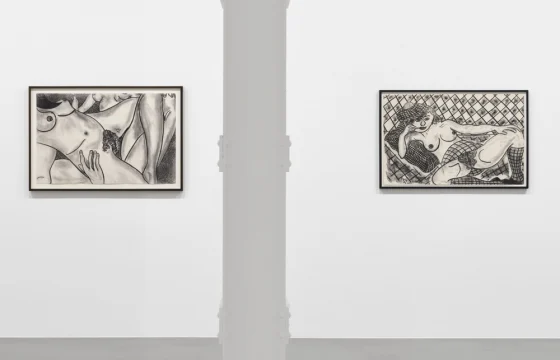
Copley’s meticulous approach to his craft is evident in his typical preparatory process, which involved two distinct stages of drawing before embarking on a painting. The initial phase consisted of small-scale studies, serving as conceptual springboards. These were followed by larger, more refined versions where Copley meticulously honed the composition, introduced significant alterations, and amplified the work’s pictorial dynamism. The resulting paintings often retain a deliberately "slapdash" style, with figures rendered with a loose, gestural quality rather than with precise, academic detail. The exhibition at Galerie Max Hetzler thoughtfully illuminates this developmental trajectory by presenting compelling pairings of preparatory drawings alongside their completed painted counterparts. A prime example of this is the juxtaposition of Calcutta (1973) and its accompanying study, Untitled (1973), offering viewers an intimate glimpse into Copley’s creative evolution.
Visual Language and Critical Reception: A Dialogue with Art History
The visual language employed in the "X-Rated" series is striking. Scenes depicting copulations and orgies are set against vibrant, intensely colored backgrounds animated by bold, geometric patterns. This deliberate artistic treatment led critic James R. Mellow to observe that the works were "too artful to be libidinous, let alone lascivious." The distinctive treatment of these backgrounds, coupled with the contorted, entwined bodies characterized by attenuated limbs and schematic outlines, has prompted art historians to draw connections between Copley and the aesthetic sensibilities of Henri Matisse on multiple occasions.
However, Copley’s approach to the human form and its sexual expression diverged significantly from traditional art historical precedents. While depictions of the nude and sexual imagery throughout art history have often relied on suggestion, idealization, and a degree of reticence, Copley presented the sexual act with an unblinking directness, leaving little to the viewer’s imagination. This radical transparency was a hallmark of his artistic philosophy.
Cinematic Echoes and Cultural Commentary
Adding another layer of conceptual complexity to the "X-Rated" series is Copley’s practice of borrowing titles from iconic Hollywood films. Titles such as Les Quatre Cent Coups (The 400 Blows), The Exorcist, and Tobacco Road infuse the explicit imagery with a playful, pop-cultural sensibility. While the cinematic narratives rarely align explicitly with the visual content of the paintings, these borrowed titles act as potent triggers for a cascade of associations in the viewer’s mind, creating a rich interplay between the visual and the conceptual.
The very title of the series, "X-Rated," draws directly from the film industry’s classification system. Until the 1990s, the "X-rated" designation in the United States was reserved for films deemed suitable only for adults. This choice of nomenclature was not merely a stylistic flourish but a deliberate statement about the mature and potentially provocative nature of the content. Despite the cautionary notices accompanying the 1974 exhibition at the New York Cultural Center, which warned that some visitors might find the subject matter offensive, the show, curated by the progressive director Mario Amaya, garnered a notably positive critical response. Peter Schjeldahl, writing for Art in America, hailed the presentation as a "uniformly gorgeous exhibition" and a "highly satisfying development in Copley’s work."
A Subversive Legacy in the Modern Era
The "X-Rated" series stands as a singular and often deliberately anachronistic chapter within William N. Copley’s extensive oeuvre, consciously diverging from the prevailing artistic currents of the early 1970s. Even within today’s seemingly uncensored and image-saturated global landscape, Copley’s suggestive canvases retain a potent subversive charge. By masterfully merging the realms of fine art and eroticism, Copley fundamentally challenged conservative societal norms and rejected the notion of artistic neutrality. He consciously dismantled moralistic constraints, championing instead a philosophy of directness, uninhibited expression, and a profound embrace of humor. Galerie Max Hetzler’s exhibition offers a vital opportunity to re-examine this pivotal period in Copley’s career and to appreciate the enduring power of his provocative vision.