
The Architecture of Memory: Christian Quintin and the Evolution of Romantic Surrealism
By [Journalist Name/Editorial Staff]
In an era of contemporary art often defined by rapid-fire digital consumption, heavy irony, and conceptual abstraction, the work of Christian Quintin stands as a quiet, defiant monument to the enduring power of beauty and technical mastery. Born in the mist-shrouded coastal regions of Brittany and currently residing in the sun-drenched valleys of Northern California, Quintin has spent over four decades developing a visual language that bridges the gap between the external natural world and the internal landscapes of the human psyche.
Quintin does not merely paint what he sees; he paints the resonance of memory. His images—ranging from meticulously crosshatched ink drawings to luminous oil landscapes—arrive with the haunting familiarity of déjà vu. In his world, a tree is rarely just a botanical specimen; it is a dancer, a lover, or a sentinel of the subconscious. His body of work, which defies easy categorization, suggests a "visual philosophy" that seeks to reconnect modern consciousness with the symbolic language of the soul.

Main Facts: A Dual Heritage of Spirit and Form
Christian Quintin’s artistic identity is defined by a synthesis of two distinct geographical and cultural poles: the Romantic melancholy of Northern France and the vibrant, "sacred ecology" of the American West. This dual heritage has allowed him to develop a style that combines the rigorous discipline of classical French training with the expansive, visionary spirit of California art.
Key to understanding Quintin’s work is his rejection of art as a didactic tool. Unlike many of his contemporaries who use the canvas for political slogans or social manifestos, Quintin offers an invitation to "read poetry" through imagery. His practice is characterized by:
- Technical Precision: A mastery of diverse mediums, including pen and ink, oil, graphite, and pastel.
- Meticulous Craftsmanship: Some of his complex surrealist compositions take upwards of six to seven months to complete, utilizing intricate crosshatching and layering.
- Symbolic Language: A recurring vocabulary of mythic islands, anthropomorphic trees, and "kaleidoscopic consciousness" where human faces dissolve into ecosystems.
Chronology: From the Shores of Saint Brieuc to the Global Stage
To understand the depth of Quintin’s vision, one must trace the geographic and educational milestones that shaped his hand and mind.

1957–1974: The Formative Mists of Brittany
Born in 1957 in Saint Brieuc, a port town on the northern coast of Brittany, Quintin’s earliest influences were the rugged cliffs, ruined castles, and storm-lashed landscapes of his homeland. A pivotal location in his personal mythology is L’Île de la Comtesse, an island that served as a childhood sanctuary. Its storybook aura and solitary architecture would later reappear as recurring motifs in his mature work, representing a psychic "point of return."
1975–1980: The Discipline of Paris
In 1975, Quintin moved to Paris to study at the prestigious Beaux Arts Academy. This period was essential for grounding his romantic instincts in classical discipline. Under the tutelage of master ateliers, he perfected his draftsmanship and gained a deep understanding of materials. While he absorbed the legacy of French Surrealism and Symbolism, he eschewed the movement’s typical desire to "shock," opting instead to "reveal" the hidden dimensions of reality through precision.
1981–1998: The California Integration
The most significant turning point in Quintin’s life occurred in 1981 when he relocated to Northern California. Settling in the vineyards and rolling hills of Sonoma County, he found a landscape that resonated with his internal state. He began to fuse the old-world myths of Brittany with the "eruption of life" found in the American West. During these decades, he established himself as a prominent figure in the regional art scene, completing public commissions for hospital lobbies and city murals while winning prestigious honors like the Grumbacher Award (1987).

1999–Present: International Recognition and the Visionary Continuum
In 1999, Quintin’s career reached a new plateau when he began showing with the Vorpal Gallery, the institution famous for introducing M.C. Escher to the United States. This association solidified his place in a lineage of artists who combine mathematical-like precision with mind-bending surrealism. By the 2020s, under the representation of Lorin Gallery (Los Angeles/Paris), his work entered the global market, appearing at major international fairs such as KIAF in Seoul and Art Central in Hong Kong.
Supporting Data: Mediums, Methods, and Milestones
Quintin’s output is notable for its labor-intensive nature, which acts as a form of meditative resistance against the "speed" of modern life.
The Surrealist Laboratory
In works like The Aviary, Quintin explores what he calls "kaleidoscopic consciousness." In this piece, the artist’s face emerges from a crystal, his neck transforms into a tree trunk, and his hair becomes a leafy canopy. Such works are not accidents of "automatic writing" (a common surrealist technique) but are built with intense intent. His work La Porte Ouverte, inspired by the Sufi poet Rumi, required seven months of dedicated ink work to achieve its depth of symbolism.

The Landscape as "Emotional Terrain"
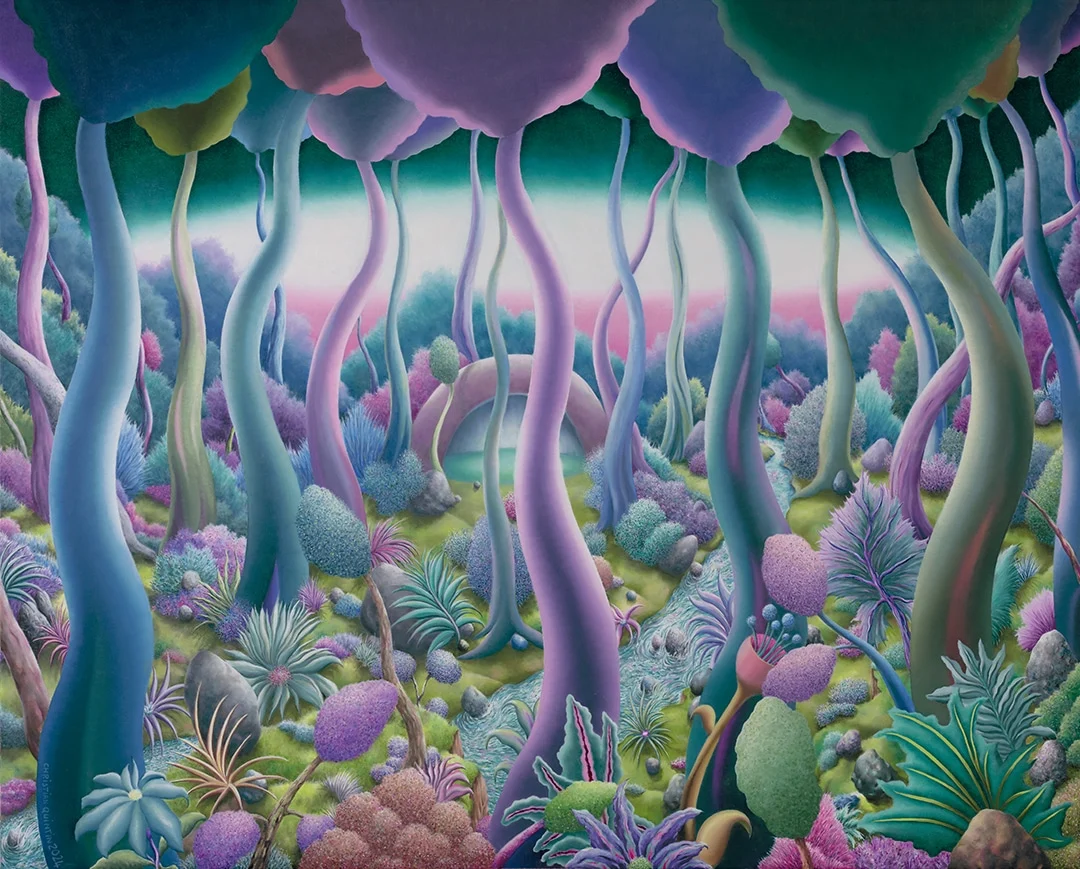
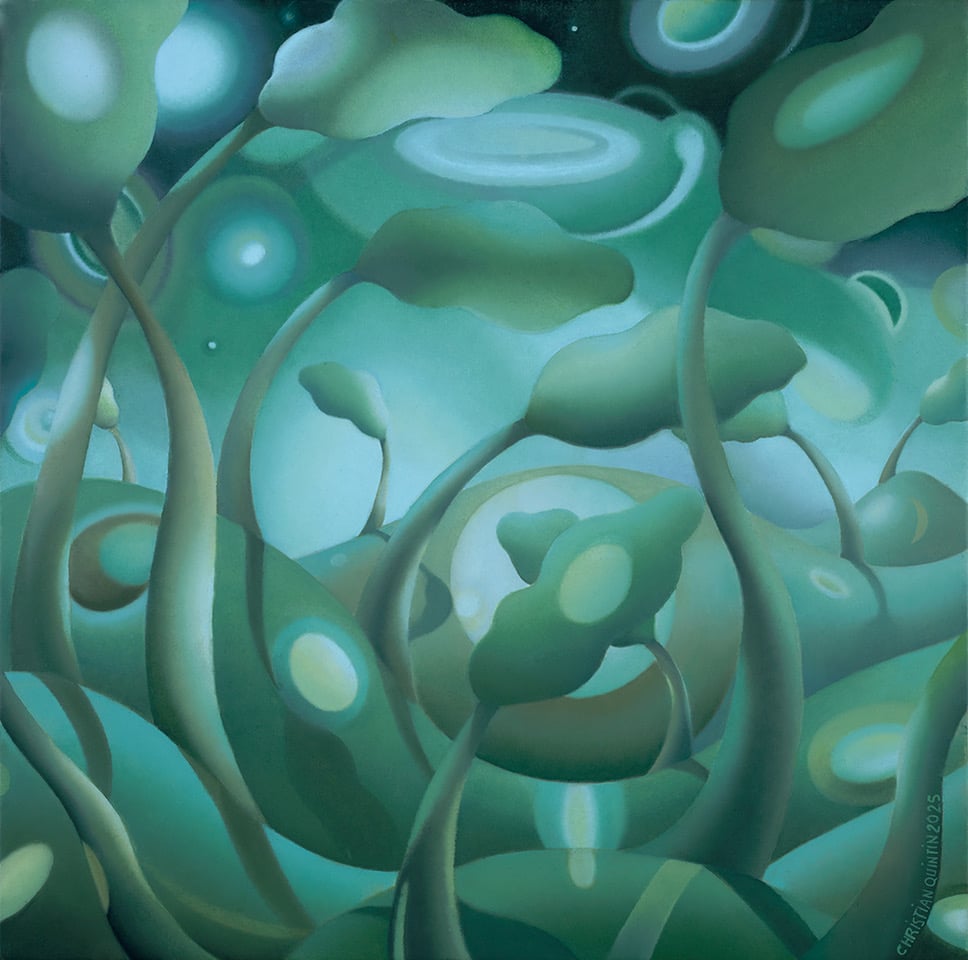
Parallel to his surrealist works are his "luminous landscapes." These are not documentations of specific places but "emotional terrains" rendered in oil or pastel.
- Color Theory: In A Lake Color of Emeralds, Quintin utilizes a palette where the sky is brown-orange and the sea is olive green, using color as a direct conduit for mood rather than literal representation.
- Anthropomorphism: In Leaves of Absence and Les Amants, trees are imbued with human movement—swaying like dancers or embracing like lovers.
Exhibition and Award History
- Major Representation: Lorin Gallery (LA/Paris), Morrison Gallery (Connecticut), Calabi Gallery (California).
- Key Awards: Grumbacher Award (1987); Award of Excellence, California State Fair (1990).
- International Presence: Solo and group exhibitions in Paris, New York, Seoul, Hong Kong, and Los Angeles.
Official Responses: Critical Acclaim and the "Beauty" Diagnosis
The critical reception of Quintin’s work often centers on a single, controversial word in the modern art world: beauty. In an era where "beauty" was often dismissed as superficial or sentimental, critics have rediscovered it in Quintin’s work as a profound necessity.
Alhia Warren described his portfolio as a "beautiful intimate mystery," noting the way his technical skill draws the viewer into a private, meditative space. Dan Taylor, writing for the Press Democrat, highlighted the "emerging beauty" of his Sonoma-inspired works, noting how they capture the spirit of the region without falling into the trap of traditional "wine country" kitsch.

A particularly poignant 2022 review from Calabi Gallery stated: "In an era largely devoid of it, his work is beautiful. We could all use more beauty in our lives." This sentiment reflects a growing trend in art criticism that views Quintin’s work not as an escape from reality, but as a "wondrous sanctuary for the soul." By providing a space for intuition and wonder, Quintin’s work acts as a psychological counterweight to the cynicism often found in contemporary galleries.
Implications: The Legacy of the Visionary Bridge
The significance of Christian Quintin’s career extends beyond his individual canvases; it represents a bridge between several disparate traditions.
1. The Surrealist Evolution
While Quintin belongs to the tradition of Dalí, Magritte, and Escher, he represents a "kinder" surrealism. He moves away from the Freudian nightmares and shocking juxtapositions of the early 20th century, moving instead toward a "Sacred Geometry" of thought. He proves that surrealism can be used to harmonize the human experience rather than just disrupt it.

2. The Visionary Art Movement
Living in Northern California, Quintin is often grouped with the "Visionary Art" movement—the heirs to the 1960s psychedelic spiritualists. However, Quintin brings a European classical rigor to this movement. Where visionary art can sometimes be chaotic or overly bright, Quintin’s work is muted, structured, and "slower," offering a more contemplative entry point into the "invisible" world.
3. Beauty as Resistance
Perhaps the most significant implication of Quintin’s work is his assertion that beauty is a form of defiance. In a culture of spectacle and instant gratification, his six-month-long projects and intricate ink-strokes are a testament to the value of "slowness." His work suggests that the role of the artist is to remind the viewer of their own capacity for wonder—a function of art that remains vital even as the mediums of art continue to change.
Conclusion
As Christian Quintin continues to exhibit globally, his work remains anchored in the simple philosophy that "intuition comes first, technique follows." By refusing to provide a "message" or a "slogan," he allows his art to function as a mirror for the viewer’s own memories and emotions. Whether he is painting a storm over the Brittany coast or a floating face in the clouds of Sonoma County, Quintin continues to map the "hidden dimensions" of our world, proving that the most profound landscapes are the ones we carry within us.
For those seeking to experience his work, Quintin is currently represented by Lorin Gallery, with upcoming exhibitions planned at the Morrison Gallery in Kent, Connecticut. His enduring legacy is one of craftsmanship, patience, and an unwavering belief in the sanctuary of the image.


Leave a Comment