The Architecture of Desperation: Anna Mantzaris and the Unfiltered Humanity of ‘PLEASE’
In the delicate, tactile world of stop-motion animation, where every frame is a testament to patience and every movement is a labor of manual precision, Swedish director Anna Mantzaris has carved out a niche that is as uncomfortable as it is endearing. Her latest work, a short film titled PLEASE, serves as a visceral exploration of the lengths to which human beings will go to secure affection, validation, and a sense of belonging. Through her signature felted characters, Mantzaris navigates the treacherous waters of social awkwardness and emotional nudity, offering a mirror to the "ugly" feelings we usually reserve for the privacy of our own minds.
Main Facts: A Symphony of Neediness and Wool
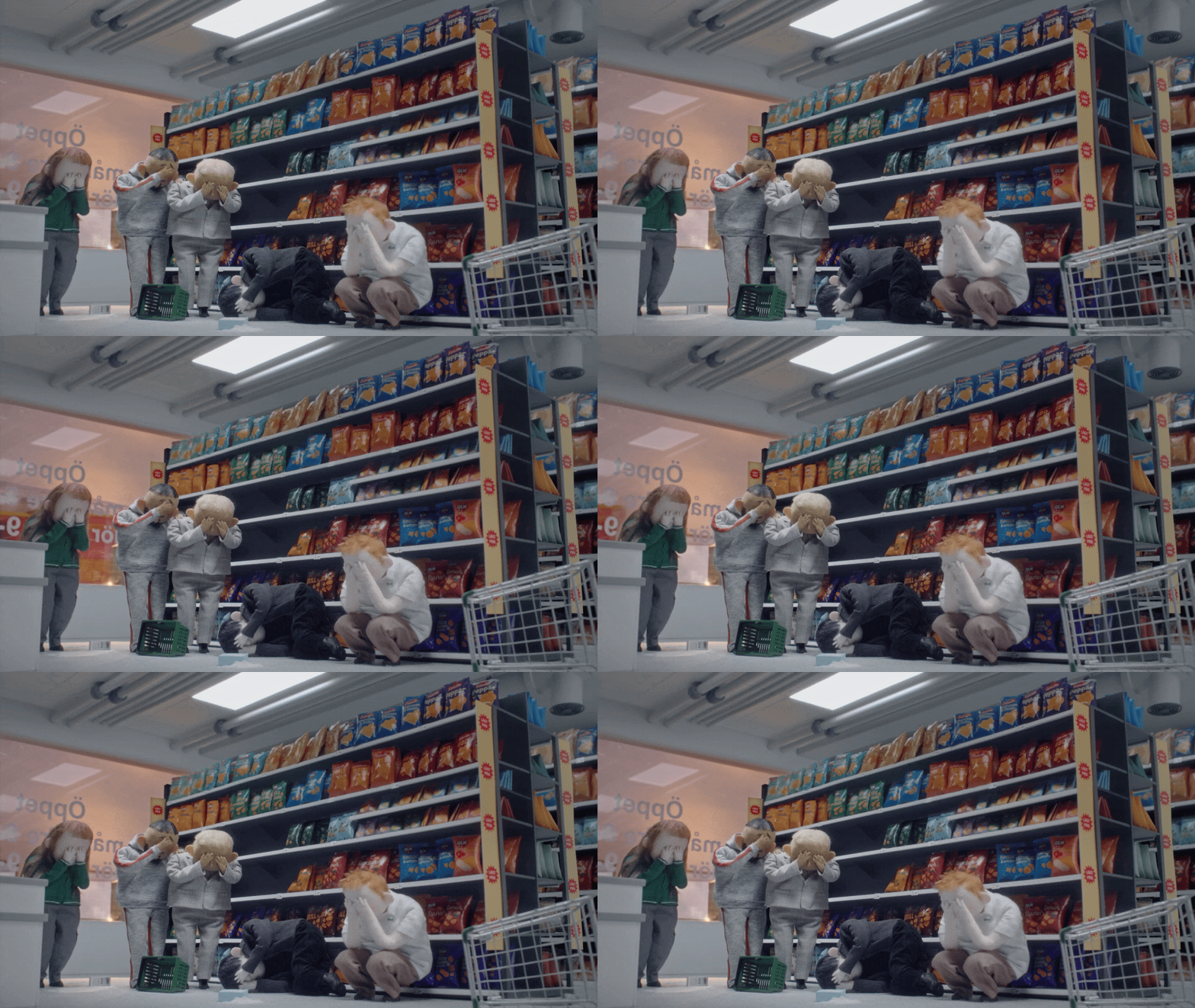
PLEASE is not merely a film about love; it is a film about the hunger for love. Presented through a series of loosely connected vignettes, the short plunges into the "pitiful and cringy" aspects of the human experience. Mantzaris’s puppets—soft, rounded, and perpetually looking a bit worse for wear—engage in acts of increasingly unhinged desperation. Whether it is lighting fires to force a marriage proposal, sobbing uncontrollably in a grocery store’s snack aisle, or clinging to a stranger’s puppy on a train platform, the characters embody a raw, unfiltered neediness that is rarely depicted with such blunt honesty in mainstream cinema.
The film has garnered significant attention not only for its thematic depth but also for its high-profile collaboration. Joining the cast is the esteemed Swedish actor Stellan Skarsgård, fresh off an Oscar nomination for his role in Sentimental Value. Skarsgård lends his voice to a character named Winston, bringing a layer of gravitas to the whimsical yet dark world Mantzaris has constructed.
The aesthetic remains true to Mantzaris’s established style: soft-sculpture puppets made of felt and wool, set against minimalist, slightly melancholic backdrops. This contrast—the softness of the material versus the hardness of the emotional reality—is the engine that drives the film’s impact. Currently, PLEASE is navigating the international film festival circuit, with a wider digital release anticipated in the coming months.
Chronology: From Pandemic Isolation to Festival Acclaim
The genesis of PLEASE can be traced back to the early days of the COVID-19 pandemic, a period that fundamentally altered the global collective psyche. As the director revealed in recent interviews, the concept was born from the enforced isolation of 2020 and 2021.
The Pandemic Catalyst (2020-2021)
During the lockdowns, Mantzaris observed a shift in how individuals perceived themselves and their relationships. Trapped behind screens, the world became a series of Zoom calls and digital interfaces. This "digital mirror" led to an unprecedented level of self-obsession and self-scrutiny. Mantzaris noted that as people spent more time looking at their own reflections on screens, they simultaneously felt a growing disconnection from the tangible, messy reality of other human beings. It was in this vacuum of physical touch and authentic connection that the seeds of PLEASE were sown.
Production and Craftsmanship (2022-2023)
The production of a stop-motion short is a marathon, not a sprint. Following the conceptual phase, Mantzaris and her team began the painstaking process of character design and set construction. Unlike 3D animation, where physics can be simulated, stop-motion requires every tear, every flicker of a flame, and every fold of a felt jacket to be manipulated by hand. The inclusion of Stellan Skarsgård marked a pivotal moment in the production, elevating the project’s profile and bridging the gap between indie animation and prestige drama.
Festival Circuit and Public Debut (2024-Present)
By 2024, PLEASE began its journey through the festival circuit. The trailer, released on YouTube, immediately went viral within the animation community, praised for its "uncomfortable relatability." Social media platforms, particularly Instagram, have served as a secondary gallery for the project, where Mantzaris shares character backstories—such as the tragicomic dating profile of a discouraged 21-year-old—further enriching the film’s universe before its general release.
Supporting Data: The Psychology of the "Felted" Emotion
To understand why PLEASE resonates so deeply, one must look at the psychological intersection of the medium and the message. Stop-motion, particularly when utilizing soft materials like felt, triggers a specific empathetic response in the viewer.
The Power of Tactile Vulnerability
Research into the "Uncanny Valley" suggests that while hyper-realistic CGI can often repel viewers, stylized puppets can bypass our natural defenses. By using felt—a material associated with childhood, warmth, and domesticity—Mantzaris creates a "safe space" for viewers to confront "unsafe" emotions. When a felt puppet sobs in a chip aisle, the absurdity of the material cushions the blow of the sadness, allowing the audience to laugh and empathize simultaneously.
The Statistics of Loneliness
The themes of PLEASE are backed by a sobering reality. According to recent sociological studies, nearly one in four adults worldwide reports feeling "very" or "fairly" lonely. The "neediness" Mantzaris depicts is a heightened version of a global trend. By focusing on the "cringy" side of this loneliness, the film addresses a part of the human condition that is often stigmatized. We are allowed to be "sad," but we are rarely allowed to be "pathetic." Mantzaris forces the viewer to sit with that pathos.

The "Zoom Effect" on Self-Image
Mantzaris’s observation about the "Zoom calls" is supported by psychological findings regarding "mirror anxiety." A 2021 study published in Clinical Psychological Science found that increased time spent looking at oneself during virtual meetings led to a decrease in mood and an increase in self-criticism. PLEASE serves as a creative rebellion against this polished, curated digital self, opting instead for characters that are literally and figuratively "fuzzy" and unrefined.
Official Responses: Insights from the Director
In a series of discussions, most notably with Creative Boom, Anna Mantzaris has been candid about her artistic intentions and the philosophy behind her work. Her commentary provides a window into why she chooses to highlight the darker, more desperate facets of the human heart.
"I’m interested in the difference between what we show the world and what we actually feel," Mantzaris explained. This dichotomy is at the heart of PLEASE. In a world dominated by "main character energy" and the pressure to appear perpetually composed, Mantzaris’s characters are a breath of fresh—if somewhat heavy—air.
Regarding the choice of puppets as a medium for these "ugly" feelings, she added: "Presenting the ‘ugly’ feelings through the puppets makes us feel seen. They get to do it for us, so we feel we’re not alone." This suggests a cathartic function for the film. By witnessing a puppet commit a social faux pas or exhibit extreme emotional neediness, the viewer is granted a form of proxy absolution for their own moments of desperation.
The collaboration with Stellan Skarsgård also drew comment. Critics have noted that Skarsgård’s involvement signals a growing trend of "A-list" talent seeking out experimental and independent animation as a means of exploring more nuanced, character-driven storytelling that might be lost in large-scale live-action productions.
Implications: The Future of Dark Comedy in Animation
The success and reception of PLEASE carry several implications for the future of the medium and the cultural conversation surrounding mental health and social connection.
1. The Normalization of Emotional Complexity
PLEASE joins a growing movement of "adult" animation that refuses to equate the medium solely with children’s entertainment or crass satire. By focusing on the nuances of neediness and the "un-perfect" ways we reach out to one another, Mantzaris is helping to normalize a broader range of emotional expression in art. The film suggests that there is value—and even a dark sort of beauty—in our most desperate moments.
2. The Resurgence of the "Handmade"
In an era increasingly dominated by Artificial Intelligence and procedurally generated content, the success of PLEASE highlights a burgeoning appetite for the "handmade." The visible textures of the wool, the slight tremors in the puppets’ movements, and the tangible nature of the sets provide a sensory grounding that digital media often lacks. This "tactile storytelling" is becoming a premium commodity in the digital age.
3. A New Vocabulary for Loneliness
As the film reaches a wider audience, it provides a new visual and emotional vocabulary for discussing loneliness. Rather than treating isolation as a grand, tragic sweeping epic, Mantzaris treats it as a series of small, embarrassing, and deeply human mistakes. This shift in perspective could influence how other creators approach themes of social anxiety and the search for love.
4. Expansion of the Mantzaris Brand
Following the success of her previous shorts like Enough, which depicted people giving in to their most impulsive and violent urges in mundane situations, PLEASE solidifies Mantzaris’s reputation as a master of the "human glitch." Her ability to capture the moment when a person’s social filter fails is becoming a hallmark of contemporary Swedish art, positioning her as a significant voice in international cinema.
As PLEASE continues its tour through festivals from Annecy to Sundance, it leaves behind a trail of viewers who feel just a little bit more understood in their own moments of "cringe." In the end, Mantzaris’s felted world reminds us that while we might all be desperately reaching out from our own bubbles, at least we are doing it together.