The Soil of Memory: Delcy Morelos and the Architecture of the Earth
The Colombian artist Delcy Morelos has long been recognized for her ability to transform the visceral and the terrestrial into profound meditations on human existence. Her recent feature in Art21’s Human Nature series sheds new light on her practice, tracing her journey from the war-torn landscapes of Tierralta to the hallowed, colonial halls of Seville. By utilizing soil, straw, and ancestral spices as her primary media, Morelos challenges the boundaries between the body and the land, the past and the present, and the sacred and the profane.
Main Facts: A Sensory Reclamation of the Earth
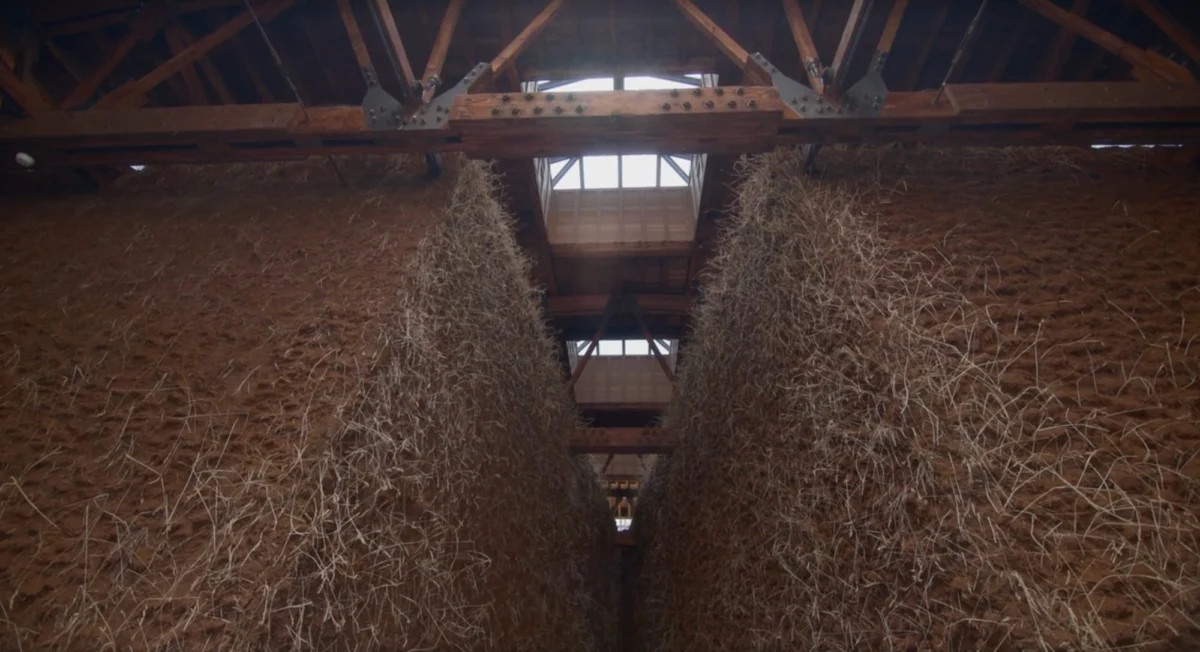
Delcy Morelos’s work is characterized by its monumental scale and its sensory depth. Unlike traditional sculpture, which often seeks to dominate space, Morelos’s installations—frequently composed of hundreds of tons of earth—invite a quiet, immersive communion. Her recent installation at the Centro Andaluz de Arte Contemporáneo (CAAC) in Seville serves as a pinnacle of this approach.
The installation is situated within a former Carthusian monastery, a site of immense historical weight that once served as a residence for Christopher Columbus and a temporary resting place for his remains. Morelos counters this colonial legacy with a "sepulchral mound" made of soil, straw, and grass. This structure does not merely sit in the space; it breathes within it, emitting the scents of cinnamon and cloves—spices that carry the heavy history of transatlantic trade and colonial extraction.
The primary facts of Morelos’s current artistic trajectory include:
- Medium Shift: A definitive move from two-dimensional acrylic painting, which she used to process the violence of the Colombian conflict, to large-scale, three-dimensional earth installations.
- The Seville Intervention: A site-specific work at the CAAC that utilizes soil-laden structures to grow produce native to both the Americas and Europe, effectively "replanting" the history of the site.
- Art21 Feature: Her inclusion in Season 12 of Art21’s Human Nature episode, which documents her process of hand-applying "gobs" of straw-laden soil to standing structures, highlighting the labor-intensive and tactile nature of her work.
- Philosophical Core: An emphasis on the interconnectedness of all life forms, aimed at puncturing the "bubble" of human isolation that leads to environmental and social degradation.
Chronology: From the Paradise of Tierralta to Global Acclaim
To understand Morelos’s work, one must look at the chronological evolution of her relationship with the land, which began in the late 1960s in the town of Tierralta, Colombia.
1960s–Early 1970s: The Edenic Foundation
Morelos describes her childhood as spent in a "paradise full of butterflies and unpaved streets." Her grandmother’s garden was her first studio, a place where she ran barefoot and learned the rhythms of the earth. This period established her foundational belief that the ground beneath our feet is not merely "dirt," but a sacred, living entity.

Late 1970s–1980s: The Arrival of Violence
The tranquility of Tierralta was shattered when paramilitary and guerrilla forces moved into the region. The ensuing conflict plunged the area into a state of chronic fear and grief. This trauma became the catalyst for Morelos’s early artistic output.
1990s: Painting the Wound
During the 1990s, Morelos gained recognition for her large-scale acrylic paintings. These works were often monochromatic, utilizing deep reds and browns that mimicked the colors of blood and earth. At the time, her work was a direct translation of the death and destruction she witnessed in her homeland. The canvas served as a container for the visceral reality of the Colombian civil war.
2000s–Present: The Return to the Soil
As Morelos evolved, she found that painting was insufficient to capture the holistic connection she sought with the environment. She transitioned into installation art, moving from the representation of the earth to the use of the earth itself. By the early 2010s, she was creating massive structures of soil and clay, such as En el nombre del padre (In the Name of the Father), which filled gallery spaces with the scent and presence of the land. Her participation in the 2022 Venice Biennale, titled The Milk of Dreams, solidified her status as a major voice in contemporary art, where her work Earthly Paradise invited visitors to walk through towering walls of fragrant peat.
Supporting Data: The Materiality of the Sacred
Morelos’s work is supported by a rigorous technical process that blends ancient agricultural techniques with contemporary architectural forms. The data behind her installations reveals the sheer scale of her labor.
Material Composition
The "soil" used in her installations is rarely just dirt. It is a carefully curated mixture designed to sustain life and evoke memory:
- Soil and Clay: Sourced locally whenever possible to ground the work in the specific history of the site.
- Straw and Grass: Acts as a binding agent, providing structural integrity to the "sepulchral mounds."
- Aromatic Spices: In the Seville installation, Morelos utilized cinnamon and cloves. These are not merely for scent; they represent the "Columbian Exchange"—the movement of plants, people, and diseases between the New World and the Old World following 1492.
- Living Produce: The walls at the CAAC were designed to grow native produce, turning a static sculpture into a living ecosystem.
Architectural Impact
In the CAAC installation, the towering walls of growth create a physical sensation of being "enveloped." Visitors report a drop in temperature and a shift in acoustics when entering her earth-walled corridors. This sensory data supports Morelos’s goal of removing the viewer from their "bubble" and forcing a physical confrontation with the fecundity and weight of the earth.

Official Responses: Curatorial and Critical Perspectives
The reception of Morelos’s work has been overwhelmingly positive, with curators noting her ability to bridge the gap between political activism and spiritual contemplation.
The Art21 Perspective
In the Human Nature episode, Art21 producers highlight Morelos as a quintessential artist for the Anthropocene. The segment emphasizes that her work is not just about "nature" as a distant concept, but about "human nature"—the inherent, often forgotten, biological and spiritual tie we have to the planet. The film captures her in Seville, showing the physical toll of the work as she hand-applies the material, a process the producers describe as a "direct tie to the sacred."
The CAAC and Institutional Context
Officials at the Centro Andaluz de Arte Contemporáneo have noted the significance of hosting Morelos in a space so deeply tied to Christopher Columbus. By allowing Morelos to install a "sepulchral mound" in a former monastery, the institution acknowledges a shift in how colonial histories are processed. Curators suggest that her work provides a "healing" or "decolonial" layer to the site, replacing the cold stone of colonial architecture with the living, breathing soil of the Americas and Europe combined.
Critical Reception
Art critics have compared Morelos’s work to the Land Art movement of the 1960s and 70s (such as Walter De Maria’s Earth Room), but with a crucial difference. While early Land Art often felt clinical or minimalist, Morelos’s work is described as "maternal," "ancestral," and "visceral." Critics argue that her use of soil is an act of "radical care," contrasting sharply with the "extractive" logic that has dominated human-land relations for centuries.
Implications: Breaking the Bubble of the Anthropocene
The work of Delcy Morelos carries profound implications for the future of both art and environmental philosophy. Her statement in the Art21 film—that "many people believe they are in a bubble"—serves as a critique of modern individualism and the alienation of humanity from the natural world.
Decolonizing the Landscape
By placing earth installations in colonial sites like the Seville monastery, Morelos implies that the history of the land is deeper and more resilient than the history of empires. Her work suggests that to move forward, we must "re-earth" our history, acknowledging the trauma of the past while fostering the growth of the future.

Ecological Interconnectedness
Morelos’s practice suggests that environmental degradation is a symptom of a spiritual crisis. If humans believe they are separate from the earth, they are capable of harming it. By creating "towering walls of growth" that evoke the "divine right beneath our feet," she forces a re-evaluation of what we consider sacred. The implication is that the "sacred" is not in the vaulted ceilings of a monastery, but in the soil that feeds us.
The Permanence of the Impermanent
Finally, Morelos’s work challenges the traditional art market’s obsession with permanence. Her installations are often temporary; they dry out, they grow, and eventually, they return to the earth. This cyclical nature mirrors the biological reality of life and death, suggesting that true art—like life—is a process of constant transformation rather than a static object to be owned.
In conclusion, Delcy Morelos is doing more than creating art; she is conducting a sensory excavation of our collective memory. Through her hands, the soil of Tierralta and the soil of Seville become one, reminding a fragmented world that we are all, ultimately, made of the same earth. As her work continues to gain international prominence, it serves as a vital reminder that the path to healing—both social and environmental—begins with the simple act of reconnecting with the ground beneath our feet.