The Grotesque and the Grandiose: An In-Depth Analysis of Matt Lesniewski’s ‘Faceless and the Family’
The landscape of contemporary independent comics is often defined by a tension between minimalist digital efficiency and the raw, labor-intensive craft of pen-and-ink traditionalism. Standing firmly in the latter camp is Matt Lesniewski, a creator whose work feels less like a modern publication and more like a fever dream unearthed from a time capsule of 1970s underground comix. His latest offering, Faceless and the Family, published by Oni Press, represents a significant milestone in his artistic evolution—a sprawling, surrealist odyssey that challenges the boundaries of visual storytelling while grappling with the complexities of identity and belonging.
Main Facts: The Genesis of a Hand-Shaped World
Faceless and the Family is a prestige-format graphic novel written and illustrated by Matt Lesniewski, priced at $29.99 and released under the Oni Press banner. The narrative centers on a protagonist known only as "Faceless," a man attempting to navigate a world that is as metaphorically rich as it is physically bizarre. The setting is perhaps one of the most distinctive in recent memory: a planet shaped like a colossal human hand floating in the vacuum of space.
This celestial anatomy dictates the social order. The "Palm" serves as a sprawling, impoverished wasteland where the marginalized and the "poor folk" struggle for survival. Conversely, the "Finger Cities"—soaring metropolises located at the tips of the planetary digits—house the elite and the wealthy. This stark geographical stratification sets the stage for a classic "journey to the center" (or in this case, the apex) narrative, as Faceless embarks on a quest for physical and spiritual transformation.
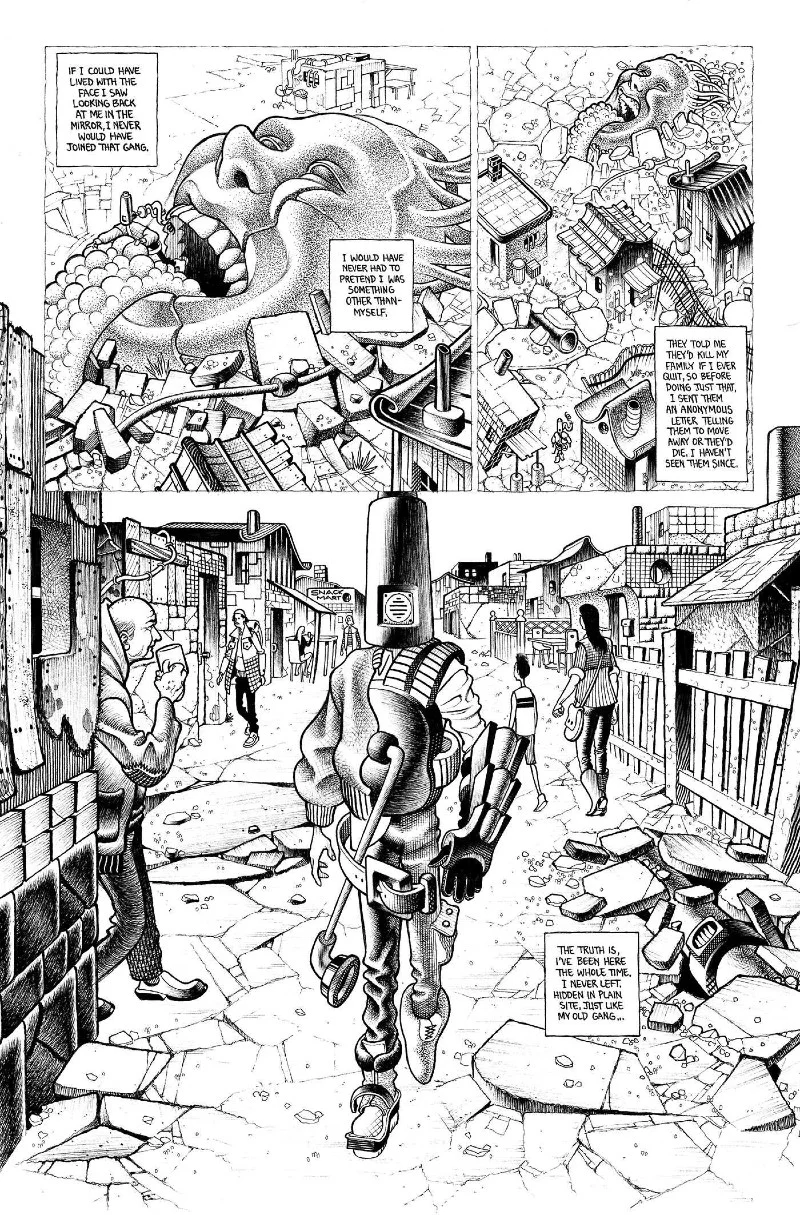
The book is presented in high-contrast black and white, a choice that highlights Lesniewski’s meticulous attention to texture. Every page is an exercise in "horror vacui"—the fear of empty space—filled with a dizzying array of crosshatching, stippling, and intricate linework that demands the reader’s undivided attention.
Chronology: The Evolution of Matt Lesniewski
To understand the weight of Faceless and the Family, one must look at the trajectory of Lesniewski’s career. He first garnered significant critical attention five years ago with the release of The Freak, a work that immediately established him as a "cartoonist’s cartoonist." Early critics were quick to draw parallels between Lesniewski and legendary masters of the medium, specifically Moebius (Jean Giraud) and Geoff Darrow.

While The Freak showcased a fascination with the grotesque and the hyper-detailed, Faceless and the Family marks a departure into a more synthesized aesthetic. If his earlier work was a tribute to the masters of the "Ligne Claire" and "Hard Core" styles, Faceless is a more idiosyncratic fusion. It draws from a wider pool of influences: the psychedelic whimsy of the Yellow Submarine animated film, the cinematic pacing of Westerns, the speculative grit of 1980s sci-fi, and the kinetic energy of manga.
This chronological development shows a creator moving away from imitation and toward a singular voice. In Faceless, Lesniewski uses geometric patterns and impossible anatomy not just for shock value, but as a primary language of the world he has built. The five-year gap between his debut and this magnum opus has allowed his style to ferment, resulting in a work that feels more confident and atmospheric than his previous efforts.
Supporting Data: A Visual and Narrative Deep Dive
The strength of Faceless and the Family lies in its sheer visual density. Analysis of the artwork reveals a "smorgasbord" of techniques that create a tangible sense of weight.
The Art of Texture and Form
Lesniewski’s approach to the page is maximalist. He employs swarms of crosshatching to create shadows that feel heavy, almost oppressive. Objects in this world do not merely exist; they have a perceived mass. When a character moves, the reader can almost feel the displacement of air.
One of the most striking elements of the visual data is the use of "dissolving" figures. Lesniewski often allows his characters to elongate at impossible angles or partially merge with the background textures. This isn’t a lack of technical skill; rather, it is a deliberate choice to reflect the unstable nature of the characters’ identities. In a world where identity can be bought and sold through plastic surgery, the very form of the body is fluid.

Character Design and World-Building
The protagonist, Faceless, has spent a decade hiding his identity after deserting a violent gang. His "mask" is a piece of industrial piping—a brutalist, clunky object that serves as a perfect metaphor for his self-imposed exile.
As he travels from the Palm to the Finger Cities, he assembles a "found family" of four other outcasts. Each character is visually distinct, avoiding the "same-face" syndrome that plagues many modern comics. Lesniewski’s ability to render unique, believable faces amidst a sea of surrealism provides a necessary emotional anchor. The world-building is further enriched by "organic industrialism"—scenes where massive warts erupt from the earth to release monsters, or where shady plastic surgeons operate in back alleys using machinery that looks both ancient and futuristic.
The Narrative Friction
Despite the visual triumph, the narrative data suggests a disconnect between the "show" and the "tell." The dialogue often falls into the trap of over-explanation. Characters frequently vocalize their internal monologues with a bluntness that can feel jarring against the sophisticated backdrop of the art.
Themes of self-acceptance and the definition of family are not merely suggested through action; they are stated explicitly. For some readers, this transparency may diminish the "visual punch" of the book, as the script occasionally struggles to keep pace with the imagination displayed in the drawings.
Official Responses and Critical Reception
The critical consensus surrounding Faceless and the Family has been largely positive, though nuanced. Reviewers have praised Oni Press for its willingness to publish such a visually challenging and idiosyncratic work. In an era where many major publishers lean toward "house styles" that are easily adaptable for film and television, the release of Faceless is seen as a win for the medium of comics as a pure art form.

Matthew Amuso, a prominent voice in comic criticism, awarded the book a 7/10, noting that while the "clunkiness of Lesniewski’s words strains the story," the artist nonetheless "finds new ways to spark the imagination on almost every page." This sentiment is echoed across the industry: the book is viewed as a visual masterpiece that occasionally trips over its own ambitious plotting.
Oni Press has positioned the book as a "must-read" for fans of avant-garde storytelling, emphasizing Lesniewski’s status as a "formidable cartoonist." The marketing of the book has focused heavily on the preview pages, allowing the art to serve as the primary ambassador for the story—a wise move given that the book’s greatest strength is its aesthetic immersion.
Implications: The Future of the "Total Cartoonist"
The publication of Faceless and the Family carries several significant implications for the comic book industry and for Matt Lesniewski’s career.
The Return of the Auteur
Lesniewski belongs to a rare breed of "total cartoonists"—individuals who handle every aspect of the creative process from concept to final ink. The success of Faceless suggests there is a healthy market for creator-owned projects that do not adhere to traditional commercial aesthetics. It encourages other artists to lean into their "strangeness" rather than sanding down their edges for the sake of mass-market appeal.
The Challenge of Narrative Balance
The primary takeaway for Lesniewski, and for the industry at large, is the delicate balance between world-building and storytelling mechanics. Faceless and the Family is a dense work, perhaps too dense in its subplots and exposition. The implication for Lesniewski’s future work is a need for "honing concepts to the essentials." If he can match his narrative economy to his visual extravagance, he has the potential to produce a work that is not just a 7/10, but a definitive masterpiece of the genre.

The Longevity of Physical Craft
In a digital-first world, Faceless and the Family serves as a testament to the power of the physical line. The "tangible sense of heart" mentioned by critics stems from the visible effort on the page—the thousands of tiny dots and scratches that represent hundreds of hours of manual labor. This book reaffirms that there is an irreplaceable quality to "messy" creative processes on a grand scale.
In conclusion, Faceless and the Family is a flawed but brilliant achievement. It is a work of immense passion that constructs an immersive world unlike any other. While the dialogue may occasionally stumble, the visual journey through the Palm and into the Finger Cities is one of the most rewarding experiences in recent comics. Matt Lesniewski has confirmed his place as one of the most exciting visual stylists in the industry, and his path forward promises to be as bright as it is beautifully grotesque.