The Enduring Power of the Concise: A Deep Dive into May 2026’s Speculative Fiction Gems
Main Facts
In an era often characterized by dwindling attention spans and an overwhelming flood of information, the art of the short story has not only endured but thrived, particularly within the expansive realms of science fiction, fantasy, and horror. May 2026 proved to be a particularly fertile month for these concentrated narratives, offering readers a rich tapestry of worlds, ideas, and chilling scenarios encapsulated in brevity. A recent compilation of ten standout short stories from the month underscores this trend, presenting a collection designed as "little reading treats" to herald the arrival of summer. Far from being superficial, these selections demonstrate the profound impact that concise storytelling can wield, tackling complex themes from interstellar colonization and geopolitical commentary to personal transformation and the human condition in the face of the unknown.
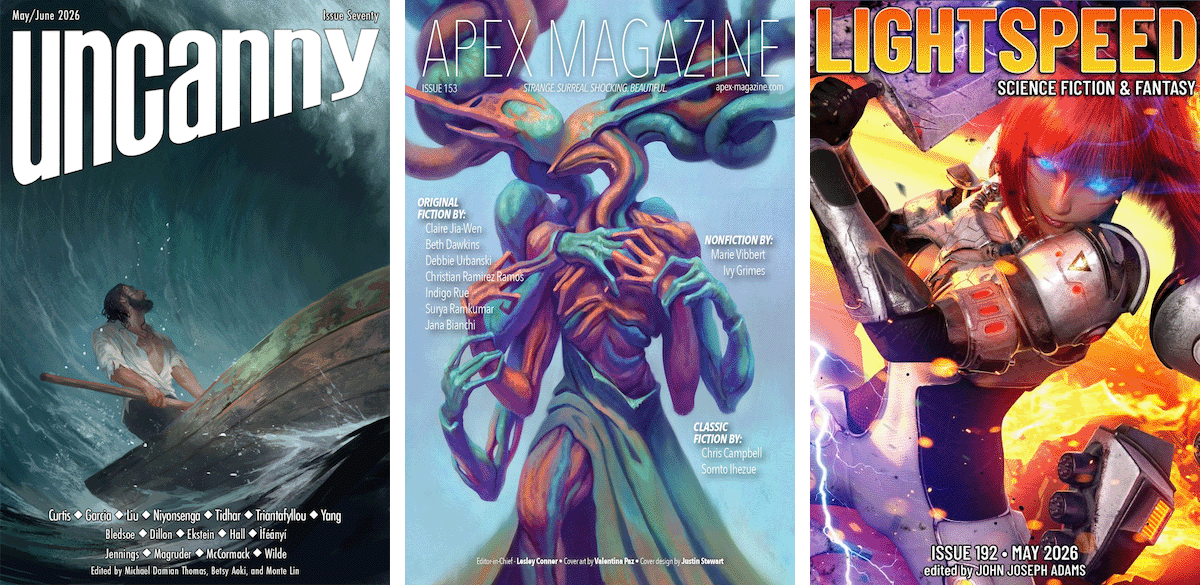
The curated list, spanning prestigious genre publications such as Lightspeed Magazine, Uncanny Magazine, Strange Horizons, and Apex Magazine, alongside innovative platforms like Small Wonders, Phano, and The Future Fire, showcases an impressive breadth of imagination and a commitment to diverse voices. Each story, meticulously crafted, distills intricate concepts and potent emotions into narratives that resonate deeply, proving that literary weight is not solely a function of word count. From the chillingly plausible future of Martian tourism to the ethereal dance of cosmic evolution, and from deeply personal tales of cultural diaspora to sharp critiques of societal aggression, these ten stories collectively highlight the dynamism and critical relevance of contemporary short-form speculative fiction. They serve not merely as diversions but as potent reflections and challenging explorations, inviting readers to engage with expansive ideas within the intimate confines of a few thousand words.
A Journey Through May’s Literary Cosmos: The Featured Short Stories
The May 2026 collection of short speculative fiction offers a compelling tour de force through the genre’s current landscape, showcasing innovation in narrative structure, thematic depth, and cultural resonance. Each entry, while brief, delivers a distinctive and memorable experience.
"1,001 Best Hikes on Mars: The Peterson Historic Trail (‘Peterson’s Folly’)" by Ron Fein (Small Wonders, May 2026; issue 35)
Ron Fein’s "1,001 Best Hikes on Mars" immediately captures attention with its ingenious structural choice: a simulated excerpt from a future Martian travel guide. Set in the majestic, yet perilous, Noctis Labyrinthus within the Phoenicis Lacus quadrangle, the story masterfully intertwines practical trail information—terrain descriptions, visitor center amenities—with the chilling, fragmented history of an ill-fated expedition. The narrative subtly sprinkles clues about the expedition team’s demise, gradually unveiling the dark significance behind the trail’s colloquial moniker, "Peterson’s Folly." This innovative approach sidesteps conventional science fiction tropes of Mars colonization, instead immersing the reader in a landscape both breathtakingly alien and terrifyingly human, where the allure of discovery clashes with the unforgiving realities of a new frontier. Fein’s genius lies in telling a colonization story not through grand pronouncements, but through the granular details of a tourist brochure haunted by tragedy.
"The Aerialist" by Yoon Ha Lee (Lightspeed Magazine, May 2026; issue 192)
Yoon Ha Lee, a name synonymous with intricate world-building and elegant prose, delivers a mesmerizing blend of gaslamp fantasy and poignant longing in "The Aerialist." The protagonist, Kallista, a disgraced aerialist, yearns for her past life, soaring through skies powered by "intoxicating faerie fuel" in a sturdy biplane. Now confined to a closet, her only companion is a stolen typewriter from a museum. Yet, this is no ordinary artifact; it holds a magic that promises to grant her the one thing she desperately craves: to fly again. Lee crafts a narrative rich with whimsical charm and mechanical wonder, but beneath the surface, there are "hidden depths" exploring themes of exile, resilience, and the enduring human desire for freedom and self-expression, even through unconventional means. The story is a testament to Lee’s ability to imbue fantastical elements with profound emotional weight.
"Dark, Where the Sun Never Sets" by Yasmeen Amro (Phano, April 2026; issue 16)
Yasmeen Amro’s "Dark, Where the Sun Never Sets" is a powerful and poignant work of science fiction that uses its speculative setting to deliver incisive social commentary. Khadija visits her relatives on Trappist-1d, a planet where she feels culturally and linguistically adrift, primarily speaking English while her family converses in Arabic. Against this backdrop of familial connection and subtle disconnection, her relatives recount the tale of an American space station’s catastrophic fall, leaving a permanent crater on their world. This event serves as a potent metaphor and direct comment on Israeli and American military aggression toward Palestine, exploring themes of displacement, memory, and the lasting scars of conflict. Amro’s choice of "Nabati" as the local name for the planet is a particularly insightful detail, referencing a vernacular form of Arabic poetry traditionally practiced by Bedouin communities, thereby grounding the cosmic narrative in rich cultural heritage and historical resilience.
"Excrescence" by R. F. Daniels (Quotidian Bagatelle, May 2026; issue 5)
R. F. Daniels’ "Excrescence" is a masterclass in the often-underestimated art of flash fiction. Commencing with the unsettling line, "It began as an itch in the back of my throat," the story plunges the reader into a world of concentrated horror and visceral discomfort. Despite its extreme brevity—a mere two paragraphs—Daniels manages to pack an astonishing amount of narrative and emotional punch. This piece defies the notion that flash fiction is merely "ephemeral" or "bite-sized" without substance. Instead, "Excrescence" demonstrates the format’s potential for immediate, impactful storytelling that resonates long after the final word. Its conciseness is not a limitation but a strength, ensuring that every word counts and every image lingers, proving that some stories achieve their greatest power by being precisely "what a flash fiction story should be."
"Extracted from an unravelled braid" by Aline-Mwezi Niyonsenga (Uncanny Magazine, May/June 2026; issue 70)
Aline-Mwezi Niyonsenga’s "Extracted from an unravelled braid" is a beautifully written and subtly devastating critique of colonial exploitation wrapped in speculative technology. Memoire, a Rwandan immigrant likely living in Canada, embraces a cutting-edge procedure that braids memory fibers into real hair, connecting directly to her brain. Initially, this technology promises a profound way to honor her ancestors and reconnect with the lost stories and essence of her homeland. However, the narrative expertly pivots to reveal the insidious nature of this innovation: the technology is owned and controlled by Western entities whose primary interest is "colonial extraction," not cultural preservation. Niyonsenga’s "clever storytelling" illuminates how even seemingly beneficial advancements can perpetuate historical power imbalances, transforming ancestral memory into another resource to be commodified and controlled. The story is a powerful exploration of identity, heritage, and the ongoing struggles of the diaspora.
"Me, Myself, and I" by Marsden Lyonwahl (Perseid Prophecies, Spring 2026; issue 9)
Marsden Lyonwahl’s "Me, Myself, and I" delves deep into the rich, unsettling tradition of Southern gothic literature. John Broussard returns to his ancestral home, an aging, dilapidated plantation house in Attakapas Parish, Louisiana, after a prolonged absence. Once the epitome of influence and wealth, the Broussard name has faded into obscurity, and their grand estate lies in ruins. John, however, holds the key to restoring the family’s former glory, a burden—or perhaps a destiny—that he may not willingly embrace. Lyonwahl masterfully builds an atmosphere of decay, forgotten history, and simmering secrets, painting a vivid picture of a region grappling with its past. The narrative unfolds with a creeping sense of dread and culminates in an "unexpected ending" that delivers a satisfyingly dark twist, cementing its place as a standout in the Southern gothic tradition.
"Not Hunger, Not Feeling" by Grace Crouthamel (Allegory, Spring/Summer 2026; issue 76)
Grace Crouthamel’s "Not Hunger, Not Feeling" offers a chillingly relatable take on the zombie apocalypse, resonating with recent global experiences of widespread contagion and lockdown. The story introduces Gretchen, a protagonist whose experience of going to work amidst a collapsing world mirrors the surreal reality many faced during real-world pandemics. In Crouthamel’s world, a virulent strain of HSV transforms individuals into "brainless killer zombies." Gretchen and a colleague from HR find themselves trapped within the confines of their corporate office building’s security office, facing not only the relentless threat of the living dead but also the insidious dangers that emerge when human beings are pushed to their limits. The narrative skillfully explores themes of survival, human fragility, and the unexpected perils that can arise even from within presumed safe spaces, offering a visceral and timely horror experience.
"Senescence" by aegor ray (Strange Horizons, May 4, 2026)
aegor ray’s debut fiction publication, "Senescence," is a breathtakingly lyrical and profound exploration of transformation and cosmic existence. The story introduces a being without a fixed name or form, constantly shifting states: from "he" to "she," from "forty-nine sticky droplets of impulse and intelligence, tucked under dried oak leaves, clinging to a stone" to a pregnant entity that "flies through galaxies and deep, sick quiet." ray’s prose is exquisitely crafted, evoking a sense of ancient wisdom and boundless potential. The narrative transcends conventional linearity, instead presenting a mosaic of existence, decay, and rebirth on a universal scale. The story culminates in an ending that elicits "a sigh of hope," hinting at cycles of renewal and the enduring spirit of life across vast stretches of time and space. This is a remarkable debut, marking ray as a distinctive new voice in speculative literature.
"The Trident-Tailed Water Monster" by Rae Zalopany (The Future Fire, May 2026; issue 2026.76)
Rae Zalopany’s "The Trident-Tailed Water Monster" is a thoughtful and subtly unsettling piece that navigates themes of caution, desire, and agency within a patriarchal world. Natalie, the protagonist, travels to a resort near Little Lake Kerr in Central Florida, drawn by a prophetic dream about a god. Her inherent caution around men, particularly one persistent individual who "hassles" her, is presented not as paranoia but as a justified response to societal realities. The story critiques the societal dismissal of women’s caution, arguing that "those of us who are often the targets of the patriarchy would probably say her level of caution is just fine." When Natalie and the man find themselves at the springs, the safety she desperately seeks manifests in a "dangerous package," forcing her to confront the cost of her desires. Zalopany delivers a potent narrative about reclaiming power and achieving one’s will, regardless of the morally ambiguous means.
"The Vigil of the Tenth Air" by Surya Ramkumar (Apex Magazine, May 2026; issue 153)
Surya Ramkumar’s "The Vigil of the Tenth Air" is a "breathtaking, bittersweet tale" that masterfully blends Hindu tradition with the contemporary experience of diaspora. The story begins with a father’s cremation, performed according to Hindu rites, but his son’s failure to complete the vital ritual of kapāla-kriyā leads to a profound consequence: the father’s prāṇa (life force) attaches itself to his son. They journey to the son’s home in an unnamed Western country, where the father’s spectral presence observes his son’s daily life. Through the father’s perspective, the narrative poignantly explores the immense "difficulties of living in the diaspora," particularly the pressures and sacrifices involved in assimilation into a new, often uncomprehending, society. Ramkumar crafts a deeply moving story about grief, cultural heritage, filial bonds, and the enduring struggle to maintain identity amidst the currents of migration and modernity.
Supporting Data and Emerging Trends in Speculative Fiction
The selection of these ten stories offers compelling "supporting data" for several significant trends shaping contemporary speculative fiction. Firstly, the diversity of the publishing platforms, from long-established giants like Lightspeed and Apex to newer, niche journals like Small Wonders and Quotidian Bagatelle, highlights a vibrant ecosystem dedicated to short fiction. These venues are crucial incubators for emerging talent and experimental narratives, providing essential spaces for voices that might not fit traditional molds.
Secondly, the authors featured—Yoon Ha Lee, Yasmeen Amro, Aline-Mwezi Niyonsenga, Surya Ramkumar, Rae Zalopany, and aegor ray, among others—represent a broad spectrum of backgrounds and perspectives. This demographic shift is not merely cosmetic; it directly informs the thematic richness of their work. Stories like Amro’s "Dark, Where the Sun Never Sets" and Niyonsenga’s "Extracted from an unravelled braid" are not just speculative tales but critical engagements with geopolitical realities, post-colonial legacies, and the complexities of cultural identity. Ramkumar’s "The Vigil of the Tenth Air" further underscores the growing importance of diaspora narratives, offering nuanced insights into cultural preservation and assimilation from within marginalized communities.
Furthermore, the thematic scope of these stories reflects a genre increasingly concerned with real-world issues. Mars colonization in Fein’s story becomes a vehicle for cautionary tales rather than triumphalism. Crouthamel’s zombie narrative taps into collective anxieties about pandemics and societal breakdown. Zalopany’s fantasy tackles patriarchy and female agency. Even ray’s cosmic tale of transformation can be read as an allegory for environmental change and evolutionary cycles. This demonstrates that speculative fiction continues to be a powerful lens through which to examine and critique the human condition, societal structures, and our evolving relationship with technology and the environment. The enduring appeal of the short story format, as evidenced by this collection, lies in its ability to deliver these complex ideas with precision and immediacy, making profound statements without requiring a massive time commitment from the reader.
Critical Reception and Editorial Vision: Affirming Short Fiction’s Power
While specific critical reviews for each story from May 2026 are still nascent, their inclusion in a "favorite stories" list by a discerning reader implicitly speaks to a positive reception within the speculative fiction community. More broadly, the editorial decisions made by the magazines publishing these works serve as "official responses" to the ongoing evolution of the genre. By selecting and championing narratives that are structurally inventive (like Fein’s travel guide format), thematically courageous (Amro’s geopolitical allegory), or stylistically daring (ray’s lyrical prose), these editorial teams are actively shaping the landscape of speculative fiction.
The continued prominence of short fiction in these high-profile publications reaffirms its critical role. Editors recognize that short stories are not merely stepping stones to novels but a distinct and powerful art form. They provide a vital platform for experimentation, allowing authors to explore concepts or narrative techniques that might be too unconventional for longer works. Moreover, these publications, through their editorial choices, signal a commitment to fostering a diverse range of voices and perspectives. The very existence of magazines dedicated solely to short speculative fiction underscores a shared belief in the format’s capacity to deliver potent, memorable experiences. This collective editorial vision affirms that short stories are not just "reading treats" but essential contributions to contemporary literature, capable of sparking conversations, challenging assumptions, and inspiring new generations of writers and readers.
Implications for the Future of Speculative Storytelling
The collection of these ten short stories from May 2026 carries significant "implications" for the future trajectory of speculative storytelling. Firstly, it emphatically confirms the enduring vitality and innovation within short fiction. In an age of digital distraction, the ability of these concise narratives to command attention and deliver deep intellectual and emotional engagement is a testament to their inherent power and the skill of their creators. This suggests that short stories will continue to be a cornerstone of the genre, offering accessible entry points for new readers while providing challenging new perspectives for seasoned fans.
Secondly, the thematic breadth and diversity of authors indicate a sustained and growing commitment within speculative fiction to explore complex contemporary issues through imaginative lenses. The genre is increasingly becoming a crucial space for social commentary, ethical interrogation, and cultural exploration, moving beyond mere escapism to engage with the pressing realities of our world. This trend points towards a future where speculative fiction is not only entertaining but also profoundly relevant, serving as a mirror and a blueprint for humanity’s challenges and aspirations.
Finally, the sheer variety of narrative styles and structural innovations seen in these stories—from travelogue to flash fiction, from gaslamp fantasy to cosmic transformation—highlights a genre that is unafraid to experiment and push boundaries. This creative dynamism ensures that speculative fiction will remain fresh, surprising, and deeply engaging, continuing to attract both established literary talent and exciting new voices. As we kick off the summer, these "little reading treats" are more than just momentary pleasures; they are potent indicators of a thriving, evolving, and critically important literary landscape.