Fungalpunk Noir: Adrian M. Gibson Navigates the Sophomore Slump with "A Murder Most Fungal"
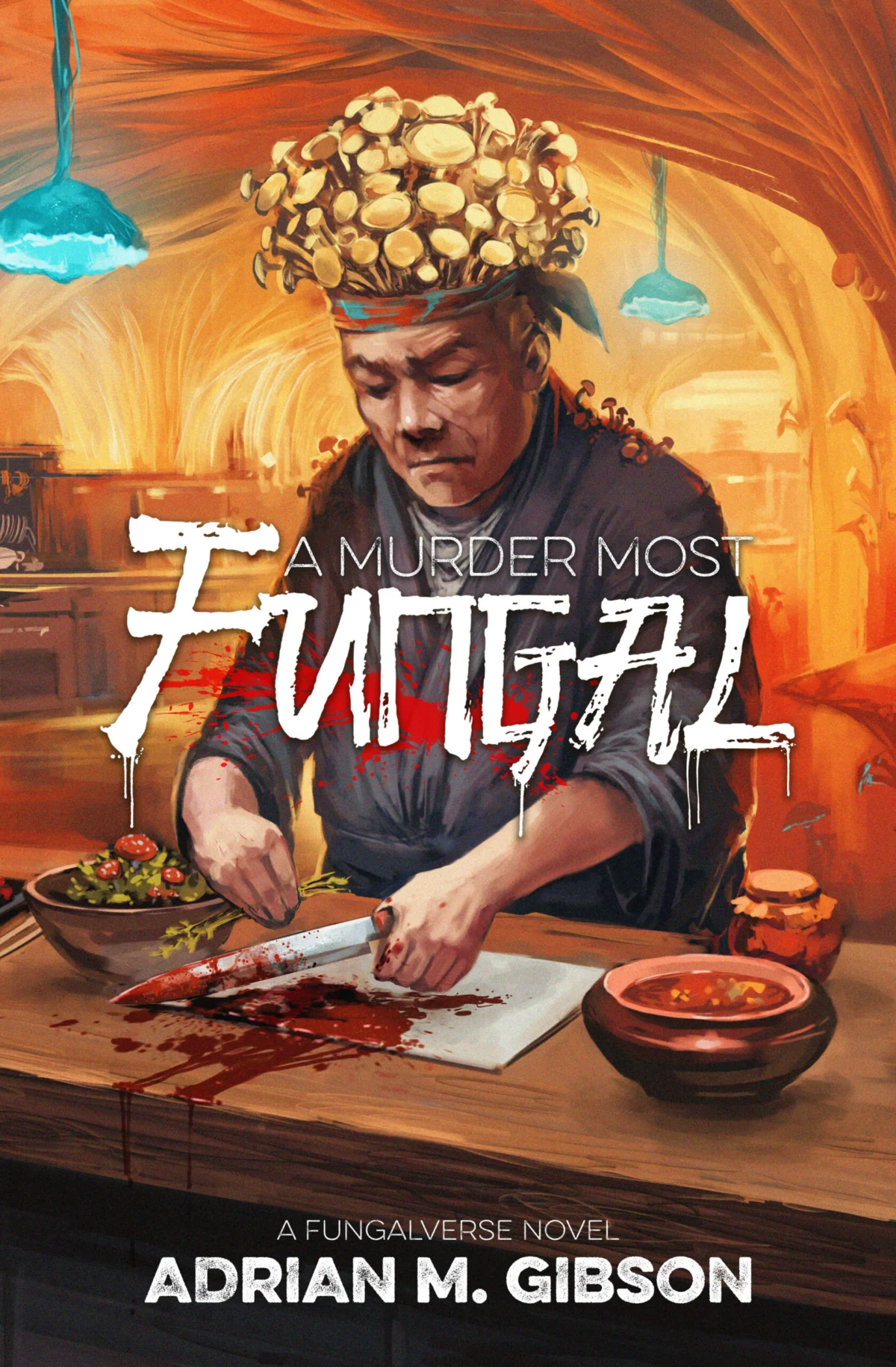
Neo Kinoko, the mushroom metropolis, is once again the stage for a gripping tale of crime, cuisine, and chilling fungal transformations. Award-winning author Adrian M. Gibson returns with "A Murder Most Fungal," a standalone novel that plunges readers into a world where culinary artistry meets deadly intrigue, and where the sophomore slump for authors is as real as the threat of parasitic fungi.
Gibson, a celebrated figure in the SFF community known for his debut novel "Mushroom Blues," delves into the complexities of writing a follow-up to a successful work, revealing the profound impact of creative pressure and the unexpected inspirations that fueled his latest venture. "A Murder Most Fungal" is not a direct sequel to "Mushroom Blues," but rather a side story that expands the rich Fungalverse, offering a fresh perspective on its unique inhabitants and their precarious existence.
The Stakes Are High in Neo Kinoko
Set several months after the devastating "Fuyu Massacre," Neo Kinoko, the Håpponese capital, is reeling. The city is under the oppressive thumb of a foreign military occupation, a consequence of the ensuing riots and whispers of revolution. Amidst this turmoil, Pocho Jiro, a former master makizushi chef, finds himself in a precarious position. His culinary skills have made him the personal chef – and indentured servant – to Duncan MacArthur, the Coprinian Military Governor of Håppon.
Pocho’s world is violently upended when he crosses paths with dangerous fungal gangsters. This encounter triggers a desperate chain of events, leaving him with an impossible choice: assassinate Governor MacArthur, or witness the brutal death of his beloved sister. The narrative promises a high-octane thriller, blending the meticulous culinary precision of "Jiro Dreams of Sushi" with the frenetic intensity of "The Bear" and the explosive tension of classic Hong Kong crime films. The question looms: will Pocho wield his chef’s knife not for gastronomy, but for assassination?
Navigating the "Sophomore Slump": A Creator’s Crucible
The journey from a successful debut to a highly anticipated follow-up is rarely straightforward. Adrian M. Gibson candidly discusses the formidable challenge of writing a second book, a phenomenon often dubbed the "sophomore slump."
"Just before I published my debut novel, Mushroom Blues, I had all these grand, ambitious publishing plans, and even a projection timeline that lined up release windows years in advance," Gibson shares. "I told myself, ‘I’ll write and release book two by X date, and then do book three by Y date, et cetera et cetera.’ But, well… all of that fell apart faster than a goddamn fungus grows after a rainstorm."
Gibson’s experience highlights the psychological toll of immense success. "The thing is, as much as I’d prepared myself mentally (even talking to numerous published authors on my podcast about this very concept), I wasn’t ready for how I would actually feel once Mushroom Blues was published, nor was I ready for the weeks and months that followed. I put so much of my mental and emotional energy into that book that I didn’t leave room to enjoy the achievement of debuting, or the successes that followed, or the fact that I had other stories that I wanted to write."
The critical acclaim for "Mushroom Blues"—thousands of copies sold, numerous award nominations and wins, and a second-place finish in Mark Lawrence’s tenth Self-Published Fantasy Blog-Off (SPFBO)—created a formidable benchmark. "I set the bar pretty fucking high for my first go at this, so the aftermath of my debut was riddled with starts and stops, ideas that burst into my brain, only to fizzle away after a few self-conscious pages," Gibson admits. This led to self-doubt: "Was Mushroom Blues a fluke? Would I be able to write a good book again? What the hell am I even doing?"
The Sacredness of Creativity: Reclaiming the Craft
A significant factor in Gibson’s creative drought was an overemphasis on marketing following his debut. "Truthfully, my debut broke my creative spirit," he states. "In hindsight, a major reason why the sophomore slump hit me as hard as it did is because I didn’t stop marketing Mushroom Blues for a year-and-a-goddamn-half. I was so wrapped up in making that book a success that I created this tunnel vision scenario for myself, where nothing felt as important as the thing that already existed—this tangible book that had already been published."
The turning point came when marketing efforts began to plateau, and the organic momentum of word-of-mouth took over. Gibson realized the most effective marketing strategy was not to continue pushing an existing product, but to create a new one. "The creative parts of my brain were screaming at me to ‘WAKE THE FUCK UP AND WRITE!’" he recalls. "I realized I couldn’t market this book forever, and the best marketing I could and should do was write and publish the next book. After all, I’d spent far too long desecrating the most sacred aspect of being an author: writing."
This realization prompted a period of intense self-reflection, leading Gibson to re-evaluate his approach and prioritize the creative process. "It took a lot of effort, but I began to find joy in the process again," he says. Collaborations, including the folktale novelette "The Stem-Cutter’s Daughter" for The Book of Spores anthology, a graphic novel, and an audio drama, helped reignite his passion. "Marketing can occupy the sidecar of my creative motorcycle as opposed to riding the bike itself," he concludes, underscoring his renewed focus on creation.
Food as a Worldbuilding Catalyst
The decision to center "A Murder Most Fungal" around food proved to be a profound worldbuilding revelation for Gibson, despite initial trepidation. "I love me some food. Cooking, too. But at the outset of writing A Murder Most Fungal, I had a lot of trepidations about centering an entire story around food. Not only that, centering it around a chef who is also a mushroom person."

However, as he delved deeper, he discovered the immense narrative potential food holds within his Fungalverse. "Ultimately, every biological being requires some degree of sustenance, and that sustenance can take many forms. But once a living being reaches a level where they manipulate their food beyond its natural state, oooooh, that’s when things get fun!"
Gibson elaborates on the multifaceted role of food in culture: "Food is a fundamental pillar of most any culture (real, fantasy or otherwise), and it can reveal so much about a people once it becomes cuisine." He highlights how food can illuminate a culture’s geography, available resources, societal structures, agricultural and commercial systems, and even governmental control over food distribution. Furthermore, culinary traditions are intertwined with language, storytelling, celebrations, and religious practices.
"Food is a literal feast of worldbuilding opportunities," Gibson enthuses. He employed a subtle approach in "A Murder Most Fungal," weaving in "simple, throwaway details that could add to their immersion and engage their imaginations." For example, a mention of "fungalfin tuna" prompts readers to ponder the existence of other hybridized creatures in this world. This layered approach, both by author and reader, contributes to a more believable and immersive experience.
The Kitchen as a Crucible of Drama
Gibson’s initial hesitation about setting a story within a restaurant environment was also overcome by the realization of its dramatic potential. "It’s a pretty confined environment without a lot of space to work with, so would there be enough tension and drama, or opportunities for character and relationship development?" he questioned.
His doubts were quickly dispelled as he discovered kitchens to be an "ideal breeding ground for storytelling possibilities." He likens a kitchen to a "modern-day equivalent of a pirate ship," where a diverse group of individuals with unique skills and temperaments are forced to collaborate under high pressure. "It’s a narrative goldmine!" he exclaims, noting the potential for intense camaraderie, trauma bonding, sexual tension, and infighting among staff.
Gibson drew inspiration from various media to explore kitchen drama, citing the comedic brilliance of Pixar’s Ratatouille, the fiery intensity of Gordon Ramsay’s shows like Hell’s Kitchen, the quiet obsession of Jiro Dreams of Sushi, and the anxiety-inducing familial struggles depicted in The Bear. "This is trainwreck-style drama, and the restaurant setting is so well suited to it," he observes. "Suffice to say, my early doubts were absurd, because restaurants are a perfect scenario for high-stakes drama. After all, a kitchen is bound to get messy at some point, and that mess makes for great stories."
The Allure of Fungal Body Horror
A defining characteristic of Gibson’s Fungalverse, and particularly evident in "A Murder Most Fungal," is his fascination with fungal body horror. "There’s something weirdly captivating about body horror. It’s visceral and unsettling, especially seeing something as familiar as the human body being deformed and altered in ways both subtle and overt."
His interest was significantly shaped by the video game and television series The Last of Us, which masterfully depicted the insidious spread of fungal spores and mycelia, transforming hosts into grotesque, mushroom-adorned creatures. Equally influential was Jeff VanderMeer’s Southern Reach Trilogy, which explored the psychological and philosophical dimensions of mind control by alien entities.
"Now that I write my own fungalpunk fiction, it was inevitable that body horror would play a part in it," Gibson states. He explains that the focus on food in "A Murder Most Fungal" allowed for a particularly disturbing escalation of this theme. "While I dabbled with fungal horror a fair bit in Mushroom Blues, it’s nothing compared to A Murder Most Fungal. This obsession I have took a disturbing turn in the latest book simply because of the story’s focus on food. While planning out the climax, I thought to myself, How could food and fungi come together to create a truly fucked up body horror extravaganza?"
Authorial Profile: Adrian M. Gibson
Adrian M. Gibson is a multifaceted Canadian SFF author, podcaster, book designer, illustrator, and tattoo artist. He is the driving force behind the SFF Addicts podcast, where he, alongside co-hosts M. J. Kuhn and Greta Kelly, engages in in-depth interviews with authors and presents writing masterclasses. Gibson also serves as the Publishing Project Manager at Grimdark Magazine, overseeing their line of fantasy and science fiction novellas. He currently resides in Quito, Ecuador, with his family.
"A Murder Most Fungal" is available on Amazon and through The Broken Binding.
Connect with Adrian M. Gibson:
- Website: adrianmgibson.com
- Instagram: instagram.com/adrianmgibson
- SFF Addicts Podcast: linktr.ee/SFFAddicts
- YouTube: youtube.com/@fanfiaddict