Navigating the Labyrinth of Physics: A Visual Journey from Newton to Quantum Uncertainty
OpenCulture.com | June 18, 2026
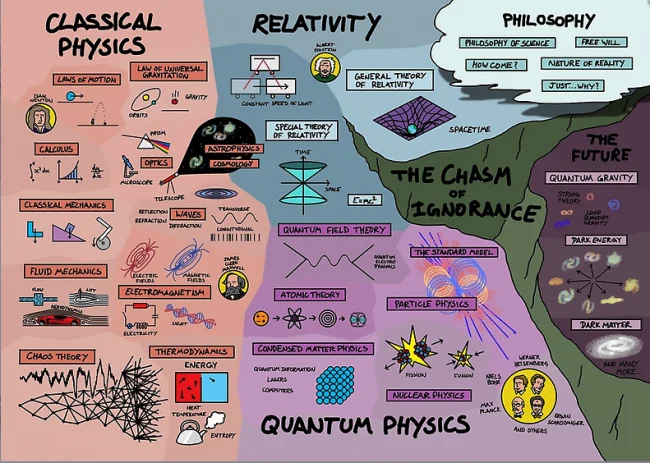
The field of physics, once seemingly governed by predictable, orderly laws, has evolved into an increasingly intricate and often baffling landscape. From the elegant mechanics of Sir Isaac Newton to the mind-bending theories of Albert Einstein’s relativity and the perplexing paradoxes of quantum mechanics, understanding the interconnectedness of these disciplines can be a significant challenge for the uninitiated. Physicist Dominic Walliman, recognizing this common struggle, has developed an innovative solution: an animated "Map of Physics" designed to visually chart the relationships between classical physics, relativity, and quantum mechanics, making this complex domain more accessible to a wider audience.
The Foundation: From Classical Certainty to Emerging Mysteries
Physics, at its core, is the study of matter, energy, space, and time, and their interactions. For centuries, the Newtonian paradigm provided a seemingly complete and coherent framework for understanding the universe. Newton’s laws of motion and universal gravitation, coupled with his development of calculus, laid the bedrock for much of our scientific understanding. This era was characterized by a belief in a deterministic, clockwork universe, where events could be precisely predicted if the initial conditions were known.
H2: The Newtonian Legacy: Order and Predictability
The genesis of physics as a formal discipline can be traced back to the groundbreaking work of Isaac Newton. His seminal publication, Philosophiæ Naturalis Principia Mathematica (Mathematical Principles of Natural Philosophy) in 1687, revolutionized scientific thought. Newton’s three laws of motion – inertia, acceleration, and action-reaction – provided a mathematical framework for describing how objects move. His law of universal gravitation explained the force that pulls objects towards each other, from falling apples to orbiting planets.
Newton’s genius also extended to mathematics, with his independent invention of calculus. This powerful tool allowed physicists to describe continuous change, a fundamental aspect of motion and forces. The inseparable relationship between physics and mathematics was cemented during this period, with calculus becoming the indispensable language for articulating physical laws.
Beyond mechanics and gravity, Newton also made significant contributions to the study of light. His experiments with prisms demonstrated that white light is composed of a spectrum of colors, laying the groundwork for wave optics. This early exploration into the nature of light foreshadowed later developments, such as James Clerk Maxwell’s unification of electricity and magnetism into a single theory of electromagnetism, which revealed light to be an electromagnetic wave.
H3: The Proliferation of Classical Sub-disciplines
As the Newtonian framework proved its efficacy, physics began to branch out into numerous sub-disciplines, each exploring specific facets of the natural world. Fluid mechanics, the study of liquids and gases in motion, emerged as a crucial area, impacting everything from engineering to meteorology. Thermodynamics, the study of heat, work, and energy, provided insights into the fundamental processes of energy transfer and transformation, explaining phenomena like engines and the behavior of matter at different temperatures. Chaos theory, which emerged much later, explored the behavior of complex, nonlinear systems, revealing that even seemingly deterministic systems could exhibit unpredictable outcomes due to extreme sensitivity to initial conditions.
Across these diverse fields, a unifying principle emerged: the study of energy in its various forms and transformations. This principle underpinned the success of classical physics, enabling remarkable technological advancements and a profound understanding of the macroscopic world. For centuries, this edifice of knowledge stood strong, its predictions aligning remarkably well with observations.
The Dawn of the Quantum and Relativistic Revolutions
However, as the 19th century drew to a close and the 20th century began, cracks began to appear in the seemingly seamless edifice of classical physics. New experimental results and theoretical inquiries at the extremes of scale – both the very large (cosmic distances) and the very small (atomic and subatomic particles) – presented phenomena that classical mechanics could not adequately explain. This marked a pivotal moment, leading to the emergence of two revolutionary branches of physics: relativity and quantum mechanics.
H2: Einstein’s Universe: Redefining Space, Time, and Gravity
Albert Einstein’s theories of special and general relativity fundamentally altered our understanding of the universe. Special relativity, published in 1905, revolutionized our concepts of space and time, demonstrating that they are not absolute but are intertwined into a single continuum known as spacetime. It introduced the idea that the speed of light in a vacuum is constant for all observers, regardless of their motion, leading to counter-intuitive consequences such as time dilation and length contraction at speeds approaching that of light. The iconic equation E=mc², derived from special relativity, revealed the profound equivalence of mass and energy, a principle that underpins nuclear physics.
General relativity, published in 1915, expanded upon special relativity by incorporating gravity. Einstein proposed that gravity is not a force in the traditional sense, but rather a curvature of spacetime caused by the presence of mass and energy. Massive objects warp the fabric of spacetime around them, and other objects follow these curves, which we perceive as gravitational attraction. This theory explained phenomena that Newtonian gravity could not, such as the anomalous precession of Mercury’s orbit and the bending of starlight by massive objects.
H3: The Realm of the Infinitesimal: Quantum Mechanics
While relativity dealt with the very large and the very fast, quantum mechanics emerged to describe the behavior of matter and energy at the atomic and subatomic levels. Unlike the deterministic nature of classical physics, quantum mechanics is inherently probabilistic. At this scale, particles do not have definite positions or momenta simultaneously; instead, they exist in a state of superposition, described by wave functions that represent the probabilities of finding them in various states.
Key concepts in quantum mechanics include:
- Quantization: Energy, momentum, and other properties are often quantized, meaning they can only exist in discrete, specific values. This was a radical departure from the continuous nature of classical physics.
- Wave-Particle Duality: Subatomic entities exhibit characteristics of both waves and particles, a phenomenon that defied classical intuition.
- The Uncertainty Principle: Formulated by Werner Heisenberg, this principle states that there are fundamental limits to how precisely certain pairs of physical properties of a particle, such as its position and momentum, can be known simultaneously. The more precisely one is known, the less precisely the other can be determined.
Quantum mechanics has been incredibly successful in explaining a vast range of phenomena, from the behavior of atoms and molecules to the functioning of lasers and semiconductors. However, its counter-intuitive nature and the mathematical complexities involved have made it a subject that often eludes easy comprehension.
Bridging the Gaps: The "Map of Physics"
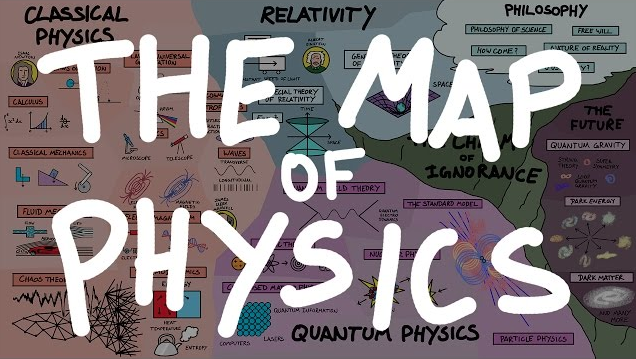
The challenge of integrating these disparate branches of physics into a coherent whole is precisely what Dominic Walliman’s "Map of Physics" aims to address. The animation, embedded within the article, provides a visual narrative that guides viewers through the historical development and conceptual connections of different physics domains.
H2: Visualizing the Interconnectedness
Walliman’s map begins with the foundational principles of classical physics, highlighting Newton’s laws and the indispensable role of mathematics. It then traces the lineage to Maxwell’s work on electromagnetism, demonstrating how Newton’s early investigations into optics paved the way for understanding light as an electromagnetic wave. The animation illustrates the subsequent proliferation of classical sub-disciplines, all unified by the fundamental study of energy.
The crucial turning point arrives around 1900, when the limitations of the Newtonian worldview became apparent. The map then bifurcates, illustrating the emergence of relativity and quantum mechanics as distinct but interconnected realms. Walliman’s explanation emphasizes that while relativity deals with the large-scale structure of the universe and gravity, quantum mechanics governs the behavior of the very small.
H3: The "Chasm of Ignorance": Frontiers of Modern Physics
The animation and accompanying map also acknowledge the limitations of our current understanding. As Walliman points out, while quantum field theory offers the "best description of the universe we have," a significant challenge arises when attempting to unify quantum mechanics with general relativity – a quest known as quantum gravity. This unresolved problem represents the "Giant Chasm of Ignorance" in modern physics.
Speculative and controversial ideas such as string theory and loop quantum gravity are presented as attempts to bridge this chasm, representing the cutting edge of theoretical physics. The journey through the map ultimately leads back to philosophy, underscoring the deep conceptual questions that physics continues to grapple with.
Supporting Data and Resources: Deepening Understanding
The "Map of Physics" is not merely an academic exercise; it is a practical tool designed to demystify the subject for a broad audience. The accompanying resources and links provide avenues for further exploration:
- Poster Purchase: A tangible "Map of Physics" poster is available for purchase, allowing individuals to have a constant visual reminder of the field’s intellectual geography.
- Digital Download: A digital version of the map is also accessible, offering flexibility for personal study.
- TEDx Talk: Walliman’s engaging TEDx talk, also featured, demonstrates his skill in communicating complex scientific ideas in an accessible and charming manner, even explaining quantum physics for young audiences. This underscores the importance of effective science communication in making these fields understandable.
- Related Content: A curated list of related articles and videos, including animated explanations of the history of physics, the Feynman Lectures, Stephen Hawking’s theories, and the life of Marie Curie, offers further opportunities for learning and engagement.
Official Responses and Implications
While there are no "official responses" in the traditional sense to a visual explainer like Walliman’s "Map of Physics," the widespread interest and positive reception from the scientific and educational communities speak to its value. Educators, students, and science enthusiasts alike have found the map to be an invaluable tool for navigating the complex landscape of physics.
The implications of such visualizations are significant:
- Enhanced Learning: By providing a visual framework, the map aids in conceptual understanding, helping learners to see the connections between seemingly disparate areas of physics. This can foster deeper engagement and a more holistic appreciation of the subject.
- Democratization of Knowledge: Making complex scientific concepts accessible to a wider audience contributes to the democratization of knowledge, encouraging greater scientific literacy and potentially inspiring future generations of scientists.
- Stimulating Further Research: By clearly delineating the frontiers of current knowledge, such as the "Chasm of Ignorance," these tools can also highlight areas ripe for further research and investigation.
In conclusion, Dominic Walliman’s "Map of Physics" serves as a vital compass in the intricate labyrinth of modern physics. By transforming abstract concepts into a navigable visual representation, it empowers individuals to explore the historical evolution, conceptual interconnections, and unresolved mysteries of this fundamental scientific discipline, making the journey from Newton’s predictable universe to the probabilistic realm of quantum mechanics a more understandable and engaging adventure.