The Price of Paper: Federal Sentencing of Texas Artist Ignites First Amendment Crisis
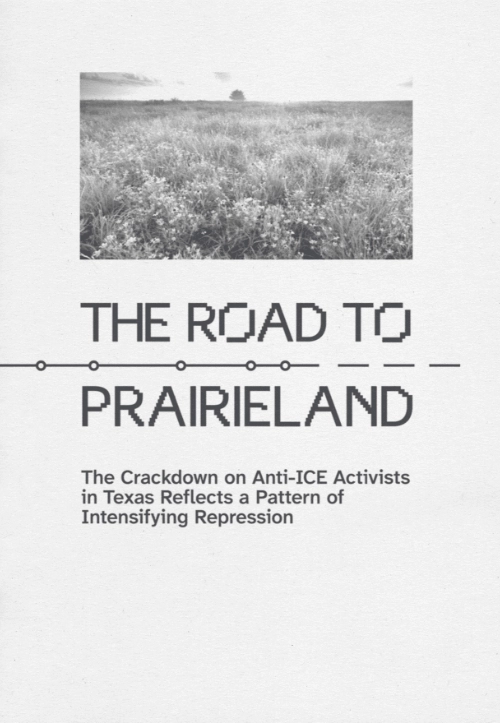
FORT WORTH, TX — In a case that has sent shockwaves through the artistic and activist communities, the U.S. District Court for the Northern District of Texas has handed down a series of historic sentences against individuals linked to anti-government protests. At the center of the controversy is Des Sanchez Estrada, a local tattoo artist and zine creator, who was sentenced to 30 years in federal prison. His crime, according to federal prosecutors, was the corrupt concealment of documents—specifically, a box of self-published political pamphlets, illustrations, and stickers.
The severity of the sentences, which include a 50-year term for a mother of one for possessing printing equipment, has sparked a national debate over the "terrorism enhancement" of non-violent offenses and the perceived weaponization of the Department of Justice against political dissent.
Main Facts: Art, Activism, and the "Antifa" Designation
The prosecution of Des Sanchez Estrada and the group now known as the "Prairieland Defendants" marks a significant escalation in the federal government’s approach to domestic political movements. Following an executive declaration by the Trump administration labeling "Antifa" as a domestic terrorist organization, the Department of Justice (DOJ) has utilized broad anti-terrorism statutes to prosecute individuals associated with leftist and anarchist ideologies.
The core of the government’s case rests on a protest that occurred at the ICE Prairieland Detention Center outside of Dallas. While the demonstration involved acts of vandalism and a shooting that injured a police officer, the subsequent investigation expanded to include individuals who were not present at the scene. These individuals, including Estrada, were targeted based on their associations, their creative output, and their efforts to move personal property—which the government reclassified as "terrorist materials"—in the wake of the initial arrests.
The evidence presented by the prosecution included:

- Zines and Pamphlets: Self-published booklets criticizing Immigration and Customs Enforcement (ICE) and the police.
- Printing Equipment: A commercial copy machine, paper cutters, and book-binding tools.
- Artistic Assets: Tattoo flash sheets and stickers containing anti-government imagery.
- Commercial Fireworks: Classified by the prosecution as "explosives" in the context of the protest.
Chronology of Events: From Protest to Prison
The legal saga began in 2025, during a period of heightened civil unrest regarding federal immigration policies.
The Prairieland Incident
In late 2025, a group of activists organized a "noise demonstration" at the ICE Prairieland Detention Center. What began as a protest involving chants and the lighting of fireworks quickly spiraled. Some participants began vandalizing parked vehicles and a guard shack. During the chaos, an officer responding to the scene was shot. While the officer survived, the incident triggered a massive federal response. Several individuals were arrested on-site, including Maricela Rueda, the wife of Des Sanchez Estrada.
The Recorded Conversation
Following her arrest, Rueda contacted her husband from a recorded jailhouse phone. During the call, Rueda, appearing panicked, instructed Estrada to "do whatever you need to do" and to "move whatever you need to move at the house." Prosecutors would later argue that this was a coded instruction to hide evidence of a domestic terrorist cell’s operations.
The Search and Arrest
Acting on the recorded call, federal agents intercepted Estrada’s vehicle. Upon searching the car, they discovered a box containing "Antifa materials." This included zines, flyers, and tattoo art. Estrada, who was not present at the Prairieland protest and was not accused of participating in the violence, was indicted on one count of "corruptly concealing a document or record," a charge carrying a maximum sentence that was significantly lengthened by the application of terrorism enhancements.
The 2026 Sentencings
In June 2026, the court began issuing sentences. The outcomes exceeded even the most pessimistic projections from legal observers.

- Elizabeth Soto: Sentenced to 50 years for providing material support to terrorists and conspiracy to carry explosives (fireworks). Her "material support" consisted of owning a printing press.
- Des Sanchez Estrada: Sentenced to 30 years for transporting the box of zines and art.
- Ines Soto: Awaiting sentencing on July 1, facing similar decades-long prospects.
Supporting Data: The Disparity of "Corrupt Concealment"
The 30-year sentence handed to Estrada for "corruptly concealing a document" has drawn immediate comparisons to other high-profile federal cases involving the same charge. Legal analysts point to the case of Waltine Nauta and Carlos de Oliveira, who were accused of moving boxes of highly classified national security documents at the behest of former President Trump.
Under standard federal sentencing guidelines, the concealment of classified documents typically carries a maximum of 20 years. However, in Estrada’s case, the documents were not classified state secrets, but rather political art and "zines"—a medium of self-expression protected by the First Amendment for decades. The application of the "terrorism enhancement" allowed the court to bypass standard guidelines, treating the distribution of political art as equivalent to the distribution of bomb-making instructions or the funding of overseas terrorist cells.
Furthermore, the evidence against the Sotos—the couple accused of running a "terrorist printing hub"—was notably thin. According to reports from the Fort Worth Star-Telegram, the prosecution admitted it could not prove the printing press in the Sotos’ garage was actually used to produce the specific zines found at the protest. Despite this, the mere possession of the equipment, combined with the presence of fireworks (labeled as explosives), was sufficient to secure a half-century sentence for Elizabeth Soto.
Official Responses: The Government’s Stance
The Department of Justice has defended the prosecutions as a necessary measure to combat domestic extremism. The federal indictment describes the "North Texas Antifa Cell" as a structured organization with the explicit goal of the "overthrow of the United States Government, law enforcement authorities, and the system of law."
In a statement following Estrada’s sentencing, a spokesperson for the U.S. Attorney’s Office for the Northern District of Texas stated:

"The First Amendment does not provide a shield for those who provide the ideological and logistical framework for violence against law enforcement. The defendants in this case were not merely artists or protesters; they were active participants in a conspiracy to destabilize federal institutions. The sentences handed down reflect the gravity of the threat posed by domestic terrorism."
Conversely, civil liberties groups and fellow artists have condemned the rulings. Ryan Estrada, an Eisner-nominated author (unrelated to Des), has been a vocal critic of the case. "I am also a cartoonist named Estrada who makes comics about fighting fascism," he stated, highlighting the "chilling reality" that his own work could be reclassified as "terrorist propaganda" under this legal precedent.
Implications: The Chilling Effect on the First Amendment
The sentencing of the Prairieland Defendants represents a pivotal moment in American jurisprudence, with several long-term implications for civil society:
1. The Redefinition of "Material Support"
By classifying a printing press and political pamphlets as "material support for terrorism," the court has significantly lowered the bar for what constitutes a terrorist act. This creates a precarious environment for journalists, publishers, and artists whose work may be critical of the government. If "zines" can be considered "insurrection planning," the boundary between protected speech and criminal activity becomes dangerously blurred.
2. Judicial Climate and the Right to Protest
The Northern District of Texas has become a focal point for what critics call "judicial activism from the right." The harshness of these sentences suggests a shift toward using the judiciary as a tool for political deterrence. The message to the public is clear: participation in a protest where any violence occurs—even if the individual is not the perpetrator—can lead to life-altering federal charges.
3. The Future of Political Art
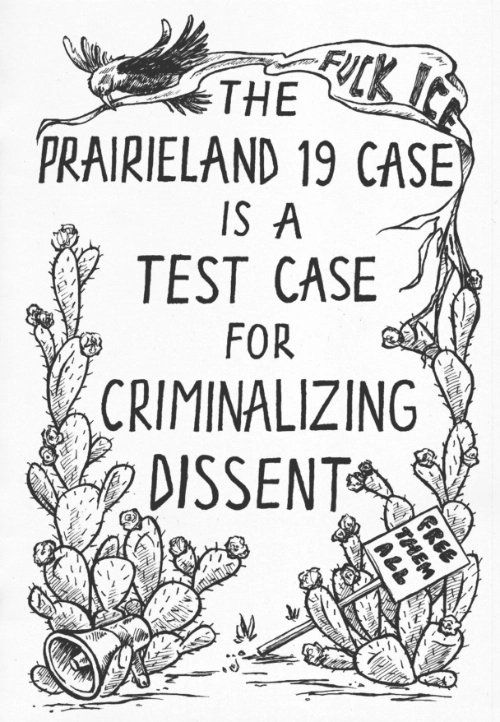
For the artistic community, the Estrada case is a "canary in the coal mine." Zines and "tattoo flash" have long been staples of underground culture and political commentary. The criminalization of these mediums threatens to drive political art further underground, effectively silencing dissent through the fear of decades-long imprisonment.
4. The Path to Appeal
Legal experts believe the Prairieland Defendants face a difficult road ahead. Finding relief in the current appellate system, which has been reshaped by conservative appointments, is considered a "long shot." Advocates for the defendants, such as the organizers of the "Free Des!" campaign, suggest that their only hope may lie in a future presidential pardon or a radical shift in the Department of Justice’s policy under a different administration.
As Des Sanchez Estrada begins his 30-year sentence, the box of zines that led to his downfall remains in federal custody—a silent testament to the high price of political expression in a polarized America. For now, his supporters continue to raise funds for legal fees, hoping that the higher courts will eventually recognize a distinction between a box of paper and a threat to the republic.