The Persistence of the Pen: Analyzing the Evolution and Cultural Impact of Modern Cartooning
Main Facts: A Convergence of Legacy and Modernity
In the early summer of 2026, the world of sequential art finds itself at a unique crossroads, where the legacy of classic newspaper strips meets the high-stakes world of international media and political commentary. Recent profiles and retrospectives have brought three distinct narratives to the forefront of the cultural conversation: the surrealist evolution of the long-running comic strip Heathcliff under Peter Gallagher; the surprising cartooning origins of media heavyweights at The Dartmouth; and the poignant, biting legacy of Marjane Satrapi’s contributions to European journalism.
The central narrative emerging from these reports is the enduring utility of the comic strip as a foundational medium for storytelling, political discourse, and absurdist humor. Despite the decline of traditional print media, Heathcliff remains a powerhouse in syndication, appearing in over 1,000 daily newspapers. Simultaneously, the archives of Ivy League student publications reveal that the skills required to craft a daily comic—brevity, visual composition, and satirical sharp-wittedness—have served as the ultimate training ground for Emmy-winning producers, Academy Award-winning directors, and leading news anchors.
Finally, the retrospective analysis of Marjane Satrapi’s work for Le Monde underscores the medium’s ability to transcend borders, blending personal tragedy with global economic and political critique. Together, these stories illustrate that while the delivery method of cartoons may be shifting from newsprint to digital screens, the influence of the cartoonist remains a vital force in shaping public consciousness.
Chronology: From the Drafting Table to the Global Stage
The Gallagher Era: 1973 to Present
The history of Heathcliff is a multi-generational saga. Created by George Gately (Gallagher) in 1973, the strip originally occupied a space of traditional domestic "gag" humor, often compared to—and competing with—Jim Davis’s Garfield. However, the trajectory of the strip shifted significantly when Peter Gallagher, George’s nephew, took the reins.
For the past 17 years, while balancing a career as an educator at Montclair State University, Peter Gallagher has steered the orange cat into increasingly surreal territory. This evolution culminated in the 2020s with the introduction of "Garbage Ape" and other logic-defying recurring motifs that have captured a new, younger demographic via social media, even as the strip maintains its massive traditional newspaper footprint.
The Dartmouth Incubator: 1991–2001
The decade spanning the early 1990s to the turn of the millennium proved to be a "golden age" for The Dartmouth, the student newspaper of Dartmouth College.
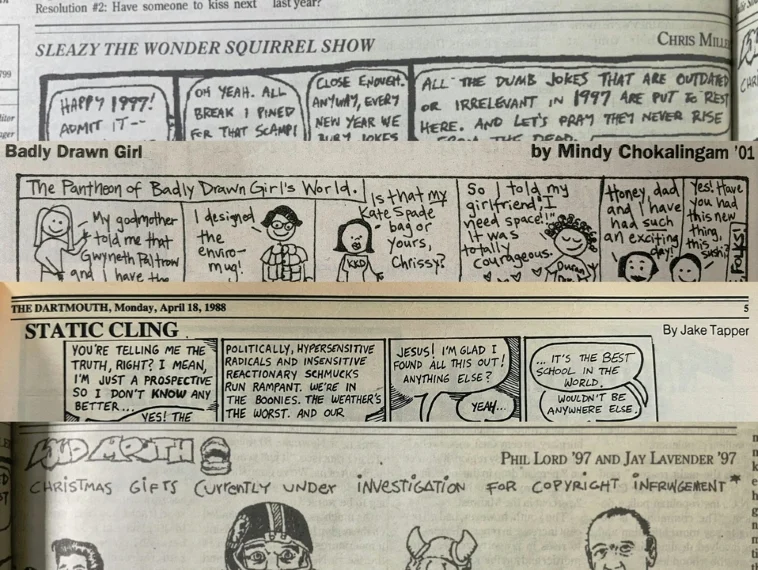
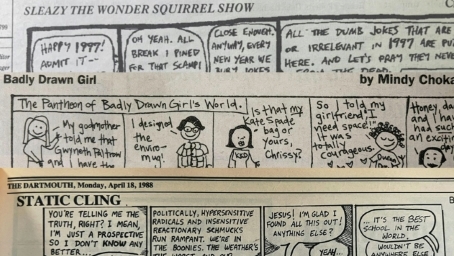
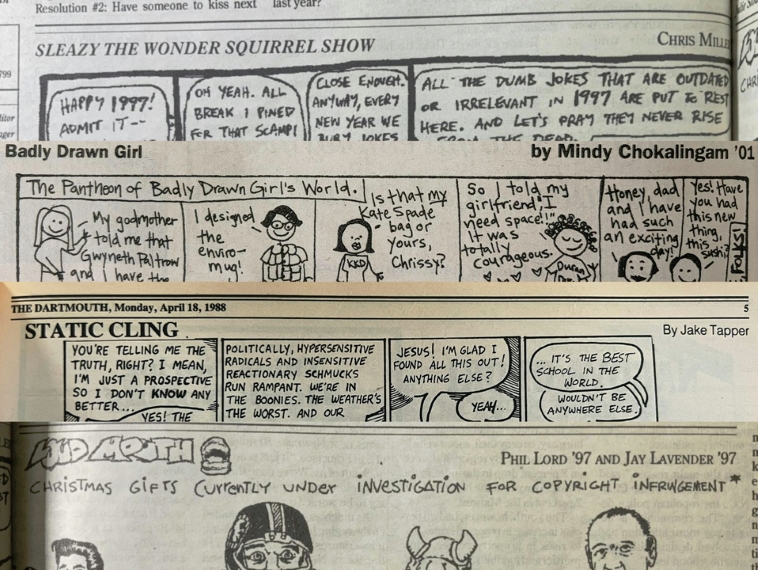
- 1991: Jake Tapper, now a lead anchor for CNN, was a prolific cartoonist, publishing five days a week by his sophomore summer.
- 1997: Phil Lord and Christopher Miller, the duo behind The LEGO Movie and Spider-Man: Into the Spider-Verse, were honing their comedic timing through strips like "Loud Mouth" and "Sleazy the Wonder Squirrel Show."
- 2001: Mindy Kaling, future star of The Office and creator of The Mindy Project, utilized her strip "Badly Drawn Girl" to provide a satirical look at the female undergraduate experience.
The Satrapi Transition: 2003–2005
Following the international success of her graphic memoir Persepolis (2000–2003), Marjane Satrapi moved from long-form autobiography to short-form journalistic commentary. In 2005, she began a seminal run with Le Monde 2, the weekly supplement of the French newspaper of record. Her column, "Ma semaine" (My Week), ran for several months, marking a period where she transitioned from an exiled storyteller to a premier European public intellectual.
Supporting Data: Circulation, Tenures, and Archival Reach
The resilience of the cartooning medium is supported by several key metrics highlighted in recent reports:

- Syndication Strength: Peter Gallagher’s Heathcliff maintains a circulation of over 1,000 daily newspapers. In an era where many regional papers have shuttered or reduced their "funny pages," this figure represents a significant saturation of the remaining print market.
- Educational Longevity: Gallagher has served as a professor of Editorial Illustration at Montclair State University for 17 years. This dual role as practitioner and educator highlights the academic shift toward treating cartooning as a formal discipline of media studies.
- The "Dartmouth Effect": The Dartmouth, founded in 1799, has a historical track record of producing influential cartoonists. Beyond the modern media moguls, the paper claims Theodore Geisel (Dr. Seuss) as an alumnus. This data point suggests that college humor magazines and newspapers are among the most effective incubators for high-level creative talent in the United States.
- Archival Resurgence: The digital archiving of Le Monde 2 and The Dartmouth has led to a 20-year "look-back" cycle, where the early works of now-famous figures are being re-evaluated for their prophetic political and social content.
Official Responses and Critical Perspectives
On the "Absurdist" Heathcliff
In a recent profile for The New York Times, critic Calum Marsh noted that Gallagher has transformed Heathcliff from a "predictable gag strip" into something "slightly surreal" and "logic-defying." Gallagher himself acknowledges the disconnect between his medium and his students, stating, "Kids don’t read the newspaper… I don’t think they even know what a newspaper is."
Despite this, the "Garbage Ape" phenomenon—a character Gallagher introduced that makes nonsensical appearances—has become a cult hit online. Critics argue that Gallagher has successfully "future-proofed" the strip by making it "weird enough" to survive as internet memes while keeping the traditional format for older readers.
On the Dartmouth Legacy
The editors of The Dartmouth, Alex Klee and Eliza Dorton, recently reflected on the "prestigious tenure" of their alumni. They noted that the transition from cartooning to media production is a natural one. Jake Tapper’s experience of publishing five days a week provided a "rigorous deadline discipline" that mirrors the pace of a modern newsroom. Similarly, the "Sleazy the Wonder Squirrel Show" by Christopher Miller is now viewed by animation historians as an early precursor to the irreverent, fast-paced humor that would define Miller and Lord’s later cinematic successes.
On Marjane Satrapi’s "Ma semaine"
Clément Ghys, writing for Le Monde, describes Satrapi’s 2005 strips as "biting" and "tinged with a sense of tragedy." Her work is praised for its ability to tackle "French exceptionalism" and global scandals (such as the Lance Armstrong doping case) with the same visual vocabulary she used to describe the Iranian Revolution. Critics suggest that Satrapi’s work for Le Monde proved that the "comic strip" could function as a high-level editorial column, equal in weight to the paper’s leading text-based editorials.

Implications: The Future of Sequential Art in Media
The convergence of these three stories suggests several broader implications for the media industry:
1. The Comic Strip as a "Skill-Set" Foundation
The success of Kaling, Tapper, Lord, and Miller suggests that cartooning is not merely an artistic endeavor but a comprehensive training in media literacy. Creating a daily strip requires a creator to be a writer, director, editor, and marketer simultaneously. As the media landscape becomes more visual and condensed, the "cartoonist’s mindset"—the ability to convey complex ideas in a single frame or a four-panel sequence—is becoming a premium skill in Hollywood and journalism.
2. The Shift from Print Loyalty to Brand Loyalty
Peter Gallagher’s success with Heathcliff indicates that long-running intellectual properties (IP) can survive the death of their primary medium (the newspaper) if they adapt their "vibe" to modern sensibilities. By embracing the absurd, Gallagher has ensured that Heathcliff remains relevant in digital spaces like Reddit and X (formerly Twitter), where surrealism is a primary currency.
3. Cartooning as Global Diplomacy
Marjane Satrapi’s work underscores the role of the cartoonist as a bridge-builder. By using a "simple" visual style to tackle complex issues like the global economy and national identity, cartoonists can communicate across linguistic and cultural barriers more effectively than traditional prose journalists. This suggests that in an increasingly polarized world, the "graphic editorial" may become a more prominent tool for international discourse.
4. The Enduring Value of Student Media
The archives of The Dartmouth serve as a reminder of the critical importance of well-funded student journalism. Without the low-stakes environment of a college paper to experiment with characters like "Sleazy the Wonder Squirrel" or "Badly Drawn Girl," the media landscape might have been deprived of some of its most influential modern voices. As universities face budget cuts, the "cartoonist pipeline" remains a powerful argument for the preservation of student-run press.
In conclusion, the pen has not lost its power. Whether through the absurdist antics of a neighborhood cat, the early satirical sketches of future media titans, or the tragicomic reflections of a global icon, the comic strip continues to be a vital, evolving, and indispensable component of the modern cultural fabric.