The Architecture of Absence: Katherine Wolkoff’s Poetic Exploration of the Natural World
Main Facts: Capturing the Impression of Life
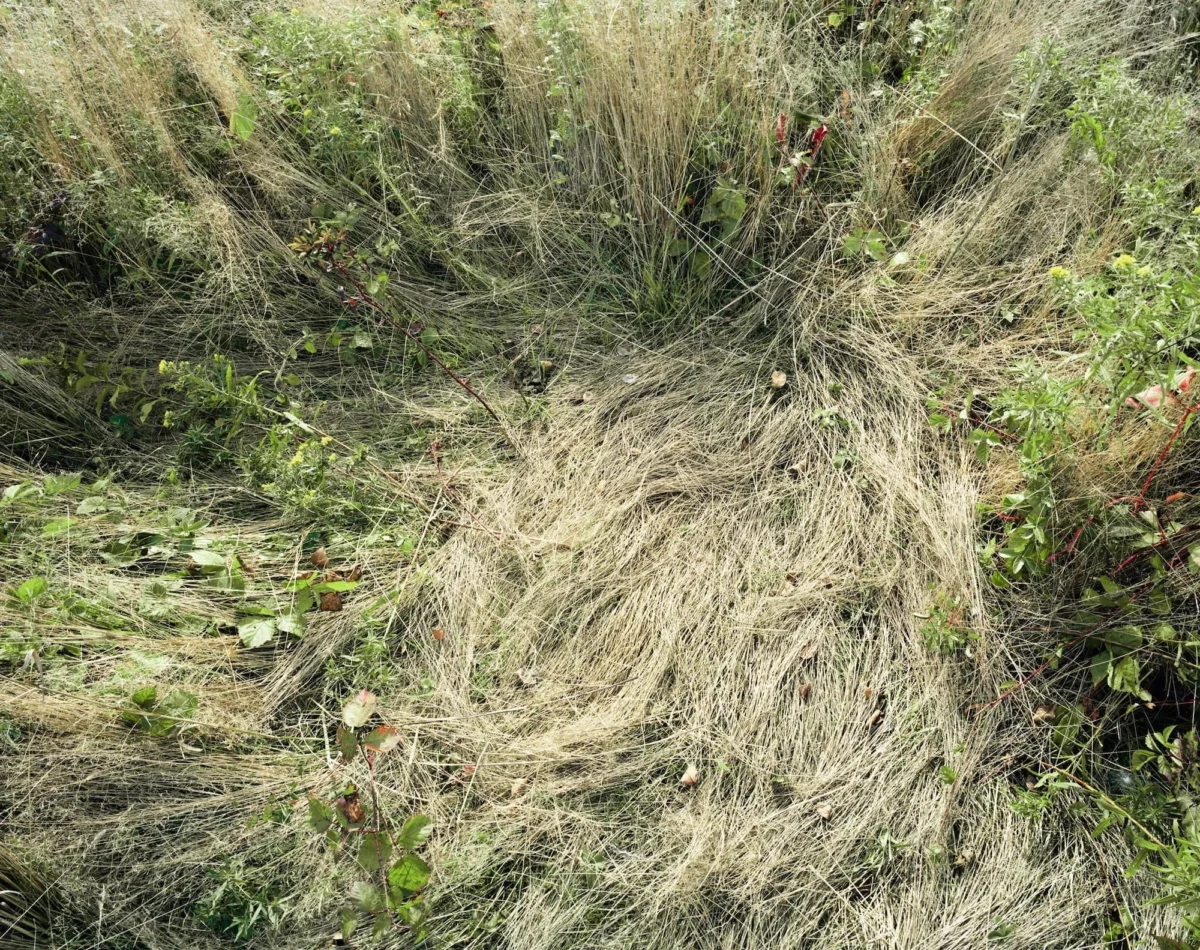
In the quiet, windswept meadows of Block Island, Rhode Island, a subtle phenomenon occurs every night. White-tailed deer, moving through the tall grasses under the cover of darkness, select specific sites to rest. When they depart at dawn, they leave behind "deer beds"—flattened, oval-shaped impressions in the vegetation that serve as temporary monuments to their presence. Photographer Katherine Wolkoff has spent years documenting these ephemeral structures in her evocative series, Deer Beds.
Unlike traditional wildlife photography, which seeks to "capture" the animal in a moment of action or repose, Wolkoff’s work focuses entirely on the void left behind. Her images do not feature the deer themselves; instead, they focus on the nest-like spaces where the animals once lay. These photographs are printed at nearly life-size, a technical choice that invites the viewer to stand at the edge of the bed, creating an intimate, meditative experience. By removing the horizon line and focusing downward, Wolkoff strips away the traditional landscape context, transforming a patch of flattened grass into a profound meditation on comfort, resilience, and the quiet intersections of life and land.
The Deer Beds series serves as a foundational pillar of Wolkoff’s broader body of work, which increasingly examines the natural world through the lens of the Anthropocene—the current geological age in which human activity is the dominant influence on climate and the environment. Her work is characterized by a "solitary, meditative search," a process that bridges the gap between scientific observation and fine art.

Chronology: From Scientific Inquiry to Artistic Vision
Katherine Wolkoff’s fascination with the hidden patterns of nature began not in a studio, but in the field, guided by the pedagogical influence of her mother. As a science teacher, her mother introduced her to the concept of deer beds, teaching her to read the landscape for signs of life that were not immediately visible to the untrained eye. This early education in observation laid the groundwork for Wolkoff’s artistic methodology.
The development of the Deer Beds series took place over several years on Block Island. Located a few miles off the coast of Rhode Island, the island serves as a unique laboratory for Wolkoff’s work due to its diverse ecosystems and its role as a critical stopover for migratory species. Wolkoff began by following established deer paths—narrow trails worn into the earth by generations of movement—which eventually led her to the secluded areas where the animals bedded down.
Following the critical success of Deer Beds, Wolkoff’s focus has shifted from the terrestrial to the aerial. Currently, she is finalizing a new body of work and a corresponding book that utilizes pinhole photography to document the experiences of migratory birds. This project, which will be featured in a forthcoming exhibition at the Benrubi Gallery in New York City next spring, represents a chronological progression from the stillness of the deer beds to the "blurred, frantic quality" of animals pushed to their physical limits. This transition reflects Wolkoff’s evolving concern with the "depletion" of the natural world and the precariousness of survival in a changing climate.

Supporting Data: The Biology and Aesthetics of the "Bed"
To understand the weight of Wolkoff’s imagery, one must understand the biological reality of her subjects. Deer are crepuscular creatures, most active during dawn and dusk. Their bedding behavior is not random; it is a strategic choice influenced by thermal regulation and predator avoidance. A "home range" for a deer may include several bedding spots that they return to repeatedly, though they rarely sleep in the exact same spot two nights in a row to avoid detection by predators.
Wolkoff’s photographs capture the physical manifestation of this survival strategy. The "beds" are created by the weight of lean, muscular bodies pressing down on tall grasses, such as switchgrass or little bluestem, which are common to the Rhode Island coast.
The aesthetic power of the series lies in its technical execution:

- Scale: By printing the images at nearly life-size, Wolkoff eliminates the distance between the viewer and the subject. The viewer is forced to engage with the grass on a 1:1 scale, making the absence of the deer feel palpable.
- Perspective: The lack of a horizon line creates a sense of immersion. There is no "away" in these photos; there is only the immediate, tactile reality of the nest.
- Texture: The high-resolution detail of the flattened stalks against the upright grass highlights the contrast between the "used" and "unused" parts of the environment, emphasizing the impact of a living body on the physical world.
This focus on the "after-image" of the animal aligns Wolkoff with a tradition of conceptual photography that values the trace over the object, suggesting that what is missing is often more telling than what is present.
Official Responses: Subverting the "Photographic Hunt"
Critical reception of Wolkoff’s work has frequently highlighted her subversion of traditional photographic tropes. In a review for Artforum, critic Eva Diaz noted a fundamental shift in Wolkoff’s approach compared to historical wildlife documentation.
"The prevailing metaphor of photography is that of the hunt," Diaz wrote. "Photographers shoot, even stalk, their subjects; in the case of Katherine Wolkoff’s work, the absence of ‘prey’ itself becomes the subject of the project."

This observation identifies a crucial tension in Wolkoff’s work. In the history of photography, the camera has often been used as a tool of conquest—a way to "capture" and "possess" the wild. By arriving after the deer have departed, or by capturing the moment they "dart away, startled," Wolkoff relinquishes this control. She is not a hunter, but a witness.
Art historians have also noted that Wolkoff’s work resonates with the concept of the "indexical trace"—a term used in semiotics to describe a sign that is caused by the thing it represents (like a footprint or a shadow). In this context, the deer beds are indexical signs of the deer. The power of the work comes from the viewer’s realization that a living, breathing creature was just there, and its warmth might still be lingering in the grass. This creates a sense of "presence in absence" that is both haunting and comforting.
Implications: Art in the Anthropocene and the Atlantic Flyway
Wolkoff’s work carries significant implications for how we perceive the environment in an era of ecological instability. By documenting the "beds" of deer and the "depletion" of birds, she is creating a visual record of the relationship between inhabitants and their habitats at a time when those habitats are under threat.

Her upcoming project on the Atlantic Flyway—a major north-south flyway for migratory birds in North America—shifts the tone from the meditative stillness of the deer beds to a more chaotic, urgent register. The Atlantic Flyway is one of the most threatened migratory routes in the world due to urban development, light pollution, and climate change. Wolkoff’s use of pinhole photography—a primitive technique that requires long exposures and often results in blurred images—is a deliberate choice to visualize the "exhaustion" of these birds.
"The resulting pictures have a blurred, frantic quality that I think of as visualizing the birds’ depletion," Wolkoff explains. "The chaos of an animal pushed to its limits over open water and unfamiliar coastline, flying through the night with no guarantee of where it will land."
The implications of this work are twofold:

- Ecological Awareness: By focusing on the struggle of migration, Wolkoff highlights the "unfamiliar coastline" that birds must navigate as sea levels rise and weather patterns shift. Her work serves as a quiet but firm call to acknowledge the "limits" being reached by non-human species.
- Philosophical Re-evaluation: Wolkoff’s work asks the viewer to consider the land not as a resource or a backdrop, but as a site of "care and resilience." Whether it is a deer finding a place to sleep or a bird seeking a place to land, the land provides a sanctuary that is increasingly fragile.
As Wolkoff prepares for her exhibition at the Benrubi Gallery, her work continues to challenge the boundaries between science and art. Through her lens, the natural world is not something to be conquered or even fully understood, but something to be followed, respected, and mourned. The "deer beds" remain as silent witnesses to a world that exists in the periphery of human activity—a world that is both resilient and profoundly vulnerable.