The Digital Frontier: Inside NASA’s Massive Open-Source Media Archive
The recent successful flyby of the Artemis II mission marked a pivotal moment in human spaceflight, representing the first time in over half a century that humans have ventured to the lunar vicinity. While the scientific data and mission milestones—including the testing of the Orion spacecraft’s life support systems—were the primary objectives, the mission yielded a secondary, equally significant treasure: a breathtaking collection of high-definition imagery and video.
From a distance of more than 250,000 miles, the Artemis II crew captured the "Blue Marble" for a new generation. Perhaps most surprisingly, some of the most viral images of the mission were captured not by bespoke, million-dollar space cameras, but by consumer-grade iPhone 17 Pro Max devices mounted within the Orion capsule. These images, now part of NASA’s sprawling digital library, offer a unique perspective on our home planet, bridging the gap between the specialized world of aerospace engineering and the everyday technology found in our pockets.
Because NASA is a federally funded agency of the United States government, the vast majority of this content is released into the public domain. This policy has created one of the most significant open-source cultural and scientific repositories in human history. However, navigating this "digital cosmos" requires a roadmap.
Main Facts: The Open-Access Mandate
The fundamental principle governing NASA’s media output is rooted in the National Aeronautics and Space Act of 1958, which mandates that the agency "provide for the widest practicable and appropriate dissemination of information concerning its activities and the results thereof." This translates to a massive, free-to-use library of images, videos, and audio files.
1. Public Domain Status
Unlike private space corporations, NASA’s media is generally not subject to copyright. This means that students, filmmakers, digital artists, and space enthusiasts can download, remix, and redistribute high-resolution space photography without paying licensing fees. This has facilitated everything from Hollywood blockbusters to academic textbooks.

2. Consumer Tech in Deep Space
The Artemis II mission highlighted a significant shift in NASA’s hardware strategy. While specialized sensors are used for deep-space telemetry, the agency increasingly utilizes "Commercial Off-The-Shelf" (COTS) technology. The use of the iPhone 17 Pro Max for interior and window shots demonstrates the incredible fidelity of modern mobile optics, allowing for immediate, relatable imagery that resonates with the public.
3. The Scale of the Archive
NASA’s digital footprint is spread across multiple platforms, encompassing everything from the earliest Mercury mission film reels to the latest 8K video from the International Space Station (ISS). The archive currently holds hundreds of thousands of assets, including raw telescope data, mission control audio, and high-speed engineering footage.
Chronology: The Evolution of Space Documentation
To understand the current state of NASA’s media library, one must look at the technological trajectory of how we have documented our departure from Earth.
The Film Era (1958–1980s)
In the early days of the Space Race, documentation was a physical challenge. Astronauts on the Gemini and Apollo missions used modified Hasselblad cameras. These film canisters had to survive the vibration of launch and the radiation of space before being physically returned to Earth for processing. The iconic "Earthrise" photo from Apollo 8 was the result of this painstaking process.
The Digital Transition (1990s–2010s)
With the advent of the Space Shuttle program and the launch of the Hubble Space Telescope, NASA began the transition to digital imaging. This era saw the rise of CCD (Charge-Coupled Device) sensors. Images were no longer "returned"; they were transmitted as data packets. However, the resolution was limited by bandwidth. During this period, NASA began consolidating its physical archives into the first iterations of online databases.

The High-Definition and Social Era (2010s–Present)
The deployment of the James Webb Space Telescope (JWST) and the Artemis program has ushered in an era of unprecedented clarity. Modern missions now utilize high-speed laser communications to transmit gigabytes of visual data. Simultaneously, the rise of social media shifted NASA’s focus toward real-time engagement, leading to the creation of the unified NASA Image and Video Library in 2017.
Supporting Data: Navigating the Repositories
For those looking to dive into the archive, the sheer volume of data can be overwhelming. NASA does not host everything in a single folder; rather, the data is distributed across several key "hubs," each serving a different purpose.
The NASA Image and Video Library (images.nasa.gov)
This is the agency’s primary search engine. It consolidates content from across NASA’s ten field centers.
- Search Capability: Users can filter by media type (image, video, audio) and by year.
- Metadata: Most files include extensive EXIF data. For instance, a photo of the lunar surface might include the focal length, exposure time, and the specific camera used—be it a high-end Nikon or an iPhone.
- Usage Tip: Use specific mission names (e.g., "Artemis II," "JWST," "Perseverance") to narrow down results, as generic terms like "Moon" will return thousands of pages.
NASA Images and the "Image of the Day"
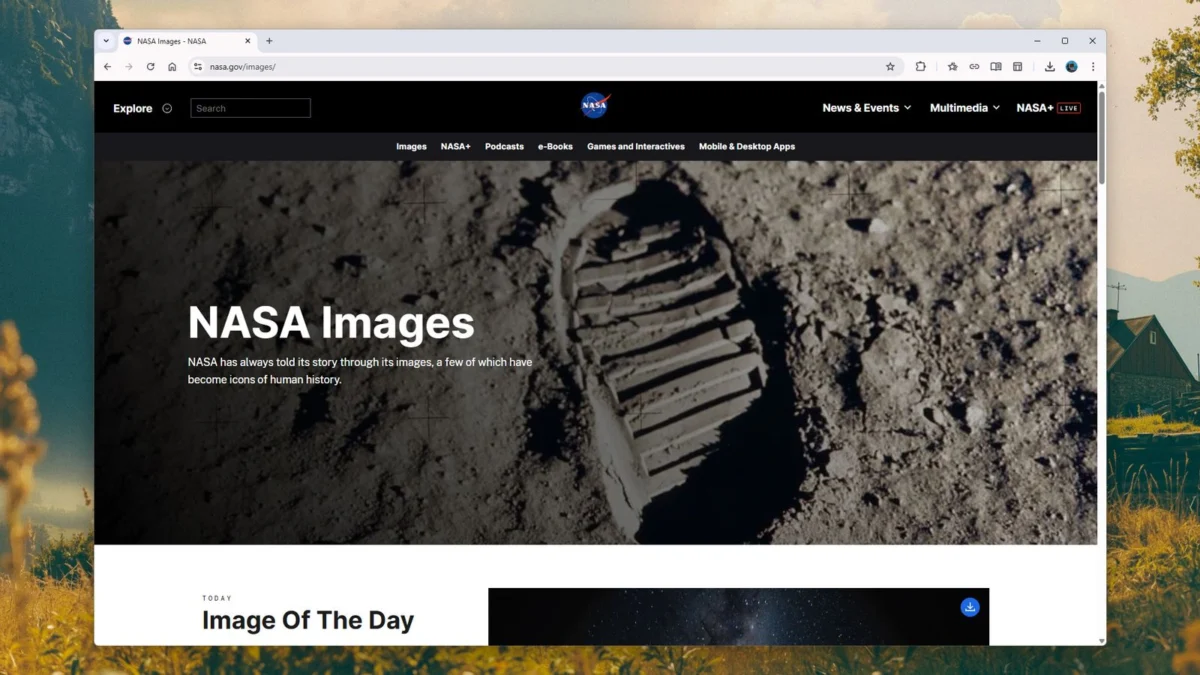
While the main library is a raw database, the NASA Images portal (nasa.gov/images) is a curated experience.
- Image of the Day: This feature provides a daily high-resolution shot accompanied by a detailed "mini-essay" explaining the scientific significance of the visual.
- Accessibility: This portal is better suited for casual browsing and educators who need context alongside the visuals.
The NASA Johnson Flickr Account
For those who prefer a more organized, "album-style" browsing experience, the Johnson Space Center maintains a massive Flickr presence.

- Statistical Impact: At the time of writing, the account hosts over 63,500 photos.
- Organization: Unlike the search-heavy main library, Flickr allows users to browse by mission-specific albums. This is the best place to find "behind-the-scenes" photos of astronaut training and Orion capsule manufacturing.
Official Responses: The Mission of Public Engagement
NASA officials have frequently emphasized that these images are not just "pretty pictures," but essential tools for transparency and inspiration.
In a recent statement following the Artemis II return, NASA’s Office of Communications noted: "Our goal is to make the moon and Mars feel accessible to everyone. By providing high-resolution, public-domain imagery, we allow the world to ride along with our astronauts. When a student can download the same image used by our scientists and set it as their wallpaper, we have succeeded in bringing the frontier a little closer to home."
Furthermore, the agency has addressed the use of consumer technology like the iPhone 17 Pro Max. Engineering leads at the Johnson Space Center have pointed out that using COTS hardware reduces the weight and cost of missions while providing a user interface that astronauts are already familiar with, allowing them to focus on mission-critical tasks while still capturing high-quality documentation.
Implications: The Democratization of Space
The availability of this massive, free-to-use library has profound implications for society, science, and the arts.
Educational Equality
By removing the paywall from high-quality scientific data, NASA provides a level playing field for educational institutions worldwide. A small school in a developing nation has the same access to James Webb Telescope imagery as a prestigious university in the United States. This democratization of data is a cornerstone of global scientific literacy.

The "Blue Marble" Effect 2.0
The original "Blue Marble" photo is credited with helping spark the environmental movement of the 1970s. The new wave of imagery from Artemis II—sharper, more vibrant, and captured with familiar technology—has the potential to reinvigorate global interest in space exploration and planetary stewardship. Seeing Earth from 250,000 miles away in 8K resolution provides a psychological shift, often referred to as the "Overview Effect," on a mass scale.
AI and Future Innovation
The public domain nature of this library makes it a primary training set for Artificial Intelligence. Developers are using NASA’s archives to train machine learning models to identify celestial bodies, predict weather patterns on Earth, and even generate hyper-realistic space simulations for VR training.
A Warning to the Curious
As the source article suggests, the only "downside" to NASA’s library is its addictive nature. The depth of the collection—from the technical blueprints of 1960s spacesuits to the hauntingly beautiful infrared views of the Pillars of Creation—is a testament to human curiosity. It is a digital monument to our species’ desire to explore the unknown, and it is entirely free for the taking.
Whether you are a professional researcher or a casual stargazer, NASA’s digital vaults offer a window into the sublime, reminding us that while space may be a vacuum, it is far from empty—it is filled with stories, waiting to be downloaded.