The Third Wave: Navigating the Intersection of Hype and Transformation in the Digital Economy
The history of technology is rarely a smooth upward curve; rather, it is a series of violent punctuations—periods of intense speculation followed by systemic shifts that redefine the foundations of commerce and culture. For those positioned at the intersection of finance and technology, these moments offer both the greatest risks and the most profound opportunities.
Currently, the global markets find themselves at a familiar yet jarring crossroads. The convergence of blockchain technology, cryptocurrencies, and Non-Fungible Tokens (NFTs) has ignited a firestorm of debate, reminiscent of the early days of the internet and the disruptive birth of the free-to-play (F2P) gaming model. As the industry grapples with the volatility of the "Web3" era, veterans of previous cycles are noticing a pattern. For the third time in two decades, a fundamental change is occurring beneath a layer of speculative froth.
Main Facts: The Anatomy of a Technological Shift
The current discourse surrounding digital assets is characterized by a sharp divide between "believers" and "skeptics." However, a historical perspective suggests that both groups are often simultaneously correct. The "Main Facts" of the current technological landscape can be summarized as follows:
- The Persistence of Digital Value: The concept that digital items possess value is no longer a fringe theory. From the early days of "horse armor" in The Elder Scrolls IV: Oblivion to the multi-billion dollar skin economy in Fortnite, consumers have proven they value digital self-expression as much as physical goods.
- The Speculative Bubble vs. Fundamental Utility: Large swaths of the 2021 NFT and crypto markets exhibit the classic hallmarks of a "greater fool" theory or Ponzi-style mechanics. Yet, the underlying infrastructure—the blockchain—offers a permanent, decentralized ledger that could solve long-standing issues of digital scarcity and ownership.
- The Generational Gap in Understanding: Each major shift creates a vacuum where established leaders struggle to comprehend new models. In 2000, it was the "bricks and mortar" executives; in 2008, it was the premium console publishers; in 2021, it is the traditional F2P pioneers who find themselves playing the role of the skeptical veteran.
Chronology: Three Decades of Disruption
To understand the current state of blockchain and gaming, one must examine the two preceding revolutions that set the stage for today’s volatility.
2000: The Dotcom Inflection Point
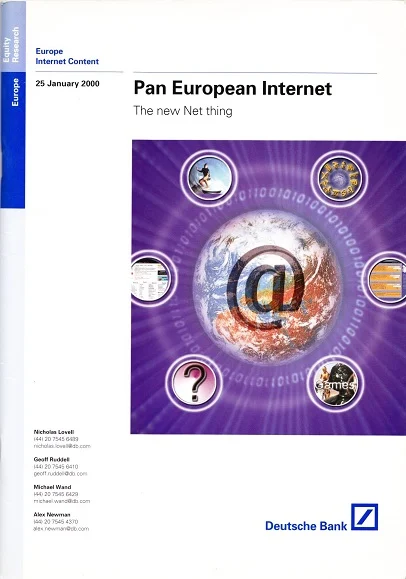
In the late 1990s, the internet was viewed by the financial establishment as a "nerdy" curiosity. By 2000, it had become a speculative monster. At firms like Deutsche Bank, analysts were tasked with advising a generation of middle-aged, male investors on how to navigate a world that was moving from physical ledgers to digital networks.
Three months before the infamous dotcom crash, valuations were stratospheric. The prevailing wisdom among savvy analysts was not to focus on absolute valuation—which was often untethered from reality—but to identify the business models and teams capable of surviving the inevitable correction. This era birthed "Black Swans" like Amazon, which survived a 90% stock price drop to eventually dominate global retail. The lesson of 2000 was clear: the bubble was real, but the internet was even more real.
2008: The Free-to-Play and Mobile Revolution
By 2008, the author had transitioned from the world of high finance to the front lines of the gaming sector, specializing in M&A for small to medium-sized developers. During this period, meetings with the titans of the industry—CEOs of EA, Activision, and Eidos—revealed a deep-seated anxiety.
A new model was emerging from the East. Browser-based games in South Korea and Germany were demonstrating that "giving the game away for free" was not a recipe for bankruptcy, but a path to unprecedented scale. By tying players to persistent accounts and charging for progress or cosmetics, developers were creating "games as a service" (GaaS).
This shift was accelerated by Steve Jobs’ announcement of the iPhone. Suddenly, the delivery mechanism for gaming changed from a $60 disc in a retail store to a digital download on a device that lived in the user’s pocket. Traditional executives struggled to process this. They were accustomed to a "hit-driven" model based on one-time purchases, not the data-driven, long-term retention strategies required by the F2P model.
2021: The Blockchain and NFT Paradox
The third wave arrived with the explosion of Web3. The combination of decentralized finance (DeFi) and digital collectibles created a market that looked, to many, like a repeat of the 2000 bubble. The rhetoric was dominated by "moon" missions and "HODLing," while the actual utility of many NFT projects remained opaque.
However, the core shift remains the same: a new way to define and trade value. For the first time, the author—now the "older investor"—finds themselves in the position of the skeptic. The urge to dismiss the entire sector as "Ponzi-nonsense" is strong, yet history suggests that dismissing the technology because of the behavior of its earliest, most speculative adopters is a mistake.
Supporting Data: Market Valuations and Growth Trajectories
The scale of these shifts can be measured through the lens of market performance and consumer behavior.
- The Dotcom Era: At its peak in March 2000, the NASDAQ Composite index reached 5,048.62, more than doubling its value in a single year. While the subsequent crash wiped out trillions in market cap, it cleared the way for the "Web 2.0" giants.
- The Mobile/F2P Era: In 2008, mobile gaming was a negligible sliver of the global games market. By 2021, mobile gaming accounted for over 50% of the $180 billion global market, consistently outperforming both PC and console sectors combined. The F2P model became the dominant revenue generator, with titles like Honor of Kings and Candy Crush Saga generating billions annually.
- The NFT/Blockchain Era: In 2021, NFT trading volume surpassed $24.9 billion, compared to just $94.9 million in 2020, according to DappRadar. While much of this was speculative, it signaled a massive influx of capital and talent into the decentralized space.
Official Responses and Industry Sentiment
The industry’s reaction to these shifts has followed a predictable pattern of resistance, followed by cautious experimentation, and eventually, total adoption.
The Incumbent Perspective:
In the 2008 era, major publishers were initially dismissive of F2P, fearing it would devalue their premium IPs. John Riccitiello (then CEO of EA) eventually pivoted the company toward digital services, a move that was initially panned by investors but later seen as visionary.
In the 2021 cycle, the response has been more fragmented. Ubisoft became one of the first major publishers to integrate NFTs via its "Quartz" platform, meeting significant backlash from its core player base. Meanwhile, companies like Square Enix and Take-Two have expressed long-term interest in the technology, while Valve (Steam) has banned blockchain games entirely, citing concerns over volatility and fraud.
The Regulatory Stance:
Governments have been slow to react. In the early 2000s, the focus was on antitrust (Microsoft). In the 2010s, it shifted to loot boxes and gambling mechanics in F2P games. In the current era, the SEC and other global regulators are primarily concerned with whether cryptocurrencies and NFTs constitute "unregistered securities," a debate that will likely define the legal landscape for years to come.
Implications: The Future of Digital Identity and Ownership
As the "older investor" tries to find the signal in the noise of 2021, several long-term implications emerge:
1. The Normalization of Digital Scarcity
For decades, the digital world was defined by infinite reproducibility. The blockchain introduces the concept of "provable scarcity." Even if the current price of a "Bored Ape" is inflated, the underlying ability to prove that this digital item is the original will likely become a standard feature of digital life.
2. The Evolution of Self-Expression
Just as people use luxury cars or designer clothing to signal status and identity in the physical world, the next generation is doing so with avatars and digital assets. This is not a "bubble"—it is a fundamental shift in human sociology. If a player spends 2,000 hours in a virtual world, their identity in that world is more "real" to them than the clothes they wear to the grocery store.
3. The Democratization of Game Economies
The most radical (and controversial) implication is the "Play-to-Earn" or "Play-and-Earn" model. While early iterations like Axie Infinity faced sustainability issues, the idea that players should own a piece of the value they create in a game’s ecosystem is a powerful one. It challenges the traditional "walled garden" approach of publishers and suggests a future where game economies are more like real-world economies.
4. The Challenge of "The Third Event"
The author’s personal journey reflects the broader challenge of the industry. In 2000 and 2008, the path forward felt clearer, even amidst the chaos. In 2021, the complexity of the technology and the intensity of the hype make it harder to see the destination.
The struggle is to avoid the "curmudgeon trap"—dismissing a revolution because it is messy, loud, and populated by bad actors. The internet was messy in 1995. F2P was widely hated by "hardcore" gamers in 2003. Yet, they both became the building blocks of our modern world.
Conclusion
The "Third Transformational Event" is currently in its most volatile phase. We are seeing the collision of high-concept technology and low-brow speculation. For the analyst, the investor, and the developer, the task remains the same as it was in 2000 and 2008: look past the valuations, ignore the memes, and identify the business models that solve real problems or satisfy fundamental human desires.
The blockchain may currently be a "hot potato" for many, but as the music slows and the speculators exit, the infrastructure that remains will likely form the backbone of the next twenty years of digital interaction. For those willing to learn, the opportunities lie beneath the hype. Luck, as they say, is what happens when preparation meets opportunity—and in this third wave, preparation involves a very steep learning curve.