The Rise of the ‘Cozy’ Sim: Trash Goblin Surpasses Funding Goals as Final 24-Hour Countdown Begins
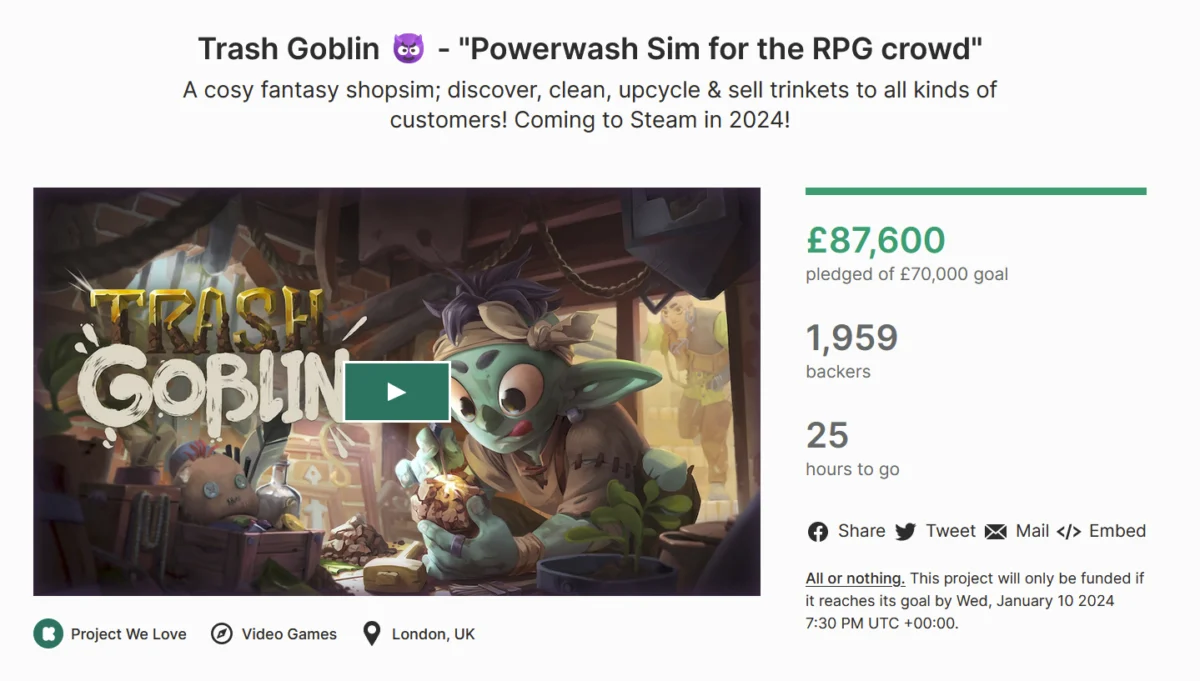
LONDON — In an era where the indie gaming landscape is increasingly crowded, Spilt Milk Studios has carved out a significant victory. Their latest project, Trash Goblin, a "cosy trinket-cleaning simulator," has officially surpassed its primary funding goal on Kickstarter, reaching 124% of its target with only 24 hours remaining in the campaign. As the clock ticks down, the studio and its leadership are making a final push to cross the "magic" £100,000 threshold, a milestone that would provide additional resources for polish and potential stretch goals.
The success of Trash Goblin reflects a broader shift in consumer appetite within the gaming industry, moving away from high-stress competitive environments toward "wholesome" or "meditative" experiences. Described by its creators as "Powerwash Simulator for the RPG crowd," the game invites players into a whimsical world where the primary objective is the meticulous restoration of discarded items.
Main Facts: A Crowdfunding Success Story
The Trash Goblin Kickstarter campaign has become a beacon of success for independent self-publishing in 2024. As of January 9, the project has secured more than 124% of its initial financial requirement. The campaign’s momentum accelerated significantly following the New Year, a period often considered difficult for fundraising due to post-holiday financial fatigue.
The game itself is a unique blend of shopkeeping and tactile restoration. Players take on the role of a goblin operating a small workshop, where they receive boxes of "trash"—crusty, dirt-covered artifacts from various fantasy adventures. Using a variety of tools, players must carefully chip away grime, scrub surfaces, and repair broken components to reveal the treasures beneath. Once restored, these items can be sold to a cast of quirky NPCs, each with their own backstories and requirements.
The financial health of the project is bolstered by a dual-track strategy:
- Kickstarter Backing: Direct financial support from a dedicated community of "superfans."
- Steam Wishlisting: A critical metric for the game’s eventual retail success, which the studio is actively encouraging to trigger favorable algorithmic placement on the Steam storefront.
Chronology: From Concept to the Final 24 Hours
The journey of Trash Goblin is inextricably linked to the evolution of Spilt Milk Studios, a London-based independent developer known for its creative experimentation.
Early Development and Genre Pivot
Spilt Milk Studios, led by founder Andrew Smith, has a history of diverse titles, including the massive multiplayer experiment Lazarus and the action-heavy Tango Fiesta. However, the development of Trash Goblin marked a strategic pivot toward the burgeoning "cozy game" genre. The team identified a gap in the market for games that offer the satisfaction of manual labor without the stress of combat or time-sensitive failure states.
The Campaign Launch
The Kickstarter was launched in late 2023, amidst a volatile period for the games industry characterized by layoffs and studio closures. Despite the economic climate, the campaign found an immediate audience. The "Powerwash Simulator" comparison resonated with players who enjoyed the "oddly satisfying" genre of digital cleaning and restoration.
The New Year Surge
By late December, the campaign was approaching its goal. It was shortly after the New Year that the project hit its 100% funding mark. This milestone transformed the final week of the campaign into a "stretch goal" sprint, aiming to maximize the budget for the game’s planned release. On January 9, 2024, the campaign entered its final 24 hours, sitting at 124% funding with the ambitious £100,000 target in sight.
Supporting Data: The Business of ‘Cozy’ Games
The success of Trash Goblin is not an isolated incident but rather a data point in a larger industry trend. The "Cozy Games" movement, popularized by titles like Animal Crossing: New Horizons, Stardew Valley, and more recently, Unpacking, has become a multi-million dollar sub-sector of the indie market.
Market Comparables
- Powerwash Simulator: A surprise hit that proved players would spend dozens of hours performing digital chores if the feedback loops were sufficiently satisfying.
- Unpacking: Demonstrated that the act of organizing and "cleaning" a space could carry deep emotional and narrative weight.
- The ‘Wholesome Games’ Direct: A dedicated marketing event that now attracts millions of viewers, specifically targeting the demographic Trash Goblin is designed for.
The Importance of Wishlists
For indie developers, Steam wishlists are the primary currency of pre-launch success. Data suggests that a game with 50,000 to 100,000 wishlists is significantly more likely to receive "Featured" status on the Steam homepage upon release. By leveraging the Kickstarter campaign to drive Steam wishlists, Spilt Milk Studios is effectively running a two-pronged marketing assault that ensures long-term viability beyond the initial crowdfunding burst.
Official Responses: A New Leadership Perspective
A pivotal factor in the recent momentum of Trash Goblin is the shifting role of Nicholas Lovell within Spilt Milk Studios. Lovell, a renowned game industry consultant, author of The Curve, and founder of Gamesbrief, recently transitioned from a non-executive role to an executive one.

Nicholas Lovell’s Involvement
Lovell’s transition comes at a time of personal and professional challenge. In a recent statement, Lovell revealed his ongoing struggle with Long COVID, which has necessitated a part-time schedule. Despite these health constraints, his increased involvement in the executive functions of the studio has provided a strategic edge.
"I’m so excited that the Kickstarter I’m part of has funded," Lovell stated. "I’ve recently stepped up from a non-executive role at Spilt Milk to an executive one. I’m still part-time, but I’m much more involved. And the biggest thing I’m involved in is Trash Goblin."
Lovell’s expertise lies in "The Curve"—a business philosophy that focuses on finding a small group of dedicated fans who are willing to pay more for a product they love, rather than trying to appeal to a mass market with a generic offering. Trash Goblin is a textbook application of this theory, using Kickstarter to identify and engage that core audience early in the development cycle.
The Studio’s Vision
The studio’s official stance emphasizes community engagement. By allowing backers to influence certain aspects of the game’s development through the Kickstarter platform, Spilt Milk is fostering a sense of ownership among its players. This "open development" model is designed to reduce the risks associated with self-publishing.
Implications: The Future of Self-Publishing and Indie Sustainability
The success of the Trash Goblin campaign carries broader implications for the indie development community, particularly regarding how small studios survive in a post-consolidation industry.
The Self-Publishing Path
By bypassing traditional publishers, Spilt Milk Studios retains 100% of the intellectual property and a larger share of the revenue. However, this path requires the studio to take on the full burden of marketing and community management. The success of Trash Goblin suggests that for studios with a clear "hook" and a well-defined niche, self-publishing via crowdfunding remains a viable, albeit labor-intensive, path to market.
The Psychological Appeal of Restoration
From a design perspective, Trash Goblin taps into a deep-seated human desire for order and restoration. In a world that often feels chaotic, the ability to take something broken and "ugly" and make it whole and "beautiful" provides a therapeutic loop. This "digital zen" is becoming a staple of indie game design, providing an alternative to the dopamine-heavy, high-stress loops of mainstream AAA titles.
What Comes Next?
As the Kickstarter concludes, the focus will shift from fundraising to production. The additional funds secured beyond the 100% mark will likely be allocated to:
- Enhanced Visuals: Increasing the fidelity of the "crust" and "grime" shaders that are central to the cleaning mechanic.
- Expanded Narrative: Hiring additional writers to flesh out the backstories of the customers who frequent the goblin’s shop.
- Platform Porting: While currently focused on Steam, the funding level may allow for future considerations regarding Nintendo Switch or other consoles, which are traditionally strong markets for the cozy genre.
Conclusion: The Final Push
With less than 24 hours remaining, Trash Goblin stands as a testament to the power of a clear vision and a dedicated community. The transition of Nicholas Lovell to an executive role signifies a professionalization of the studio’s business strategy, blending creative whimsy with hard-nosed market analysis.
Whether or not the campaign reaches the "magic £100,000," the project is already a confirmed success. For the RPG crowd looking for a change of pace—from slaying dragons to scrubbing the dirt off their discarded loot—Trash Goblin represents the next wave of satisfying, low-stress gaming.
As Lovell concluded in his address to the community: "It would be amazing if you could check it out on Kickstarter, wishlist us on Steam, and maybe, just maybe, get us over that magic £100,000."
The industry will be watching closely to see how the final hours of this campaign unfold, and more importantly, how the "Trash Goblin" itself fares when it eventually opens its doors to the public.