The Enduring Epic of Homecoming: Unpacking Homer’s Odyssey
By [Your Name/Journalist Alias, or Mark Cartwright as per source]
[City, Date] – More than two and a half millennia after its composition, Homer’s Odyssey remains an unparalleled masterpiece, a foundational text of Western literature, and a narrative that continues to resonate with audiences worldwide. Far from being a mere ancient tale, this epic poem is a profound exploration of human endurance, loyalty, identity, and the relentless quest for home. It is, as many scholars observe, Greek mythology’s greatest road trip, a journey of redemption, and a homecoming voyage, all meticulously woven into a single, compelling tapestry.
At its heart lies Odysseus, the cunning and resourceful king of Ithaca, a veteran of the brutal Trojan War. After ten years of fighting at Troy, Odysseus faces another decade of perilous wanderings across unknown seas, battling mythical beasts, outwitting vengeful gods, and resisting seductive nymphs, all in his desperate bid to return to his faithful wife, Penelope, and his son, Telemachus. His odyssey, a term now synonymous with any long, arduous journey, is a testament to the human spirit’s capacity for persistence against overwhelming odds.
First solidified in written form around the 8th century BCE, following a rich and extensive oral tradition, the Odyssey plunges its hero and its readers into a world of both divine intervention and human folly. It is a literal voyage into hell and back, captivating generations with its daring deeds, misadventures, and a deeply longed-for happy ending that reminds us of a timeless era when courage, loyalty, and unwavering heroism could, against all expectations, overcome the most formidable obstacles. The narrative structure, featuring flashbacks and a hero recounting his own tales, was revolutionary and continues to influence storytelling to this day.
Main Facts: The Core of the Epic
The Odyssey is attributed to the legendary Greek poet Homer, though the "Homeric Question"—whether Homer was a single individual or a collective name for a tradition of oral poets—remains a subject of scholarly debate. Regardless of authorship, the poem itself is a monumental achievement, comprising 12,109 lines of dactylic hexameter, traditionally divided into 24 books.
The central premise is Odysseus’s struggle to return to his kingdom of Ithaca following the fall of Troy. Unlike his fellow Greek heroes who largely sailed home without significant detours, Odysseus incurs the wrath of Poseidon, the god of the sea, ensuring his journey is fraught with divine opposition and monstrous encounters. Meanwhile, back in Ithaca, his palace is overrun by arrogant suitors vying for Penelope’s hand and squandering Odysseus’s wealth, presuming him dead. The narrative thus unfolds on two parallel fronts: Odysseus’s external struggle to return, and Telemachus’s internal struggle to mature and protect his mother and patrimony.
Key themes woven throughout the epic include:
- Nostos (Homecoming): The profound longing for home and the identity tied to it.
- Metis (Cunning Intelligence): Odysseus’s defining characteristic, often allowing him to overcome challenges where brute force would fail.
- Xenia (Hospitality): The sacred ancient Greek custom of guest-friendship, frequently violated by villains and upheld by virtuous characters.
- Divine Intervention: The active role of gods like Athena (Odysseus’s patron) and Poseidon (his antagonist) in human affairs.
- Loyalty and Perseverance: Exemplified by Penelope’s unwavering fidelity and Odysseus’s relentless determination.
- Justice and Retribution: The ultimate fate of the suitors and those who transgress moral codes.
Chronology: Odysseus’s Perilous Voyage Home
Odysseus’s journey begins after the Achaeans’ victory at Troy, a triumph largely credited to his stratagem of the Trojan Horse. His initial departure is swift, but divine displeasure quickly sets the stage for his prolonged suffering.
The Early Misfortunes and Temptations
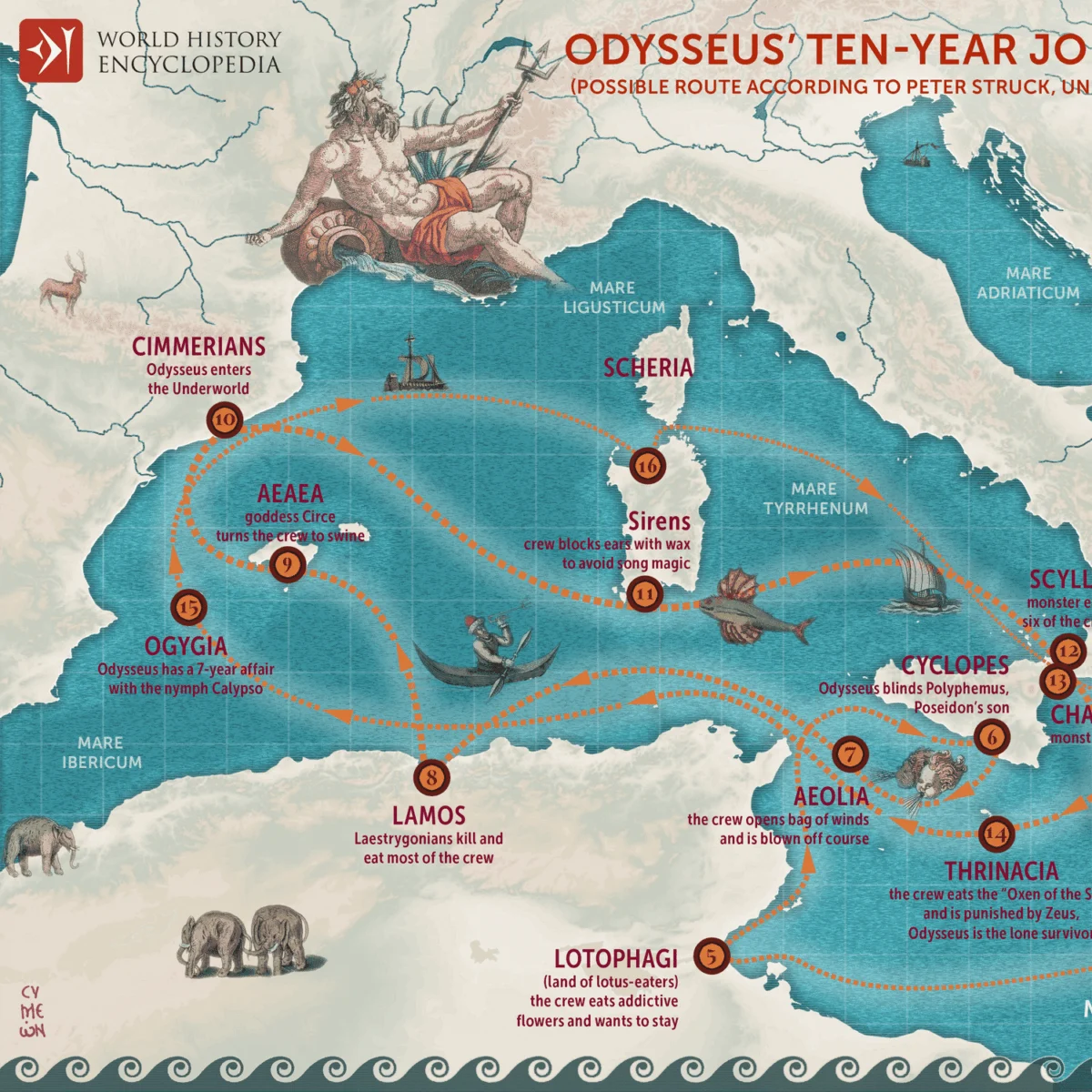
- The Cicones: The first stop is Ismarus, home of the Cicones. Odysseus’s men plunder the city but linger too long, allowing the Cicones to regroup and inflict heavy casualties, marking the first tragic loss for Odysseus’s crew.
- The Lotus-Eaters: Blown off course by a storm, they land on the island of the Lotus-Eaters. Some of Odysseus’s men eat the intoxicating lotus flower, which makes them forget their desire to return home. Odysseus must forcibly drag them back to the ships. This episode highlights the allure of oblivion over the struggle for purpose.
- Polyphemus the Cyclops: A pivotal and brutal encounter. Odysseus and his men stumble upon the cave of Polyphemus, a giant, one-eyed Cyclops, who traps them and begins to devour them. Odysseus employs his famed cunning, introducing himself as "Nobody" (Outis), intoxicating the Cyclops, and then blinding him with a heated stake. They escape by clinging to the bellies of Polyphemus’s sheep. However, in an act of hubris, Odysseus reveals his true name, inviting the Cyclops’s father, Poseidon, to curse his journey home. This curse becomes the primary driver of Odysseus’s subsequent suffering.
- Aeolus, God of Winds: They arrive at the floating island of Aeolia, where Aeolus, keeper of the winds, hospitably gives Odysseus a bag containing all unfavorable winds, allowing a smooth sail home. But just as Ithaca is in sight, Odysseus’s curious and greedy crew open the bag, unleashing a tempest that blows them all the way back to Aeolus, who, believing them cursed, refuses further aid.
Catastrophe and Divine Counsel
- The Laestrygonians: A disastrous stop at the land of the Laestrygonians, a race of giant, cannibalistic people. They destroy all but one of Odysseus’s twelve ships and devour most of his remaining crew. This encounter epitomizes the raw, unbridled danger of the unknown world.
- Circe’s Island (Aeaea): Odysseus and his last ship land on Aeaea, the island of the sorceress Circe. She transforms many of his men into swine. With the help of Hermes, who provides him with the magical herb moly, Odysseus resists Circe’s magic and forces her to restore his men. They remain on her island for a year, enjoying her hospitality. Before their departure, Circe instructs Odysseus to journey to the Underworld to consult the prophet Tiresias for guidance on his homecoming.
The Descent into the Underworld (Nekyia)
- Journey to the Land of the Dead: Odysseus descends into Hades, the realm of the dead. There, he performs a ritual sacrifice to summon the spirits. He speaks with Tiresias, who foretells his challenging path home, warns him against harming the cattle of Helios, and predicts his eventual death at sea. Odysseus also encounters the spirits of his mother, Anticleia, various heroes of Troy (Agamemnon, Achilles, Ajax), and mythological figures, gaining invaluable insights into the fate of mortals and the nature of the afterlife.
Navigating Deadly Passages
Upon returning to Circe, she provides Odysseus with crucial warnings and advice for the perilous journey ahead, as detailed in the original excerpt:
"Odysseus returns to Circe, who warns him of the Sirens, creatures which are half-bird and half-woman who prey on sailors. She advises the men to plug their ears with wax and for Odysseus to lash himself to the mast. He must then negotiate passage past the six-headed monster Scylla and deadly whirlpool Charybdis. He also receives his second warning of the folly of interfering with the herds of Helios. The heroes set sail across the wine-dark sea once more to negotiate the perils described by Circe…"
- The Sirens: Following Circe’s counsel, Odysseus’s men plug their ears with wax, while Odysseus, bound to the mast, is the only one to hear the Sirens’ enchanting, deadly song, which lures sailors to their doom. This demonstrates his unique blend of courage and curiosity, seeking knowledge even at great personal risk.
- Scylla and Charybdis: Odysseus steers his ship between these two formidable dangers. Scylla, a six-headed monster, snatches six of his men from the deck, devouring them. Charybdis, a monstrous whirlpool, threatens to swallow the entire ship. Odysseus bravely sacrifices six men to avoid the total annihilation of his vessel and crew, a grim decision illustrating the harsh realities of leadership.
- The Cattle of Helios (Thrinacia): Despite explicit warnings from both Tiresias and Circe, Odysseus’s famished crew, stranded on the island of Thrinacia by a storm, succumbs to temptation and slaughters some of Helios’s sacred cattle while Odysseus is asleep. The sun god Helios appeals to Zeus, who, in retribution, sends a thunderbolt that destroys Odysseus’s ship, drowning all his men. Odysseus alone survives, clinging to wreckage.
Solitary Survival and Divine Aid
- Calypso’s Isle (Ogygia): Odysseus drifts to the island of Ogygia, home of the nymph Calypso. She holds him captive for seven years, offering him immortality if he stays with her. Odysseus, however, pines for his home and family, refusing her offer. Eventually, Athena intervenes on his behalf, persuading Zeus to send Hermes to command Calypso to release him. She reluctantly helps him build a raft.
- The Phaeacians (Scheria): After leaving Calypso, Odysseus is shipwrecked again by Poseidon, who spots him sailing. He washes ashore on Scheria, the land of the Phaeacians, a hospitable and seafaring people. He is discovered by Nausicaa, the king’s daughter, who guides him to her parents, King Alcinous and Queen Arete. Odysseus recounts his entire epic journey to them, a brilliant narrative device that allows Homer to present the bulk of Odysseus’s adventures as a flashback. Impressed by his tale and moved by his plight, the Phaeacians provide him with a ship and crew to finally transport him home.
The Return to Ithaca and Restoration
- Arrival in Ithaca: The Phaeacians deliver Odysseus, sleeping, to the shores of Ithaca. Athena appears, disguises him as an old beggar, and informs him of the dire situation in his palace, overrun by over a hundred insolent suitors vying for Penelope’s hand and consuming his wealth.
- Reunion and Planning: Odysseus first seeks out his loyal swineherd, Eumaeus, who unknowingly offers him hospitality. He then reveals himself to his son, Telemachus, who has just returned from a journey seeking news of his father. Together, they begin to plot the suitors’ downfall.
- The Beggar in the Palace: Odysseus enters his own palace in disguise, enduring insults and abuse from the suitors. Only his old dog, Argos, recognizes him and dies shortly after. His faithful nurse, Eurycleia, recognizes him by a distinctive scar while washing his feet, but he swears her to secrecy.
- Penelope’s Test: Penelope, still hoping for Odysseus’s return, proposes an archery contest: whoever can string Odysseus’s mighty bow and shoot an arrow through the holes of twelve axe heads will win her hand. Only Odysseus, still disguised as a beggar, can perform this feat.
- The Suitors’ Massacre: After successfully stringing the bow and shooting the arrow, Odysseus sheds his disguise. With the aid of Telemachus, Eumaeus, and the cowherd Philoetius, and divine assistance from Athena, he systematically slaughters all the suitors in a brutal and bloody battle, exacting his justice. He also punishes disloyal servants.
- The Test of the Olive Tree Bed: Penelope, ever cautious and fearing trickery from the gods, tests Odysseus. She tells Eurycleia to move their marriage bed into the hall. Odysseus, knowing that their bed is immovably carved from the trunk of an olive tree that grows within their bedchamber, describes its unique construction. This intimate detail, known only to them, proves his identity to Penelope, leading to a tearful and joyous reunion after twenty years.
- Restoration of Order: Odysseus reconciles with his aging father, Laertes. The families of the slain suitors seek revenge, but Athena intervenes, establishing peace in Ithaca, thus restoring order to Odysseus’s kingdom and family.
Supporting Data: Historical Context and Literary Genesis
The Odyssey emerged from a rich tradition of oral storytelling that predated written language. Bards, or aoidoi, would perform these epic poems, often improvising within established poetic formulas, using mnemonic devices like epithets ("rosy-fingered Dawn," "wise Odysseus," "wine-dark sea") and recurring scenes. The transition from this oral tradition to a written text in the 8th century BCE was a monumental step, preserving these stories for posterity.
Scholarly debates surrounding "the Homeric Question" have explored whether The Iliad and The Odyssey were composed by a single poet, or if "Homer" represents a long tradition of bards whose works were later compiled. Regardless, the sophisticated structure, character development, and thematic unity of the Odyssey suggest a singular, powerful creative force or at least a highly skilled editor.
The poem offers invaluable insights into the values and customs of early Iron Age Greek society, sometimes reflecting earlier Bronze Age Mycenaean influences. It illuminates concepts such as:

- The Heroic Code: Emphasizing honor, glory (kleos), and a strong sense of personal worth.
- Divine Intervention: The polytheistic worldview where gods actively shape human destiny, often with capricious motives.
- Social Hierarchy: The roles of kings, nobles, servants, and slaves.
- Navigation and Warfare: Depictions of seafaring, shipbuilding, and the brutal realities of ancient combat.
- The Importance of Lineage and Inheritance: The struggle to reclaim ancestral lands and power.
The language of Homer is a unique literary dialect, primarily Ionic Greek with Aeolic and other archaic influences, rendered in dactylic hexameter, a meter that gives the epic its distinctive rhythm and grandeur. The use of epic similes—extended comparisons often drawing from nature—enriches the narrative, providing vivid imagery and emotional depth.
Scholarly Perspectives and Modern Interpretations
The Odyssey‘s influence has been continuous, shaping literary and philosophical thought for millennia.
Ancient Reception: In antiquity, the Odyssey was a cornerstone of Greek education, alongside The Iliad. Philosophers like Plato, while critical of Homer’s portrayal of the gods in some respects, acknowledged the poems’ profound moral and educational value. Aristotle praised its sophisticated plot and character development. Roman poets like Virgil were heavily influenced, with the Aeneid drawing inspiration from Odysseus’s journey.
Medieval and Renaissance Periods: Though less widely available in Western Europe during the early Middle Ages, its knowledge was preserved in the Byzantine Empire and later rediscovered during the Renaissance, fueling a renewed interest in classical antiquity and inspiring poets like Dante Alighieri (who placed Odysseus in his Inferno for his endless wandering).
Enlightenment and Romanticism: The Enlightenment valued Odysseus’s rationality and cunning, while the Romantics embraced his adventurous spirit and emotional depth, seeing him as a symbol of individualism and exploration.
20th and 21st Century Adaptations: The Odyssey continues to be reimagined across various media:
- Literature: James Joyce’s monumental Ulysses (1922) transposes Odysseus’s journey to a single day in Dublin, following Leopold Bloom. Margaret Atwood’s The Penelopiad (2005) offers a feminist retelling from Penelope’s perspective. Derek Walcott’s Omeros (1990) reinterprets the epic in a Caribbean context.
- Film and Television: Adaptations range from serious historical dramas to fanciful retellings. The Coen Brothers’ O Brother, Where Art Thou? (2000) famously re-imagines Odysseus’s journey in the American Deep South during the Great Depression.
- Psychological and Philosophical Readings: Carl Jung’s concept of the "hero’s journey" finds a prime archetype in Odysseus, whose trials represent stages of psychological development and self-discovery. Philosophers explore themes of identity, free will, fate, and the ethical dilemmas presented throughout the narrative.
- Feminist Critiques: Modern scholarship often re-examines the roles of female characters—Penelope, Circe, Calypso, Nausicaa—moving beyond passive archetypes to explore their agency and power within the patriarchal society depicted.
- Post-colonial Interpretations: Some scholars view Odysseus’s encounters with other cultures through a post-colonial lens, analyzing themes of exploration, conquest, and the encounter between "civilized" and "othered" peoples.
Implications: The Enduring Legacy of the Wanderer
The Odyssey is far more than a historical artifact; it is a living text whose implications continue to shape our understanding of literature, culture, and the human condition.
The Archetypal Narrative: Joseph Campbell’s seminal work, The Hero with a Thousand Faces, popularized the concept of the monomyth, or "hero’s journey," for which Odysseus serves as a quintessential example. His journey—departure, initiation, and return—provides a narrative template that underpins countless stories across cultures and time, from ancient myths to modern blockbusters. This structure resonates because it mirrors the challenges and transformations inherent in human life itself.
Influence on Western Thought: The themes explored in the Odyssey have profoundly influenced Western philosophical and ethical thought. Odysseus’s resilience, his intellectual prowess (metis), and his unwavering commitment to his family and kingdom have made him an enduring symbol of human potential. The ethical questions raised by the text—the nature of justice, the morality of revenge, the responsibilities of leadership, the sanctity of hospitality—continue to be debated.
Educational Value: As a foundational text in classical studies, comparative literature, and philosophy, the Odyssey remains a staple of educational curricula worldwide. It introduces students to epic poetry, ancient Greek culture, and universal human experiences, fostering critical thinking and a deeper appreciation for literary artistry.
Cultural Resonance: In an increasingly globalized world marked by displacement, migration, and the constant search for belonging, the Odyssey‘s central theme of nostos (homecoming) resonates with particular power. Odysseus’s longing for home, his struggle to reclaim his identity, and his eventual reunion with his loved ones speak to universal human desires for stability, connection, and a sense of place. The narrative reminds us that the journey, however arduous, is often as transformative as the destination itself.
From the quiet contemplation of a scholar to the shared experience of a film audience, The Odyssey continues to captivate. Its ability to transcend time and cultural boundaries lies in its profound exploration of universal human experiences: love, loss, courage, cunning, and the enduring power of hope. It reminds us that even after the longest and most perilous of journeys, the deepest human desire remains the return to what truly matters.