Ancient Echoes, Modern Tome: "The Treasury of Folklore" Unveils Humanity’s Shared Myths
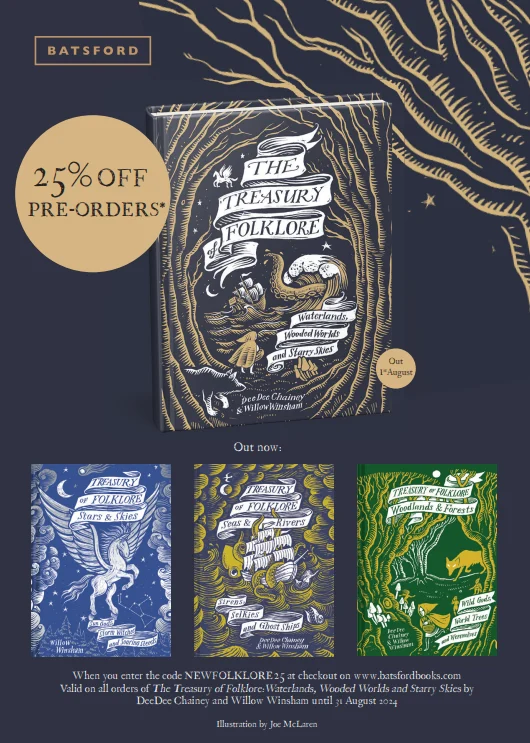
LONDON, UK – July 22, 2024 – Nearly a decade after its initial conception, the ambitious vision of exploring global folklore through the lens of shared human landscapes culminates this August in a monumental new compendium. Authors Dee Dee Chainey and Willow Winsham, alongside illustrator Joe McLaren, are set to release "The Treasury of Folklore: Waterlands, Wooded Worlds and Starry Skies" on August 1st, 2024. This single, beautifully crafted volume compiles the most cherished tales and insights from their highly successful three-book series, promising readers a journey into the universal threads that weave through humanity’s deepest fears, dreams, and customs.
The Genesis of a Global Narrative: From Vision to Three Volumes and Beyond
The journey to this comprehensive tome began with a simple, yet profound, idea: to create a single book that would traverse the diverse physical landscapes inhabited by humans across the world, documenting the folklore born from these environments. However, the sheer volume and richness of the material uncovered by Chainey and Winsham quickly outgrew the confines of a single publication. The overwhelming outpouring of engagement and inspiration, particularly through the vibrant #FolkloreThursday hashtag on social media, underscored the deep public appetite for these ancient narratives and their modern relevance.
This initial expansion led to the creation of three distinct, celebrated volumes: Seas and Rivers, Trees and Woodlands, and Stars and Skies. Each book meticulously explored how different cultures articulated their understanding of, and relationship with, these fundamental elements of the natural world through myths, legends, and customs. The series quickly garnered a dedicated readership, a reception the authors describe as both "surprising and heartwarming." The success of these individual works solidified the notion that while the specific details of beliefs and customs might vary from one corner of the globe to another, the underlying human experiences—primal fears, aspirations, and a shared awe for the unknown—remain remarkably consistent.
The idea for a compendium was a natural evolution, an opportunity to finally realize the original grand vision of a unified exploration. Behind the scenes, the process involved a meticulous re-evaluation of the existing material. The authors approached their well-known words with "fresh eyes," carefully curating what to include and what to omit to ensure the new volume flowed seamlessly as a single, cohesive narrative. This extensive effort was aimed at distilling the essence of the series into a definitive collection that would span "shared landscapes across time and place," ultimately delivering a product that has left the creators "blown away" by the end result.
Unearthing Universal Truths: Supporting Data from the Heart of Folklore
At its core, "The Treasury of Folklore" project is driven by a quest for understanding: how humans worldwide forge beliefs and narratives around their dwelling places. The enduring power of folklore lies in its ability to articulate our deepest connections to the environment and to each other. The compendium masterfully illustrates this by presenting diverse examples that resonate with shared human experiences.
Water Horses: The Allure and Peril of the Deep
The book delves into the fascinating and often terrifying realm of water horses, mythical steeds that haunt the world’s lakes and waterways. These creatures, whether interpreted as literal beasts or potent cautionary tales, embody humanity’s ancient respect and fear of water’s untamed power.

One of the most renowned is the Scottish Kelpie, though the text clarifies the distinction between the river-dwelling Kelpie and the loch-frequenting each-uisge. The Kelpie, a majestic yet malevolent entity, lures unwary travelers onto its back, only to drag them to a watery demise. Yet, tales also speak of its potential, albeit fleeting, taming through a cross-marked bridle, or even its defeat by red-hot iron—a common vulnerability for many folkloric entities. The Kelpie’s profound cultural impact is undeniable, evidenced by the towering 30-meter sculptures near Falkirk, a modern testament to its enduring hold on the Scottish imagination, and its appearances in contemporary literature by authors like Lari Don and J.K. Rowling.
Intriguingly, the Kelpie’s presence is conspicuously absent from English folklore, suggesting unique regional mythologies despite geographical proximity. This deficit is strikingly redressed in Wales with the Ceffyl Dwr, a shapeshifting water spirit that persisted in belief into the 19th century. In northern Wales, it assumed various forms, often violent, while in the south, it consistently appeared as an enchanting, small horse. Known for incredible speed, the Ceffyl Dwr would cover vast distances before vanishing, leaving its hapless rider to drown. An unusual exception existed for clergymen of any creed, who were said to be able to ride the horse safely, highlighting a curious intersection of religious belief and ancient myth.
Across the North Sea, Scandinavia offers the Bäckenhäst, or ‘brook horse,’ often sighted in fog. Described as luminous and majestic, it beguiles riders before plunging them into the water. Children are frequently its victims in these tales, perhaps amplifying the sense of peril. A popular story tells of boys saved from a Bäckenhäst when the last child mispronounces a rhyming colloquial phrase as "Jesus Christ," a name the creature despises. Like the Kelpie, the Bäckenhäst could sometimes be tricked into servitude, showcasing the recurrent theme of human ingenuity against supernatural forces. These narratives collectively underscore a shared global apprehension of treacherous waters, personified by beautiful but deadly equine spirits.
Lords of the Wild: Guardians and Tricksters of the Forest
Leaving the aquatic realm, the book transports readers to the "verdant greenery of the forest," the domain of the "Lords of the Wild." These spirits and creatures, ranging from malevolent destroyers to protective guardians, embody humanity’s complex relationship with the untamed wilderness.
In Finnish folklore, Tapio, also known as Metsähine or Hiisi, reigns as the king of the forest. Depicted as tall and thin, adorned in ermine fur or moss, with a mossy beard and tree-like back, he is both the personification and protector of the forest. Hunters traditionally sought his blessing for a successful hunt, pledging respect for the land and its creatures—a clear reflection of animistic beliefs and the necessity of harmonious coexistence with nature. Tapio, with his benevolent wife Mielikki (or stern Kuurikki), and helpful children Nyrikki (guide for hunters) and Tulikki (director of prey), represents a pantheon deeply intertwined with the rhythms of the forest. The Estonian equivalent shares similarities, notably possessing a single eye, akin to the Norse god Odin, hinting at broader Indo-European mythic connections.
Slavic tradition introduces the Leshy (or Leshii, Lyeshy), a tutelary spirit and protector of trees and animals, particularly wolves or bears. The Leshy hibernates like its ursine companions and is a master shapeshifter, capable of altering its size from a blade of grass to a towering tree. While appearing human-like, it possesses tell-tale signs: lack of eyelashes or brows, shoes worn on the wrong feet, clothes wrapped in reverse, wild hair, cloven feet, and sometimes wings or a tail. Its moral ambiguity is striking; it protects the forest but is a notorious trickster, able to mimic voices, confuse travelers, and even tickle victims to death. It abducts women and children and can inflict curses on farms, demanding appeasement through offerings or prayers.

Despite its formidable powers, humans developed ingenious ways to thwart a Leshy. Turning clothes inside out or shoes on the wrong feet is said to provoke laughter, instantly returning the lost to their path. Swearing at the Leshy or making the sign of the cross are other methods of banishment. For those daring enough to seek its presence, a specific ritual involves cutting young birch trees, arranging them in a circle, and calling out to the "grandfather of the forest" from the center, devoid of Christian symbols. The Leshy’s social life is also noted; it may live alone or with its wife, the lesovikha, and children, sometimes engaging in battles with its own kind or indulging in gambling (often with squirrels) and vodka at local taverns. These tales vividly portray the forest as a realm of both mystical beauty and inherent danger, requiring respect, caution, and a deep understanding of its unseen inhabitants.
The Hare in the Moon: Sacrifice, Fate, and Celestial Scars
Finally, the compendium turns to the heavens, exploring the universal fascination with the moon and the myriad tales woven around the images perceived on its surface. A widely prevalent motif is that of a rabbit or hare inhabiting the moon, with specific lunar features often identified as its head, ears, or body.
In the Buddhist Sasa-jātaka, the hare, a paragon of charity, offers itself as food to the deity Sakka, disguised as an old beggar, when it has nothing else to give. Impressed by this ultimate act of self-sacrifice, Sakka places the hare’s image on the moon for all eternity, sometimes by extracting its essence from a mountain. This narrative, focused on compassion and selfless giving, echoes in similar tales from Sri Lanka and Japan. In the Sri Lankan version, Buddha himself, lost and hungry, is offered the hare’s life, leading to its celestial placement. The Japanese tale, featuring the Tsuki no Usagi (Moon Rabbit), also involves a self-sacrificing rabbit offering itself to a disguised beggar (the Man in the Moon), who then elevates it to the lunar abode. This Japanese story is particularly popular, recounted to children during the Harvest Moon and Mid-Autumn Festival, reinforcing cultural values of generosity and sacrifice.
In a starkly different vein, a tale from South Africa attributes humankind’s mortality to the hare. The Moon tasks Hare with delivering a message to humanity: just as the moon wanes and returns, so too would humans experience death and rebirth. However, the flighty Hare misdelivers the message, proclaiming only death. Enraged, Moon attacks Hare with a hatchet, scarring its lip, while Hare, retaliating, scars the Moon’s face—marks still visible today. This story provides a compelling etiological myth for both human mortality and the physical features of the moon, highlighting how cultures use folklore to explain fundamental aspects of existence and the natural world.
These extracts are but a glimpse into the richness of the compilation, each brought to life by the evocative original illustrations of Joe McLaren, whose black and white engravings imbue the tales with an atmospheric depth that is both timeless and captivating.
Authors and Publisher: A Shared Vision Achieved
Dee Dee Chainey and Willow Winsham express profound satisfaction with the final product. "To say we have been blown away by the end result is an understatement," they share, "and we are utterly thrilled to be able to share this beautifully bound volume with you." They highlight the physical attributes of the book—its "hefty tome" feel, the integrated cover design, and the "beautiful cream paper"—all contributing to its status as a collector’s item.

The authors are keen to manage reader expectations by stressing that the compendium does not contain new material but is a direct compilation of text from the existing three books. Nevertheless, they confidently assert its value: "It will however, make a beautiful addition to any book case or coffee table, a conversation starter, a way to connect." Published by Batsford Books, a renowned name in illustrated non-fiction, the compendium is designed to be both aesthetically pleasing and intellectually stimulating, divided into three clear sections corresponding to the original books and featuring McLaren’s art throughout.
Implications: The Enduring Resonance of Shared Human Stories
The release of "The Treasury of Folklore: Waterlands, Wooded Worlds and Starry Skies" holds significant implications for both casual readers and enthusiasts of cultural studies. In an increasingly globalized yet often fragmented world, such a compilation serves as a powerful reminder of our shared humanity. By presenting diverse cultural narratives that spring from common experiences of the natural world – the fear of the deep, the mystery of the forest, the wonder of the cosmos – the book fosters cross-cultural understanding and empathy. It demonstrates that beneath the surface differences of language and custom, humans across continents and millennia grapple with similar existential questions and express universal emotions.
The book’s structure, consolidating previously published material, also underscores the value of curation and accessibility. For new readers, it offers a single entry point into the vast and captivating world of folklore explored by Chainey and Winsham. For existing fans, it provides a definitive, beautifully presented edition that honors the series’ original intent. Its potential as a "conversation starter" speaks to its role in encouraging dialogue about cultural heritage, the power of storytelling, and the enduring relevance of myth in modern society.
Furthermore, the emphasis on the physical quality of the book—its binding, paper, and illustrations—reaffirms the enduring appeal of the printed word in an increasingly digital age. It positions folklore not merely as academic subject matter, but as a tactile, immersive experience to be savored and shared. As humanity continues to navigate an ever-changing world, the timeless wisdom and imaginative richness contained within these ancient tales offer both comfort and profound insight. "The Treasury of Folklore" stands as a testament to this legacy, inviting readers to explore the collective dreams and dreads that unite us all.
"The Treasury of Folklore: Waterlands, Wooded Worlds and Starry Skies" is now available for pre-order and will be released on August 1st, 2024. For a limited time, readers can receive 25% off their order at Batsford Books using the code NEWFOLKLORE25.