Global Bulletin: From Star Trek Rarities to Cosmic Mysteries
Los Angeles, CA – July 12, 2026 – This week’s global news roundup traverses the vast expanse of human endeavor, from the hallowed halls of pop culture memorabilia and literary anniversaries to the cutting edge of space exploration and the profound questions of our planet’s future. Auctions feature ultra-rare sci-fi artifacts, literary fairs celebrate iconic vampires, and scientific inquiries challenge our understanding of the cosmos and the climate.
Cultural Collectibles: Icons and Investments
Ultra-Rare Star Trek Autograph Card Set for Auction
Main Facts:
An exceptionally rare 2013 Rittenhouse Star Trek: The Original Series "Heroes and Villains" dual-autograph card, personally signed by the legendary William Shatner (Captain James T. Kirk) and Leonard Nimoy (Mr. Spock), is slated for auction at Heritage Auctions’ "July 16 Non-Sports Trading Cards Showcase." This highly sought-after collectible has been certified a GEM MINT 10 by Professional Sports Authenticator (PSA), with a reported population of only eight such cards globally, making it an extraordinary find for collectors. It was originally issued as a coveted six-case incentive by Rittenhouse Archives, signaling its immediate rarity upon release.
Chronology & Supporting Data:
The card originates from the 2013 Rittenhouse Star Trek: The Original Series trading card release, a set designed to commemorate the enduring legacy of the groundbreaking 1966 science fiction television series. Rittenhouse Archives produced this collection featuring iconic imagery, episode content, and character highlights spanning all three seasons of Star Trek: The Original Series, prominently showcasing Captain Kirk, Mr. Spock, Dr. McCoy, and the intrepid crew of the USS Enterprise. The particular card offered for auction features the two lead actors, William Shatner and Leonard Nimoy, in their roles from the fan-favorite episode "Mirror, Mirror," further enhancing its thematic appeal. Its designation as a "6-case incentive" meant that collectors had to purchase an entire six-case lot of the trading card series—a significant investment—to even have a chance at acquiring one of these ultra-rare inserts. The PSA GEM MINT 10 certification attests to its pristine condition, a critical factor in the high-end collectible market, while the "POP 8" (population of 8) status confirms its extreme scarcity.
Implications:
The forthcoming auction of this dual-autograph card underscores the robust and ever-growing market for high-value pop culture memorabilia. The enduring appeal of Star Trek: The Original Series and its iconic characters, particularly Kirk and Spock, ensures a constant demand for such artifacts. The card’s extreme rarity, coupled with its perfect grading and the fact that both actors are now deceased (Leonard Nimoy passed in 2015), elevates its status from a mere collectible to a significant investment piece. For fans, it represents a tangible link to the golden age of science fiction television and the indelible performances that shaped generations. For investors, it signifies a liquid asset with potential for substantial appreciation, reflecting the intersection of nostalgia, scarcity, and authenticated provenance in the burgeoning collectibles market.
Rare Books LA Celebrates Anne Rice and the Undead
Main Facts:
Rare Books LA is returning to the historic Los Angeles Union Station on October 3-4, 2026, for its annual fair. This year’s event will mark the 50th anniversary of Anne Rice’s seminal novel, Interview with the Vampire. The fair will feature a special 50th-anniversary edition of the book from Alfred A. Knopf, bundled with a fundraiser ticket benefiting the Library Foundation of Los Angeles. In a unique pre-fair event, Rare Books LA is partnering with the American Red Cross and Mozaic at Union Station Apartments to host a blood drive on Friday, October 2, offering free weekend admission to participants. The fair will also host a special exhibit of vampire-related memorabilia, including John William Polidori’s 1819 novella The Vampyre, a first edition of Interview with the Vampire, and Anne Rice’s authentic black Chinese wedding dress. Her son, Christopher Rice, will headline an afternoon panel discussing his mother’s literary impact and her influence on his own work and contemporary fiction.
Chronology & Supporting Data:
The fair’s dates, October 3-4, 2026, coincide perfectly with the golden jubilee of Interview with the Vampire, originally published in 1976. This milestone provides a thematic anchor for the entire event, celebrating Anne Rice’s profound impact on the gothic and vampire genres. More than 50 exhibitors, hailing from major literary centers like London and New York, as well as various points in between, will fill the Ticket Concourse at LA Union Station, offering a vast selection of antiquarian books, maps, fine prints, and book arts. The fair’s collaboration with AbeBooks underscores its standing within the global rare book community. The innovative blood drive on October 2 is a clever, thematic nod to the vampire genre, encouraging community engagement while providing a tangible benefit (free fair admission) and supporting a vital cause. The special exhibit curated for the anniversary promises a journey through vampire literature and Anne Rice’s personal history, culminating in a panel discussion led by Christopher Rice, an accomplished author himself, offering unique insights into his mother’s legacy and its ongoing relevance. Attendees are encouraged to utilize public transit via Metrolink, Metro Rail, or Amtrak, aligning with the event’s transit-friendly location.
Implications:
The Rare Books LA fair’s thematic focus on Interview with the Vampire highlights the enduring cultural power of Anne Rice’s work and the vampire mythos. By bringing together rare book dealers, literary enthusiasts, and community initiatives, the event fosters a unique blend of commerce, culture, and social responsibility. The presence of Christopher Rice ensures a direct link to the author’s family and a contemporary perspective on her lasting influence. For the Library Foundation of Los Angeles, the event provides a crucial fundraising opportunity, supporting local literary and educational programs. Furthermore, the fair’s carefully curated exhibits and discussions serve to educate the public on the historical trajectory of vampire literature, from its early manifestations to its modern interpretations, solidifying the genre’s place within the broader literary canon and demonstrating its continued evolution and relevance.
Industry Insights: Shifting Tides and Enduring Legacies
"Elon Musk’s Mars Illusion": A Critical Deep Dive
Main Facts:
Dominic Gates, the recently retired aerospace reporter from The Seattle Times, has published a penetrating analysis on Elon Musk’s ambitious Mars colonization plans in the tech news site GeekWire, titled "Elon Musk’s Mars illusion." Gates critically examines Musk’s shifting timelines and the profound scientific challenges, particularly concerning "terraforming," which he posits as crucial yet highly improbable with current technology. The article also scrutinizes the recent SpaceX IPO, noting how the integration of xAI, valued at an astronomical $26.5 trillion market opportunity (dwarfing SpaceX’s $2 trillion in the filing), supercharged investor interest. Gates observes that Wall Street largely overlooked Musk’s controversies—including his political stances, incendiary rhetoric, and embrace of authoritarian figures—focusing instead on his entrepreneurial success and ability to "conjure the future."

Chronology & Supporting Data:
Musk’s pronouncements on Mars colonization have indeed seen frequent revisions. Last year, he publicly stated a "50:50 chance" of SpaceX sending its first uncrewed Starships to Mars by 2026, with crewed landings anticipated "as soon as 2029, although 2031 is more likely." More recently, in February, he shifted priorities, suggesting SpaceX would establish a city on the Moon first, then commence building a Mars city "in about 5 to 7 years." Gates’s article highlights that these moving targets are merely symptomatic of deeper issues. The core scientific hurdle is "terraforming"—the hypothetical process of transforming Mars’s hostile surface environment to partially resemble Earth’s, making it habitable for humans. Scientists widely agree that terraforming Mars, given its thin atmosphere, lack of a global magnetic field, and scarcity of water, is beyond humanity’s current technological capabilities and understanding, if not outright impossible.
Financially, the SpaceX IPO in June was a significant event. Musk’s strategic move to absorb his xAI project into SpaceX before the filing undoubtedly played a role in attracting investors. The IPO filing’s valuation of xAI at $26.5 trillion versus SpaceX’s $2 trillion illustrates the intense market appetite for anything related to artificial intelligence, often overshadowing more conventional aerospace ventures. Gates also points out the remarkable investor willingness to set aside controversies surrounding Musk’s politics, his support for certain leaders, his rhetoric on social media, and his critical stance on government services. The Economist in May lauded Musk’s risk-taking and resource mobilization as "capitalism at its most remarkable," reflecting the prevailing sentiment among investors.
Implications:
Gates’s analysis suggests a significant disconnect between Musk’s grand visions and the scientific and logistical realities of Mars colonization. The article raises crucial questions about the ethics of promoting potentially unrealistic timelines for such monumental endeavors, particularly when they influence public perception and investment. The financial success of the SpaceX IPO, despite the scientific skepticism and Musk’s controversial public persona, highlights a fascinating aspect of modern capitalism: the power of a visionary leader, even one prone to hyperbole, to attract massive capital. This phenomenon has broader implications for how technological ventures are funded and perceived, where the "transcendent AI promise" or the allure of a charismatic founder can seemingly override traditional due diligence and ethical considerations. The piece serves as a vital reminder to temper technological optimism with scientific rigor and critical examination, urging readers to distinguish between aspirational dreams and achievable goals in the race to the stars.
The Decline of Superhero Cinema: An Autopsy
Main Facts:
Daniel Parris’s article, "How Superhero Movies Lost Their Power" at Stat Significant, declares the end of "peak-superhero" cinema. Parris pinpoints April 2, 2019—the presale launch day for Avengers: Endgame—as the genre’s zenith, marked by website crashes, unprecedented ticket sales, and theaters operating for up to 72 consecutive hours. Fast forward seven years, and the landscape is starkly different: recent superhero films, including Supergirl, The Marvels, Eternals, The Flash, and Blue Beetle, have largely underperformed at the box office. Parris attributes this decline to "corporate engineering" of the Marvel Cinematic Universe (MCU) and predicts an especially steep fall for the genre.
Chronology & Supporting Data:
The trajectory of superhero films, particularly those within the Marvel Cinematic Universe, is a textbook case of rapid ascent followed by an equally rapid saturation and decline. In April 2019, Avengers: Endgame shattered box office records, selling three times as many presale tickets in its first hour as its predecessor, Avengers: Infinity War. AMC’s website crashed under the demand, and 64 locations remained open overnight, with 17 operating for 72 hours straight, showcasing an unprecedented level of public fervor. This period, dubbed "Phase Three" by Marvel, truly represented the genre’s cultural dominance.
However, the post-2020 era has seen a consistent string of disappointments. Supergirl, the latest adaptation, debuted to a mere $37 million at the U.S. box office last weekend, signaling one of the weakest openings in recent memory for a superhero film. This follows a trend set by other major releases: The Marvels (2023) earned a disappointing $206 million worldwide against a reported $274.8 million budget; Eternals (2021) received mixed reviews and underperformed; The Flash (2023) suffered from production issues and a lukewarm reception; and Blue Beetle (2023) struggled to find an audience. These figures stand in stark contrast to the billions grossed by earlier MCU entries. Parris argues that while previous entertainment fads have come and gone, few have matched the "cultural heights, scale, or corporate engineering" of the MCU, suggesting its fall could be particularly impactful.
Implications:
The "autopsy" of superhero movies presented by Parris suggests a significant shift in audience preferences and the challenges of maintaining narrative coherence and novelty across an ever-expanding cinematic universe. The decline has substantial implications for major studios like Disney (Marvel) and Warner Bros. Discovery (DC), forcing a reevaluation of their long-term strategies, content pipelines, and investment in shared universes. It signals a potential need for greater creative risk-taking, a departure from formulaic storytelling, and a renewed focus on character-driven narratives rather than spectacle alone. For the broader entertainment industry, it highlights the cyclical nature of popular genres and the inherent risks of market saturation, serving as a cautionary tale for franchises that prioritize quantity and interconnectedness over quality and originality. The end of "peak-superhero" could pave the way for new genres or narrative forms to capture the cultural zeitgeist, ushering in a new era of cinematic storytelling.
Science & Exploration: New Discoveries and Ancient Mysteries
Chinese Tianwen-2 Mission Beams Back First Image of Earth’s "Mini-Moon"
Main Facts:
The Chinese Tianwen-2 spacecraft has successfully beamed back its inaugural image of Kamoʻoalewa, often referred to as Earth’s "mini-moon." This quasi-satellite orbits the Sun but maintains a close proximity to Earth, ranging between 9 million and 25 million miles from our planet. Kamoʻoalewa is one of eight such known quasi-satellites. Scientific theories are currently divided on its origin, with some suggesting it could be a fragment of Earth’s Moon ejected by an ancient impact, while observations from the James Webb Space Telescope offer counter-evidence. The Tianwen-2 spacecraft embarked on its 621 million-mile journey 400 days ago, having launched on May 28, 2025. Its mission is to collect and return samples from the 66-foot-diameter asteroid, which rotates on its axis every 28 minutes, with samples scheduled to return to Earth in 2027.

Chronology & Supporting Data:
Kamoʻoalewa, discovered in 2016, represents a fascinating object of study due to its unusual orbital dynamics and potential lunar origins. As a quasi-satellite, it shares Earth’s orbital period around the Sun but is not gravitationally bound to Earth in the same way our Moon is. The theory that Kamoʻoalewa is a relic from an ancient impact on our Moon gains traction from some spectral analyses, suggesting a composition similar to lunar rocks. However, more recent and sophisticated observations, including those from the James Webb Space Telescope, have introduced complexities that challenge this simple explanation, indicating the need for direct sample analysis.
The Tianwen-2 mission is a testament to China’s rapidly advancing capabilities in deep space exploration. Launched on May 28, 2025, the spacecraft has navigated approximately 621 million miles over 400 days to reach its target. Kamoʻoalewa itself is a relatively small asteroid, roughly the size of a school bus (66 feet in diameter), and its rapid rotation every 28 minutes presents a significant engineering challenge for sample collection. The mission plans for the spacecraft to perform close-up observations, then execute a precision landing to gather samples, which will then be returned to Earth in 2027 during a flyby.
Implications:
The successful imaging and upcoming sample return from Kamoʻoalewa hold profound implications for planetary science. If the samples confirm a lunar origin, it would provide unprecedented insights into the early history of Earth-Moon impacts and the dynamics of our solar system. Even if it proves to be a conventional asteroid, the mission will offer valuable data on the composition and evolution of near-Earth objects, which are crucial for understanding planet formation and potential resource utilization. Furthermore, the Tianwen-2 mission solidifies China’s position as a leading force in space exploration, demonstrating its technical prowess in complex deep-space maneuvers and sample return operations. This mission will contribute significantly to our understanding of cosmic phenomena and the origins of matter in our solar neighborhood, pushing the boundaries of scientific knowledge and inspiring future generations of space explorers.
Our Solar System May Have Hosted Two More Gas Giants
Main Facts:
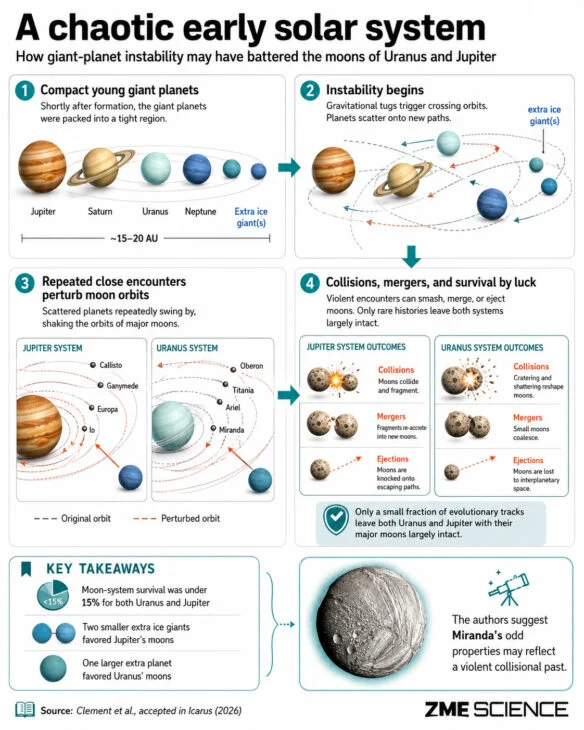
New research, reported by Jonathan Cowie of SF Concatenation, suggests that our early solar system might have initially harbored six or seven gas giant planets, rather than the four we observe today. A small collaboration of U.S.-based researchers utilized computer models to explore the chaotic gravitational interactions in the nascent solar system. Their findings indicate that the immense gravitational pull of Jupiter played a pivotal role in ejecting these additional worlds, effectively sling-shotting them into interstellar space. This planetary migration theory helps explain current solar system anomalies, such as Uranus’s peculiar axial tilt. The primary research, "The fragility of the Uranian moons during the giant planet instability," by Clement, M. S. et al., was published in Icarus, vol. 453, 117056 (2026).
Chronology & Supporting Data:
The current configuration of our solar system—four terrestrial planets, an asteroid belt, and four gas giants (Jupiter, Saturn, Uranus, Neptune)—has long posed questions for astronomers. One prominent anomaly is Uranus’s extreme axial tilt of 98 degrees, causing it to effectively spin on its side. Traditional models have struggled to adequately explain such an event without invoking a massive impactor, which has its own set of problems.
Building upon existing planetary migration theories, such as the "Nice Model," which posits that the giant planets were once in different orbits and migrated to their current positions, this new research introduces the idea of an even more crowded early solar system. The U.S. research team ran sophisticated N-body simulations, modeling the gravitational dynamics of protoplanetary disks with varying numbers of gas giants. Their results consistently showed that a system with six or seven gas giants, rather than the current four, better explains the orbital and rotational characteristics observed today. The models suggest that during a period of gravitational instability, massive Jupiter, being the largest planet, acted as a "gravitational bouncer," dynamically interacting with the extra gas giants. These interactions would have imparted enough velocity to these additional planets to overcome the Sun’s gravity, sending them hurtling out of our solar system into the vastness of interstellar space, where they would now wander as rogue planets. This chaotic period of ejection would also have caused significant perturbations to the remaining planets, potentially accounting for Uranus’s tilt.
Implications:
This study fundamentally alters our understanding of the early formation and evolution of our solar system. The hypothesis of transient gas giants offers a compelling explanation for several long-standing mysteries, particularly the unusual orientation of Uranus. It suggests that planetary ejections may be a more common and integral part of star system formation than previously thought, influencing the final configuration of planets. Furthermore, the findings have broader implications for exoplanet research, informing models of how other stellar systems might form and evolve. If our solar system once had more gas giants, it raises the intriguing possibility that many observed rogue planets in interstellar space might be ejected giants from other forming systems. This research deepens our appreciation for the dynamic and often violent processes that shaped our cosmic home, revealing a past far more crowded and chaotic than previously imagined.
Environmental Discourse: Hopes and Warnings
Kim Stanley Robinson on Climate Change: A Delicate Balance of Optimism
Main Facts:
Renowned science fiction author Kim Stanley Robinson recently engaged in a Q&A session with Scott Snibbe on A Skeptic’s Path, offering his nuanced perspective on the climate crisis. Robinson, who attended the 30th UN Climate Change Conference, acknowledges the "extraordinary danger" humanity faces but emphasizes that fundamental physical tipping points—which would irreversibly lock Earth into a "hothouse" state—have not yet been crossed. He warns of the possibility of "permanent climate change" leading to a Pliocene-like Earth, where rising sea levels and uninhabitable tropical regions could devastate civilization. Despite this, he notes a widespread understanding of the crisis, contrasting it with the "psychopathology" of climate denialism, which he likens to a "death cult."

Chronology & Supporting Data:
Robinson’s participation in the 30th UN Climate Change Conference (likely COP30, which would have occurred in November 2025, if the article is dated July 2026) provides him with an informed, albeit cautious, perspective on global climate action. His discussion with Scott Snibbe highlights a central tenet of his work and advocacy: the urgency of action balanced with the belief in humanity’s capacity to avert the worst outcomes.
He meticulously explains the concept of "tipping points"—critical thresholds beyond which a system reorganizes, often abruptly and irreversibly. While acknowledging the proximity to such points, Robinson suggests we haven’t yet triggered a runaway greenhouse effect towards a Venus-like state, but rather a Pliocene-like Earth. The Pliocene epoch, roughly 3 million years ago, saw global temperatures 2-3°C warmer than pre-industrial levels and sea levels 10-25 meters higher, demonstrating a stable, yet drastically different, planetary state. Such conditions would indeed wreck modern civilization, making vast swathes of land uninhabitable and displacing billions.
Robinson’s "positive side" is the growing recognition of this danger across diverse populations. However, he sharply criticizes climate denialists, categorizing their stance as either driven by "other projects and priorities" or a more alarming "Götterdämmerung state of mind"—a desire for a cataclysmic end, or a "death cult." This psychological framing emphasizes that for most people, the instinct for survival and collective well-being should prevail over such destructive ideologies.
Implications:
Kim Stanley Robinson’s perspective offers a vital blend of scientific realism and cautious optimism, a stance frequently found in his "cli-fi" novels. His emphasis on the distinction between catastrophic and merely disastrous outcomes provides a framework for understanding the ongoing climate debate: it is not a matter of "all or nothing" but "better or worse." This nuanced view is crucial for mobilizing action, as it avoids both paralyzing despair and unfounded complacency. His characterization of climate denialism as a form of "psychopathology" or "death cult" is a provocative but potent challenge to those who obstruct climate solutions, highlighting the moral and ethical dimensions of the crisis. Ultimately, Robinson’s insights underscore the imperative for rapid, collective action to prevent crossing irreversible thresholds, ensuring a future that, while challenging, remains habitable and capable of sustaining human civilization.
Tributes: Honoring Legacies
Disney Legend and Oscar Winner Don Iwerks Passes at 96
Main Facts:
Donald Warren "Don" Iwerks, a celebrated Disney Legend