Turning Trash into Gold: The Strategic Success of Spilt Milk Studios’ ‘Trash Goblin’ Kickstarter
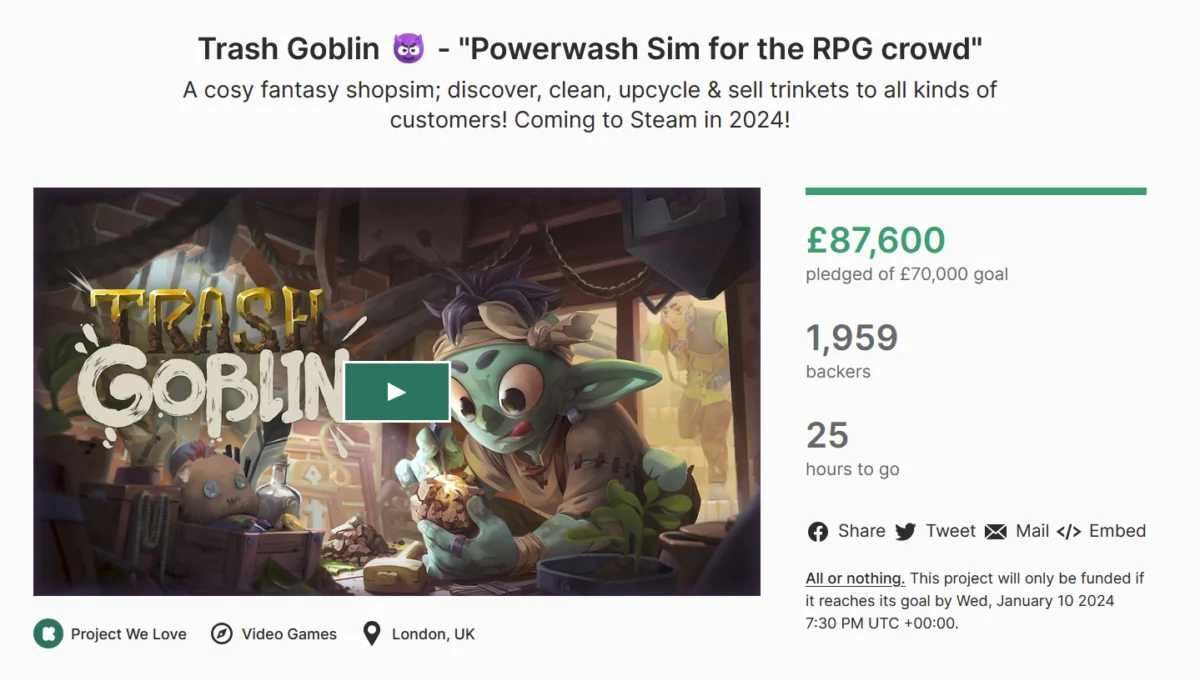
The indie gaming landscape is often characterized by its volatility, yet occasionally a project emerges that perfectly captures the cultural zeitgeist. Trash Goblin, the latest title from the London-based Spilt Milk Studios, has done exactly that. Described by its creators as a "cosy trinket-cleaning game" and a "Powerwash Simulator for the RPG crowd," the project has officially surpassed its primary funding goal on Kickstarter. As of the final 24-hour countdown, the campaign sits at 124% of its initial target, eyeing a final "magic" milestone of £100,000.
This success is not merely a stroke of luck but the result of a calculated transition within the studio’s leadership and a keen understanding of the burgeoning "cosy gaming" market. The involvement of industry veteran Nicholas Lovell, who recently transitioned from a non-executive to an executive role at Spilt Milk, marks a significant shift in the studio’s strategic direction.
Main Facts: A New Frontier in Cosy Gaming
At its core, Trash Goblin is a wholesome, endearingly grimy simulator. Players take on the role of a goblin working in the basement of a curiosity shop. The gameplay loop is deceptively simple yet deeply satisfying: players discover "trash" (obscured artifacts), use specialized tools to chip away dirt and grime, scrub them to a shine, and then upcycle or repair them for sale to a cast of quirky RPG-style customers.
Key Campaign Metrics:
- Funding Status: 124% funded.
- Time Remaining: Less than 24 hours.
- Stretch Goal Target: £100,000.
- Platform Focus: PC (Steam), with potential for future console ports.
- Developer: Spilt Milk Studios.
The game’s aesthetic leans heavily into the "low-stakes, high-reward" philosophy that has propelled titles like Unpacking and Powerwash Simulator to the top of the charts. By blending the tactile satisfaction of cleaning with the narrative charm of a fantasy world, Trash Goblin has carved out a unique niche that appeals to both casual players and hardcore RPG enthusiasts seeking a reprieve from high-stakes combat.
Chronology: From Concept to Crowdfunding Success
The journey of Trash Goblin began long before its Kickstarter debut in late 2023. Spilt Milk Studios, founded by Andrew Smith, has a history of experimental and genre-defying titles, including Lazarus and Tango Fiesta. However, Trash Goblin represents a more focused attempt at capturing a specific community-driven market.
Early Development and Vertical Slice
The development team spent several months refining the "cleaning" physics. In the world of simulation games, the "feel" of the interaction is paramount. If the act of scrubbing a virtual gem doesn’t feel tactile, the game loses its primary draw. By mid-2023, the studio had a playable demo that generated significant buzz on social media platforms like TikTok and X (formerly Twitter), where "oddly satisfying" content thrives.
The Leadership Shift
In late 2023, Nicholas Lovell—a renowned game consultant and author of The Curve—stepped up his involvement at the studio. Lovell’s expertise in the business of games and "free-to-play" mechanics (applied here to community engagement and premium indie sales) provided the studio with a more robust framework for their crowdfunding efforts. Despite managing the challenges of long-term health issues (Long Covid), Lovell’s move to an executive role signaled a professionalization of the studio’s marketing and outreach strategies.
The Kickstarter Launch
The campaign launched in December 2023, a period usually considered risky due to the noise of the holiday season. However, the "cosy" nature of the game served as a perfect counter-programming to the winter chill. The project reached its initial funding goal shortly after New Year’s Day 2024, proving that the appetite for tranquil, creative gaming experiences remains unsatiated.
Supporting Data: The Rise of the "Oddly Satisfying" Genre
To understand why Trash Goblin is currently 124% funded, one must look at the broader market data surrounding the "cosy" and "simulation" genres.
The "Powerwash" Effect
Since its release, Powerwash Simulator has reached over 12 million players. This proved that "digital chores" are not just a niche interest but a massive market. Data from SteamDB indicates that games tagged with "Relaxing" or "Cosy" have seen a 30% year-on-year increase in player engagement since 2020.
Crowdfunding Resilience
While general crowdfunding for games has seen a slight decline from the "Golden Age" of 2012–2015, niche simulation games continue to overperform. Trash Goblin’s success mirrors other recent indie hits that focus on specific, high-fidelity interactions rather than sprawling, over-ambitious open worlds. By keeping the scope manageable—a basement shop and a set of cleaning tools—Spilt Milk Studios has convinced backers of the project’s feasibility.
Wishlist Conversion
Nicholas Lovell has emphasized the importance of Steam wishlists alongside the Kickstarter campaign. Current industry benchmarks suggest that a successful Kickstarter often correlates to a 5x to 10x multiplier in Steam wishlists. For Trash Goblin, reaching the £100,000 mark would provide the "runway" needed to polish the game to a triple-A indie standard, further boosting its visibility on Steam’s algorithmic discovery queues.

Official Responses: A Note from the Frontlines
Nicholas Lovell’s personal involvement has been a central narrative of the campaign. In his recent communications, Lovell expressed a mixture of exhaustion and exhilaration, highlighting the personal stakes involved in indie development.
"I’m so excited that the Kickstarter I’m part of has funded," Lovell stated. "I’ve recently stepped up from a non-executive role at Spilt Milk to an executive one. I’m still part-time, but I’m much more involved. The biggest thing I’m involved in is Trash Goblin."
Lovell’s endorsement is significant. As the founder of Gamesbrief and a strategist who has spent decades advising others on how to make money in the games industry, his decision to commit his own time and reputation to Trash Goblin serves as a powerful "proof of concept." His goal for the final 24 hours is clear: push past the 124% mark and hit the £100,000 stretch goal, which likely unlocks additional content or platform ports that would ensure the game’s longevity.
The studio’s official stance has been one of deep gratitude toward the "Goblin Gang"—the affectionate name for their community. They have maintained a transparent development log, showing off the procedural dirt systems and the narrative backstories of the trinkets players will clean, which has fostered a high level of trust among backers.
Implications: What This Means for the Indie Industry
The success of Trash Goblin carries several implications for the future of independent game development and the business of self-publishing.
1. The Professionalization of Indie Strategy
Lovell’s transition to an executive role suggests that indie studios are increasingly seeking "business-first" minds to navigate the crowded marketplace. It is no longer enough to make a great game; you must understand "The Curve"—the ability to provide varying levels of value to different types of fans, from the £15 digital downloader to the £500 "design-a-character" backer.
2. The Longevity of Crowdfunding
Many critics have called the end of the Kickstarter era for games. Trash Goblin refutes this. It demonstrates that for specialized, high-concept "gimmick" games (used here in the most positive sense), crowdfunding remains a vital tool for both capital and community validation. It allows a studio to bypass traditional publishers who might find a "goblin cleaning trash" concept too idiosyncratic for a mass-market portfolio.
3. The "Cosy" Genre as a Permanent Pillar
We are moving past the point where "cosy games" are a trend; they are becoming a permanent pillar of the industry. As the world becomes increasingly stressful, the demand for "digital sanctuaries"—games that provide order, cleanliness, and low-pressure progression—will only grow. Trash Goblin’s success confirms that this audience is willing to pay upfront to see these visions realized.
4. Navigating Health in the Creative Arts
Lovell’s candidness about his struggle with Long Covid also sheds light on a growing reality within the industry. The "hustle culture" of game development is being challenged by the physical realities of its creators. By taking an executive but part-time role, Lovell is modeling a way for veteran talent to remain impactful without succumbing to the "crunch" that has historically plagued the sector.
Conclusion: The Final Push
As the clock ticks down on the Trash Goblin Kickstarter, the focus shifts from "will it fund?" to "how far can it go?" The move toward the £100,000 mark is more than just a financial milestone; it is a statement of intent. For Spilt Milk Studios, it represents the resources to turn a clever hook into a polished, expansive experience. For the industry, it is a reminder that there is still plenty of gold to be found in the "trash," provided you have the right tools to clean it.
Investors, players, and fellow developers will be watching the final hours closely. Regardless of the final tally, Trash Goblin has already succeeded in its most important mission: proving that in the modern gaming market, the most satisfying experiences often come from the simplest of pleasures.