A3: Assault on the Aerie of the Slave Lords – A Critical Examination of a Classic D&D Module
Originally Published March 16th, 2002 (Revised and Enriched October 26th, 2023)
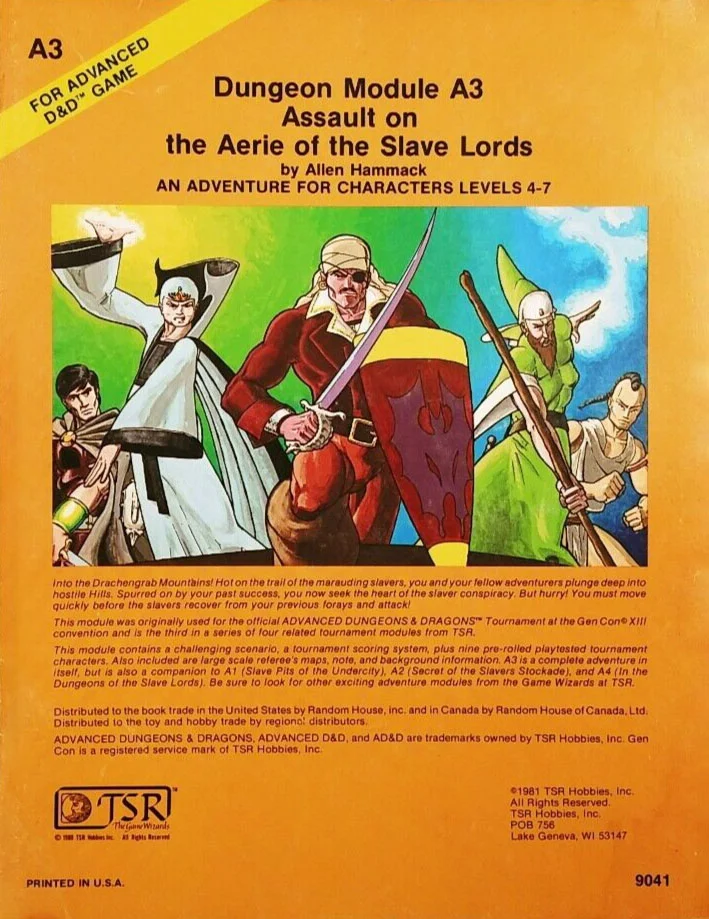
The storied legacy of Advanced Dungeons & Dragons (AD&D) modules is replete with adventures that have captivated generations of players and DMs. Among these, the ‘A’ series, "Against the Slave Lords," holds a particularly significant place, not only for its narrative ambition but also for its origins as a high-stakes tournament series. A3: Assault on the Aerie of the Slave Lords, penned by Allen Hammack, stands as the third installment in this iconic quadrilogy. While its predecessors, A1: Slave Pits of the Undercity and A2: Secret of the Slavers Stockade, are widely lauded for their tight design and compelling challenges, A3 often finds itself under a more critical lens, frequently cited as the point where the series’ quality begins to waver.
This article delves into the intricacies of A3, building upon earlier critical assessments, to offer a comprehensive journalistic analysis. We will explore its foundational premise, dissect its strengths and weaknesses in detail, contextualize its place within AD&D’s golden age, and evaluate its enduring relevance for contemporary DMs.
Unveiling the Slavers’ Stronghold: Main Facts
A3: Assault on the Aerie of the Slave Lords thrusts player characters (PCs) deeper into the heart of the sinister Slave Lords’ operations. Following intelligence gathered in A2, the adventurers are tasked with infiltrating and dismantling the slaver organization from within its seemingly impenetrable mountain stronghold. Designed for characters of 5th to 7th level, A3 represents a significant escalation in the campaign, shifting the PCs from reactive investigation to proactive assault.
The module’s core narrative unfolds across three distinct environments: the treacherous Caves of Drachensgrab, the sprawling and hidden subterranean city of Suderham, and the dark Catacombs leading directly to the Slave Lords’ council chambers. This multi-layered approach promised a rich tapestry of exploration, stealth, and combat, offering a compelling progression from wilderness infiltration to urban espionage and final confrontation.
However, despite this promising conceptual framework, A3 has historically been met with a mixed reception. Critics and players alike have pointed to a noticeable dip in the module’s execution, particularly concerning its dungeon design logic and a controversial "railroad" ending that funnels players towards the final module, A4: In the Dungeons of the Slave Lords. The paradox of A3 lies in its strong thematic premise and moments of genuine brilliance — most notably the Hidden City of Suderham — juxtaposed against a backdrop of design choices that challenge player agency and narrative coherence.
A Chapter in Time: Chronology and Context
A3: Assault on the Aerie of the Slave Lords was originally published in 1981 by TSR, Inc., then the undisputed titan of the tabletop role-playing game industry. It was designed by Allen Hammack, a notable figure in early D&D module development, known for his contributions to other classic adventures.
The ‘A’ series itself originated from a unique and influential context: the official AD&D tournaments at Gen Con. These modules were initially crafted not for general retail release but as challenging competitive scenarios for elite players. A1 and A2 set a high bar, offering intricate puzzles, tactical combat, and a clear, albeit challenging, progression. Their success in a tournament setting translated remarkably well to retail, establishing them as benchmarks for adventure design.
The transition from tournament to retail product, however, presented inherent challenges, particularly for later modules in a series. Tournament scenarios often prioritize specific outcomes, character builds, and encounter pacing to ensure a fair competition and timely completion. This sometimes meant sacrificing elements crucial for a satisfying long-form campaign, such as player freedom, logical consistency, and the organic development of a narrative.
By the time A3 was conceived, the narrative arc of the Slave Lords campaign was deepening, and the need to guide players toward the climactic A4 became a primary design consideration. This imperative, arguably, influenced Hammack’s design choices, leading to elements that, while functional in a competitive environment, felt less organic and more contrived in a home game. The module’s 1981 publication places it firmly within the "Silver Age" of D&D, a period of prolific module releases that defined the genre for many players and set the stage for later developments in tabletop gaming.
Dissecting the Aerie: Supporting Data and Analysis
To understand the complex nature of A3, it is essential to delve into its structure and evaluate each section with a critical eye, weighing its innovative elements against its design shortcomings.
The Narrative Arc: A Promising Blueprint
The overall structure of A3 is, on paper, compelling. The progression from dangerous wilderness infiltration to a concealed urban environment and then to the inner sanctum of the villains offers a dynamic and escalating challenge. This high-level outline – locate the hidden route, navigate a secret city, and lay siege to the enemy command center – is a testament to strong conceptualization. It promises a multi-faceted adventure, moving beyond mere dungeon delving into espionage, social interaction, and strategic combat. However, as the saying goes, the devil is often in the details, and it is here that A3 begins to stumble.
The Caves of Drachensgrab: A Descent into Illogic
The initial phase of the adventure, the Caves of Drachensgrab, immediately introduces the module’s most significant criticisms. Following leads from A2, PCs are directed into the harsh Pomarj wasteland to find the hidden entrance to the slaver stronghold. What follows is a series of encounters often described as "advanced spelunking with as many illogical twists as Allen Hammack could dream up."
The caves are populated with a bewildering array of creatures and traps that defy ecological or architectural sense. Gnolls, typically surface-dwelling humanoids, are found deep underground in unexpected contexts. "Salt slides" present bizarre environmental hazards. Traps are numerous and often improbable, seemingly placed without any clear purpose beyond obstructing adventurers. The module introduces unique monsters like "piercers" and the "storoper" (a roper disguised as a stalagmite), which, while creative, contribute to an overall sense of artificiality when presented in rapid succession without plausible context. An "illusionary throne room" further compounds the feeling of disjointed design, forcing DMs to stretch suspension of disbelief to its limits.
The core issue here is a lack of internal consistency. A well-designed dungeon often implies a history, a purpose for its inhabitants, and a logical placement of its defenses. The Caves of Drachensgrab, however, feel less like a lived-in environment and more like a collection of disparate challenges arbitrarily strung together. This "funhouse dungeon" approach, while sometimes embraced for its whimsical nature, clashes with the serious tone of the Slave Lords campaign and the expectations set by A1 and A2‘s more grounded design. For a DM, making these encounters plausible and engaging requires significant improvisation and often a complete re-contextualization of the module’s written content.
The Hidden City of Suderham: A3‘s Resplendent Crown Jewel
Emerging from the chaotic depths of Drachensgrab, the PCs stumble upon A3‘s undeniable masterpiece: the Hidden City of Suderham. This entire city, concealed deep within the heart of the mountains, serves as a central hub for the Slave Lords’ operations. This section of the module is where A3 truly shines, offering an experience unparalleled in many modules of its era.
Suderham is presented with an astonishing level of detail. The module provides a complete encounter key for every building, detailing inhabitants, businesses, and potential points of interest. This meticulous world-building creates a vibrant, believable, and awe-inspiring environment. The original review notes that "whenever a group of PCs emerges from the caves to see the Hidden City sprawled out beneath them, a moment of silence invariably settles over the group." This speaks volumes about the impact of this section.
The Hidden City transforms the adventure from a linear dungeon crawl into a sandbox of possibilities. PCs are encouraged to keep a low profile, engage in reconnaissance, gather information, and strategize their approach to the Slave Lords’ inner sanctum. This allows for diverse playstyles, from stealth and subterfuge to social engineering and targeted raids. The inclusion of a Player’s Map for Suderham further enhances immersion and strategic planning, empowering players to navigate and explore independently. Suderham represents a triumph of environmental design, offering a rare glimpse into the daily operations and infrastructure of a villainous organization beyond mere combat encounters.
The Catacombs: A Return to Subterranean Traversal
The path from Suderham to the Slave Lords’ stronghold lies through the city’s sewers and catacombs. While this section returns to a more traditional dungeon crawl format, it benefits from a more logical justification for its traps and defenses. Unlike the arbitrary nature of Drachensgrab, the catacombs are explicitly presented as a restricted, non-traffic area, allowing the Slave Lords to place whatever formidable defenses they deem necessary without impeding their own operations. This contextualization helps mitigate the "illogical contrivance" that plagued the earlier cave system.
However, this section, while more justifiable, still leans heavily into a series of dangerous encounters designed to wear down the party. It serves primarily as a gauntlet leading to the module’s climax.
The Climax and the "Railroad": A Point of Contention
Eventually, the PCs navigate the catacombs and arrive at the Council Chamber of the Slave Lords, setting the stage for the module’s final, and most controversial, encounter. Here, the tournament background of the ‘A’ series becomes undeniably apparent. The DM is presented with a choice: either force a loss upon the PCs, thus necessitating their capture and the events of A4, or allow them to defeat the Slave Lords outright.
This "railroad" ending is a significant flaw in a module designed for general retail. It directly undermines player agency and the principle of emergent storytelling central to D&D. Forcing a loss, regardless of player skill or strategic brilliance, can be incredibly frustrating and demoralizing. While the original review suggests that "several ways that a DM could restructure this final encounter so that the players aren’t run over by a train," the module itself provides no guidance, leaving DMs to devise their own solutions to reconcile the tournament imperative with a satisfying home game experience. This design choice highlights the tension between competitive module design and the freedom expected in a traditional campaign.
Echoes of the Past: Industry Reception and Legacy
Upon its release in 1981, specific contemporary journalistic reviews for individual AD&D modules were less common than today, making it challenging to pinpoint the exact initial public and critical reception of A3. However, its reputation over the decades suggests that the perceived drop in quality was noted by players and DMs who had experienced the polished design of A1 and A2. The "funhouse dungeon" elements and the forced ending likely garnered feedback, even if not formally documented in extensive reviews.
TSR, Inc. at the time operated with a high volume of releases, and addressing granular feedback on individual module design choices was not typically their public modus operandi. The tournament origins of the ‘A’ series were well-known, and the design compromises inherent in such a format were perhaps understood, if not always appreciated, by the player base. The success of the overall series, however, was undeniable, solidifying the Slave Lords as quintessential AD&D villains.
Despite its flaws, A3 has endured as a classic. Its inclusion in later compilations, such as the Against the Slave Lords omnibus (which gathered the entire A-series), speaks to its historical significance and its necessary role in the overarching narrative. While it may not be universally praised in the same breath as A1, it remains a subject of discussion and a module that many DMs have grappled with, seeking to extract its inherent potential. The lasting community view is that A3 is a "fixer-upper" – a module with brilliant components requiring significant DM intervention to reach its full potential.
Allen Hammack’s contribution to D&D is undeniable, and A3 should be viewed within the context of the era’s design philosophies and the specific constraints of the tournament series. It’s a snapshot of a particular moment in module design, where innovation sometimes coexisted with expedient design choices.
Enduring Value: Implications for Modern Gaming
A3: Assault on the Aerie of the Slave Lords holds several implications for both the historical study of D&D and its contemporary application.
Impact on the A-Series and Narrative Flow
A3 is a crucial bridge to A4: In the Dungeons of the Slave Lords. Without the events of A3, particularly the forced capture of the PCs (or a creatively designed alternative), A4 would lack its foundational premise. While its perceived weaknesses might slightly diminish the overall polish of the series, A3 remains an indispensable narrative link. A DM running the full campaign must address A3‘s challenges to maintain a cohesive story.
Lessons for Module Design
A3 serves as a valuable case study in adventure design. Its strengths, particularly the meticulously detailed Hidden City of Suderham, underscore the power of rich environmental storytelling and providing players with agency within a complex setting. Suderham demonstrates how a detailed, "living" environment can elevate an adventure beyond mere combat encounters. Modern designers can learn from this by focusing on creating immersive settings that offer multiple avenues for player interaction.
Conversely, A3‘s weaknesses offer clear cautionary tales. The "illogical contrivance" of Drachensgrab highlights the importance of internal consistency and plausible world-building, even in a fantasy setting. The railroad ending underscores the fundamental importance of player agency in tabletop role-playing games. Designers today strive to create adventures that allow for diverse outcomes based on player choices, avoiding predetermined conclusions that diminish the player experience.
Value for Modern DMs
Despite its flaws, A3 retains significant value for the modern Dungeon Master, especially for those who enjoy adapting and enriching published material. The original review accurately concludes that "The structure presented here is a good one. And the Hidden City material probably makes this a worthwhile purchase."
For a DM willing to invest time in preparation, A3 offers a robust framework:
- The Hidden City of Suderham: This section alone provides immense value. A DM can run Suderham almost as written, leveraging its detail for weeks of engaging gameplay focused on espionage, social interaction, and tactical planning. It’s a compelling hub that can be integrated into various campaigns, even outside the Slave Lords series.
- A Foundation for Adaptation: The overall premise of infiltrating a mountain stronghold remains potent. A creative DM can re-imagine the Caves of Drachensgrab to be more logical, replacing arbitrary traps with more contextually appropriate defenses or natural hazards. The climax can be restructured to allow for genuine player choice and consequences, rather than a forced outcome.
- Historical Significance: For DMs and players interested in the history of D&D, experiencing A3 (even in an adapted form) offers insight into the evolution of module design and the challenges faced by early designers.
At its original price point of $4.99 (ESD), or its inclusion in modern compilations, A3 represents a significant amount of "raw material." It’s not a module that can be run straight out of the box without critical thought and adaptation, but for the DM who enjoys world-building and customizing content, it provides a solid canvas upon which to create a memorable adventure. It challenges the DM to be a co-creator, transforming its rough edges into a polished gem.
In conclusion, A3: Assault on the Aerie of the Slave Lords stands as a complex and often contradictory artifact of early D&D design. While it may represent a dip in the consistent quality of the ‘A’ series, its moments of brilliance, particularly the Hidden City of Suderham, ensure its enduring legacy. It serves as a testament to the fact that even flawed modules can offer rich inspiration and a fertile ground for imaginative DMs to craft unforgettable adventures.
Module Details:
- Style: 2/5
- Substance: 3/5
- Author: Allen Hammack
- Publisher: Wizards of the Coast (originally TSR, Inc.)
- Line: AD&D (ESD)
- Price: $4.99 (ESD)
- ISBN: 0-935696-27-X
- Product Code: TSR9041
- Pages: 30
- Year Published: 1981
Next in the Series: A4: In the Dungeons of the Slave Lords