"The Artificer’s Knot" Electrifies SPFBO Semi-Finals with a Gritty Tale of Power, Oil, and Moral Compromise
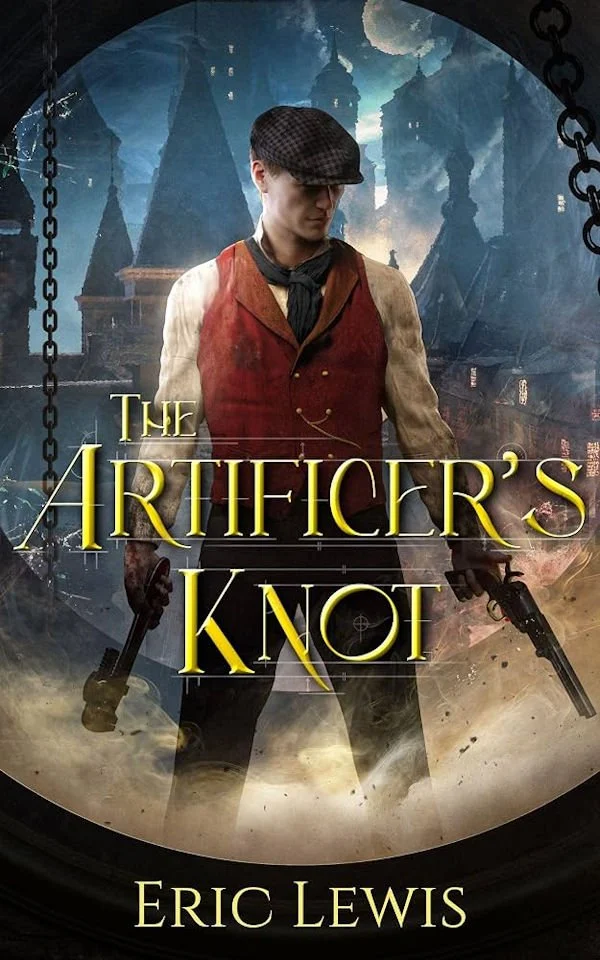
LONDON, UK – In a literary landscape often dominated by epic sagas and high fantasy, The Artificer’s Knot has carved out a distinctive niche, earning its place as a semi-finalist in this year’s highly competitive Self-Published Fantasy Blog-Off (SPFBO). This gaslamp crime story, praised for its sharp prose, distinctive characters, and uncomfortably relevant themes, offers a compelling blend of steampunk adventure, urban grit, and profound moral dilemmas, captivating judges with its intricate world of energy monopolies, gang warfare, and an unlikely hero caught in the crossfire.
Penned by an author who challenges conventional genre boundaries, The Artificer’s Knot plunges readers into a meticulously crafted industrial age powered by the mystical, energetic substance known as Vril. This vital resource, however, is not freely accessible, its supply and distribution tightly controlled by an elite class of Alchemists, fostering an environment ripe for corruption and socio-economic stratification. Against this backdrop, the story introduces Randyll Tephius, a brilliant but disgraced Artificer whose radical discoveries threaten to upend the established order, setting in motion a chain of events that forces him to navigate the treacherous currents of a city where innovation clashes with entrenched power.
Unraveling the Knot: A Deep Dive into Randyll Tephius’s World
The narrative arc of The Artificer’s Knot is a testament to the author’s ability to weave a complex tapestry of ambition, survival, and moral ambiguity. Central to this tale is Randyll Tephius, a protagonist whose journey from academic brilliance to the shadowy underworld forms the backbone of the story.
The Spark of Rebellion
Randyll Tephius, a promising student Artificer, finds his career and reputation irrevocably shattered when his university thesis—a groundbreaking exploration of newly discovered oil deposits—poses a direct threat to the Alchemists’ Vril monopoly. The very existence of an alternative, potent energy source threatens to dismantle their industrial dominance and the vast wealth accumulated through their control. Consequently, Ran is summarily expelled in disgrace, stripped of his academic standing and cast out into a harsh world that has little use for a brilliant mind without the proper credentials. His fall from grace is swift and brutal, a stark illustration of the power wielded by the elite and their willingness to crush any challenge to their authority. The injustice of his expulsion not only sets the stage for his personal struggle but also highlights the systemic corruption inherent in a society where innovation is stifled by economic self-interest.
From Academia to Underworld
Survival on the unforgiving streets of a city designed to exclude the dispossessed forces Ran to confront a reality far removed from the hallowed halls of academia. His rescue by Gouger Nebb, an aging but shrewd mob boss, is both a lifeline and a plunge into a morally ambiguous world. Nebb, a character imbued with a unique blend of street smarts and a surprising intellect, recognizes the untapped potential in the disgraced Artificer. He sees not just an engineer but a weapon, a means to legitimate his own operations and secure a comfortable retirement as a "legitimate businessman." This unlikely benefactor provides Ran with the resources to rebuild his career, funding ingenious inventions that promise to revolutionize various industries. The dynamic between Ran and Nebb is a fascinating study in contrasts: the refined intellect of the Artificer grappling with the brutal pragmatism of the gangster, each using the other to achieve their own version of success.
Navigating a Labyrinth of Danger
As Ran throws himself into his work, using mob money to fuel his creative genius, his efforts are met with relentless sabotage. His inventions, intended to bring efficiency and profit, inevitably disrupt existing power structures, drawing the ire of both established industries and rival criminal enterprises. The narrative thrust intensifies as Ran is forced to maneuver through a treacherous labyrinth populated by competing gangs, disdainful aristocrats who view him as an upstart, and sadistic police forces who are often complicit in the very corruption they are meant to fight. The constant threat of betrayal, violence, and ruin forces Ran to adapt, to shed some of his academic innocence, and to embrace the pragmatic, often ruthless, logic of the underworld. His struggle is not merely against external adversaries but also an internal battle to prevent himself from becoming the very thing he despises: a gangster devoid of principles.
The Alchemists’ Temptation
The architects of Ran’s initial downfall, the powerful Alchemists, eventually re-emerge from the shadows, now offering a tempting proposition. They dangle the promise of immense wealth and a path to redemption, provided Ran abandons his current allegiances and aids them in expanding their deadly Vril monopoly worldwide. This offer presents Ran with the ultimate moral quandary: to betray the man who saved him, the only one who believed in his potential when no one else would, in exchange for a return to societal acceptance and unimaginable power. The Alchemists’ proposal is a masterstroke of manipulation, preying on Ran’s past grievances and offering a chance to reclaim his lost status, albeit at a profound ethical cost. This climactic dilemma forces Ran to confront the true price of ambition and the corrosive nature of power, leaving readers to ponder what choices he will make and what kind of man he will ultimately become.
Critical Acclaim and Nuanced Perspectives: Judges Weigh In
The Artificer’s Knot resonated deeply with the SPFBO judges, garnering significant praise for its literary craftsmanship and thematic depth, even as some aspects of its plot drew nuanced critiques.
A Consensus on Craftsmanship
Across the board, judges lauded the novel’s exceptional prose and writing style. EG highlighted the "excellent" prose, noting how the "writing is smooth and draws you along so you almost don’t feel like you’re reading." The distinctiveness of the dialogue, which felt "unique to each character," and a certain "je ne sais quoi" were particularly appreciated, contributing to a rich and immersive reading experience. Julia echoed this sentiment, describing the book as "fast, clever, and confident," with a narrative flow that consistently entertained. Maureen further underscored the engaging quality, likening the reading experience to "riding a zip line above the crowds on a fairground midway," emphasizing the constant action and vibrant atmosphere conveyed through the writing.
The Protagonist: Ran’s Complex Journey
Randyll Tephius emerged as a particularly captivating character. EG found Ran "fascinating to read," noting his "unsuitable background for being a gangster, yet he seemed to thrive there," which added a "twisty and fascinating" layer to the story. Julia delved deeper into Ran’s "over-competence," acknowledging that while it occasionally "drain[ed] some tension" because "failure rarely feels like a real possibility," her engagement stemmed from "what success demanded of him." She praised watching him "test his own limits, compromise his values, and slowly reshape his sense of right and wrong," which provided the narrative with its "emotional weight." Ran’s voice felt "grounded," and his flaws "human," even when his abilities stretched credibility, solidifying him as a memorable and relatable figure despite his extraordinary talents. Kerry, too, appreciated Ran’s journey, noting how he "manages to work his way up the gangster ladder due to his skills and in doing so exposes the greed and corruption in the world of energy production."
Gouger Nebb: Beyond the Stereotype
Gouger Nebb, the mob boss who rescues Ran, proved to be another character of considerable depth and intrigue. EG characterized Nebb as "snarky and dangerous and yet somehow one of the most intelligent characters in the book, despite his lack of education." Adawia initially harbored reservations, finding Nebb "a bit like a try-hard version of Brick Top (Snatch)" with "a few too many threats." However, she ultimately conceded that his "overall sharpness and—sometimes brutal—common sense eventually won me over," recognizing that "this is a gritty world, and it’s hard to be a nice person and be successful." Julia also found Nebb compelling, describing him as "not a flashy or charismatic figure" but written in a way that made her "care about his fate." She highlighted his ruthlessness, balanced by a "sense of rough fairness" and a "practical code that includes protecting people in his territory and taking responsibility for the consequences of his power," which made him "more interesting than I expected."
A World of Grime and Gaslight
The world-building of The Artificer’s Knot was widely praised for its immersive quality and thematic resonance. The SPFBO judges collectively noted how the world "feels uncomfortably relevant." EG initially felt drawn in by the "steampunk-esque adventure," a genre she confessed to being a "sucker for." Adawia underscored the "gritty world" where "corruption and gang rivalry are rampant," painting a vivid picture of a society where survival demands difficult choices and alliances. Maureen’s "zip line" analogy perfectly captured the vibrant, bustling, and dangerous environment, filled with "steam trains, steam boats," and a constant sense of activity. The blend of fantastical elements with a tangible, almost historical, feel contributed significantly to the novel’s unique atmosphere.
Plot Pacing and Peril: Divided Opinions
While the prose and characters garnered widespread acclaim, the plot’s execution elicited more varied responses. EG found herself "less enthralled" as the story progressed, noting that it read "less like a steampunk novel and more like a historical fiction about a gang war in Chicago." Her primary critique centered on the escalating drama, which became "underwhelming and a bit predictable" due leading to "so many catastrophes." She confessed to skimming the latter half of the book, still grasping the ending. In contrast, Maureen found the constant action to be a strength, praising the "no lack of ups and downs, edge of-your-seat moments, and treachery." Julia, while acknowledging Ran’s competence could reduce tension, emphasized that her interest lay not in if he would succeed, but "what success demanded of him," focusing on his moral evolution rather than pure plot mechanics. Adawia, too, noted that "the story developed in complexity and cleverness as it went on which kept me intrigued," despite occasional moments where character actions felt "a little too convenient."
Timely Themes: Oil, Monopoly, and Morality
One of the novel’s most compelling aspects, highlighted by multiple judges, was its thematic depth and contemporary relevance. Julia particularly lauded the "political and scientific underpinnings," noting that "the struggle over energy, monopolies, and control feels sharply relevant, with entrenched powers willing to sabotage any threat to their dominance." She praised the "uncomfortable framing of oil as a relative improvement over existing systems, while still clearly carrying its own moral and environmental cost." The narrative’s refusal to offer "easy answers" and its focus on characters driven by "survival, leverage, and control" gave the world "real bite." Kerry underscored this point, stating that the introduction of petroleum "does and should sit uncomfortably on the reader especially in light of what is happening in the real world at present," commending the ending for leaving readers "questioning our MC’s morals and how he now views the world." The book, therefore, transcends mere genre fiction, serving as a powerful commentary on global issues.
SPFBO XI: Acknowledging Excellence
The journey of The Artificer’s Knot through SPFBO XI underscores the incredible talent thriving within the self-published fantasy community. The SPFBO organizers praised the book for pulling judges in with its "sharp prose, distinctive characters, and a world that feels uncomfortably relevant," acknowledging that its departure from straightforward fantasy is precisely "what makes it interesting."
As one of the four semi-finalists in Round One, The Artificer’s Knot stands on the precipice of advancing further in the competition. The anticipation builds for the announcement of the finalist pick, who will move on to Round Two on Friday, June 26th.
A sincere thank you was extended by the SPFBO organizers to every author who entered the competition, recognizing that "putting your work forward for a competition takes real courage." This sentiment highlights the dedication and bravery inherent in self-publishing and the value of platforms like SPFBO in bringing these voices to a wider audience.
The judging panel for SPFBO XI is a diverse and dedicated group of literary enthusiasts, including Adawia Asad, Eva Geraghty, Evelyn Grimald “E.G.” Stone, Julia Kitvaria Sarene, Karen Lucia, Kerry Smith, Kit Caelsto, Maureen Neuman, Robert Max Freeman, Sara Rosevear, Sherry Cammer, Stacey Markle, Tianna Twyman, and Yaniv Rosenfeld Cohen. Their collective expertise and varied preferences contribute to the rigorous and fair evaluation process that defines the SPFBO competition. Readers and aspiring authors can keep up with round one of the contest on the official SPFBO website and learn more about the competition’s structure and goals. Any queries regarding the competition are directed to the editor, Jennie Ivins, via direct message on Bluesky or Threads.
Beyond the Page: The Broader Implications of "The Artificer’s Knot"
The success of The Artificer’s Knot in the SPFBO semi-finals extends beyond its literary merits, carrying broader implications for both the fantasy genre and the self-published landscape.
A Mirror to Modern Society
At its heart, The Artificer’s Knot functions as a potent allegory for contemporary societal challenges. Its exploration of energy monopolies, corporate greed, political corruption, and the moral compromises individuals make for survival and ambition resonates deeply in a world grappling with similar issues. The Vril monopoly and the struggle against the Alchemists reflect real-world debates surrounding fossil fuels, renewable energy, and the powerful entities that control global resources. The novel’s ability to frame these complex issues within a compelling gaslamp fantasy setting allows readers to engage with critical social commentary through an imaginative lens, prompting reflection on the cost of progress and the ethics of power.
The Self-Published Landscape
The book’s strong performance in SPFBO XI serves as a powerful testament to the burgeoning quality and diversity within the self-published fantasy market. Competitions like SPFBO are crucial in elevating deserving independent authors, offering them a platform to gain recognition and reach new readers who might otherwise overlook works outside traditional publishing channels. The Artificer’s Knot exemplifies the potential for self-published novels to be not only entertaining but also thoughtfully crafted, thematically rich, and professionally polished, challenging any lingering preconceptions about the quality of independent literature.
The Enduring Appeal of Gaslamp Fantasy
By skillfully blending gaslamp fantasy with elements of crime thriller and political intrigue, The Artificer’s Knot reinforces the genre’s enduring appeal. It demonstrates how historical settings infused with speculative elements can provide a fresh canvas for exploring universal themes. The gritty, industrial aesthetic, combined with the intrigue of a criminal underworld and the high stakes of energy control, offers a captivating alternative to more traditional fantasy subgenres, proving that gaslamp fantasy remains a fertile ground for innovative storytelling.
The Cost of Progress
Ultimately, The Artificer’s Knot leaves readers with profound questions about the nature of success and the price of progress. As Julia Kitvaria Sarene eloquently summarized, the novel "more than compensates by asking sharp questions about what success costs, how power reshapes values, and who ultimately pays the price for progress." Kerry’s observation that the ending prompts readers to question Ran’s morals underscores this theme, suggesting that even if Ran achieves his goals, the journey irrevocably changes him. The ambiguous moral landscape of the novel, where clean solutions are rare and choices are always fraught with consequence, mirrors the complexities of real-world ethical dilemmas, cementing The Artificer’s Knot as a thoughtful and impactful read.
As the SPFBO XI competition draws closer to revealing its ultimate finalist, The Artificer’s Knot stands out not just as a well-crafted novel, but as a timely and relevant exploration of power, ambition, and the ever-present struggle for control in a world fueled by both innovation and greed. Its journey through the semi-finals is a testament to its compelling narrative and the profound questions it dares to ask.