The Architect of Baroque Surrealism: How Jesús Aguado Bridged the Chasm Between Illustration and Fine Art
The contemporary art world has long maintained a fractured relationship between commercial accessibility and intellectual profundity. For decades, the prevailing academic sentiment suggested that an artist could either be understood by the masses or respected by the elite, but rarely both. However, Spanish artist Jesús Aguado (b. 1976) has spent the better part of the last ten years dismantling this dichotomy. By fusing twenty years of high-stakes commercial illustration with the technical rigors of Renaissance masters, Aguado has pioneered a movement often described as "Baroque Surrealism"—a visual language that is as emotionally urgent as it is technically breathtaking.
Currently, Aguado’s work is taking center stage at Arch Enemy Arts in Philadelphia with his latest solo exhibition, Life Milestones. Running from May 24 through June 15, 2025, the showcase represents the culmination of a career defined by transition, technical alchemy, and a recent, profound personal transformation.
I. Main Facts: The Synthesis of Two Worlds
Jesús Aguado is not a traditional surrealist who emerged from the vacuum of a fine arts studio. Instead, his work is the product of a "commercial crucible." Before his emergence as a prominent figure in the Pop Surrealism and Lowbrow movements, Aguado spent two decades as a premier editorial illustrator. His portfolio includes work for the Spanish educational giant Santillana, the globally renowned National Geographic, and numerous children’s publishers reaching as far as Taiwan.

This background is the cornerstone of his current success. While many fine artists struggle to communicate complex themes to a general audience, Aguado’s twenty-year tenure in publishing taught him the art of universal visual communication. When an artist is tasked with explaining biological processes for National Geographic or narrating a story for a child in Taipei, they must master a visual shorthand that transcends language and culture.
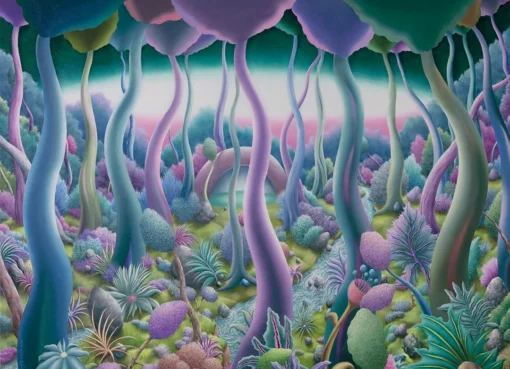
Aguado’s fine art, which he transitioned to fully between 2017 and 2018, utilizes this "universal language" to explore the human psyche. His canvases are populated by chimerical, often anthropomorphic figures—dragons, rabbits, and hybrid organisms—that inhabit dreamscapes. These works are characterized by a "density principle," a visual strategy known as horror vacui (fear of empty space), which mirrors the information-heavy landscape of the 21st century while simultaneously offering a sanctuary from it.
II. Chronology: From Valladolid to Philadelphia
The trajectory of Jesús Aguado’s career is a masterclass in creative evolution. To understand his current standing in the art world, one must look at the pivotal stages of his development:

1976 – 1998: The Foundations in Valladolid and Salamanca
Born in Valladolid, Spain, in 1976, Aguado’s early interest in art was bifurcated between the classical beauty found in European museums and the irreverent energy of comic books. He pursued formal training at the University of Salamanca, earning his credentials in Fine Arts. It was here that he mastered the foundational techniques of anatomy, light, and composition that would later define his "Baroque" style.
1998 – 2017: Two Decades in the Editorial Trenches
Upon graduation, Aguado entered the world of professional illustration. For twenty years, he worked under the pressure of editorial deadlines and strict client briefs. This period was essential for his technical development. Working with Santillana required a mastery of clarity, while his work for international publishers forced him to strip away cultural specificities in favor of archetypal imagery. This era built a "creative pressure cooker" effect; while he was successfully fulfilling commercial mandates, his personal vision was quietly fermenting.
2017 – 2018: The Great Pivot
Around 2017, Aguado made the decisive move from digital and commercial media to oil and acrylic painting on traditional supports. This was not merely a change in tools but a philosophical shift. He began applying his mastery of universal communication to his own internal mythology. This period saw his first major forays into the gallery world, where his unique fusion of comic book aesthetics and Renaissance technique immediately caught the attention of collectors.

2020 – 2024: Institutional Recognition and Fatherhood
Aguado began a fruitful relationship with Arch Enemy Arts in Philadelphia, one of the premier galleries for new contemporary and surrealist art. His 2025 exhibition, Life Milestones, marks his third solo show with the gallery since 2020. However, the most significant chronological marker in this period was the birth of his son in 2023. This personal milestone fundamentally altered the thematic direction of his work, shifting his focus toward metaphysical questions of development, growth, and the cycle of life.
III. Supporting Data: The Mechanics of Baroque Surrealism
Aguado’s work is often categorized as "Baroque Surrealism," a term that requires technical deconstruction to fully appreciate. His aesthetic is built on three specific pillars:
1. Technical Alchemy and Materiality
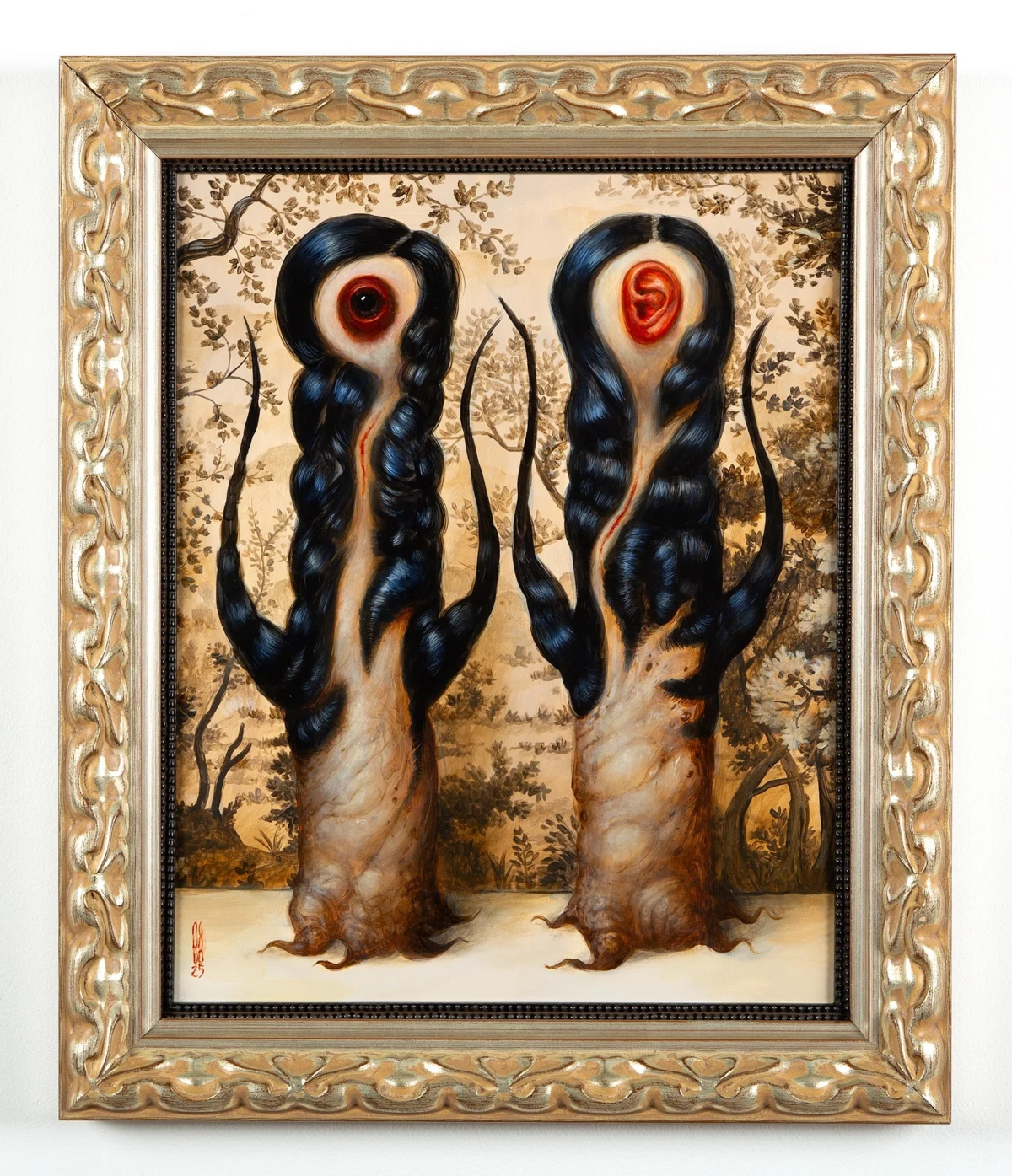
Unlike many contemporary artists who favor canvas or digital prints, Aguado paints on traditional wood panels and birch supports. This choice is strategic; the rigidity of wood allows for a specific type of paint application borrowed from the Old Masters.

His signature "shimmer" is achieved through acrylic glazing—the application of multiple translucent layers of paint. This technique allows light to pass through the upper layers of pigment, bounce off the white primer or underlying colors, and return to the viewer’s eye. The result is a luminous quality that makes his "impossible" creatures feel tangibly present. This depth of surface serves as an intentional antidote to the flat, instant-consumption nature of digital imagery.
2. The Bestiary of Dualities
Aguado’s compositions are notably devoid of human figures. In their place, he utilizes a recurring cast of animals and hybrids that function as psychological avatars:
- Dragons: Representing raw ferocity and ancient power.
- Rabbits: Embodying vulnerability, innocence, and "cuteness."
- Worms and Insects: Suggesting the grotesque, the earthbound, and the transformative.
By using animals, Aguado removes demographic barriers (race, gender, age), allowing any viewer to project their own emotions onto the characters. These beings exist on the "edge of the endearing and the disturbing," a duality that mirrors the complexity of human experience.

3. The Density Principle (Horror Vacui)
Aguado’s paintings are visual novels. He employs horror vacui, a style seen in the works of Rubens or the intricate tapestries of the Middle Ages, where every inch of the frame is filled with detail. This density is not chaotic; it is a "strategic overwhelm." It rewards the viewer for slowing down, as hidden narrative threads and secondary creatures only become visible upon sustained observation.
IV. Official Responses: Critical Interpretation and Gallery Perspective
The critical response to Aguado’s work emphasizes his ability to modernize classical traditions. Art critics frequently point to his use of chiaroscuro—the dramatic contrast between light and dark popularized by Caravaggio—as a tool for emotional storytelling.
Noah Tingley of Arch Enemy Arts has noted the artist’s unique position in the gallery’s roster. The gallery, known for championing "the unconventional," views Aguado as a bridge-builder. His work appeals to "Lowbrow" collectors who love the comic-inspired characters, but it also satisfies the "Highbrow" academic crowd through its sophisticated execution and dialogue with art history.

In his own reflections on the Life Milestones series, Aguado describes his work as a visual prescription for the modern condition. "Since my son was born, I’ve been thinking a lot about life… about the crucial moments in a person’s development," he stated. Critics have observed that this has added a layer of "parental urgency" to his work. The latest pieces—featuring winged caterpillar mothers and lobster-clawed gardeners—are seen as metaphors for the transformative, often painful, but ultimately beautiful process of mitosis and growth.
V. Implications: The Future of Accessible Profundity
The success of Jesús Aguado carries significant implications for the future of the contemporary art market.
The Revalidation of the Commercial Background
Aguado’s career proves that a commercial background is not a "contamination" of fine art but a superpower. As the art world becomes increasingly globalized, the ability to communicate across cultural boundaries—a skill honed in the illustration industry—becomes more valuable than academic insularity.

Art as Psychological Refuge
In an era of "information fatigue," Aguado’s work offers a new model for engagement. His paintings do not demand that the viewer process more "opinions" or "data." Instead, they provide a space for "the free play of imagination." By creating worlds where joy and darkness coexist, he provides a psychological architecture where viewers can process their own existential paradoxes in a safe, albeit surreal, environment.
Bridging the Gap
Aguado is part of a vanguard of artists proving that Surrealism did not end with Dalí or Magritte. By infusing the movement with modern psychology, comic book sensibilities, and 21st-century anxiety, he is ensuring its relevance for a new generation. His "and/both" philosophy—being both funny and metaphorical, both dark and light, both pop and classical—is exactly the kind of nuanced thinking required to navigate a complex, contradictory world.
Exhibition Details: Life Milestones
For those seeking to experience Aguado’s "tranquil joy" and "vivacious ecstasy" in person, the Life Milestones exhibition offers a rare opportunity to see his largest body of work to date.
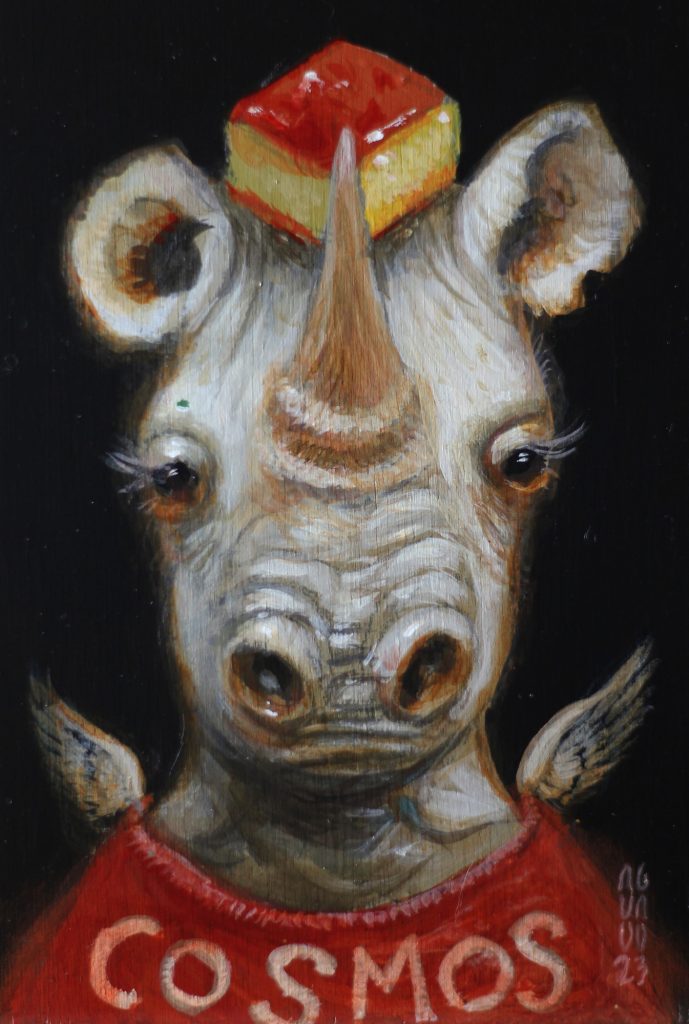
- Venue: Arch Enemy Arts, Philadelphia
- Dates: May 24 – June 15, 2025
- Opening Reception: First Friday, June 6, 2025
- Significance: This exhibition marks a turning point where Aguado moves beyond mere surrealist imagery into a deeper exploration of human existence, viewed through the lens of new fatherhood and two decades of technical mastery.
As Aguado continues to evolve, his legacy will likely be defined by his ability to make the profound approachable. He remains a reminder that in the hands of a master, the line between a textbook illustration and a masterpiece is not just thin—it is nonexistent.