"Tapeworm" by A.P. Thayer: A Chilling Dive into Body-Horror Vampirism Awakens Ancient Desires in the Californian Desert
FOR IMMEDIATE RELEASE
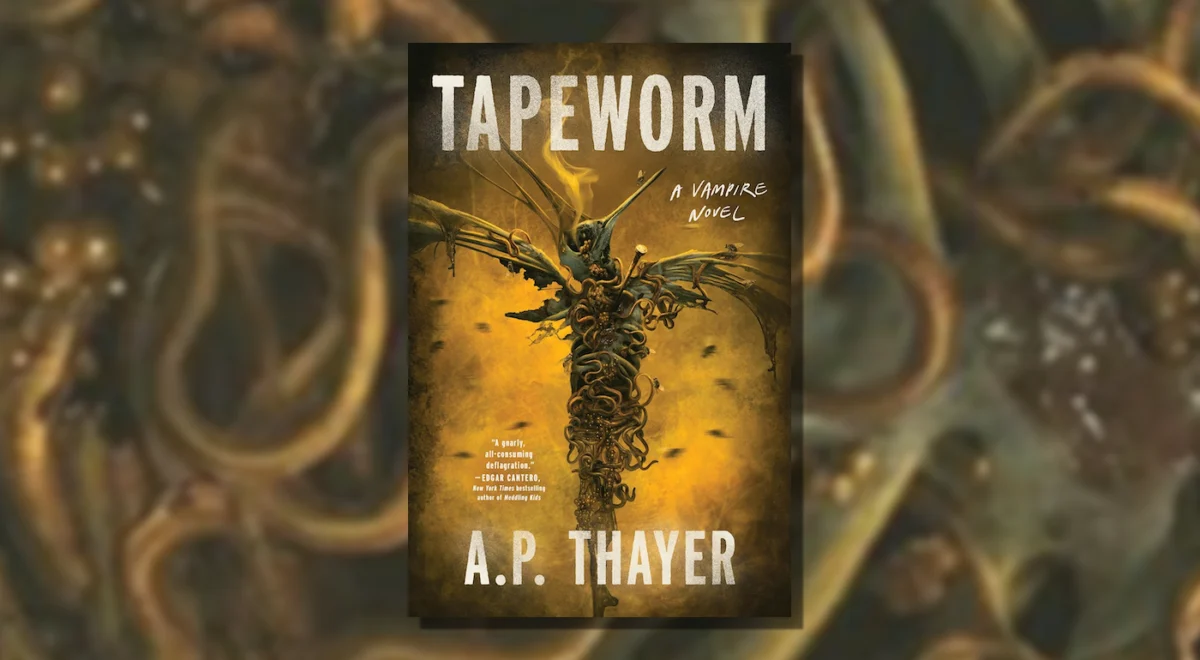
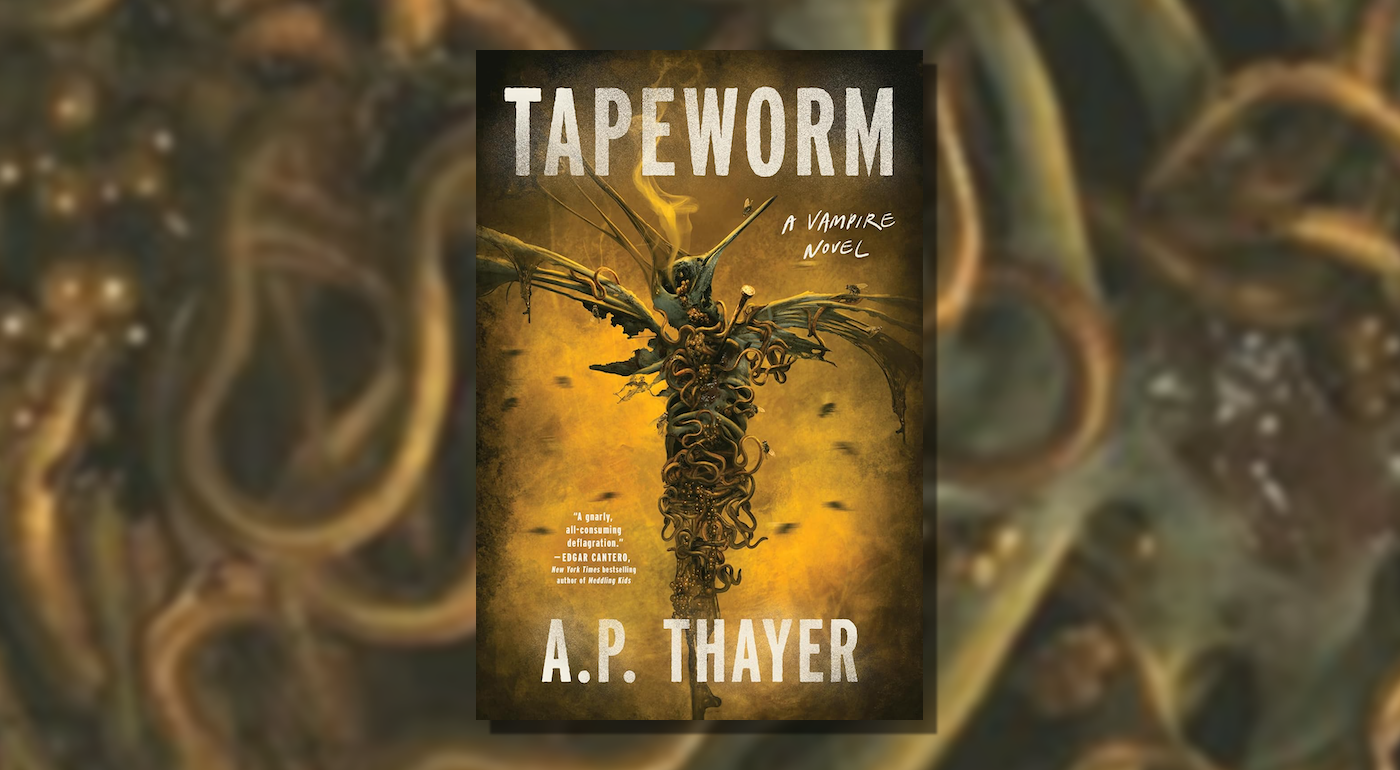
Superstition Valley, CA – [Current Date] – Prepare to confront your deepest fears and desires as Evil Twin, a publisher renowned for its cutting-edge genre fiction, announces the impending release of Tapeworm, a groundbreaking body-horror vampire novel by the critically acclaimed A.P. Thayer. Slated for publication on August 18th, Tapeworm promises to redefine the boundaries of supernatural horror, merging psychological dread with visceral, parasitic terror. Readers and listeners alike are invited to experience a tantalizing glimpse into this unsettling world with exclusive excerpts from both the print and audiobook editions, the latter masterfully narrated by Lee Osorio.
This highly anticipated novel plunges into the dark underbelly of human relationships and ancient evils, set against the desolate, yet strangely alluring, backdrop of the Californian desert town of Superstition. Thayer’s narrative weaves a chilling tapestry of personal breakdown and monstrous awakening, offering a fresh, insidious take on the vampire mythos.
The Main Facts: A New Breed of Horror Emerges
Tapeworm introduces readers to a narrative fraught with tension, both interpersonal and supernatural. The core premise revolves around Victor, a man reeling from a recent separation from his wife, Trish. In an attempt to salvage his frayed emotional state and rekindle connections with his friends, Victor embarks on their annual weekend retreat to Superstition. This seemingly innocuous desert getaway, however, quickly morphs into a crucible of terror when an ancient, ravenous entity stirs beneath the town’s arid surface.
Evil Twin’s official description frames Tapeworm as a body-horror vampire novel, a combination that immediately sets it apart. The concept of vampirism is reinterpreted not merely as a bloodlust, but as an insidious, parasitic invasion that preys on emotional vulnerabilities and repressed desires. A.P. Thayer, an author who has steadily gained recognition for pushing genre boundaries, is poised to deliver a narrative that is both intellectually stimulating and viscerally disturbing. The novel’s release on August 18th is expected to be a significant event in the horror literary calendar, appealing to fans who crave originality and a profound sense of dread.
Accompanying the print release is an equally compelling audiobook edition, brought to life by the talented voice actor Lee Osorio. Known for his ability to convey complex emotional landscapes and chilling atmospheres, Osorio’s narration is anticipated to elevate the immersive horror experience, making Tapeworm a must-listen for audiobook enthusiasts. An audio excerpt is readily available, providing a sonic precursor to the horrors that await.
Chronology of Dread: From Marital Strife to Ancient Awakening
The narrative arc of Tapeworm begins not with a monster, but with the profoundly human crisis of Victor’s failing marriage. His hopes for the Superstition retreat are simple: escape, relaxation, and a chance to mend bonds. This domestic struggle serves as the fertile ground for the supernatural horror that soon takes root.
The novel’s official excerpt provides a stark and intriguing setup:
"After the recent separation from his wife Trish, Victor hopes his friends’ annual weekend retreat to the Californian desert town of Superstition will loosen him up and reforge the group’s fraying bonds. But something is waiting underneath Superstition, crawling its way into their group, and feeding into their desires."
This establishes a clear chronology. First, the human element of Victor’s personal turmoil and the group’s strained dynamics. Second, the introduction of the latent, unknown horror lurking beneath the desert. Victor, having long repressed his own desires in an attempt to be the "perfect partner," finds himself vulnerable to the town’s "wild underbelly." The arrival of the Welcoming Committee, with its "romantic, sexually charged offer," signals the initial, deceptive lure of the entity, suggesting that the price for fulfilling desires will be far greater than Victor can imagine. The excerpt chillingly concludes: "Because something is hungry for Victor and his friends." This sets the stage for a descent into a horror where group bonding takes on a terrifying, literal new meaning.
The provided prologue, however, plunges us even further back in time, unveiling the true genesis of the horror. It opens with an uncharacteristic earthquake in Superstition Valley, not for its occurrence, but for its prolonged aftershocks. This seismic event is not merely geological; it is the catalyst for the awakening of "It," a formless yellow mist, an ancient entity released from millennia of imprisonment.
The creature’s awakening is chronicled with vivid, sensory detail:
"From this wound, It oozes, a formless mist of yellow, awakened to a new world and new sensations. A prisoner no more. Alive once again."
"As it shakes off the millennia of sleep, it delights in the sensory input of this new world. Temperature and the passage of time. Thoughts and emotions. Pain. That of others as well as the pain of its own hunger."
The prologue establishes a crucial chronological element: the creature’s imprisonment in a desolate land, and its release into a now-thriving ecosystem. Its ancient adversary, the sun, forces it to wait for nightfall, building suspense for its nocturnal rampage. The first human contact is depicted as Trish, Victor’s estranged wife, slamming a sliding glass door. Her emotional turmoil – "grief and weighed down by longing," "centuries-old anger within the woman’s pain and an overwhelming feeling of being trapped" – becomes a beacon for the hungry entity. This connection between the creature’s ancient rage and Trish’s modern despair is a potent thematic link.
The narrative of the prologue meticulously details the creature’s insidious approach, its awareness of its "ancient young" trapped below, and its strategic use of their "sacrifices" as a distraction. It culminates in the creature’s first direct physical infiltration, a terrifying invasion of Trish’s body, exploiting her emotional vulnerabilities and the decaying remnants of her relationship with Vic. The slow, methodical corruption of Trish, culminating in her chilling acceptance of the creature’s promises and the brutal crushing of a hummingbird, marks a pivotal, terrifying shift in the story’s timeline.
Supporting Data: Anatomy of a Parasitic Nightmare
The strength of Tapeworm lies in its intricate blend of psychological torment and grotesque body horror, supported by the detailed depiction of the creature’s nature and its targets. The "tapeworm" moniker itself suggests a parasitic existence, and the prologue delivers on this promise with unnerving precision.
The Creature’s Nature: "It" is not a traditional vampire. It is a "formless mist of yellow," an ancient, sentient being that revels in sensory input, particularly pain and emotion. Its physical manifestation includes "near-interminable coil of muscled segments that writhe beneath the surface," birthing "tendrils that stretch out through the packed clay and loose sand." This depiction moves far beyond classic vampiric tropes, leaning heavily into the visceral and formless horror reminiscent of Lovecraftian entities or parasitic organisms. Its sensitivity to the sun positions it within the classic vampire vulnerability, yet its methods of attack are entirely distinct.
The Psychological Feast: The creature’s true horror is its ability to feed on emotions. It targets Trish’s "maelstrom of emotional carnage," recognizing an "echo of its own centuries-old anger within the woman’s pain and an overwhelming feeling of being trapped." This is crucial supporting data for the "vampire" aspect of the novel – it’s a vampirism of the soul and mind, preying on human weakness rather than just blood. The creature "salivates inside her, instead, and feeds on the anger just as it feeds on her." It "leaks excretions into her bloodstream, spiking her cortisol and adrenaline, pumping her full of norepinephrine," manipulating her anger and preventing her from moving on. This biological and psychological warfare is a hallmark of effective body horror.
The Decay of Relationships as a Breeding Ground: The failing marriage of Trish and Vic is meticulously dissected by the creature. Their relationship is described as a "bloated dead thing, waterlogged and expanding with gas… as the flesh sloughs away. Flies swarm thickly on the putrid cadaver, eager to glut themselves on the sweet rot of what could have been and what might have been. An exquisite corpse, swollen with maggots. A mound of decayed hope and necrotized dreams." This potent metaphor illustrates how human emotional decay provides the perfect environment for the parasitic entity to thrive. The creature actively fuels their arguments, savors their falsehoods, and exploits their resentments, accelerating their downfall to better consume them.
Body Horror Manifestations: The invasion itself is a quintessential body-horror moment. The creature’s "corpse-white tendril darts out, stabbing beneath the cuticle of her pinky toe, hungry for the warmth of her flesh, where it pulls itself beneath her skin with hooked barbs." Later, it "oozes free from her ear canal" and burrows back into her skull, "where it drips honeyed poison into her prefrontal cortex." These descriptions are designed to evoke visceral discomfort, blurring the lines between internal and external threats, and making the reader feel the creature’s invasive presence.
The Audiobook’s Role: Lee Osorio’s narration is not just a reading; it’s an interpretation. In a genre like body-horror where psychological states are paramount, the nuances of a narrator’s voice—the subtle shifts in tone for Victor’s repression, Trish’s escalating anger, or the creature’s ancient, malevolent consciousness—can profoundly deepen the horror. Osorio’s anticipated skill in rendering the internal turmoil and the creature’s insidious whispers will be vital in translating Thayer’s chilling prose into an auditory nightmare. The audio excerpt serves as an immediate demonstration of this crucial element.
Official Responses and Thematic Undertones
While no direct quotes from A.P. Thayer or Evil Twin are provided, the excerpts themselves serve as the "official response" to what readers can expect. The publisher’s description frames the novel as a "body-horror vampire novel," a genre designation that is both specific and ambitious. It signals a departure from traditional vampire narratives, promising a more biologically grotesque and psychologically penetrating experience. The inclusion of the prologue excerpt further underscores this commitment, immediately immersing the reader in the creature’s perspective and its terrifying capabilities.
The novel appears to be a profound exploration of several key themes:
- The Nature of Desire and Repression: Victor’s attempts to be the "perfect partner" and his subsequent repression of desires are a central psychological conflict. The creature explicitly "feeding into their desires" suggests a confrontation with these buried urges, potentially leading to monstrous outcomes when they are unleashed and corrupted.
- Marital Decay and Emotional Vulnerability: The relationship between Trish and Vic is a microcosm of human weakness that the creature exploits. The narrative suggests that a dying relationship, rife with anger, resentment, and unfulfilled longing, creates a perfect vulnerability for external evil to latch onto. The creature’s ability to manipulate memories and create false hopes highlights the dangerous allure of toxic nostalgia.
- Parasitism and Control: The creature’s method of invasion and manipulation is a stark metaphor for parasitic relationships, both literal and figurative. It doesn’t just consume; it controls, whispers, and forces its hosts to act against their own perceived best interests, making them agents of its will.
- The Cost of "Getting What You Want": The Welcoming Committee’s "price to be paid" and the creature’s insidious promise to Trish, "I can make it better," suggest a Faustian bargain at the heart of the narrative. The novel will likely explore the horrific consequences of seeking solace or fulfillment through external, malevolent forces.
The choice of "Superstition" as a town name is itself a powerful thematic choice. It evokes ancient beliefs, unfounded fears, and perhaps, the very human tendency to ignore true danger in favor of comforting narratives. This name hints that the town itself might be imbued with a malevolent history, a perfect stage for an ancient evil to reawaken.
Implications: Reshaping the Vampire Mythos
Tapeworm by A.P. Thayer holds significant implications for the horror genre, particularly in its potential to reshape the modern vampire mythos.
Redefining Vampirism: By divorcing vampirism from its traditional, often romanticized, humanoid form and instead presenting it as a parasitic, formless entity that preys on emotions and infiltrates bodies, Thayer offers a truly unsettling reinterpretation. This approach aligns with contemporary trends in horror that favor psychological depth and biological dread over conventional monsters. It pushes the boundaries of what a "vampire" can be, moving it closer to cosmic horror or psychological thrillers while retaining the core concept of a life-draining entity.
Impact on Body Horror: The detailed, visceral descriptions of the creature’s infiltration and manipulation of Trish place Tapeworm firmly within the body-horror subgenre. It promises to explore the grotesque transformation and violation of the human form, both internally and externally. This novel could become a benchmark for how body horror can be integrated with supernatural elements to create a uniquely terrifying experience.
Exploration of Human Vulnerability: Beyond the supernatural, Tapeworm delves into the profound vulnerabilities of the human psyche—the pain of separation, repressed desires, anger, and longing. The creature’s ability to exploit these cracks in the human facade makes the horror deeply resonant and disturbing, as it taps into universal anxieties about losing control of one’s own mind and body. This makes the horror not just external, but intensely personal and internal.
A New Voice in Horror: A.P. Thayer’s distinctive vision, as evidenced by these excerpts, positions them as a compelling new voice in the horror landscape. The novel’s ambition to blend subgenres and explore complex psychological themes suggests a work that will challenge readers and critics alike, sparking discussions about the evolution of horror literature.
The chilling conclusion of the prologue, with Trish’s transformation and brutal act against the hummingbird, coupled with her deluded optimism ("Everything will be better"), leaves a lasting impression. It implies a narrative where the victims become unwitting extensions of the horror, blurring the lines between predator and prey, and hinting at a much larger, more insidious plan orchestrated by the ancient entity.
As August 18th approaches, the anticipation for A.P. Thayer’s Tapeworm builds. With its unique blend of body-horror, redefined vampirism, and profound psychological depth, this novel is set to leave an indelible mark on the genre. Readers are encouraged to dive into the available excerpts and prepare themselves for a journey into the darkest corners of the Californian desert, and the human soul.