The Sword-Wielding Legacy: A Deep Dive into David C. Smith and Richard L. Tierney’s Red Sonja Novels
FOR IMMEDIATE RELEASE
[City, State] – [Date] – In the vast, blood-soaked landscape of Sword & Sorcery, few characters loom as large and as enduring as Red Sonja, the "She-Devil with a Sword." While her origins are often mistakenly attributed directly to Robert E. Howard, the character as we know her – a formidable warrior from Hyrkania, clad in her iconic scale-mail bikini – was forged in the pages of Marvel Comics. Yet, her most celebrated prose adventures found their voice through the masterful collaboration of authors David C. Smith and Richard L. Tierney. Their six-book series for Ace Books, published between 1981 and 1983, stands as a testament to compelling fantasy writing, praised for its relentless action, intricate plotting, and surprisingly deep philosophical undercurrents.
This article delves into the significant contribution of Smith and Tierney to the Red Sonja mythos, examining how their novels not only enriched the character’s backstory and world but also left an indelible mark on the Sword & Sorcery genre. From tracing Sonja’s lineage back to her Howardian inspirations to analyzing the literary craftsmanship that made the series a fan favorite, we explore the enduring appeal of these unsung classics.
The Genesis of a Legend: Main Facts of the Smith & Tierney Series
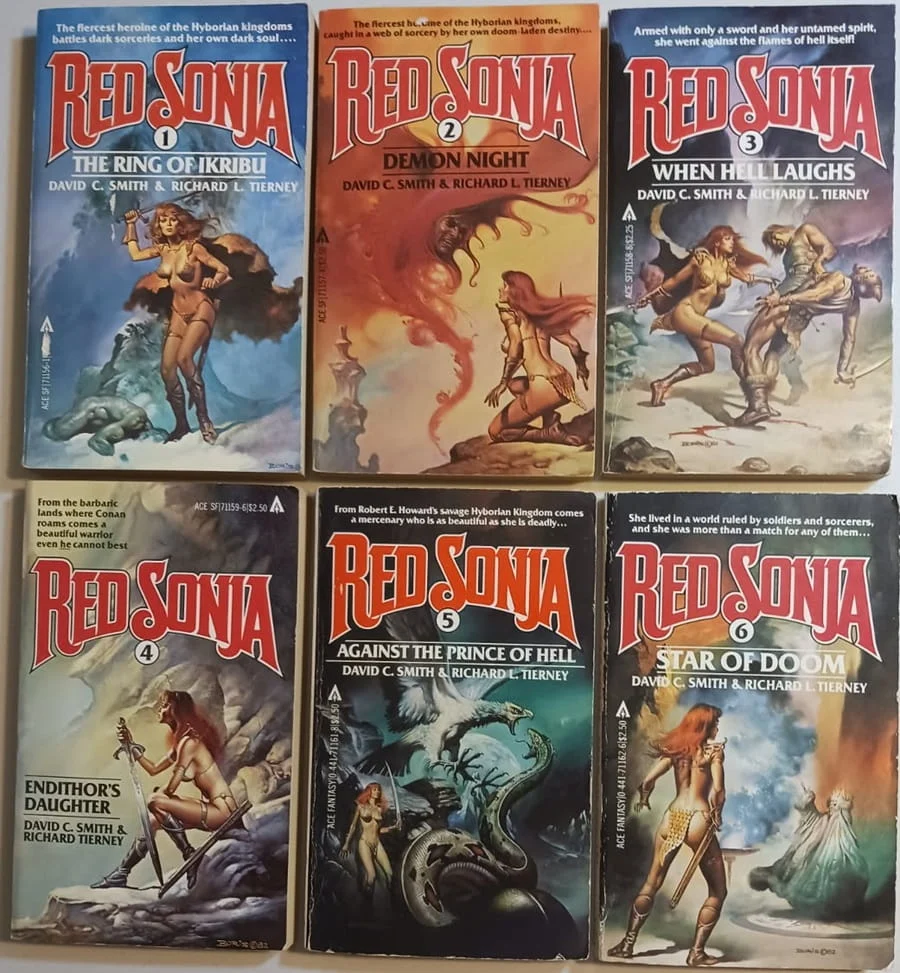
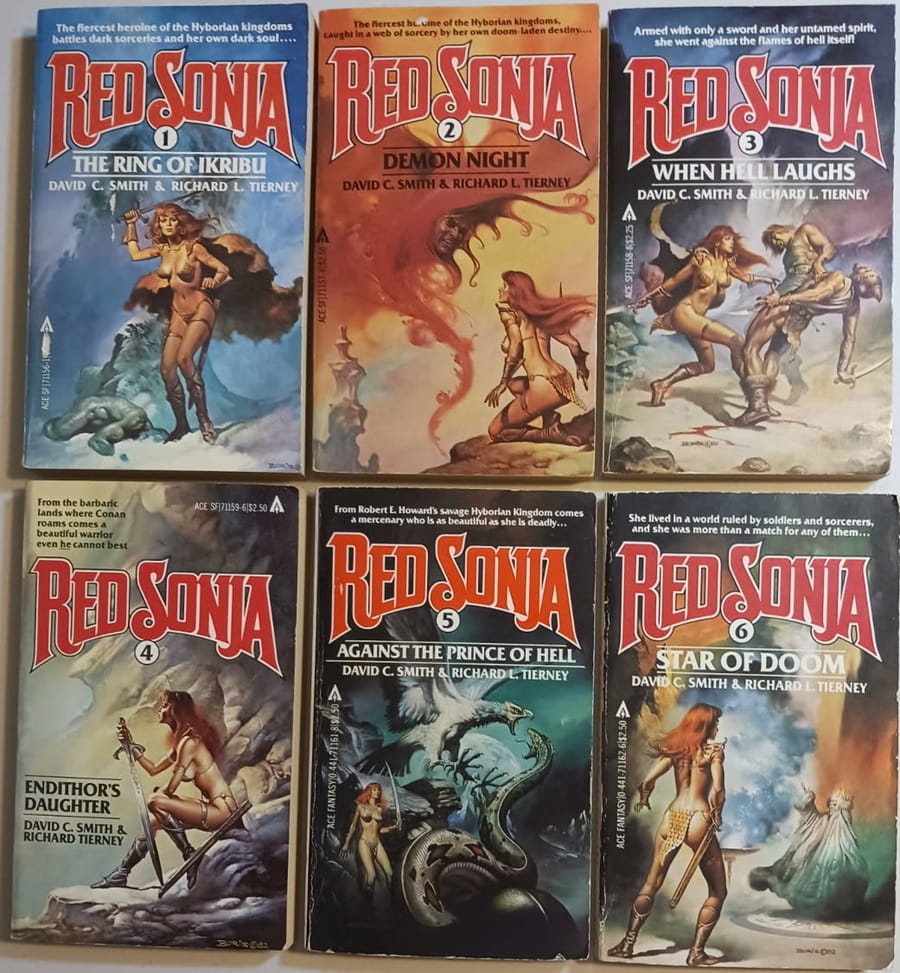
The collaborative efforts of David C. Smith, known for his robust Robert E. Howard pastiches and original fantasy works, and Richard L. Tierney, a celebrated author of Lovecraftian horror and Sword & Sorcery, yielded a six-novel series that significantly expanded the lore of Red Sonja. Published by Ace Books, these paperbacks were distinguished by their vivid covers, all masterfully rendered by the legendary fantasy artist Boris Vallejo, whose iconic interpretations of Sonja cemented her visual identity for a generation of readers.
The series, comprising The Ring of Ikribu (1981), Demon Night (1982), When Hell Laughs (1982), Endithor’s Daughter (1982), Against the Prince of Hell (1983), and Star of Doom (1983), offered readers a consistent, high-octane journey through the Hyborian Age. Unlike many series that falter in quality over time, the Smith & Tierney Red Sonja books were lauded for their increasing strength, with the later installments often cited as the strongest. They delivered a potent blend of thrilling action, detailed world-building, and unexpected philosophical depth, making them a cornerstone for fans of the Sword & Sorcery genre. These novels played a crucial role in establishing Red Sonja as a formidable literary character beyond her comic book origins, proving her capable of sustaining complex narrative arcs and exploring the darker facets of her heroic persona.
A Chronology of the She-Devil: From Howardian Echoes to Comic Book Icon and Literary Heroine
Understanding the Smith & Tierney Red Sonja series requires a journey through the character’s complex lineage, a path that weaves through the pioneering works of Robert E. Howard, the creative explosion of Marvel Comics, and finally, the dedicated craftsmanship of two prose authors.
Robert E. Howard’s Proto-Heroines
The foundational inspiration for Red Sonja lies firmly in the mind of Robert E. Howard, the father of Sword & Sorcery. While he never created a character explicitly named "Red Sonja" with a ‘J’, his literary tapestry featured several powerful female warriors who undoubtedly influenced her conception.
The most direct ancestor is widely considered to be Valeria of the Red Brotherhood, a fierce blonde pirate from Howard’s iconic Conan story, "Red Nails." Valeria is a peer to Conan, a warrior of equal skill and ferocity, demonstrating agency, martial prowess, and a defiant spirit that would become hallmarks of Red Sonja. Her independence and refusal to be a mere damsel in distress set a high bar for female characters in the genre. Indeed, the character of Valeria was prominently featured in the 1982 film Conan the Barbarian, further solidifying her image as a quintessential Howardian female warrior.
Another character, Red Sonya of Rogatino (spelled with a ‘y’), appeared in Howard’s historical tale, "The Shadow of the Vulture," collected in Sowers of the Thunder. This Sonya was a secondary character, a fierce mercenary fighting alongside Austrian forces against the Ottoman Turks. While she possessed red hair, a trait later adopted by her comic book namesake, her historical setting and role made her less of a direct thematic precursor to the fantastical Red Sonja than Valeria. Howard’s broader pantheon of female characters also included figures like Dark Agnes de Chastillon, a swordswoman in 16th-century France, and Bêlit, the pirate queen from "Queen of the Black Coast." These characters, though varied in their settings and specific circumstances, collectively established Howard’s precedent for strong, capable, and often tragic women who navigated violent worlds on their own terms. It was this rich legacy of independent female warriors that provided the fertile ground for Red Sonja’s eventual birth.
Marvel Comics: The Birth of a Hyborian Icon
The character of Red Sonja (with a ‘J’) officially burst onto the scene in 1973, not from Howard’s pen, but from the creative minds of Roy Thomas and Barry Windsor-Smith at Marvel Comics. In an era where Marvel was successfully adapting Conan the Barbarian comics, there was a desire to expand the Hyborian Age with original characters that could stand alongside Howard’s creations. Red Sonja was conceived as a potential companion or foil for Conan, a formidable female warrior who could hold her own in the brutal Hyborian world.
Her debut in Conan the Barbarian #23 (February 1973), with artwork by Barry Windsor-Smith, immediately captured readers’ imaginations. Thomas drew heavily on Valeria for Sonja’s spirit and martial skill, and on Red Sonya for her distinctive red hair and a similar, albeit updated, name. The character quickly became a fan favorite, leading to appearances in Marvel Feature #1 (November 1975) and eventually her own self-titled series, Red Sonja #1 (January 1977).
Artists like Windsor-Smith, John Buscema, and particularly Frank Thorne helped define Sonja’s iconic visual identity, most notably her "chainmail bikini" or "scaly mail" outfit. This scant but distinctive armor became synonymous with the character, a design choice that was both instantly recognizable and, as the Smith & Tierney novels would later address, highly impractical. The comic book version of Red Sonja also established key elements of her tragic backstory: a farmer’s daughter whose family was brutally murdered, and who, after suffering a traumatic assault, was granted incredible martial prowess by a mysterious "goddess" in exchange for a vow to never lie with a man unless he defeated her in fair combat. This origin story, steeped in vengeance and divine empowerment, provided a compelling foundation for her adventures.
The Literary Expansion: Smith & Tierney’s Contribution
With Red Sonja’s burgeoning popularity in comics, Ace Books saw an opportunity to bring her adventures to the prose world. The task of crafting her original novel series fell to David C. Smith and Richard L. Tierney. Both authors brought significant genre credentials to the project. Smith had already made a name for himself with his own Sword & Sorcery novels, often praised for their faithful evocation of Howardian style and thematic depth. Tierney, a contemporary of Smith, was celebrated for his contributions to the Cthulhu Mythos and other fantasy tales, demonstrating a mastery of atmospheric and dark fantasy.
Their collaboration resulted in a six-book series published rapidly between 1981 and 1983. This tight publication schedule not only capitalized on the character’s popularity but also allowed for a remarkably consistent and cohesive narrative arc across the books. The decision to enlist Boris Vallejo for all six covers was a stroke of genius. Vallejo’s hyper-realistic, dynamic, and often sensual depictions of Sonja perfectly captured the character’s fierce beauty and warrior spirit, making the books instantly appealing on bookstore shelves and cementing her visual brand in prose fiction. These novels marked a crucial phase in Red Sonja’s evolution, demonstrating her capacity to transcend her comic book origins and thrive in a more expansive literary format, offering complex characterization and elaborate plots that deepened her appeal.
Supporting Data: The Craft and Philosophy Behind the Blade
The critical praise for the Smith & Tierney Red Sonja series is not merely anecdotal; it stems from a discernible quality in their narrative construction, character development, and thematic exploration.
Masterful Storytelling and Pacing
One of the most frequently cited strengths of the series is its consistency. Across six novels published in quick succession, Smith and Tierney maintained a high standard of writing, plotting, and characterization. This is a rare feat in genre fiction, where series often suffer from declining quality or creative burnout. The books are described as "well plotted," meaning that each installment offers a clear, engaging narrative arc, with rising tension, compelling conflicts, and satisfying resolutions. The plots were intricate enough to keep readers invested, often weaving together elements of dark sorcery, ancient evils, political intrigue, and personal quests.
The pacing is consistently "fast," ensuring that the narratives "move." This relentless forward momentum is a hallmark of effective Sword & Sorcery, where action and adventure are paramount. Readers are plunged into dangerous situations, epic battles, and perilous journeys, rarely given a moment to catch their breath. Yet, this fast pace never comes at the expense of substance. The authors managed to infuse their action-packed tales with a "surprising amount of philosophy." This often manifests in Sonja’s internal monologues, her reflections on the harsh realities of her world, the nature of good and evil, justice, and survival. These philosophical interjections elevate the series beyond mere escapism, prompting readers to consider the deeper implications of Sonja’s struggles and choices in a brutal, unforgiving world.
The overarching sentiment is that the series delivered a "healthy dose of exciting S&S fun." This speaks to their successful adherence to genre conventions – the exotic settings, monstrous foes, powerful sorcerers, and the central figure of a lone warrior navigating a dangerous world. But it also hints at their ability to inject fresh energy and perspective, making the familiar feel new and exciting.
The Evolution of a Warrior: Character Depth and Backstory
Smith and Tierney inherited a character whose core traits were established in comics, but they deepened her motivations and explored the psychological impact of her past. Two key aspects of Sonja’s character were notably elaborated upon in their novels: her iconic attire and her tragic origin.
The Armor of Defiance: Red Sonja’s "brief vest and a skirt of silvery scale-mail" is perhaps her most recognizable visual element, yet it has long been a subject of debate regarding its impracticality for a warrior. Smith and Tierney, acknowledging this comic book convention, ingeniously wove an in-universe explanation into When Hell Laughs. They reveal that Sonja was once taken prisoner and forced to wear the revealing armor as an act of insult and humiliation. However, after killing her captor, she chose to continue wearing it. This wasn’t out of vanity or a lack of practical sense, but as an act of profound defiance and a grim statement of empowerment: "just for the pleasure of disemboweling any man who chose to make an issue of it." This explanation transforms a potentially problematic trope into a powerful symbol of Sonja’s resilience, her refusal to be shamed, and her unyielding ferocity. It adds a layer of psychological depth, showcasing her agency and turning a perceived weakness into a source of intimidating strength.
The Curse and the Blessing of a Goddess: The authors also faithfully incorporated and expanded upon Sonja’s tragic origin story. She is revealed to be a farmer’s daughter whose peaceful life was shattered when mercenaries slaughtered her family and raped her. This brutal trauma is the crucible in which her warrior spirit is forged. Fleeing into the forest, she is visited by a "goddess" – typically identified as Scáthach in later comics – who imbues Sonja’s sword arm with supernatural strength and speed. This "god-given power" is a classic fantasy trope, but in Sonja’s context, it’s a direct response to profound suffering, transforming her into an instrument of vengeance and justice. While the original article’s reviewer expresses a general disinclination towards such divine intervention, it is acknowledged as an integral part of Sonja’s comic book backstory and a feature of the 1985 film, and Smith and Tierney handled it with respect for the established canon, using it to justify her extraordinary prowess.
Prose Style and Genre Fidelity
The series is characterized by "strong, aggressive prose." This style is perfectly suited to the brutal, visceral world of Sword & Sorcery, conveying the intensity of combat, the harshness of the environment, and the raw emotions of the characters. Smith and Tierney mastered the art of descriptive language without bogging down the narrative, allowing readers to vividly imagine the exotic landscapes, terrifying monsters, and climactic battles.
Crucially, the authors maintained "enough consistency with the tropes of S&S to keep the genre fans connected but some surprises too." This balance is key to a successful genre work. They delivered on the expectations of Sword & Sorcery – epic quests, dark magic, valiant warriors, and perilous journeys – while also introducing unexpected plot twists, nuanced character moments, and the aforementioned philosophical musings that prevented the series from becoming formulaic. The general consensus that the books "got stronger across the series" is a rare compliment, suggesting that the authors grew more confident in their portrayal of Sonja and their shared vision for her adventures, culminating in "Books 5 & 6 [being] particular favorites." This sustained quality speaks volumes about their dedication and collaborative synergy.
Official Responses: Critical Acclaim and Enduring Legacy
While formal critical reviews from the early 1980s are not extensively digitized for all genre paperbacks, the consistent praise from fans and genre enthusiasts over the decades serves as a powerful testament to the quality of the Smith & Tierney Red Sonja series. The article’s author, Charles Gramlich, a seasoned observer of the genre, strongly recommends the paperbacks, noting that he "wouldn’t have read the whole series if I hadn’t liked them," a sentiment echoed by countless readers.
The series cemented Red Sonja’s place not just as a comic book character but as a legitimate literary figure. It proved that her adventures could sustain complex, multi-book narratives, offering a depth of character and world-building that resonated with readers who might not have been familiar with her comic book origins. The novels offered a more introspective and detailed exploration of Sonja’s psyche, her moral code, and the challenges she faced, beyond the visual medium of comics.
The partnership between Smith and Tierney, alongside Boris Vallejo’s iconic cover art, created a synergistic package that elevated the Red Sonja brand. Their work provided a definitive prose interpretation of the character for a significant period, influencing how she was perceived and understood by a wider audience. In a landscape often dominated by Conan pastiches, the Smith & Tierney Red Sonja series carved out its own distinct and respected niche, demonstrating the commercial and artistic viability of female-led Sword & Sorcery.
Implications: Red Sonja’s Broadened Appeal and the Evolution of Sword & Sorcery
The Smith & Tierney Red Sonja novels carried significant implications for the character’s broader appeal and the evolution of the Sword & Sorcery genre. They demonstrated that a character originating outside of Robert E. Howard’s direct creations could not only thrive in his established Hyborian Age but also gain substantial literary credibility.
Broadening Red Sonja’s Reach
The novels introduced Red Sonja to a demographic that might not have been regular comic book readers, expanding her fan base and reinforcing her status as a major fantasy icon. For many, these books were their first encounter with the She-Devil, offering a robust, action-packed, and surprisingly thoughtful entry point into her world. The depth of characterization, particularly the nuanced explanation for her "impractical" attire and the exploration of her traumatic past and divine empowerment, made her more than just a pin-up warrior. She became a figure of resilience, vengeance, and defiant self-determination, resonating with themes of empowerment that continue to be relevant.
The 1985 film Red Sonja, starring Brigitte Nielsen in the titular role and featuring Arnold Schwarzenegger (uncredited as "Lord Kalidor," a Conan-esque figure), further catapulted the character into mainstream consciousness. While the film’s critical reception was mixed, it undeniably showcased the character’s potential for adaptation beyond comics and novels. The Smith & Tierney books, published just before the film’s release, played a vital role in establishing the character’s narrative foundation and popularizing her image, creating a fertile ground for such adaptations.
A Testament to Collaborative Storytelling
The success of the Smith & Tierney series also highlights the power of collaboration in genre fiction. Their combined talents allowed for a rich tapestry of storytelling, blending Smith’s Howardian sensibilities with Tierney’s penchant for dark fantasy. This partnership not only produced high-quality entertainment but also served as an example of how authors can build upon existing intellectual property while injecting their unique voices and thematic concerns. Their ability to deliver a series that consistently improved, rather than declined, sets a high bar for collaborative projects in the genre.
Honoring and Expanding Howard’s Legacy
Ultimately, Smith and Tierney "did REH’s legacy proud with this series." While Red Sonja is not a direct Howard creation, she embodies the spirit of his fierce, independent, and morally complex heroes. By setting their stories in the Hyborian Age and adhering to the genre’s core tenets – exotic adventure, brutal combat, dark magic, and compelling protagonists – they extended and enriched the world Howard so brilliantly imagined. They demonstrated that the Hyborian Age was vast enough to accommodate new, compelling figures who could stand alongside Conan, offering different perspectives and narrative possibilities.
In an era of continuous reboots, adaptations, and reinterpretations of classic fantasy characters, the Smith & Tierney Red Sonja novels remain a crucial touchstone. They are a powerful reminder of a time when prose fiction played a central role in expanding the universes of beloved comic book heroes. For any fan seeking "Lots of action and exotic situations described in strong, aggressive prose," coupled with unexpected philosophical depth and a character who truly embodies defiance and strength, these six books are an essential read, continuing to deliver a "healthy dose of exciting S&S fun" decades after their initial publication. Their contribution solidifies Red Sonja’s place as one of the most enduring and captivating figures in Sword & Sorcery history.