"Bright Eyes" Episode Seven Review: A Deep Dive into Grief, Extremism, and the Search for Redemption in X-Men ’97
The latest installment of X-Men ’97, titled "Bright Eyes," plunges viewers into a complex narrative rich with emotional depth, political allegory, and profound character exploration. Episode seven, featuring a burgeoning cast and significant plot developments, delivers a powerful commentary on prejudice, the allure of extremism, and the enduring quest for redemption in a world hostile to mutants. From its poignant opening flashback to its shocking cliffhanger, the episode reaffirms X-Men ’97‘s commitment to mature storytelling, echoing the beloved animated series while fearlessly charting new, darker territory.
Main Facts: A Convergence of Crises
"Bright Eyes" marks a pivotal moment in the ongoing mutant saga, bringing several simmering conflicts to a boiling point. The episode’s core revolves around the abduction of Graydon Creed, a prominent anti-mutant presidential candidate, by the extremist Acolytes, led by the zealous Exodus. This act forces the X-Men into a morally ambiguous mission: to rescue a man who actively campaigns for their oppression.
The narrative is deeply rooted in the aftermath of the Genosha tragedy, specifically focusing on Colossus’s profound grief over the loss of his sister, Illyana Rasputin (Magik), a newly revealed casualty of the Sentinel attack. His vulnerability makes him susceptible to the Acolytes’ radical ideology, setting the stage for a dramatic clash of philosophies. Nightcrawler, a character often defined by his unwavering faith and idealism, takes center stage, advocating for a path of understanding and redemption, even for his despised half-brother, Creed.
The episode introduces Polaris to the main title sequence, highlighting her growing importance within the team, particularly alongside Bishop. Their dynamic, combined with the familial ties between Nightcrawler, Rogue, and Creed (all revealed as children of Mystique), adds layers of personal drama to the overarching mutant struggle. The climax sees a tense trial, a daring rescue, and a brutal confrontation that leaves a significant character seemingly dead, while a shocking final reveal hints at the return of a fallen X-Man and the machinations of an ancient evil.
Chronology: A Path Through Grief, Politics, and Peril
The Shadow of Genosha and a Brother’s Loss: The episode opens with a somber and unexpected flashback to the Genosha genocide, an event that still casts a long shadow over the mutant community. Viewers witness the horrific scale of destruction wrought by the Sentinels, as Colossus (voiced by Robert Cait) and his younger sister, Illyana (Courtenay Taylor), valiantly attempt to rescue innocent bystanders. In a heartbreaking moment, Illyana sacrifices her life to save others, leaving Colossus utterly devastated. This retroactive reveal of Illyana’s death serves as a powerful emotional anchor, retroactively deepening the trauma of Genosha and providing a crucial backstory for Colossus’s subsequent actions. His grief, raw and unyielding, becomes the catalyst for his radicalization.
The Rise of Anti-Mutant Rhetoric: In the present day, the political landscape is fraught with tension. Graydon Creed (Ben Pronsky), a virulent anti-mutant leader, announces his candidacy for President of the United States at a massive, charged rally. The scene is disturbingly familiar, with attendees proudly displaying "Friends of Humanity" caps and other hateful anti-mutant insignia, their chants mirroring real-world expressions of xenophobia and prejudice. Creed’s speech, laden with fear-mongering and scapegoating, targets X-Factor, accusing the government-sanctioned mutant team of draining taxpayer dollars to protect mutants over humans.
The Acolytes’ Militant Stand: Creed’s rally is violently disrupted by a group of mutants calling themselves the Acolytes. Among their ranks are a grief-stricken Colossus, the formidable Frenzy, and their charismatic, yet fanatical, leader, Exodus (Bo Poraj). Live on national television, Exodus boldly declares that the Acolytes are continuing Magneto’s legacy, a legacy of militant self-preservation and unwavering defiance against human oppression. He issues an ultimatum: release all mutants currently detained by the X-Factor team, or Graydon Creed will die. This act of aggression, while understandable in its origins, immediately positions the Acolytes as a dangerous, extremist force, mirroring the very tactics they claim to fight against.

A Moral Conundrum in the Savage Land: Despite the severe ethical implications and the vehement objections of X-Factor director Val Cooper (Catherine Disher), Professor X (Ross Marquand) makes the controversial decision to send a team of X-Men to rescue Creed. The mission takes them to the prehistoric, untamed wilderness of the Savage Land, a common refuge for the Acolytes in the comics. The chosen X-Men team includes Bishop (Isaac Robinson-Smith) and Polaris (Carolina Ravassa), whose burgeoning flirtation adds a touch of levity amidst the tension. More significantly, Nightcrawler (Adrian Hough) and Rogue (Lenore Zann) confront their shared, complicated family history, as Creed is revealed to be a half- or step-brother to both, all three being children of the shape-shifting mutant, Mystique.
The X-Men’s journey is immediately perilous. Their jet is struck by missiles and, worse, enveloped by radiation that inexplicably neutralizes their mutant powers. In a moment of quick thinking, Polaris, despite her powers being hampered, manages to deploy a parachute, allowing her and Bishop to safely land amidst the Savage Land’s dinosaurs and other ancient creatures. The rest of the team crash-lands, their powers still suppressed, only to be met by Colossus and a contingent of Acolytes.
A Glimmer of Diplomacy: Surprisingly, an immediate confrontation is averted. Instead, Nightcrawler, ever the diplomat and believer in dialogue, requests a tour of the Acolytes’ haven and an introduction to their way of life. Colossus, still wrestling with his immense sorrow, agrees. He leads the X-Men to a shrine dedicated to Illyana, Magneto, and other fallen mutants, explaining that Exodus offered him solace and purpose during his darkest hour. The Acolytes, he reveals, are dedicated to providing a safe refuge for mutants, bringing new members to their Savage Land sanctuary daily.
The Trial of Graydon Creed: Creed, though bound in handcuffs, remains unrepentant and scorns Nightcrawler’s attempts at overtures. Undeterred, Nightcrawler proposes a formal trial to determine if Creed is capable of redemption, offering to join the Acolytes himself if he fails to convince them, on the condition that Colossus presides.
Meanwhile, Bishop and Polaris, operating on the outskirts of the Acolytes’ base, continue to develop their bond while strategizing to disable the radiation tower responsible for neutralizing the X-Men’s powers.
The trial commences, a volatile affair with a rowdy crowd of Acolytes booing Creed as he spews anti-mutant epithets. Exodus, acting as prosecutor, meticulously details Creed’s heinous transgressions: founding the hate group "Friends of Humanity," developing a mutant-killing virus, and a litany of other actions fueled by his profound hatred.
Nightcrawler, for the defense, delves into Creed’s traumatic past, revealing that their mother, Mystique, abandoned him as a baby, and his human father later abandoned him upon realizing Creed possessed no mutant powers. Nightcrawler posits a radical theory: Creed doesn’t hate mutants, but rather projects his self-hatred and abandonment issues, stemming from his mutant parents, onto the entire mutant race. "Creed is just a man," Nightcrawler pleads to Colossus, "haunted, just like us."

Chaos and Consequences: Before Colossus can deliver his verdict, an impatient and furious Exodus denounces him as a "heretic" and attacks. In a dramatic entrance, Bishop and Polaris swoop in on pterodactyls, successfully disabling the radiation tower and instantly restoring the X-Men’s powers. A full-scale battle erupts between the X-Men and the Acolytes, with Colossus, swayed by Nightcrawler’s plea and Exodus’s extremism, ultimately siding with his former teammates.
In the ensuing chaos, Creed seizes a dropped gun and, in a shocking turn of events, shoots Exodus, who falls to the ground, seemingly dead. Creed then threatens Nightcrawler, but the teleporting mutant, demonstrating incredible restraint, teleports them both to the desolate, freezing expanse of Antarctica, just beyond the Savage Land’s unnatural warmth. Kurt tells Creed that despite his lack of powers, he is very much his parents’ son, a powerful indictment of Creed’s internalized hatred. In a profound act of mercy, Nightcrawler leaves Creed alive, to be retrieved by X-Factor as per the X-Men’s agreement.
The Political Fallout and a Nuanced Return: Back at the X-Mansion, Nightcrawler welcomes Colossus home. He asks if his defense had convinced Colossus of Creed’s redeemability. Colossus’s response is poignant: "No, you did not convince me," he admits, "but you would have convinced Illyana." This line underscores the lasting impact of his sister’s idealism and the profound influence she continues to exert on his moral compass.
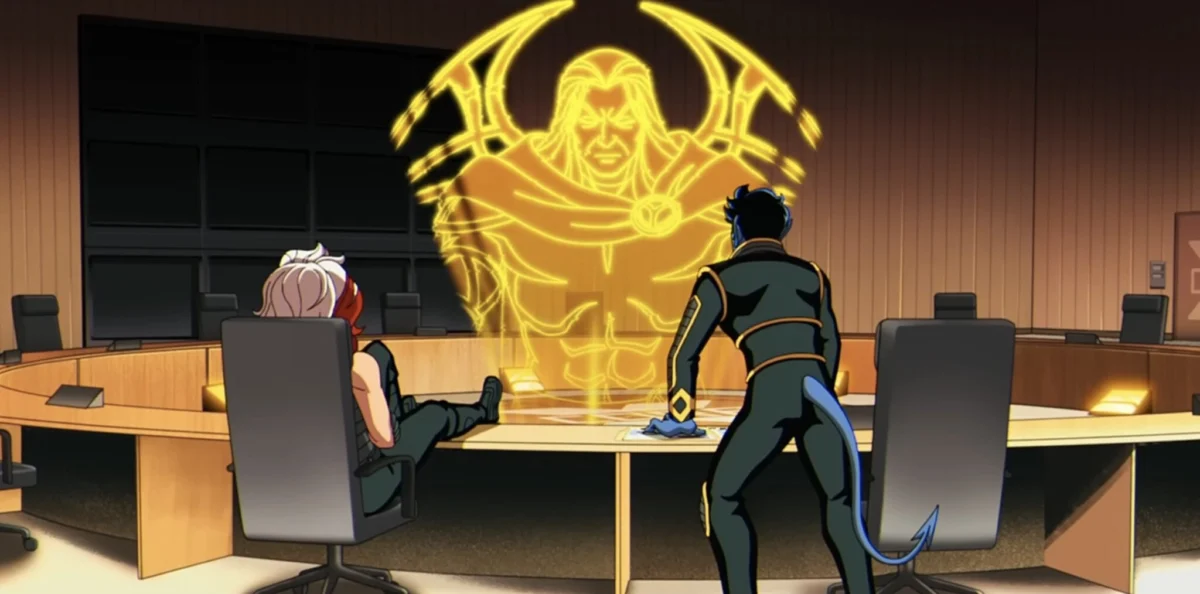
Meanwhile, Professor X and Val Cooper engage in a holographic debriefing. Xavier confirms Creed’s capture by X-Factor, fulfilling their end of the bargain. Cooper, however, remains wary, cautioning Xavier that he is "playing a dangerous game" and threatening to revoke funding for both X-Corps and the school if he continues to cross established lines.
A Shocking Cliffhanger: The episode concludes with a dramatic cliffhanger. The X-Force team, investigating Apocalypse’s abandoned base in Athens, discovers what appears to be Apocalypse’s lifeless corpse. Beside it lies a charred playing card, the unmistakable signature of the supposedly deceased X-Man, Gambit. This dual revelation promises to unravel new, potentially terrifying, storylines for the season’s final episodes.
Supporting Data: Echoes from the Comics and Deeper Thematic Roots
"Bright Eyes" expertly weaves together classic comic book lore with fresh interpretations, creating a narrative that resonates with both long-time fans and new viewers.
Genosha’s Enduring Trauma: The Genosha genocide, a pivotal event in X-Men history, is continually explored as a source of profound collective trauma. In the comics, Genosha was a mutant nation, a dream of peaceful coexistence that became a nightmare. Its destruction in X-Men ’97 serves as a stark reminder of the ever-present threat to mutantkind, fueling the radicalization of characters like Colossus and providing context for the Acolytes’ extreme measures. The retroactive reveal of Illyana’s death emphasizes that the true cost of such a catastrophe often unfolds gradually, its victims and ripple effects only fully understood over time.

The Acolytes and Magneto’s Legacy: The Acolytes, a group first introduced in the comics as zealous followers of Magneto, embody a more militant approach to mutant survival. Their belief that mutants are superior and should not coexist with humans is a radical interpretation of Magneto’s vision, one that often descends into violent extremism. Exodus, a powerful and ancient mutant whose powers are often amplified by faith and devotion, serves as a compelling, albeit underdeveloped, leader for this faction. His commitment to Magneto’s legacy, twisted by his own fanaticism, provides a stark contrast to Xavier’s dream of peaceful integration. The episode effectively portrays the Acolytes as a response to persecution, demonstrating how oppression can breed its own form of radicalism.
Graydon Creed: The Scion of Hate: Graydon Creed’s character is particularly poignant, drawing directly from his comic book origins as the human son of Mystique and Sabretooth (though the latter is not mentioned in this episode). His deep-seated hatred for mutants is rooted not in ideology alone, but in profound personal abandonment and a sense of inadequacy stemming from his mutant parentage. Nightcrawler’s defense, highlighting Creed’s psychological wounds, adds a layer of tragic realism to his villainy, suggesting that prejudice can often be a projection of one’s own internal struggles. This complex lineage—Nightcrawler, Rogue, and Creed as Mystique’s children—underscores the show’s exploration of fragmented families and the different paths individuals take when confronted with their heritage. The omission of Sabretooth and the potential inclusion of Destiny, Mystique’s long-time partner and a mother figure to Kurt and Rogue in the comics, could further enrich these familial dynamics in future episodes.
X-Factor’s Precarious Position: X-Factor’s role as a government-sanctioned mutant team is a recurring source of ethical tension. In the comics, X-Factor often walked a tightrope, attempting to work within human systems while protecting mutants. "Bright Eyes" powerfully illustrates the inherent contradictions of this position: X-Factor is simultaneously condemned by anti-mutant bigots like Creed as a waste of resources protecting "freaks," and by pro-mutant extremists like Exodus as "race traitors" for collaborating with their oppressors. This "damned if you do, damned if you don’t" scenario highlights the impossibility of satisfying all factions in a deeply polarized society, underscoring the moral compromises inherent in trying to bridge an unbridgeable divide.
The Savage Land’s Mystique: The Savage Land, a hidden tropical prehistoric jungle in Antarctica, is a classic Marvel locale, home to dinosaurs, ancient civilizations, and various mutant species. Its inclusion in this episode serves not only as a visually stunning backdrop but also as a symbolic refuge, a place untouched by human civilization where mutants might find sanctuary, albeit a dangerous one. The radiation tower, a plot device to temporarily disable powers, allows for non-mutant-centric action sequences and emphasizes the X-Men’s vulnerability when stripped of their abilities.
The Gambit and Apocalypse Tease: The cliffhanger involving Apocalypse’s apparent corpse and Gambit’s charred playing card is a direct callback to significant comic book storylines. Apocalypse, one of the X-Men’s most ancient and powerful foes, often manipulates events from the shadows. Gambit’s "death" earlier in the season was a major emotional blow, and his potential return, especially linked to Apocalypse, hints at a major plot twist. In the comics, Gambit has had complex interactions with Apocalypse, even serving as a Horseman of Apocalypse at one point. This reveal suggests a broader, more cosmic threat looms, potentially tying together the disparate threads of the season’s "bottle episodes" into a grand finale.
Official Responses: Critical Acclaim and Narrative Impact
"Bright Eyes" has largely been met with critical acclaim for its bold storytelling and thematic depth. Reviewers praised the episode’s willingness to delve into the darker repercussions of the Genosha tragedy, demonstrating a realism in depicting the protracted grief and radicalization that can follow such an event. While the retroactive nature of Illyana’s death initially surprised some, its narrative purpose in explaining Colossus’s turn to the Acolytes was widely appreciated, adding a poignant layer to his character arc.
The rally scene, with its chilling parallels to contemporary political rhetoric and the casual bigotry displayed by the "Friends of Humanity," was noted for its potent social commentary. Many critics highlighted the show’s courage in addressing such sensitive topics, making the struggle of the mutants feel even more relevant and urgent. The depiction of X-Factor’s impossible position, caught between human oppressors and mutant extremists, was lauded as a nuanced exploration of political and moral compromise.

Nightcrawler’s central role was particularly celebrated. His portrayal as a faith-driven idealist, offering a vision of redemption distinct from Professor X’s more secular humanism, was seen as a refreshing and powerful character spotlight. Adrian Hough’s voice performance was singled out for conveying the character’s unwavering conviction and empathy. The complex family dynamics between Nightcrawler, Rogue, and Creed, intertwined with Mystique’s shadowy influence, were praised for adding significant emotional weight and personal stakes to the overarching conflict. Many critics expressed hope that future episodes might further explore Mystique’s relationships, perhaps even introducing Destiny to complete the intricate familial web.
However, some minor criticisms were also voiced. The characterization of Exodus, while providing a clear foil to Nightcrawler, was perceived by some as slightly underdeveloped. While his zealotry was evident, a deeper exploration of his philosophical justifications, beyond simply inheriting Magneto’s legacy, might have made his extremism more compelling. The reviewer’s note about Exodus’s faith-amplified powers from the comics being a missed thematic opportunity resonated with this sentiment. Additionally, a few logistical questions arose regarding the X-Men’s ability to locate the Acolytes’ hidden base, the selective nature of the power-dampening tower, and the seemingly effortless taming of pterodactyls by Bishop and Polaris. While these were generally acknowledged as minor "hand-waving" typical of animated series, they were noted as slightly more prevalent in this particular episode. Nevertheless, the visual spectacle of Bishop and Polaris riding pterodactyls was a "low-key loved" moment that transcended any minor plot holes. The inclusion of more obscure Acolyte cameos, such as Gargouille and Random, was a fun nod for comic book aficionados, even if not universally recognized.
The episode’s shocking cliffhanger, involving Apocalypse’s corpse and Gambit’s playing card, generated significant buzz and speculation. While some expressed skepticism about bringing back a character as impactful as Gambit, the sheer surprise and the potential for a deeper, more menacing threat were undeniable, setting a high bar for the season’s concluding chapters.
Implications: The Shifting Sands of Mutant Destiny
"Bright Eyes" is more than just an episodic adventure; it is a foundational chapter that reshapes the future trajectory of X-Men ’97 and its characters.
The Fractured Mutant Community: The episode starkly illustrates the growing schism within the mutant community. The Genoshan tragedy has pushed many, like Colossus, towards radicalization and despair, seeking solace and vengeance in the militant ideology of groups like the Acolytes. This internal division, between Xavier’s dream of coexistence and Magneto’s legacy of self-preservation, is now more pronounced than ever. The X-Men’s struggle is no longer solely against human prejudice, but also against the seductive appeal of extremism within their own ranks. This suggests that future storylines will continue to explore the complexities of mutant identity and the varying responses to systemic oppression.
The Enduring Power of Empathy and Redemption: Nightcrawler’s impassioned defense of Graydon Creed, despite Creed’s virulent hatred, stands as a testament to the X-Men’s core philosophy. His belief in the possibility of redemption, even for the most hateful, offers a counter-narrative to the cycle of violence and retribution. Colossus’s final admission, that Nightcrawler would have convinced Illyana, underscores the lasting influence of those who champion idealism and compassion. This thematic thread implies that the X-Men will continue to grapple with these moral quandaries, striving to uphold their ideals even when faced with seemingly irredeemable adversaries.
A Precarious Political Climate: Val Cooper’s stern warning to Professor X highlights the precarious political tightrope the X-Men must walk. Their intervention to save Creed, a man who despises them, may have fulfilled a moral obligation, but it has not eased the political pressure. The threat to X-Corps and the school suggests that the government’s tolerance for mutant autonomy is waning, potentially leading to increased surveillance, control, or even direct confrontation in future seasons. The X-Men’s very existence remains a political hot potato, with their actions constantly scrutinized and manipulated by various human and mutant factions.

The Looming Threat of Apocalypse and Gambit’s Return: The discovery of Apocalypse’s corpse and Gambit’s playing card introduces a monumental new threat and a potentially game-changing resurrection. Apocalypse is traditionally one of the X-Men’s most formidable and ancient foes, his philosophy of "survival of the fittest" often manifesting in cataclysmic events. His apparent demise, coupled with Gambit’s signature, hints at a powerful, possibly magical or mystical, force at play. This cliffhanger sets the stage for a grander narrative, likely involving ancient powers, manipulation, and the very fabric of mutant existence. The implications for Gambit’s character, should he return, are vast – will he be the same Gambit, or will his resurrection come with a dark price, perhaps tied to Apocalypse’s influence? This promises an explosive finale that will tie together the season’s themes of grief, power, and the eternal struggle for mutant survival against overwhelming odds.
In conclusion, "Bright Eyes" is a triumph of episodic storytelling, deepening character arcs, raising profound ethical questions, and setting a thrilling trajectory for the remainder of X-Men ’97. It serves as a powerful reminder of the show’s ability to blend exhilarating action with thoughtful social commentary, proving that the legacy of the X-Men continues to be as relevant and impactful as ever.