Roger Zelazny’s "Lord of Light": A Masterpiece Where Gods Are Born of Technology and Myth
Main Facts
Roger Zelazny’s Lord of Light, published in 1967, stands as a towering achievement in speculative fiction, a novel that daringly blends science fiction with mythology, earning him the coveted Hugo Award in 1968. Often cited as one of the most influential works of the New Wave movement, the book reimagines Hindu and Buddhist mythologies through a futuristic lens, presenting a world where human colonists, possessing advanced technology and psionic abilities, have declared themselves gods. At its heart is the enigmatic figure of Mahasamatman, or Sam, who, despite his immense power, chooses to champion humanity’s right to technological and spiritual freedom, challenging the established pantheon and seeking to revive the teachings of Buddha.
Zelazny’s genius lies in his ability to craft a narrative that is simultaneously epic and intimately personal, exploring profound philosophical questions about power, identity, and enlightenment. The novel’s intricate world-building introduces an alien planet populated by unique species and governed by a rigid social order enforced by the self-proclaimed deities of the Celestial City. These "gods" maintain their dominion through a sophisticated system of technological reincarnation, effectively controlling life and death, and suppressing any technological advancement for the masses. Sam’s rebellion against this celestial tyranny forms the central conflict, positioning him as a cosmic Prometheus seeking to liberate humanity from divine oppression. Lord of Light remains a testament to Zelazny’s unparalleled creativity and his profound understanding of both ancient myth and futuristic possibility, securing its place as an enduring classic.
Chronology
The Genesis of a Vision
Roger Zelazny emerged as a prominent voice during the "New Wave" era of science fiction in the 1960s, a period characterized by experimental narratives, literary ambition, and a thematic shift towards internal realities, social commentary, and stylistic innovation. Unlike many of his contemporaries who drew inspiration from naturalism, modernism, or surrealism, Zelazny’s distinctive style was deeply rooted in classical mythology, poetry, and a romantic sensibility. His fascination with ancient narratives, particularly those of the Hindu and Buddhist traditions, provided a rich tapestry from which he wove his futuristic tales. This unique blend set him apart, lending his works a lyrical quality and a profound sense of timelessness, echoing the poetic grandeur of figures like W.B. Yeats and T.S. Eliot, whose influence he readily acknowledged. Lord of Light was not an anomaly but a culmination of these artistic inclinations, a bold experiment in genre fusion that sought to explore universal human themes through the lens of reinvented myth.
Zelazny’s creative process often involved taking archetypal figures and narratives and transplanting them into speculative settings, questioning their essence and exploring their modern implications. Before Lord of Light, he had already begun to establish his reputation with works like The Dream Master (expanded from the novella "He Who Shapes") and This Immortal (originally titled And Call Me Conrad), both of which showcased his talent for psychological depth and innovative world-building. These early successes provided the foundation for the ambitious scope of Lord of Light, where he would fully unleash his imaginative powers to construct a universe that was both alien and strangely familiar, populated by characters who were simultaneously godlike and deeply human. The novel’s intricate structure, non-linear storytelling, and poetic prose were hallmarks of Zelazny’s New Wave sensibility, pushing the boundaries of what science fiction could achieve.
Publication Journey
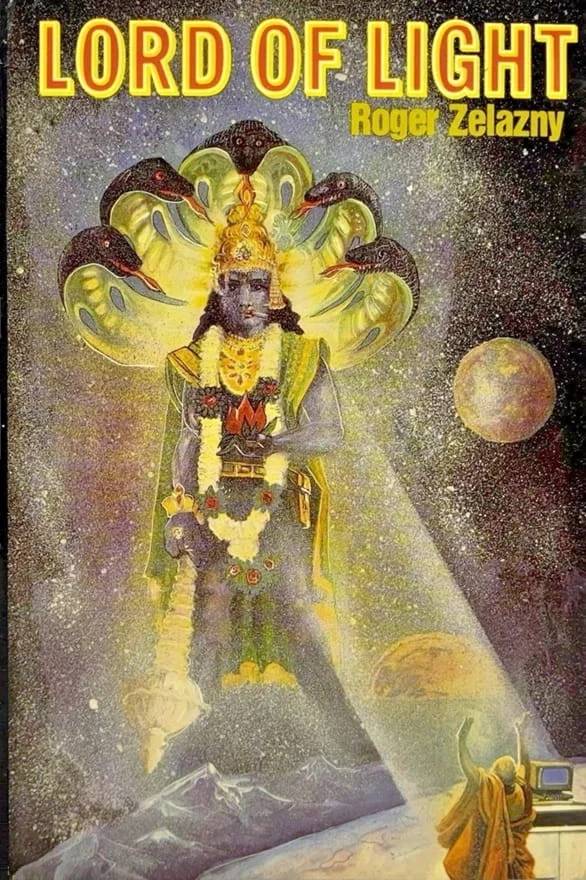
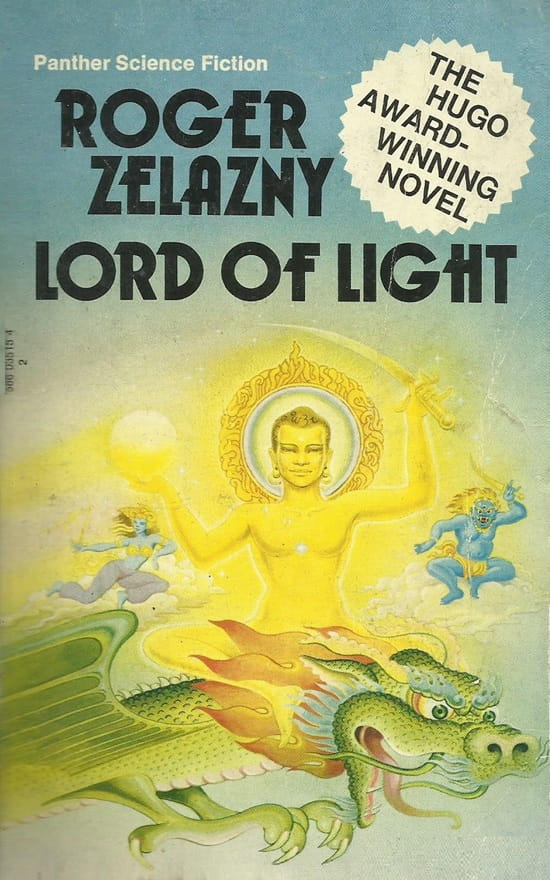
Lord of Light first graced the literary scene with its hardcover release from Doubleday in September 1967, featuring a cover by Howard Bernstein that hinted at its exotic blend of the divine and the futuristic. This initial edition quickly garnered critical attention and established the novel as a significant work. Its impact was solidified when it won the Hugo Award for Best Novel in 1968, marking it as a groundbreaking achievement. Following its critical success, the book saw numerous paperback printings, making it accessible to a wider audience and cementing its place in the science fiction canon. The Avon Books paperback, released in January 1969 with a memorable cover by Ronald Walotsky, became particularly iconic and introduced the novel to countless readers.
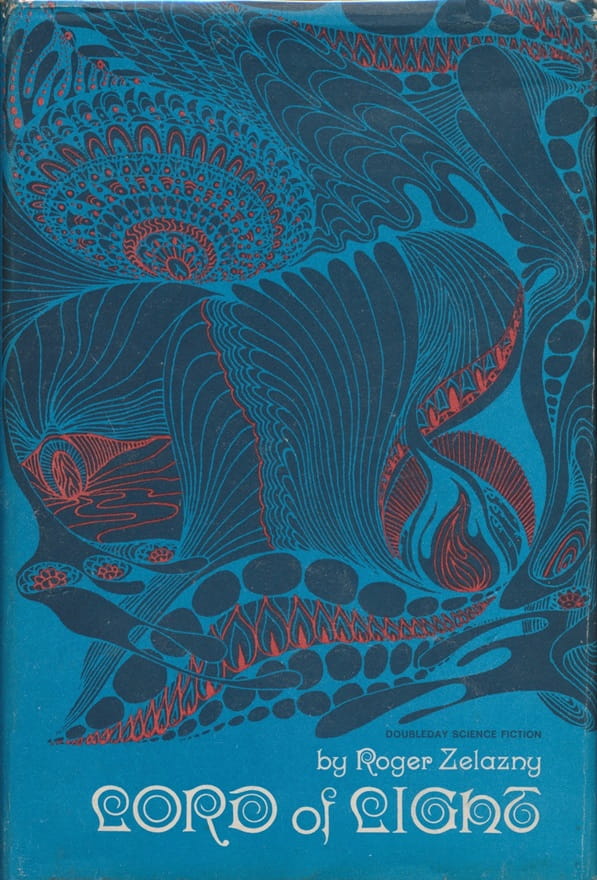
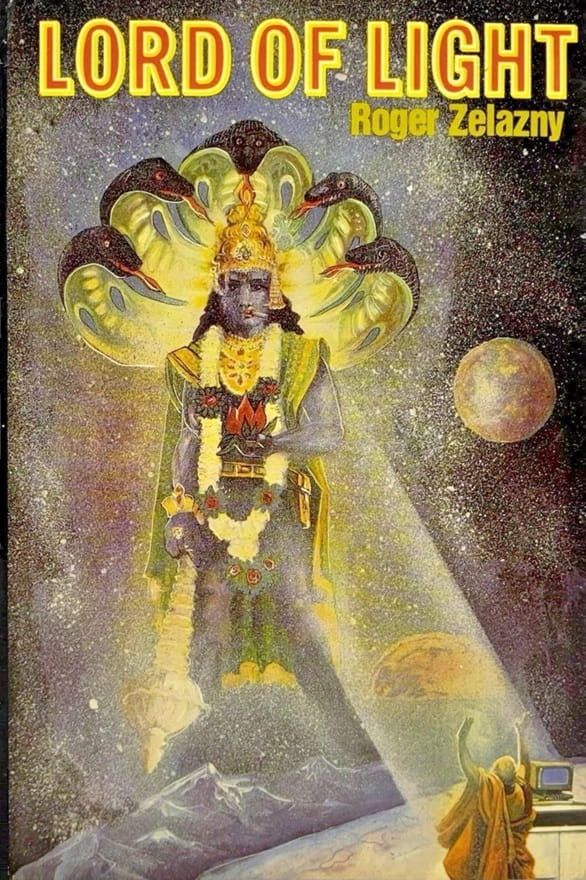
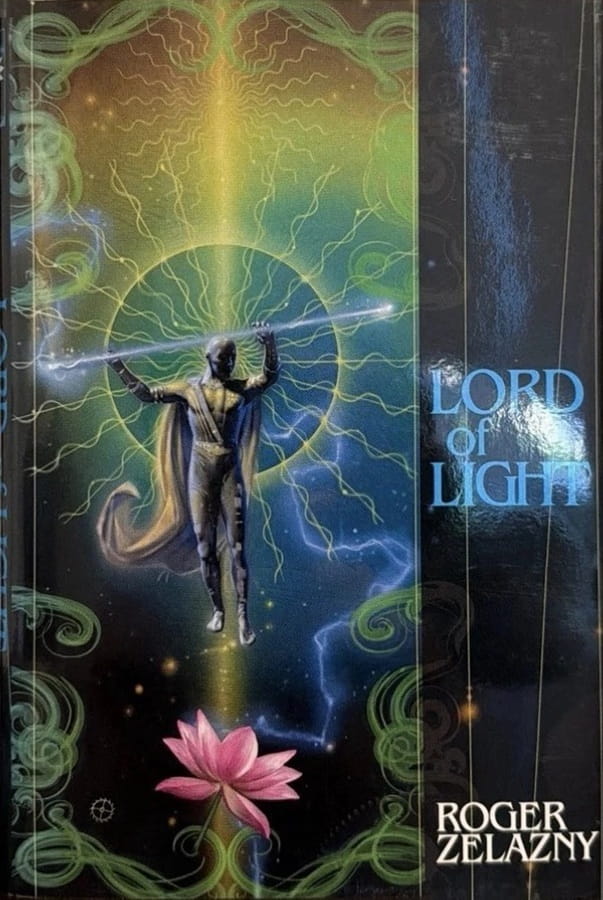
Over the decades, Lord of Light has been reissued multiple times, each new edition often featuring distinct cover art that reflects the changing aesthetics of speculative fiction publishing. The Avon Books edition of February 1987, with its striking cover by Tim White, offered a more contemporary visual interpretation of the story’s themes. The Doubleday/Science Fiction Book Club edition of April 1983, featuring art by Viido Polikarpus, and the Panther UK edition from 1973 with a cover by Bob Haberfield, further illustrate the novel’s global reach and enduring appeal across different markets. Later editions, such as the Science Fiction Book Club’s May 2001 release with Bruce Jensen’s artwork, the Avon Eos edition of May 2004 by Steve Stone, and the SF Masterworks #7 from Millennium/Orion in April 1999 with Fred Gambino’s cover, testify to its status as a perennial favorite and a foundational text within the genre. Each cover, from the early mystical interpretations to the later, more action-oriented designs, attempts to capture the complex interplay of myth and technology that defines Zelazny’s magnum opus.
Zelazny’s Legacy
Lord of Light holds a pivotal position within Roger Zelazny’s impressive bibliography, often considered his singular greatest literary achievement by critics and fans alike. While his Chronicles of Amber series later brought him wider commercial success and cemented his reputation as a master of fantasy, Lord of Light remains a benchmark for its audacious originality and profound intellectual depth. It perfectly encapsulates his thematic preoccupations with myth, power, and identity, showcasing his distinctive prose style—a blend of poetic lyricism, sharp wit, and philosophical inquiry. The novel’s success elevated Zelazny to the forefront of the New Wave movement, demonstrating that speculative fiction could be both intellectually stimulating and immensely entertaining.
The influence of Lord of Light can be seen across subsequent generations of science fiction and fantasy authors who have explored similar themes of godlike beings, technological reincarnation, and the reinterpretation of ancient myths. It solidified Zelazny’s reputation as a writer unafraid to defy genre conventions, creating narratives that transcend simple categorization. His ability to craft compelling characters, from the defiant Sam to the tragically complex Yama and the enigmatic Kali, ensured that the novel resonated on a deeply human level, even amidst its cosmic scope. Through Lord of Light, Zelazny not only delivered a captivating adventure but also posed enduring questions about humanity’s place in the universe and its perpetual struggle against perceived authority, whether divine or technological.
Supporting Data
A Tapestry of Myth and Machine
The Pantheon Reimagined: Hindu Deities as Technocratic Overlords
The ingenious premise of Lord of Light lies in its radical reinterpretation of Hindu mythology. The "gods" of this new world are not supernatural entities but rather the original human colonists of an exoplanet, who, through advanced technology and emergent psionic powers, have elevated themselves to an immortal, divine status. They have adopted the names of the Hindu pantheon—Brahma, Vishnu, Kali, Yama, Shiva, and others—and meticulously structured society around a literalized interpretation of Hindu doctrines like karma and reincarnation. Sam, the protagonist, initially known as Mahasamatman (Great-souled Sam), embodies the role of Buddha, the enlightened one who challenged the rigid caste system and Brahmanic authority in ancient India. His rebellion is a direct parallel to Siddhartha Gautama’s quest for liberation from suffering and the cycle of rebirth, albeit here framed within a struggle against a technocratic oligarchy.
Each "god" possesses an "Attribute," a specific paranormal capability (like Ratri, the goddess of night, who can manifest darkness), and an "Aspect," an outward appearance reflecting that power, giving them the aura of their mythological counterparts. These powers, initially developed through a combination of mutation, genetic manipulation, and neurosurgery during their interstellar voyage, serve to maintain their illusion of divinity. Yama, for instance, is not just the God of Death but also a brilliant technological genius who designs advanced weaponry for the pantheon, effectively combining ancient archetype with cutting-edge engineering. This intricate system of power, nomenclature, and illusion allows Zelazny to explore how belief systems can be engineered and manipulated for social control, making the gods’ claims not merely metaphorical but a tangible, technologically enforced reality.
The World of "Uratha" and Beyond
The setting of Lord of Light is an unnamed Earth-like planet orbiting a red sun, established in the opening chapter as the new home for humanity. The original homeworld, "Uratha" (a plausible Indic pronunciation of "Earth"), is hinted to have been destroyed, leaving the Star of India as the sole vessel that brought humanity to this distant star system. This detail suggests a largely Indian passenger manifest, which neatly explains the predominant cultural and religious influences on the new colony. The planet itself is far from barren, hosting its own diverse sapient life forms. These range from the enigmatic, apparently invertebrate "Mothers of the Terrible Glow" to the ethereal, self-sustaining energy patterns known as "Rakasha," which Sam, with his unique power of "electrodirection" (mental control of electromagnetic energy), is particularly adept at combating.
This vibrant and often hostile alien environment adds layers of complexity to the human colonists’ struggle for survival and dominance. The presence of the Rakasha, for example, not only provides a common enemy that initially unites the human "gods" but also highlights the sheer power and adaptability of these early settlers. The "Uratha" reference, coupled with mentions of other worlds that humans might eventually colonize, broadens the cosmic scope of the narrative, positioning the story not just as a mythological reinterpretation but as a chapter in humanity’s grand interstellar diaspora. Zelazny masterfully uses these elements to create a setting that feels both ancient and futuristic, a stage perfectly suited for his blend of epic adventure and philosophical introspection.
Technological Reincarnation and Social Control
At the core of the Deicrats’ power structure is a revolutionary technological advancement: a process that amplifies the electromagnetic pattern of a human mind and transmits it into a new, cloned body. This process effectively grants immortality, allowing individuals to shed their aging or damaged forms and be "reborn" into youthful, healthy ones, typically sought at the age of sixty. Those who die without access to this technology, or who choose not to use it, are said to experience the "true death." This system cleverly literalizes the Hindu and Buddhist doctrines of karma and reincarnation, transforming spiritual concepts into a tangible, scientifically controlled mechanism.
However, this technological "reincarnation" is far from a democratic right. The technicians who control this monopoly wield immense political power, using it as a tool for social engineering and control. Conformists are granted access to new bodies and prolonged life, while dissidents and those who challenge the established order are denied, effectively sentenced to the "true death." This stark contrast creates a rigid social hierarchy, with the "gods" at the apex, perpetually renewed, and the general populace subservient, dependent on their rulers’ whims for continued existence. The conflict between the "Accelerationists," who advocate for universal access to advanced technology, and the "Deicrats," who hoard it to maintain their divine status, forms the primary political struggle in the novel. The mind transfer system, along with other "faith-sustaining" devices like the "pray-o-mat," is thus revealed as a sophisticated instrument of oppression, masking technological control behind a veil of religious dogma.
Philosophical Undercurrents
Deity vs. Humanity: The Nature of Power
Lord of Light delves deeply into the philosophical question of what truly constitutes a "god." Is it inherent divinity, or merely superior power and knowledge? Zelazny posits that in this futuristic society, the line blurs. The original colonists, through technological prowess and the development of mutant abilities, have engineered their own godhood, leveraging humanity’s innate tendency towards worship and fear. They have consciously adopted the personas and names of Hindu deities, creating a pantheon not of divine origin but of human ambition and scientific advancement. Sam’s rebellion challenges this manufactured divinity directly. He never claims to be a god, yet never denies it, embodying a more nuanced approach to power and self-perception. His struggle forces readers to confront the implications of power monopolized and the ethics of technological supremacy, asking whether extraordinary abilities grant the right to rule, or merely a greater responsibility to serve.
Freedom and Enlightenment: Sam’s Buddhist Path
Sam’s journey is fundamentally one of liberation and enlightenment, mirroring the historical Buddha’s path. He seeks to free humanity from the oppressive control of the Deicrats, not just technologically but also spiritually. By consciously reviving Buddhism on the planet, he offers an alternative philosophy that emphasizes individual enlightenment and challenges the hierarchical, fate-driven system enforced by the "gods." His disciple, Rild, genuinely achieves enlightenment, leading to one of the novel’s most profound and enigmatic scenes: Rild’s duel with Yama. In this confrontation, Rild, despite his spiritual attainment, chooses to engage in physical combat, raising the question of whether enlightenment precludes worldly action or if, paradoxically, the struggle itself can be a path to deeper understanding. Zelazny masterfully leaves this question unanswered, enriching the moral ambiguity and depth of the narrative. Sam’s fight is not just for political freedom but for intellectual and spiritual awakening, demonstrating how ancient wisdom can find new relevance in a technologically advanced future.
The Nature of Identity: Consciousness and Rebirth
The mind transfer technology in Lord of Light raises profound questions about the nature of personal identity and consciousness. If one’s electromagnetic pattern can be transferred to a new body, is it truly the same person? Or is it merely a copy, a philosophical "zombie" as the novel terms Nirriti’s cloned army? The concept of "true death" for those denied reincarnation underscores the fragility of identity in a world where physical forms are disposable. The moving dialogue between Yama and Kubera about Yama’s daughter, Murga, who suffers brain damage due to a "transfer effect," poignantly illustrates the personal tragedies and existential risks inherent in this technology. It highlights that even with advanced science, the essence of consciousness remains elusive and vulnerable. Zelazny forces readers to ponder whether consciousness is merely a pattern that can be copied, or something more fundamental and ineffable, tying these futuristic concerns directly back to ancient philosophical debates about the soul and the self.
Narrative Craft and Style
Literary Influences and Genre Blending
Roger Zelazny’s prose in Lord of Light is a testament to his unique literary style, often described as poetic, lyrical, and rich with allusions. His background and admiration for poets like Yeats and Eliot are evident in the elevated language, symbolic imagery, and rhythmic cadences that pervade the narrative. This literary sophistication sets Lord of Light apart from much of the genre fiction of its time, imbuing it with a timeless quality that transcends its speculative elements. Zelazny masterfully blends science fiction and fantasy, creating a hybrid genre that is neither purely one nor the other. The "gods" wield powers that feel magical, yet their origins are firmly rooted in scientific mutation and technological enhancement. The mythological framework provides a familiar narrative structure, while the futuristic setting grounds it in speculative possibility. This seamless blending allows Zelazny to explore complex themes without being constrained by the rigid conventions of a single genre.
Character Depth and Conflict
One of Lord of Light‘s greatest strengths lies in its vibrant and complex characterization. Sam, the "Odyssean trickster," is a charismatic and defiant protagonist, driven by a deep conviction for freedom. His internal struggles and external battles are compelling, as he navigates a world where his former allies have become his oppressors. Yama, the God of Death, is far more than a simple villain; he is a brilliant inventor, a loyal servant of the Celestial City, and a man capable of deep love and profound grief, particularly evident in his relationship with Kali and the poignant revelation about his daughter, Murga. Kali, the goddess of destruction, is a formidable and ambiguous figure, whose loyalties and capacity for love remain in question, adding a layer of romantic and personal conflict to the grand political struggle. The intricate web of relationships—Sam’s past love for Kali, Yama’s present love for her, and their intertwined destinies—elevates the story beyond a mere adventure, grounding it in universal human emotions and motivations. Even minor characters, like Nirriti the Black with his army of cloned zombies, add texture and moral complexity, showcasing Zelazny’s talent for creating memorable figures.
The "New Wave" Context and Modern Sensibilities
Lord of Light is a quintessential product of the New Wave movement in science fiction, challenging traditional narratives and stylistic conventions. Its non-linear structure, poetic prose, and thematic depth were hallmarks of the era. Zelazny’s use of in medias res, beginning the story in the middle of the action and gradually revealing backstory, adds to its epic feel and keeps the reader engaged in piecing together the past. While the novel’s stylistic innovations were celebrated, some aspects may "grate on modern sensibilities," as noted by the original reviewer. For instance, the portrayal of a lesbian character in Chapter II reflects the social attitudes and literary norms of the late 1960s, which might be viewed critically through a contemporary lens. However, such instances are often seen as reflections of the historical context rather than detracting from the novel’s overarching artistic merit. Zelazny’s occasional touches of humor, including a "memorably terrible pun" in Chapter II, further demonstrate his playful mastery of language and his willingness to inject levity into serious themes, showcasing the experimental spirit of the New Wave.
Official Responses
Critical Acclaim and Awards
Upon its release, Lord of Light was met with widespread critical acclaim, immediately establishing Roger Zelazny as a formidable voice in science fiction. Its groundbreaking fusion of myth and technology, coupled with Zelazny’s lyrical prose and philosophical depth, resonated deeply with critics and readers alike. The novel’s most significant recognition came in 1968 when it was awarded the Hugo Award for Best Novel, one of the highest honors in the science fiction and fantasy fields. This prestigious award underscored its status as a seminal work, not just for its innovative narrative but also for its profound exploration of timeless themes. The Hugo win propelled Lord of Light into the canon of classic speculative fiction, drawing attention to Zelazny’s unique contributions to the New Wave movement.
Beyond the Hugo, Lord of Light continued to garner praise for its originality and literary merit. Critics lauded Zelazny’s audacious reimagining of Hindu and Buddhist mythologies, commending his ability to craft a story that was both intellectually stimulating and thrillingly adventurous. Reviewers often highlighted the novel’s intricate world-building, the compelling complexity of its characters, and its thought-provoking examination of power, religion, and freedom. Its enduring popularity is also reflected in its inclusion in various "best of" lists for science fiction and fantasy, cementing its reputation as a masterpiece that continues to captivate new generations of readers and scholars, eager to unravel its layers of meaning and marvel at its imaginative scope.
Academic and Fan Interpretations
Lord of Light has not only enjoyed enduring popularity among fans but has also become a subject of considerable academic interest, particularly within the fields of literary studies, comparative mythology, and speculative fiction criticism. Scholars often analyze the novel for its innovative genre blending, its philosophical inquiries into identity and consciousness, and its sophisticated reinterpretation of religious texts and mythologies. The complex interplay between technology and faith, the ethical implications of engineered immortality, and the allegorical parallels to historical figures like Buddha have provided rich ground for critical discourse.
The novel’s unique structure, which begins in medias res and gradually reveals the backstory through flashbacks and fragmented narratives, is frequently studied as an example of Zelazny’s New Wave experimentation. Furthermore, the character arcs of Sam, Yama, and Kali offer fertile ground for psychological and archetypal analysis, exploring themes of rebellion, loyalty, love, and sacrifice. The fan community, meanwhile, continues to celebrate Lord of Light for its thrilling action, memorable characters, and the sheer imaginative power of its world. Online forums, fan wikis, and dedicated discussions attest to its lasting impact, with readers continually discovering new depths and nuances within its intricate narrative. Its status as a "must-read" for anyone interested in the intersection of science, mythology, and profound storytelling remains undisputed.
Implications
A Continuing Legacy
Lord of Light‘s influence on the landscape of speculative fiction is profound and far-reaching. It served as a blueprint for countless authors seeking to integrate ancient mythologies and religious narratives into science fiction settings, demonstrating that such a fusion could yield rich, thought-provoking results rather than mere pastiche. Zelazny’s audacious concept of technologically advanced humans becoming "gods" provided a powerful archetype that has been explored in various forms across literature, film, and video games. His meticulous attention to character depth, even for ostensibly divine beings, raised the bar for how superhuman entities could be portrayed in a literary context, moving beyond simplistic hero/villain binaries to explore complex motivations and moral ambiguities.
The novel also showcased the potential of the New Wave movement to elevate genre fiction to literary heights, proving that speculative narratives could address profound philosophical questions with stylistic sophistication. It encouraged authors to experiment with narrative structure, prose style, and thematic complexity, pushing the boundaries of what science fiction could achieve. Zelazny’s work, particularly Lord of Light, inspired a generation of writers to look beyond conventional tropes and to infuse their stories with deeper cultural, historical, and philosophical resonance, thereby enriching the entire genre. Its unique contribution lies in its seamless integration of disparate elements, creating a cohesive and compelling vision that remains unparalleled.
Relevance in the Modern Era
Despite being over half a century old, the themes explored in Lord of Light resonate with striking relevance in the modern era. The novel’s central conflict—the struggle against a technocratic elite that monopolizes advanced technology to maintain power—mirrors contemporary anxieties about artificial intelligence, genetic engineering, and the concentration of wealth and control in the hands of a few. The "gods’" ability to transfer consciousness into new bodies raises profound ethical questions about immortality, identity, and the potential for a new form of digital reincarnation, issues that are increasingly debated in the age of neural networks and transhumanist aspirations.
Furthermore, Zelazny’s exploration of engineered belief systems and the manipulation of religious dogma for political control holds particular salience in a world grappling with disinformation, propaganda, and the weaponization of ideology. Sam’s fight for intellectual and spiritual freedom, against a system that literalizes karma and rebirth for social enforcement, speaks to the ongoing human quest for autonomy and authentic experience in an increasingly mediated reality. Lord of Light serves as a powerful cautionary tale and a timeless meditation on the nature of power, faith, and humanity’s perennial struggle for self-determination against forces that seek to define and control it.
Enduring Appeal
Lord of Light endures as a masterpiece of speculative fiction not merely for its innovative concepts or its literary accolades, but for its captivating storytelling and its ability to deeply involve readers with its characters. As the reviewer notes, its strength lies not just in "worldbuilding or speculation" but in its "characterization, and for its ability to involve me with its characters." The human (and god-like) drama of Sam, Yama, and Kali, their loves, betrayals, and struggles, imbues the grand mythological and scientific canvas with relatable emotion. It is an adventure story par excellence, filled with epic battles, daring raids, and intricate political maneuvering, all rendered in Zelazny’s distinctive, evocative prose.
Beyond the adventure, the novel’s philosophical inquiries into the nature of deity, the essence of consciousness, and the true meaning of freedom continue to provoke thought and discussion. It is a work that rewards multiple readings, revealing new layers of meaning and subtle nuances with each encounter. Lord of Light stands as one of the best literary treatments of superhuman powers ever conceived, demonstrating how extraordinary abilities can be used to explore the very core of what it means to be human. Its enduring appeal lies in this potent combination: a thrilling narrative that brings its unforgettable characters to life, while simultaneously challenging readers to contemplate the most profound questions of existence. It remains a powerful, imaginative, and deeply resonant work that continues to inspire and entertain.