The Architect of Interior Landscapes: The Visionary Surrealism of Christian Quintin
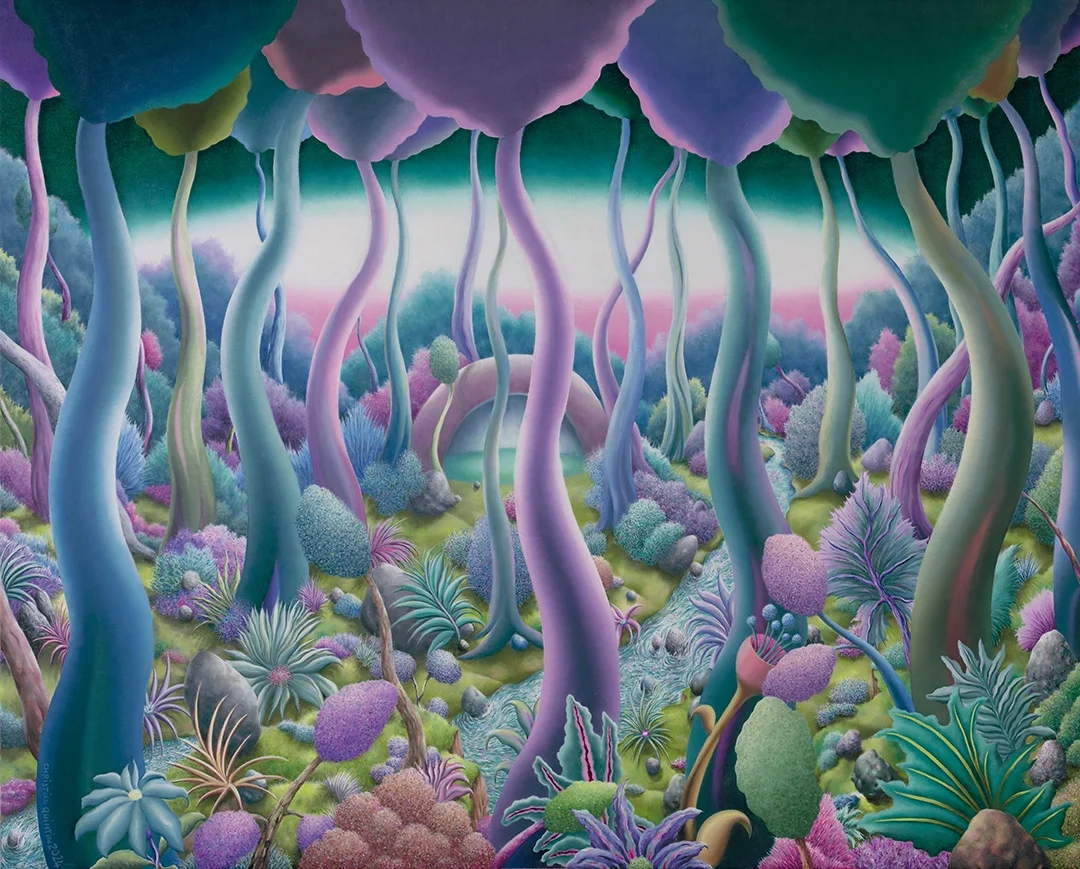
In the quiet intersection of European Romanticism and the rugged, sacred ecology of Northern California, the work of Christian Quintin emerges as a profound exploration of the human psyche. For over four decades, Quintin has cultivated a visual language that transcends mere representation, offering instead a "kaleidoscopic consciousness" that bridges the gap between the natural world and the internal spirit.
I. Main Facts: The Unified Vision of Christian Quintin
Christian Quintin is a French-born artist whose career spans more than forty years, characterized by a meticulous, labor-intensive approach to Surrealism and Romantic landscape painting. Unlike many contemporary artists who prioritize conceptual provocation or rapid production, Quintin’s practice is rooted in the "slow art" movement—a dedication to technical mastery where a single pen-and-ink drawing or oil painting may take upwards of seven months to complete.
Working primarily from his studio in Northern California, Quintin has developed a body of work that defies easy categorization. While his roots are firmly planted in the soil of French Surrealism and Symbolism, his evolution in the American West has added a layer of "Visionary Art" to his repertoire. His portfolio is bifurcated into two primary modes that, upon closer inspection, reveal themselves to be a singular vision:

- Surrealist Introspection: Complex, layered compositions often involving "kaleidoscopic" human forms, architectural metaphors, and mythological symbols.
- Emotional Landscapes: Luminous depictions of the natural world—trees, rivers, and coastlines—that function as "emotional terrains" rather than topographical documents.
Quintin’s work is currently experiencing a global resurgence. Long a staple of the prestigious California gallery circuit, his representation by the international Lorin Gallery has recently catapulted his "visual poetry" into the major art hubs of Seoul, Hong Kong, Paris, and Los Angeles.
II. Chronology: From the Storm-Lashed Cliffs of Brittany to the Valleys of Sonoma
The trajectory of Christian Quintin’s life is a narrative of geographical and spiritual migration, with each location leaving an indelible mark on his aesthetic DNA.
The Mythic Foundation: Brittany (1957–1975)
Born in 1957 in the port town of Saint Brieuc, Brittany, Quintin’s earliest memories were shaped by the moody, dramatic atmosphere of the French northern coast. This region, known for its ruined castles, storm-lashed cliffs, and Celtic mysticism, provided the "mythic point of return" for his art. A specific landmark, L’Île de la Comtesse, became a recurring motif in his work—a symbol of solitude and storybook aura that persists in his imagery today.

The Classical Discipline: Paris and the Beaux Arts (1975–1981)
In 1975, Quintin moved to Paris to study at the world-renowned École des Beaux-Arts. It was here that his raw romantic instincts were tempered by rigorous classical discipline. He mastered the technical nuances of draftsmanship, cross-hatching, and oil glazing. During this period, he absorbed the legacy of the French Surrealists like André Breton, but he found himself more aligned with the Symbolists and Romantics who sought to reveal hidden truths rather than merely shock the bourgeoisie.
The Transatlantic Transition: California (1981–Present)
The most significant turning point in Quintin’s career occurred in 1981 when he relocated to Northern California. Settling in the vineyards and rolling hills of Sonoma County, he discovered a second vocabulary. The "sacred ecology" of the American West—its ancient redwoods, golden hills, and expansive skies—resonated with the old myths of Brittany. This period marked the beginning of his "unified vision," where he began to treat the tree and the human figure as interchangeable vessels for consciousness.
III. Supporting Data: Technique, Medium, and the "Slow Art" Philosophy
Quintin’s work is a testament to the endurance of traditional mediums in a digital age. He utilizes ink, oil, graphite, and pastel, selecting his "instrument" based on the emotional frequency of the piece.

The Six-Month Canvas: Technical Precision
One of the most striking aspects of Quintin’s data-driven career is the time-to-completion ratio. His work The Aviary, a complex surrealist portrait where the human face dissolves into a leafy ecosystem, required six months of daily labor. Similarly, La Porte Ouverte, inspired by the poetry of Rumi, was the result of seven months of intricate cross-hatching.
This technical rigor is not merely an aesthetic choice but a philosophical one. Quintin describes his process as a "negotiation between spirit and form." By working slowly, he allows the "first intuition" to guide the work while the technique provides the structural integrity to hold that intuition.
Kaleidoscopic Consciousness
A recurring theme in his surrealist works is the "face as a landscape." In works like The Tempest or The Union, boundaries between the biological and the elemental are erased. These are not Freudian "dreamscapes" intended to be analyzed; they are "interior constellations."

- Symbolism of Trees: In Leaves of Absence and Les Amants, trees are anthropomorphized, swaying like dancers or embracing like lovers.
- The Palette of Feeling: Quintin uses color as a narrative tool. In A Lake Color of Emeralds, he famously noted that the sky is "brown-orange with violet" because those colors represented the "feeling" of the moment rather than the literal light.
IV. Official Responses: Critical Interpretations and Gallery Recognition
The critical reception of Christian Quintin’s work has remained remarkably consistent over four decades, with experts focusing on his ability to fill the "beauty gap" in contemporary art.
Critical Reviews
- Alhia Warren: Characterized his portfolio as a "beautiful intimate mystery," noting that his work invites the viewer to wander rather than observe.
- Suzanne Munich: Titled her influential review "Mental Landscapes," arguing that Quintin’s trees and rivers are actually maps of the human mind.
- Dan Taylor (Press Democrat): Described his work as "Emerging Beauty," highlighting his ability to find light in the melancholic depths of nature.
- Calabi Gallery (2022): In a poignant review, the gallery stated: "In an era largely devoid of it, his work is beautiful. We could all use more beauty in our lives." This critique identified Quintin as a necessary antidote to the cynicism and irony that often dominate the modern art market.
Institutional and Gallery Milestones
Quintin’s career trajectory is marked by high-level institutional validation:
- 1987: Awarded the prestigious Grumbacher Award for technical excellence.
- 1990: Received the Award of Excellence from the California State Fair.
- 1999: Representation by the Vorpal Gallery (San Francisco/New York). This was a pivotal moment, as Vorpal was the gallery that introduced M.C. Escher to the American public. Placing Quintin in this lineage solidified his status as a master of "mind-bending" precision.
- 2020s: Representation by Lorin Gallery (Los Angeles/Paris). This partnership has expanded his reach to international art fairs, including KIAF in Seoul and Art Central in Hong Kong.
V. Implications: Art as Sanctuary and the Visionary Continuum
The enduring relevance of Christian Quintin’s work carries significant implications for the contemporary art world and the broader cultural landscape.

Beauty as a Form of Resistance
In a global culture defined by speed, digital abstraction, and often-nihilistic conceptualism, Quintin’s work acts as a form of defiance. By prioritizing beauty and slow craftsmanship, he asserts that art should serve as a "wondrous sanctuary for the soul." His work implies that the human need for wonder and "déjà vu" is as essential as the need for critical discourse.
The Bridge Between Two Traditions
Quintin serves as a vital link in the "Visionary Continuum." He bridges the gap between:
- European Surrealism: (Dali, Magritte) with its focus on the uncanny and the subconscious.
- California Visionary Art: (The 1960s psychedelic heirs) with its focus on sacred ecology and expanded consciousness.
However, Quintin’s vision is quieter and more classical than his psychedelic predecessors. He offers a "sacred geometry of feeling" that is accessible yet deeply complex.

The Legacy of the "Inner/Outer" World
The ultimate implication of Quintin’s four-decade career is the dissolution of the "self vs. nature" duality. His philosophy—"When you draw a tree, you also draw yourself"—suggests a unified field of existence. As his work continues to move into major collections and international galleries like the Morrison Gallery in Connecticut, it reinforces the idea that the most profound landscapes are not those we see with our eyes, but those we remember with our souls.
Conclusion: Reentry into the Hidden Dimension
Christian Quintin does not paint to provide answers or political slogans. He paints to give the viewer space to breathe. His work is an invitation to reenter the hidden dimensions of reality—the feeling of a storm-colored sky or the silent architecture of a dream. In a world of spectacle, Quintin remains a master of the whisper, proving that art, when made with enough attention and soul, can indeed become a sanctuary.
For further exploration of his work, visit christianquintin.com.