A Tale of Two Covers: Dungeons & Dragons Unveils Contrasting Visions for the 2024 Player’s Handbook
Introduction: A New Era Dawns for D&D
The world of tabletop roleplaying games is abuzz with anticipation as Wizards of the Coast prepares to launch the next iteration of its flagship title, Dungeons & Dragons. Central to this monumental release is the 2024 Player’s Handbook, the foundational tome for countless adventurers, which promises to refine and evolve the beloved game. In a move that has captivated both veterans and newcomers, Wizards of the Coast has unveiled not one, but two distinct visions for the book’s front cover, each offering a unique thematic window into the expansive realms of D&D.
While the standard cover pulsates with the classic energy of heroic combat, depicting iconic characters locked in a dynamic struggle, an alternate version offers a remarkably different, yet equally compelling, tableau: a scene of quiet camaraderie and shared moments over a pot of tea. These contrasting artistic choices, brought to life by acclaimed artists Tyler Jacobsen and Wylie Beckert, signal a thoughtful approach to presenting the multifaceted nature of Dungeons & Dragons, catering to the diverse tastes and playstyles within its vast global community. This dual unveiling not only excites collectors but also sparks a broader conversation about the evolving identity of the world’s most popular fantasy roleplaying game.
Main Facts: Two Visions, One Core Experience
The impending release of the 2024 Dungeons & Dragons Player’s Handbook marks a significant moment for the game, representing an evolution of its core rules and a fresh artistic direction. At the heart of this excitement are the recently revealed front covers, each telling a distinct story about the essence of adventuring.
The standard cover, created by artist Tyler Jacobsen, presents a vibrant and action-packed scene that immediately evokes the heroic fantasy tradition D&D is famous for. It features a recognizable party of adventurers—including classic characters like Strongheart the Knight, Elkhorn the Dwarf Warrior, and Yolande the Elven Queen—engaged in a pitched battle. Their foes are a horde of Kobolds, a quintessential Dungeons & Dragons enemy, adding a layer of nostalgic familiarity for long-time players. Looming behind the adventurers, a majestic golden dragon stands as a silent, powerful ally, hinting at the grander scales of conflict and companionship often found in D&D narratives. This cover’s primary emphasis is on the thrill of combat and the collective bravery required to face overwhelming odds, a visual manifesto for the game’s prevalent action elements.
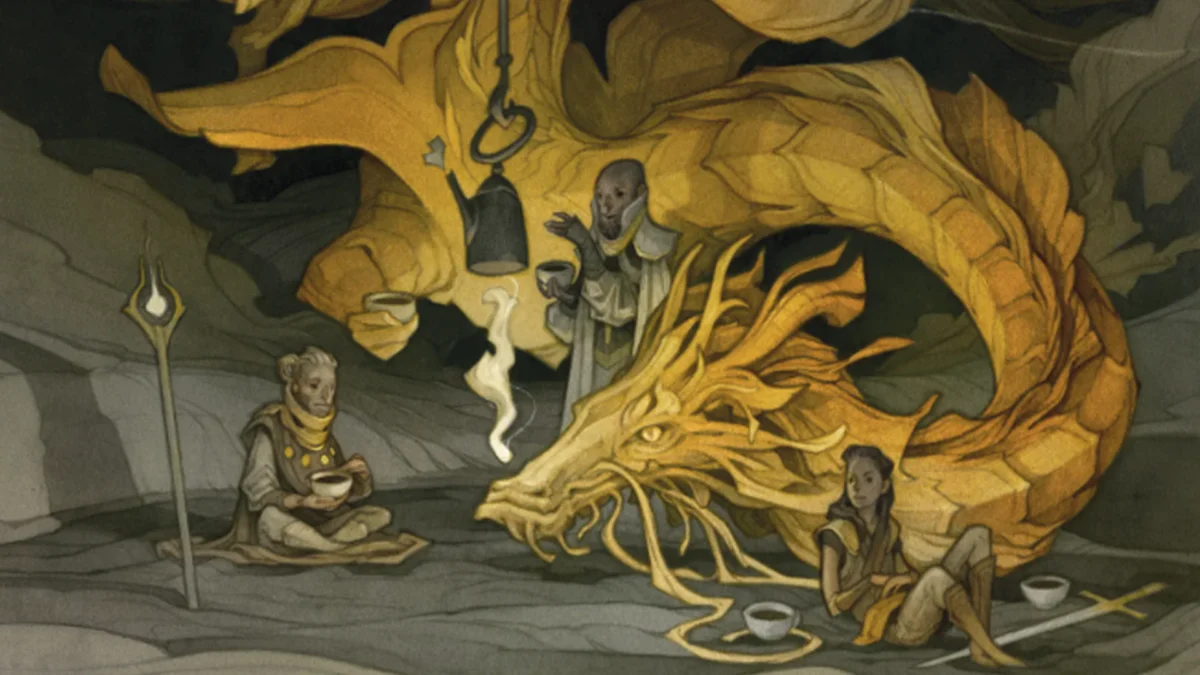
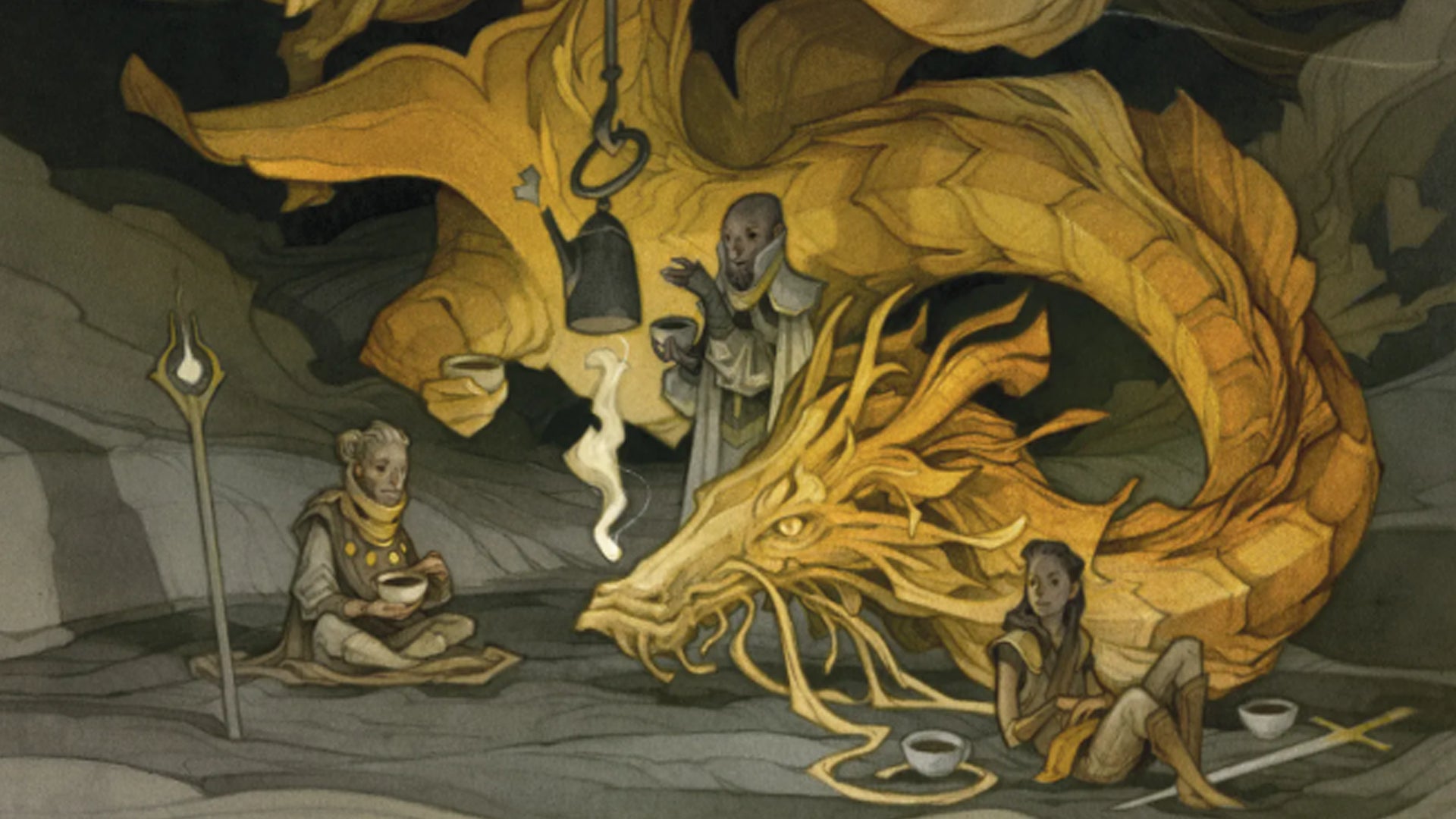
In stark contrast, the alternate cover, illustrated by the distinctive Wylie Beckert, offers a serene and introspective take on the adventuring life. Revealed shortly after the standard version, this cover showcases a classic D&D party—comprising a wizard, a cleric, a fighter, and a rogue—gathered for a tranquil tea party within the cozy confines of a cave. The same golden dragon from the standard cover reappears, but here, it is a gentle giant, delicately holding a normal-sized teacup in one massive paw, with the party’s rogue perched playfully on its body. This scene is a testament to the quieter, more character-driven aspects of D&D: the moments of camaraderie, rest, and storytelling that occur between epic encounters. Designed primarily for collectors and players who appreciate a different aesthetic, this alternate cover highlights the roleplaying and social dimensions of the game, proving that adventure isn’t always about drawing swords.
Both covers, while divergent in their immediate visual impact, serve the same foundational text. The content within the 2024 Player’s Handbook remains consistent across both editions, ensuring that the choice between covers is purely one of artistic preference or collector’s interest. The alternate version will be exclusively available at local game stores starting September 3rd, 2024, providing a two-week head start before the standard edition’s wider release on September 17th, 2024. This staggered release also acts as a strategic move to support independent retailers within the D&D community.
Chronology: The Journey to a Refined D&D
The unveiling of the 2024 Player’s Handbook covers is the latest milestone in a carefully orchestrated journey by Wizards of the Coast to evolve Dungeons & Dragons. This initiative, initially dubbed "One D&D," has been a multi-year process designed to update and refine the game’s core rulebooks while maintaining backward compatibility with the vast library of 5th Edition content.
The Road to the 2024 Player’s Handbook
The concept of "One D&D" was first announced in August 2022, setting the stage for an ambitious project to create a new generation of D&D rulebooks. The primary goal was not to launch an entirely new edition that would render previous content obsolete, but rather to iterate on the highly successful 5th Edition, incorporating years of player feedback, addressing common rules ambiguities, and streamlining gameplay mechanics. This meant significant playtesting, which took place through numerous "Unearthed Arcana" public playtest packets released online. Players worldwide were invited to test new rules for classes, races, feats, and spells, providing invaluable feedback that shaped the final product.
The playtest period allowed Wizards of the Coast to gauge community sentiment on proposed changes, ensuring that the updated rules would resonate with the player base. This iterative process underscored a commitment to community-driven development, a hallmark of the 5th Edition’s success. The 2024 Player’s Handbook is the culmination of this feedback loop, promising a more refined, balanced, and accessible experience for all. While the Player’s Handbook is the first of the core rulebooks to be spotlighted, it will be followed by updated versions of the Dungeon Master’s Guide and the Monster Manual, completing the foundational trinity for the new era of D&D.
Unveiling the Standard: The Call to Arms
The first glimpse of the 2024 Player’s Handbook’s aesthetic came with the reveal of its standard cover art. This unveiling, which occurred approximately a week before its alternate counterpart, immediately set a tone of classic heroism and dynamic action. Artist Tyler Jacobsen’s composition is a masterclass in evoking the core fantasy elements that have defined D&D for decades.
The cover prominently features a diverse party of adventurers, instantly recognizable to fans of D&D lore. Strongheart, the valiant human knight, often associated with the early modules and action figures of D&D’s past, takes a central, commanding position. Alongside him stands Elkhorn, the stalwart dwarf warrior, embodying resilience and strength. Completing the trio of classic heroes is Yolande, the elegant elven queen, whose presence signifies grace and magical prowess. These characters are not merely static figures; they are caught in a moment of intense conflict, preparing to clash with a swarm of Kobolds – small, reptilian humanoids known for their cunning and numerical superiority. The entire scene is framed by the watchful presence of a magnificent golden dragon, its scales shimmering, suggesting a powerful, albeit perhaps enigmatic, alliance.
This artwork is a direct appeal to the most widely recognized aspect of D&D: adventuring, combat, and the epic struggle between good and evil. It emphasizes the game’s roots in dungeon delving, monster slaying, and heroic quests, which have captivated generations of players and defined D&D in the public consciousness. The dynamic poses, the vibrant colors, and the clear narrative of imminent battle make it an iconic representation of the D&D experience.
The Serene Counterpart: Alternate Cover Reveal
Following closely on the heels of the standard cover’s reveal, the alternate version of the 2024 Player’s Handbook cover made its debut, first reported by outlets like Polygon. This second cover, illustrated by Wylie Beckert, presented a striking thematic departure, offering a "much different approach" as the original article stated.
Where Jacobsen’s cover exuded urgency and conflict, Beckert’s art invites contemplation and warmth. It portrays a classic D&D party – a wizard, cleric, fighter, and rogue – not in the heat of battle, but sharing a tranquil moment. They are depicted enjoying a pot of tea within what appears to be a cozy cave dwelling, a stark contrast to the standard cover’s open-air battlefield. The golden dragon makes a return, but its role has shifted dramatically from a powerful background ally to an intimate companion. It is shown holding a delicate teacup in its massive claw, an image that is both humorous and endearing, further highlighting the domesticity of the scene. The rogue, in a playful display of trust and agility, is balanced on the dragon’s body, adding to the sense of comfortable camaraderie.
This alternate cover serves multiple purposes. For collectors, it offers a visually distinct option, often favored for its unique artistic style and limited availability (being a local game store exclusive). More importantly, for players, it represents a deliberate acknowledgment of the game’s broader appeal beyond combat. It speaks to those who cherish the roleplaying aspects, the character interactions, the moments of rest and reflection, and the building of bonds within an adventuring party. It subtly suggests that D&D is as much about shared stories and quiet moments as it is about slaying monsters and plundering dungeons.
Supporting Data: Artistry, Lore, and Market Trends
The unveiling of the 2024 Player’s Handbook covers is more than just an aesthetic reveal; it’s a statement on artistic direction, a nod to D&D’s rich lore, and a reflection of current market strategies within the tabletop gaming industry.
Artistic Vision: Tyler Jacobsen and Wylie Beckert
The choice of artists for these two pivotal covers speaks volumes about Wizards of the Coast’s vision for the new Player’s Handbook.
Tyler Jacobsen, responsible for the standard cover, is known for his dynamic and vibrant fantasy art. His style often features strong compositions, heroic figures, and a keen sense of narrative action. His work frequently graces various fantasy properties, making him a fitting choice for a cover that aims to encapsulate the classic, high-octane adventuring experience of D&D. Jacobsen’s use of bold lines, dramatic lighting, and clear focus on character interaction within a perilous setting effectively conveys the excitement and danger inherent in D&D combat. His art reinforces the popular image of D&D as a game of epic quests and heroic struggles, appealing directly to the game’s historical identity and widespread public perception.
Wylie Beckert, the artist behind the alternate cover, possesses a distinctive style characterized by intricate details, whimsical storytelling, and a departure from conventional heroic fantasy aesthetics. Her work often has a painterly quality, with rich textures and unique character designs that feel both ancient and fresh. Beckert is already familiar to D&D fans through her work on the alternate cover for Tasha’s Cauldron of Everything, which also presented a more whimsical and reflective take on a core D&D supplement. Her decision to depict a tea party in a cave, complete with a gentle dragon and a playful rogue, demonstrates her ability to infuse fantasy with unexpected charm and warmth. Beckert’s art on the alternate cover is not just visually appealing; it’s a thematic statement, inviting players to consider the quieter, more personal stories that unfold around the gaming table. This choice of artist highlights a desire to showcase the depth and breadth of experiences D&D can offer, beyond just the sword and sorcery.
The Golden Dragon’s Role
A fascinating element linking both covers is the recurring presence of a golden dragon. In the standard cover, it is a formidable, almost spiritual, guardian behind the battling party, symbolizing ancient power and benevolent oversight. Its stance suggests readiness for battle, a silent but potent force. In the alternate cover, the same golden dragon is transformed into a whimsical, domestic presence, participating in a tea party. It’s a companion, a friend, rather than a distant protector.
This consistent, yet varied, depiction of the golden dragon is deeply symbolic. Dragons are, after all, in the very name of the game. They represent power, mystery, and often, significant encounters. A golden dragon, in particular, often symbolizes wisdom, benevolence, and lawfulness in D&D lore. Its dual portrayal suggests that these powerful entities can be both awe-inspiring forces of nature and intimate participants in an adventurer’s journey. It reinforces the idea that D&D is a game of shifting perspectives, where grandiosity can intertwine with personal moments, and even the mightiest creatures can exhibit unexpected charm. The dragon’s presence subtly communicates that companionship and shared experiences are as much a part of the grand adventure as slaying fearsome beasts.
The Evolution of D&D Cover Art
The history of D&D Player’s Handbook covers is a fascinating chronicle of the game’s evolving identity and artistic trends. From the seminal artwork of the original editions to the sleek designs of later versions, each cover has attempted to capture the essence of D&D for its generation.
Early editions, such as the original Advanced Dungeons & Dragons (AD&D) Player’s Handbook by David C. Sutherland III, often featured dramatic, often grim, scenes of adventurers facing iconic monsters in dark dungeons, emphasizing the perilous and challenging nature of the game. The 2nd Edition AD&D Player’s Handbook by Jeff Easley moved towards more vibrant, yet still action-oriented, fantasy landscapes. The 3rd Edition (and 3.5 Edition) covers by Henry Higginbotham and Todd Lockwood, respectively, introduced a more polished, heroic fantasy style, showcasing powerful, well-equipped adventurers. The 4th Edition Player’s Handbook by Wayne Reynolds embraced a highly stylized, almost comic-book aesthetic, reflecting the edition’s focus on tactical combat and distinct character roles.
The 5th Edition Player’s Handbook, illustrated by Tyler Jacobson (not to be confused with Tyler Jacobsen of the 2024 cover), presented a scene of adventurers battling a green dragon, a powerful and iconic image that perfectly encapsulated the edition’s return to core D&D principles and its broad appeal.
The 2024 covers continue this tradition while also marking a significant evolution. The standard cover by Tyler Jacobsen clearly builds on the legacy of dynamic, action-oriented covers. However, the alternate cover by Wylie Beckert represents a more distinct departure, moving beyond the traditional combat focus to highlight the narrative, social, and personal aspects of roleplaying. This dual approach is a modern trend in the TTRPG industry, recognizing the diverse player base and the value of collector’s items. Alternate covers cater to different aesthetic preferences, stimulate collector interest, and provide a fresh way to engage with a familiar product, effectively broadening the game’s visual identity and market reach.
Official Responses: Wizards of the Coast’s Strategic Vision
While direct quotes specifically addressing the contrasting cover art are often limited in official announcements, the decisions made by Wizards of the Coast (WotC) regarding the 2024 Player’s Handbook covers reveal a clear strategic vision for the future of Dungeons & Dragons.
Wizards of the Coast’s Vision
The decision to commission two vastly different cover arts for the same foundational rulebook is a deliberate statement from WotC. It reflects an understanding that D&D is no longer a monolithic game perceived solely through the lens of combat and monster-slaying. Instead, WotC is acknowledging and actively promoting the multifaceted nature of the game.
The standard cover, with its classic action scene, serves as an anchor to D&D’s heritage and its most universally recognized appeal. It reassures long-time fans that the core heroic fantasy experience remains paramount, and it presents an exciting, accessible image for new players who are drawn to epic adventures. This cover aligns with the marketing often used to introduce D&D to the general public, emphasizing thrilling encounters and brave heroes.
The alternate cover, however, signifies WotC’s commitment to showcasing the broader spectrum of D&D play. By presenting a scene of quiet camaraderie and introspection, WotC is implicitly endorsing the value of roleplaying, character development, and social interaction within the game. This cover speaks to players who prioritize narrative, world-building, and the bonds forged between characters and players over purely tactical combat. It suggests that D&D is as much about shared stories, laughter, and friendship as it is about dungeon crawls and dragon fights. This approach caters to a growing segment of the D&D community that actively seeks out more narrative-focused and less combat-intensive experiences.
Furthermore, the staggered release strategy – making the alternate cover available exclusively at local game stores two weeks prior to the wider release of the standard edition – is a powerful gesture of support for the independent retail sector. Local game stores are vital hubs for the D&D community, fostering player groups and introducing newcomers to the hobby. By giving them an exclusive, sought-after product, WotC strengthens these partnerships and drives foot traffic to brick-and-mortar establishments, a move that is consistently well-received by the community.
Community Reception and Anticipation
The D&D community’s reaction to the new covers has been overwhelmingly positive and filled with excited discussion. On social media platforms, forums, and fan sites, players have been debating which cover they prefer, sharing their interpretations of the artwork, and speculating on what these artistic choices mean for the 2024 ruleset.

Many players express appreciation for the contrasting themes, highlighting that both covers accurately represent different, equally valid, ways to play D&D. The action-packed standard cover resonates with those who love the thrill of combat and classic fantasy tropes. Conversely, the whimsical and intimate alternate cover has struck a chord with players who cherish the roleplaying aspects, the shared narrative, and the often humorous or touching moments that unfold around the table.
The anticipation for the 2024 Player’s Handbook has been building for years, fueled by the "One D&D" playtest. These cover reveals have injected a fresh surge of excitement, visually cementing the promise of a new, refined era for the game. Players are eager to see how the updated rules will enhance their campaigns and how the game will continue to evolve while honoring its legacy. The choice of two distinct covers provides a personal touchpoint for players, allowing them to visually align their purchase with their preferred style of play, further deepening their connection to the game.
Implications: Beyond the Page
The unveiling of the 2024 Dungeons & Dragons Player’s Handbook covers carries significant implications, extending beyond mere aesthetics to touch upon thematic direction, market strategy, and the very future of the game.
Beyond Aesthetics: Thematic Statements
The most profound implication of these dual covers lies in their thematic statements. By presenting two such disparate visions, Wizards of the Coast is making a clear declaration about the evolving identity of Dungeons & Dragons.
The standard cover, with its focus on combat and heroic confrontation, reinforces the perception of D&D as an action-adventure game. This is the D&D that many are introduced to through pop culture, where mighty heroes vanquish monstrous foes. It assures players that the thrill of battle, the strategic depth of tactical encounters, and the satisfaction of overcoming formidable challenges will remain central to the 2024 ruleset. It’s a testament to the "Dungeons" and "Dragons" parts of the game’s title, emphasizing conflict and grand scale.
However, the alternate cover offers a crucial counter-narrative. By highlighting a scene of peaceful camaraderie and shared moments, it visually elevates the "roleplaying" aspect of the game. It suggests that D&D is not solely about drawing swords, but also about building relationships, exploring characters’ personalities, and enjoying the journey between epic encounters. This cover champions the quiet moments: the strategizing over a map, the sharing of stories by a campfire, the humorous interactions between companions. It directly addresses the growing desire within the community for more narrative-driven, character-focused play, and it actively broadens the definition of what a D&D adventure can be. This strategic dualism implies that WotC is keen to foster an environment where all playstyles are not just tolerated, but celebrated and visually represented at the very entrance to the game’s core rules.
These covers, therefore, function as powerful mission statements. They subtly influence new players’ perceptions, signaling that D&D is a rich tapestry of experiences, not just a combat simulator. For existing players, they validate diverse playstyles and encourage exploration of all facets of the game.
Market Strategy and Collector’s Appeal
The decision to release an alternate cover, particularly with a staggered release schedule, is a savvy market strategy designed to maximize engagement and sales.
Firstly, alternate covers tap directly into the collector’s market. Many D&D enthusiasts take pride in owning unique or limited-edition items. The distinct artwork by Wylie Beckert, known for her unique style, makes the alternate cover a desirable collectible. This encourages players who might otherwise only buy one copy to purchase both, boosting sales.
Secondly, the strategy of making the alternate cover a local game store exclusive for a two-week period is a targeted effort to support and empower these vital community hubs. Local game stores are often the first point of contact for new players and serve as gathering places for ongoing campaigns. By offering them an exclusive, in-demand product, WotC helps drive foot traffic and sales to these small businesses, fostering goodwill and strengthening the ecosystem of D&D play. This move is a recognition of the symbiotic relationship between the publisher and the grassroots community that sustains the game.
This approach also generates significant buzz and anticipation. The limited availability and unique aesthetic of the alternate cover create a sense of urgency and exclusivity, encouraging early purchases and widespread discussion online, further amplifying the excitement surrounding the 2024 Player’s Handbook. It’s a masterclass in modern product launch strategy, blending community support with effective marketing.
The Future of Dungeons & Dragons
The 2024 Player’s Handbook, heralded by these distinctive covers, is more than just an update; it’s a cornerstone for the next generation of Dungeons & Dragons. The thematic diversity reflected in the covers suggests a future where D&D continues to expand its appeal, embracing both its traditional roots and its evolving potential.
The emphasis on refinement over reinvention, coupled with the inclusive artistic vision, indicates that WotC aims to make D&D more accessible and enjoyable for a broader audience. This could lead to more diverse content in future supplements, modules, and digital tools, catering to a wider array of player preferences. The covers signal a commitment to a game that is both epic and intimate, challenging and comforting, thrilling and reflective.
Ultimately, the 2024 Player’s Handbook and its contrasting covers represent an evolution that seeks to solidify D&D’s position as the premier tabletop roleplaying game, ensuring its longevity and continued relevance for countless adventurers yet to embark on their journeys. It is a promise that, whether you prefer to face down a horde of kobolds or share a quiet cup of tea with a dragon, there is a place for you in the ever-expanding worlds of Dungeons & Dragons.