The Lingering Spectre: Deconstructing North America’s "Indigenous Burial Ground" Trope
Main Facts
In North America, the unsettling claim that a purportedly haunted location rests upon an "Indian burial ground" has transcended mere folklore to become a deeply ingrained element of popular culture. This pervasive urban legend, frequently deployed as a literary device in horror narratives, has cycled through phases of genuine terror, comedic cliché, and eventually, internet meme. Yet, beneath its widespread acceptance lies a complex web of historical inaccuracy, cultural appropriation, and a deeply problematic reflection of settler anxieties. Far from being a harmless genre convention, the "Indigenous burial ground" trope delegitimizes authentic Indigenous histories, minimizes real injustices, and perpetuates harmful stereotypes about Indigenous peoples and their spiritual traditions.
This article will meticulously trace the origins and evolution of this trope, from its early appearances in literature and film to its modern manifestations in ghost hunting shows and internet culture. We will examine the specific instances that cemented its place in the popular imagination, scrutinize the historical inaccuracies that underpin it, and explore the psychological and cultural implications, particularly the concept of "Settler Guilt." Ultimately, this analysis aims to highlight the urgent need for critical awareness and respectful engagement with Indigenous histories and spiritualities, moving beyond reductive and harmful stereotypes.
Chronology: The Genesis and Proliferation of a Problematic Trope
The notion of a haunted site built on sacred Indigenous land did not spontaneously appear but rather evolved through a confluence of cultural narratives and media sensationalism. While the precise point of origin is elusive, its popularization can be distinctly charted through several key moments in late 20th-century American culture.
The Amityville Mythos: A Fictional Foundation
Often mistakenly cited as the trope’s genesis, Jay Anson’s 1977 bestseller, The Amityville Horror: A True Story, played a pivotal role in popularizing the concept of tainted Indigenous land. Anson’s narrative claimed the infamous Amityville house was situated on an old Shinnecock "enclosure for the sick, mad, and dying," where individuals were left to perish from exposure, their spirits supposedly infesting the land deemed demon-ridden by the Shinnecock themselves. Crucially, Anson explicitly stated that no burials occurred there, a detail often overlooked or conveniently forgotten in subsequent adaptations.
The book’s runaway success opened the door for further embellishment. Later that same year, renowned parapsychologist Hans Holzer and medium Ethan Johnson Meyers investigated the Amityville house. According to Holzer’s account, Meyers channeled the ghost of an Indigenous chief who confessed to possessing Ronald DeFeo Jr. and compelling him to murder his family. This dramatic twist, which shifted blame from the actual perpetrator to a vengeful Indigenous spirit, was readily incorporated into the 1979 Amityville Horror movie. This cinematic adaptation cemented the image of malevolent Indigenous entities as the source of supernatural terror, effectively laying the groundwork for the "burial ground" trope, even if the original book spoke of an "enclosure" rather than a cemetery.
The claims regarding the Shinnecock people were, however, entirely unfounded. Numerous historical accounts and Shinnecock statements confirm that the area was never part of their traditional territory, nor was there any evidence of a burial ground or "enclosure" at the site. Holzer and Meyers, by adding a spurious Indigenous dimension to Anson’s already questionable narrative, leveraged a nascent, lesser-known fear of Indigenous spirits to legitimize their own positions as paranormal experts. This marked a critical moment where fabricated Indigenous history was used to amplify and validate a settler-centric horror story.
Disney’s Unwitting Endorsement and King’s Literary Masterpiece
Around the same period, the "Indigenous burial ground" concept found its way into mainstream entertainment on an unprecedented scale. Disney theme parks launched their iconic Big Thunder Mountain Railroad rides in California (1979) and Florida (1980). The ride’s evolving backstory often features a runaway train traversing a haunted mine and ghost town built on Indigenous burial grounds. While explicit details of its narrative evolution are scarce, a 2020 Disney blogger recounted an employee claiming Indigenous spirits could be heard chanting on the ride, though only drums were discernible. Regardless of the specificity, hundreds of thousands of park visitors were exposed to this trope, embedding it further into the collective consciousness, albeit in a more benign, adventurous context.
The trope achieved literary gravitas in 1983 with Stephen King’s Pet Sematary. King not only utilized an Indigenous burial ground as a central plot device but also appropriated elements of the Algonquian Wendigo myth, intertwining it with themes of grief and resurrection. The novel’s immediate success and subsequent film adaptation solidified the "Indigenous burial ground" as a potent, if problematic, symbol in horror literature. Renee L. Berland, in The National Uncanny: Indian Ghosts and American Subjects, observes that while early American writers had a fascination with Indigenous ghosts, King’s Pet Sematary became one of the most popular and influential novels to employ this motif.
The trope’s presence was also noted in other prominent horror works of the era. Stanley Kubrick’s 1980 adaptation of King’s The Shining hinted at Indigenous spirits being connected to the Overlook Hotel’s malevolence. The 1982 film Poltergeist, while featuring a haunting caused by a desecrated cemetery, explicitly stated that the house was not built on an "Indian burial ground," ironically demonstrating the trope’s pervasive recognition even in its negation.
From Horror to Humour: The Trope as Pop Culture Ubiquity
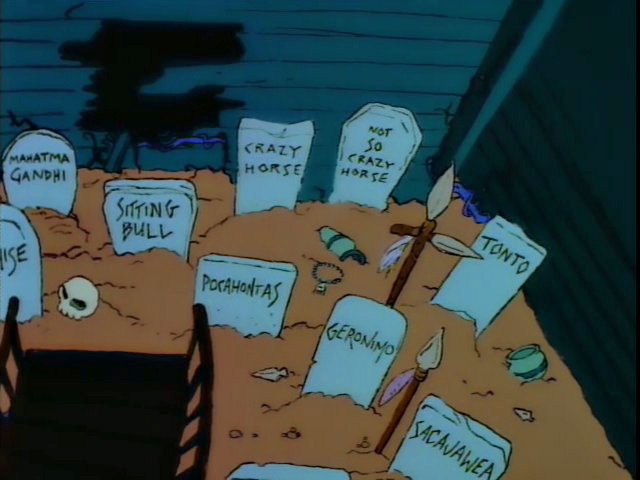
As the 20th century progressed, the Indigenous burial ground trope became so ubiquitous that it transitioned from a purely terrifying device to a comedic cliché. It has been parodied in beloved television series such as The Simpsons, Friends, South Park, Family Guy, and Parks and Recreation. Seth Grahame-Smith’s satirical How to Survive a Horror Movie humorously asks, "Are Native Americans constantly showing up to ask, ‘What happened to our cemetery?’" as a definitive sign of a haunted house. This comedic embrace, while highlighting the trope’s over-reliance, simultaneously normalizes its problematic premise, reinforcing the underlying stereotypes even as it pokes fun.
The trope’s journey continued into the digital age, blossoming into internet memes and viral content. The Onion‘s 2011 satirical video, "Report: Economy Failing Because U.S. Built on Ancient Indian Burial Grounds," brilliantly satirized the trope’s absurd reach, with panelists gravely discussing congressional reports blaming national problems on Indigenous ghosts and demanding "blood offerings." This piece, still available on YouTube, underscores how deeply entrenched the idea had become, to the point where it could be used to lampoon broader societal issues. Social media platforms like Twitter and Reddit are now rife with posts, image macros, and videos that echo this sentiment, further cementing the trope’s status as a widely recognized, if often unexamined, cultural artifact.
Supporting Data: Deconstructing the Trope’s Harmful Underpinnings
The enduring popularity of the "Indigenous burial ground" trope necessitates a critical examination of its origins, its problematic nature, and its real-world impact. Far from being a neutral storytelling device, it is deeply rooted in colonial anxieties, misrepresentation, and the erasure of Indigenous spiritual realities.
Folklore, Fear, and Settler Guilt
To understand the trope, one must consider its folkloric origins, distinguishing between genuine Indigenous spiritual beliefs and the settler narratives that project their own fears. While real burial grounds exist, and some Indigenous peoples hold beliefs about spirits associated with these sites, the vast majority of settler-driven "burial ground" stories are not rooted in Indigenous traditions. Instead, they often reflect traditional Christian fears of "uncivilized" people and unconsecrated ground. Settler ideas about the sanctity of Christian burial sites, the efficacy of the name of Christ against paranormal activity, and a Heaven exclusively for denominational believers contribute to a worldview that struggles to comprehend or respect alternative spiritual frameworks.
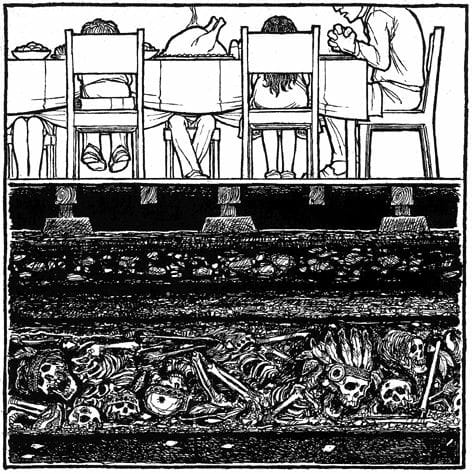
A compelling counter-argument to this "inferior earthbound ghosts" perspective is the concept of "Settler Guilt." A popular theory about ghosts is that they are spirits of those wronged or murdered in life. If settler ancestors committed horrific acts against Indigenous peoples – dispossessing them of land, enacting genocidal policies, and exploiting resources – then the idea of being haunted by these wronged spirits becomes a subconscious manifestation of collective guilt. The 1968 Ron Cobb illustration, "Thanksgiving in America," depicting a seemingly idyllic family dinner above buried Indigenous remains, powerfully captures this sentiment. It suggests that contemporary societies, built on the benefits reaped from historical injustices, may experience a psychological haunting, a lingering sense of accountability for the "sins of our forefathers and foremothers."
However, while "Settler Guilt" might explain why some sympathetic individuals perpetuate these memes and stories, the trope itself remains problematic. By claiming all places are Indigenous burial grounds, it paradoxically delegitimizes actual sacred sites and minimizes the very real crimes and injustices perpetrated against Indigenous peoples – from individual acts of violence to systemic genocides like those associated with residential school graveyards. It reduces complex historical trauma to a simplistic horror narrative, often with little regard for accuracy or respect.
Historical Precursors: Colonial Dread and the Ghost Dance
Fear of Indigenous ghosts predates the modern "haunted burial ground" legends. Historical accounts reveal a deep-seated colonial dread, particularly evident during the late 19th century. Newspapers in 1890, for example, reflected palpable anxiety as the Ghost Dance movement gained momentum across North America. This ceremonial dance, intended to raise the spirits of recently deceased tribal members for protection against settler injustices, was misconstrued by colonists as a prelude to armed rebellion. This fear culminated in the tragic Wounded Knee Massacre, where the US Army killed between 150 and 300 Lakota people, predominantly women, children, and Elders. The irony is stark: settlers feared resurrected ghosts but showed no compunction in creating new ones.
Early 20th-century Canadian examples further illustrate this colonial anxiety. An author from British Columbia recounts the oldest report of an Indigenous grave causing a haunting in the province, dating back to 1924. The Victoria Daily Times reported that seven road builders were haunted by "whishing" sounds and rapping noises for four nights after building their camp. Unable to find a rational explanation, they concluded their camp was built on the grave of a "Red Indian" and promptly relocated. This narrative exemplifies how unexplained phenomena were readily attributed to Indigenous spirits, reflecting a cultural readiness to project fear onto the "other."
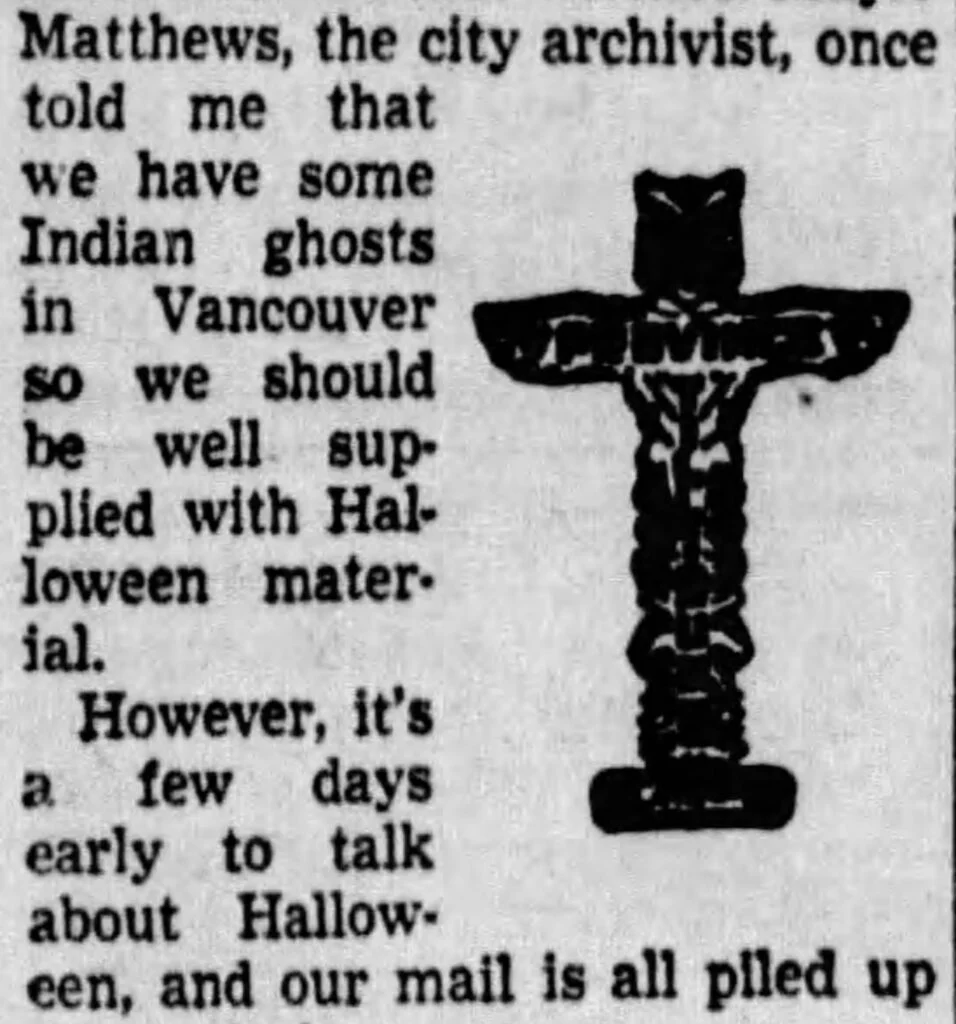
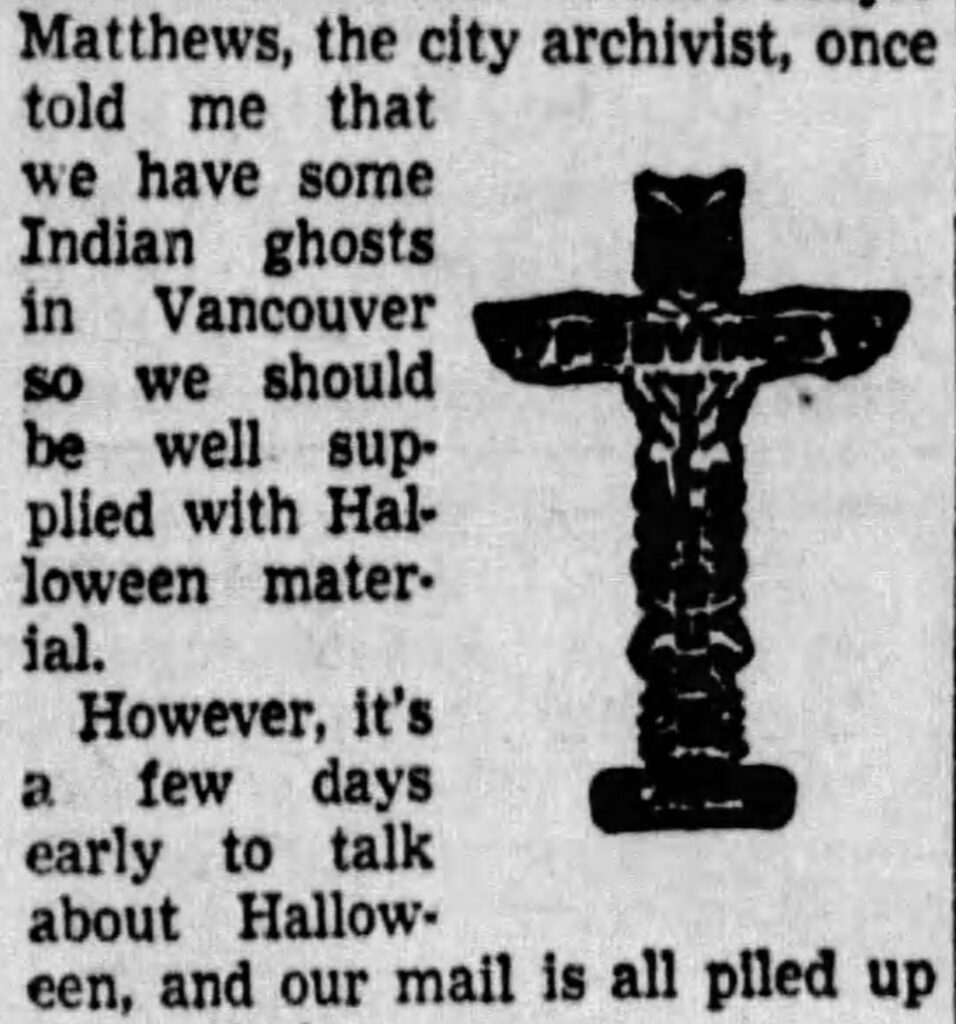
In 1940, City Archivist Major Mathews cryptically mentioned "Indian ghosts" in Vancouver to a Province reporter, without elaboration, amidst a piece about Halloween. This brief, almost offhand mention, highlights the casual integration of Indigenous spectral presence into the broader settler consciousness of the supernatural. Another fascinating Ontario story from the 1946 Vancouver Sun described a headless woman’s ghost seen near the rumored secret grave of Tecumseh, the renowned Shawnee chief. The association of a haunting with a historically significant Indigenous figure, even without concrete evidence, underscores the ongoing fascination and appropriation of Indigenous narratives within settler folklore.
The 1950 Vancouver Sun published "The Ghost of Graveyard Flats" by pulp writer Bjarne Kirchhoff, which notably featured an Indigenous burial ground haunted by a Wendigo, 33 years before Stephen King’s Pet Sematary. This demonstrates that elements of this trope, including the appropriation of specific Indigenous myths, were circulating in popular media long before their mainstream explosion.
Local Legends and Cultural Misappropriation
The Comox haunting reported in The Times Colonist in 1966, which eventually entered several books, illustrates the trope’s evolution and the problematic sexualization and misrepresentation of Indigenous women. Early versions spoke of a mist-like apparition, but by the 1960s, "Bloody Mary" had transformed into an "Indigenous woman" described as "young and well-stacked." Later iterations renamed her "Dancing Mary" and linked her to either a grave or a massacre site, conflating various paranormal reports and even a settler cemetery. This transformation showcases how settler narratives can distort and sensationalize Indigenous figures, stripping them of their cultural context and imbuing them with objectifying or violent attributes.
The rise of ghost tourism in Victoria, British Columbia, further amplified the "Indigenous burial ground" narrative. By the 1980s, local ghost hunters Robin Skelton and Jean Kozacari, both claiming psychic abilities, fueled a boom in local haunting stories. Victoria rapidly became known as one of Canada’s most haunted cities, with its proximity to water and its purported location on an Indigenous burial ground being the two most common explanations. The author critically notes the "childlike" nature of the "water theory" but condemns the "shameful" burial ground stories.
Claims of Victoria being built on a "mega burial ground" are debunked by historical and archaeological evidence. While burial mounds exist in areas like Beacon Hill Park, Cadboro Bay, and Saltspring Island, these numbers are vastly outweighed by settler cemeteries. Crucially, local First Nations historically used cairns, tree burials, raised platforms, or cave burials near shorelines, not the mound structures often imagined in settler narratives. The casual collection of Indigenous bones as souvenirs by early settlers further complicates the picture, highlighting a colonial disregard for Indigenous remains. The argument that "the city wasn’t built on a mega burial ground" directly challenges the foundational premise of many haunting claims.
Perhaps most egregious is the chapter "The Indian Inheritance" from Skelton and Kozacari’s 1989 book, Gathering of Ghosts. It blames "tainted land" for a cult’s actions near Nanaimo, incorrectly identifying it as Kwakiutl territory and a "slave-body dump site." The authors wrote: "It seems not unlikely that the long history of Indian raids, feasts, and ritual killings accounted in part for the way in which Brother Twelve’s initially peaceful and gentle community became disturbed… The problem was the land and its history. It was crying out for blood. The evil was in the earth itself." These claims, like those in Amityville, were demonstrably false. Yet, they painted Indigenous people as the source of inherent evil, or their land as sentient with a bloodthirsty past. The fact that Skelton was a respected university professor makes this hateful depiction particularly disturbing, illustrating how deeply entrenched these stereotypes can become, even within academic circles.
The author’s personal anecdotes about hearing "Indigenous burial ground" claims in their own Saskatchewan neighbourhood and other B.C. locations further underscore the trope’s ubiquity as an urban legend. The "friend-of-a-friend" attribution and the consistent sharing of these tales by people of European background highlight their settler-centric nature. The frequent appearance of "Indigenous royalty" like chiefs in headdresses to "common folk" in these stories also points to a romanticized and often inaccurate portrayal of Indigenous leadership and regalia, disconnected from actual cultural practices.
Official Responses: The Call for Respect and Accuracy
While there aren’t "official responses" in the sense of government statements on the trope, the academic and Indigenous communities have long offered critical perspectives and called for a more respectful engagement with Indigenous histories and spiritualities.
Scholarly works like Phantom Past, Indigenous Presence: Native Ghosts in North American History and Culture document actual stories of spirits associated with ancestral remains in museums and archaeological digs. These accounts, however, are often not suitable for consumerist horror narratives, highlighting a fundamental disconnect between genuine Indigenous beliefs and settler appropriation. Indigenous communities typically have designated storytellers and knowledge keepers who are authorized to share specific narratives, as many stories are intentionally private and sacred. The common settler clichés of "ancient people dancing around in regalia" stand in stark contrast to widespread traditional beliefs that even speaking about a deceased person can inadvertently cause a haunting.
Furthermore, the traumatic legacy of abusive residential schools, which forcibly imposed Christian beliefs, including the notion of Jesus being the only cure for evil, has deeply impacted Indigenous spiritual traditions. This colonial imposition attempted to erase Indigenous cosmologies, contributing to a context where settler-created "Indigenous ghost" stories can be particularly harmful and disrespectful.
The language used to describe Indigenous peoples and their histories is also critical. Terms like "Indigenous" are preferred over outdated and often offensive labels like "Indian," though terminology is constantly evolving and varies between nations and generations. Beyond the disrespectful "burial ground" terminology, cultural appropriation is a significant factor. The appropriation of sacred stories, symbols, and spiritual concepts for entertainment purposes, without understanding, permission, or respect, further perpetuates harm and misunderstanding. The Alutiiq Museum’s cultural appropriation flowchart, referenced by the author, provides a valuable guide for respectful engagement, emphasizing the necessity of understanding protocols for recording oral histories and seeking guidance from Elders and experts.
Implications: Reclaiming Narratives and Moving Forward
The pervasive "Indigenous burial ground" trope carries profound and damaging implications, extending far beyond mere entertainment. It is a symptom of a deeper cultural problem rooted in historical denial, unresolved guilt, and the ongoing marginalization of Indigenous voices.
Firstly, the trope actively delegitimizes actual Indigenous sacred sites and histories. By fabricating countless "burial grounds," it dilutes the significance of genuine ancestral lands and the very real spiritual connections Indigenous peoples hold with their territories. It transforms profound cultural heritage into a generic plot device, obscuring the specificities and diversity of Indigenous nations.
Secondly, it perpetuates harmful stereotypes of Indigenous peoples as inherently vengeful, demonic, or eternally tied to the past. This portrayal denies their contemporary existence, their vibrant cultures, and their diverse spiritual beliefs. It reduces complex societies to two-dimensional figures of terror, feeding into a colonial narrative that justifies historical injustices by dehumanizing the victims. The consistent portrayal of Indigenous ghosts as "evil" or "demonic" aligns with Holzer’s "shift-the-blame-to-nonwhite-ghosts strategy," which has become worryingly mainstream in ghost hunting shows and popular culture. This strategy implicitly links non-white spiritual entities with malevolence, reinforcing racist undertones.
Thirdly, the trope minimizes the immense trauma and injustices inflicted upon Indigenous peoples. Residential school graveyards, sites of massacres, and countless unmarked burial sites are grim realities of colonial violence. When every haunted house is attributed to a generic "Indian burial ground," it trivializes these specific, documented atrocities and the ongoing work of truth and reconciliation. It substitutes a fictional, easily digestible horror story for the difficult, uncomfortable truths of history.
Finally, the trope is a potent example of cultural appropriation. It takes elements of Indigenous spirituality and folklore, often distorting them, and recontextualizes them for settler entertainment without respect, understanding, or permission. This act of taking without giving back, of benefiting from another culture’s heritage while simultaneously misrepresenting it, is a form of ongoing colonial exploitation.
The question "Why are the Indigenous burial ground stories so popular?" ultimately reveals a discomfiting truth about North American society: our mainstream explanation for malevolent hauntings often defaults to the ghosts of the very people our ancestors wronged. This speaks to a collective inability or unwillingness to confront the historical violence of colonization directly. "Settler Guilt" alone is insufficient if it merely manifests as a generalized, fictionalized fear rather than leading to genuine acknowledgment, reconciliation, and systemic change.
Indigenous peoples are not inherently evil or demonic. Their traditional versions of spiritual realms are often far more beautiful, nuanced, and less judgmental than many settler beliefs. Moving forward requires a fundamental shift in perspective. It demands critical examination of the stories we tell, the media we consume, and the historical narratives we accept. It necessitates active listening to Indigenous voices, respecting their protocols for storytelling, and supporting their efforts to reclaim and share their own histories and spiritualities on their own terms. Only by dismantling these harmful tropes can we begin to foster genuine understanding, respect, and ultimately, reconciliation between Indigenous and non-Indigenous peoples in North America.