The Architecture of Memory: The Visionary Landscapes and Surrealist Philosophy of Christian Quintin
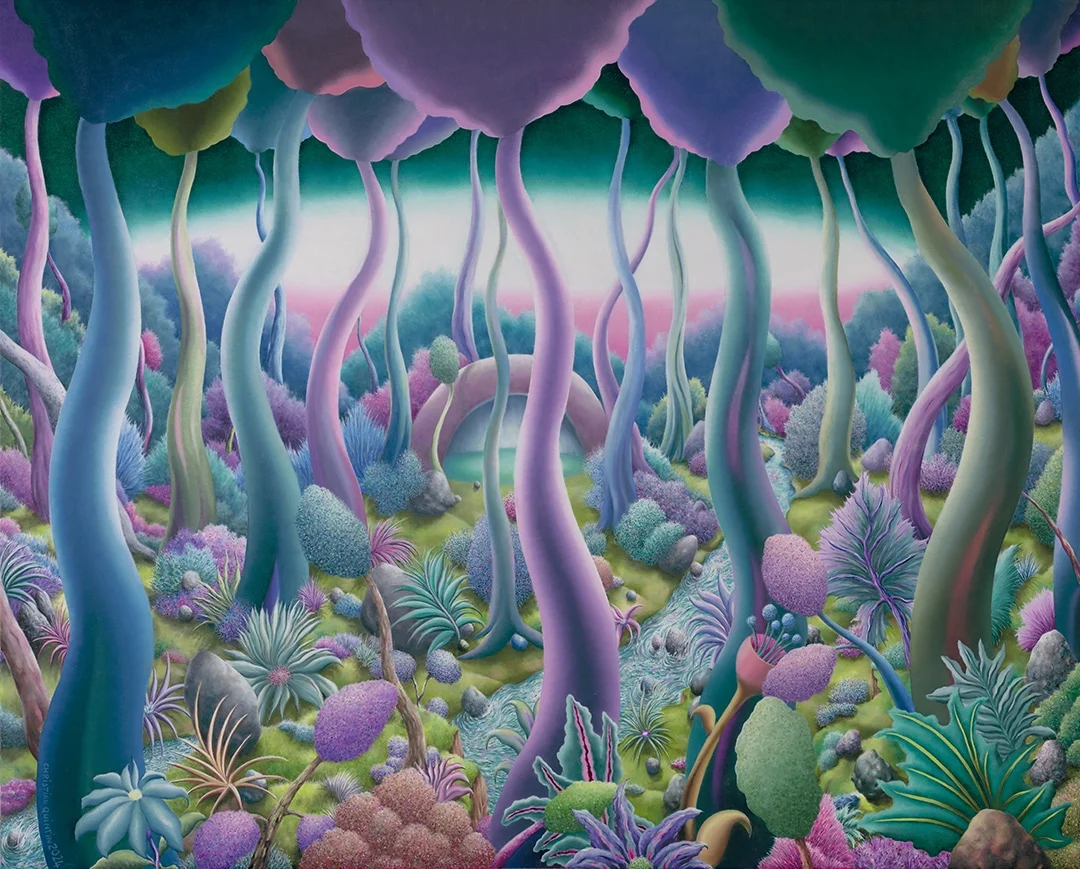
In an era where the contemporary art world often prioritizes irony, social critique, or digital abstraction, the work of Christian Quintin stands as a profound anomaly. For over four decades, the French-born, California-based artist has cultivated a visual language that bypasses the intellect to speak directly to the subconscious. Quintin does not paint what he sees; he paints what one remembers feeling before language existed to define it. His canvases function as a form of visual poetry—meticulously crafted, deeply philosophical, and unapologetically beautiful.
Through a practice that spans intricate pen-and-ink drawings and luminous oil landscapes, Quintin has established himself as a bridge between the classical traditions of European Surrealism and the expansive, spiritual ecology of the American West. His work, now gaining significant international momentum, offers a sanctuary for the modern soul, suggesting that beauty is not merely a decorative choice but a radical act of defiance against a cynical world.
Main Facts: A Unified Vision of Inner and Outer Worlds
Christian Quintin’s body of work defies the traditional silos of art history. While he is often categorized as a Surrealist, his approach is more accurately described as a "visual philosophy." He explores the twin landscapes of the human psyche and the natural world, treating them not as separate entities but as a seamless, symbolic continuum.

The Stylistic Intersection
Quintin’s work is characterized by a "kaleidoscopic consciousness," a term he uses to describe the dissolution of boundaries between the self and the environment. In his compositions, a face may unfurl into a canopy of leaves, or a landscape may breathe with the rhythmic pulse of a living organism. This is not the "shock-value" surrealism of the early 20th century; rather, it is a Romantic, Symbolist exploration of presence.
Technical Prowess
A hallmark of Quintin’s practice is his staggering technical precision. His large-scale ink works often require six to seven months of daily, disciplined labor. Utilizing cross-hatching, layering, and a masterly control of light, he creates textures that feel both ancient and ethereal. Whether working in oil, graphite, or pastel, Quintin matches his medium to the "emotional temperature" of the subject, ensuring that the technique always serves the intuition.
Current Standing
After decades of steady production in Northern California, Quintin’s career has seen a significant international surge. Represented by Lorin Gallery (Los Angeles/Paris), his work has recently been featured at major global art fairs, including KIAF in Seoul and Art Central in Hong Kong. This shift marks a moment where the global art market is increasingly "catching up" to Quintin’s timeless aesthetic.

Chronology: From the Cliffs of Brittany to the Valleys of Sonoma
The evolution of Quintin’s art is inextricably linked to his geographical journey. Each location he has inhabited has contributed a specific "vocabulary" to his visual language.
1957–1975: The Breton Foundations
Born in 1957 in Saint Brieuc, a port town on the northern coast of Brittany, Quintin’s earliest influences were the moody, storm-lashed landscapes of the French coast. The region’s ruined castles, isolated islands, and mythic atmosphere instilled in him a sensitivity to nature’s grandeur and melancholy. One specific landmark, L’Île de la Comtesse, remains a recurring motif in his work—a symbol of solitude and the storybook aura of childhood memory.
1975–1981: The Parisian Discipline
In 1975, Quintin moved to Paris to study at the prestigious Beaux Arts Academy. It was here that his romantic instincts were tempered by classical discipline. He mastered the legacy of the French Surrealists and Symbolists, not as a means of rebellion, but as a toolkit for revelation. This period forged the precise draftsmanship and control of form that allow his most fantastical images to maintain a sense of structural logic.

1981–Present: The California Synthesis
The pivotal turning point in Quintin’s life occurred in 1981 when he relocated to Northern California. Settling in the vineyards and rolling hills of Sonoma County, he found a landscape that resonated with his internal world. He famously remarked, "I feel the same spirit in a tree as in myself." In California, the old myths of Brittany found a new mirror in the sacred ecology of the American West. The "Mental Landscapes" he produced during this era began to blend the technical rigors of his French training with the expansive, visionary spirit of the Pacific Coast.
Supporting Data: Analysis of Key Works and Methodologies
To understand the impact of Quintin’s work, one must look at the specific intersections of time, technique, and theme found in his major pieces.
The Surrealist Explorations: The Aviary and La Porte Ouverte
In The Aviary, Quintin presents a quintessential example of his "kaleidoscopic consciousness." His own face emerges from a crystalline structure, his neck transforming into a tree trunk, and his hair becoming a lush canopy. The piece is an ecosystem of the self, suggesting that the individual is not an observer of nature but a participant in it.

Similarly, La Porte Ouverte (The Open Door), inspired by the poetry of Rumi, serves as a visual meditation on liberation. The work, which took seven months to complete using intricate ink cross-hatching, asks the viewer: "Why stay in prison when the door is wide open?" The complexity of the drawing reflects the complexity of the mind’s self-imposed barriers, rendered with a detail that demands the viewer slow down and "wander" into the imagery.
The Romance of Nature: Emotional Terrains
Quintin’s landscapes are rarely literal. In works like Leaves of Absence or Les Amants (The Lovers), trees take on anthropomorphic qualities, swaying like dancers or locked in an eternal embrace. His use of color is equally symbolic. In A Lake Color of Emeralds, he utilizes a brown-orange sky and violet undertones to convey a specific mood rather than a meteorological reality.
The Fusion of Modes
Critics often note that Quintin does not have a "split" practice. His realistic landscapes and his surrealist mind-maps are two sides of the same coin. In West Sonoma County, a floating face emerges from the clouds, its lips becoming a literal island. This fusion illustrates his core philosophy: the symbolic enters the natural, and the natural becomes symbolic.

Official Responses: Critical Reception and Artist Philosophy
The reception of Quintin’s work over the decades reflects a consistent appreciation for his ability to fill an emotional void in the contemporary art scene.
Critical Acclaim
Critics have frequently pointed to the "healing" or "sanctuary-like" quality of his work.
- Alhia Warren described his portfolio as a "beautiful intimate mystery," highlighting the personal connection viewers feel with his imagery.
- Suzanne Munich, in her review titled "Mental Landscapes," noted the psychological depth that underpins his technical skill.
- A 2022 Calabi Gallery review offered perhaps the most poignant diagnosis of his relevance: "In an era largely devoid of it, his work is beautiful. We could all use more beauty in our lives."
The Artist’s Perspective
Quintin himself maintains a humble and intuitive stance regarding his output. He rejects the need for slogans or political manifestos, stating, "I do not have a message. But I feel compelled to convey the feelings that flow through me as I attempt to create something beautiful."

His advice to fellow artists emphasizes the importance of the subconscious: "Intuition first. Technique follows." He advocates for drawing the first thing that comes to mind without judgment, a practice that allows the "kaleidoscopic" nature of the mind to manifest on the page before the logical brain can intervene.
Implications: Quintin’s Legacy in the Visionary Continuum
The success and longevity of Christian Quintin’s career carry significant implications for the trajectory of contemporary art and the "Visionary" tradition.
A Bridge Between Traditions
Quintin belongs to a lineage that includes Dalí, Magritte, and Escher—artists who used meticulous technique to make the impossible legible. However, unlike the early Surrealists who often sought to unsettle or disturb the viewer, Quintin’s work is geared toward awakening and harmony. He also shares common ground with the Northern California Visionary Art movement of the 1960s, yet he replaces their often-chaotic psychedelic palettes with a more classical, restrained "sacred geometry."
The Return to Beauty as Resistance
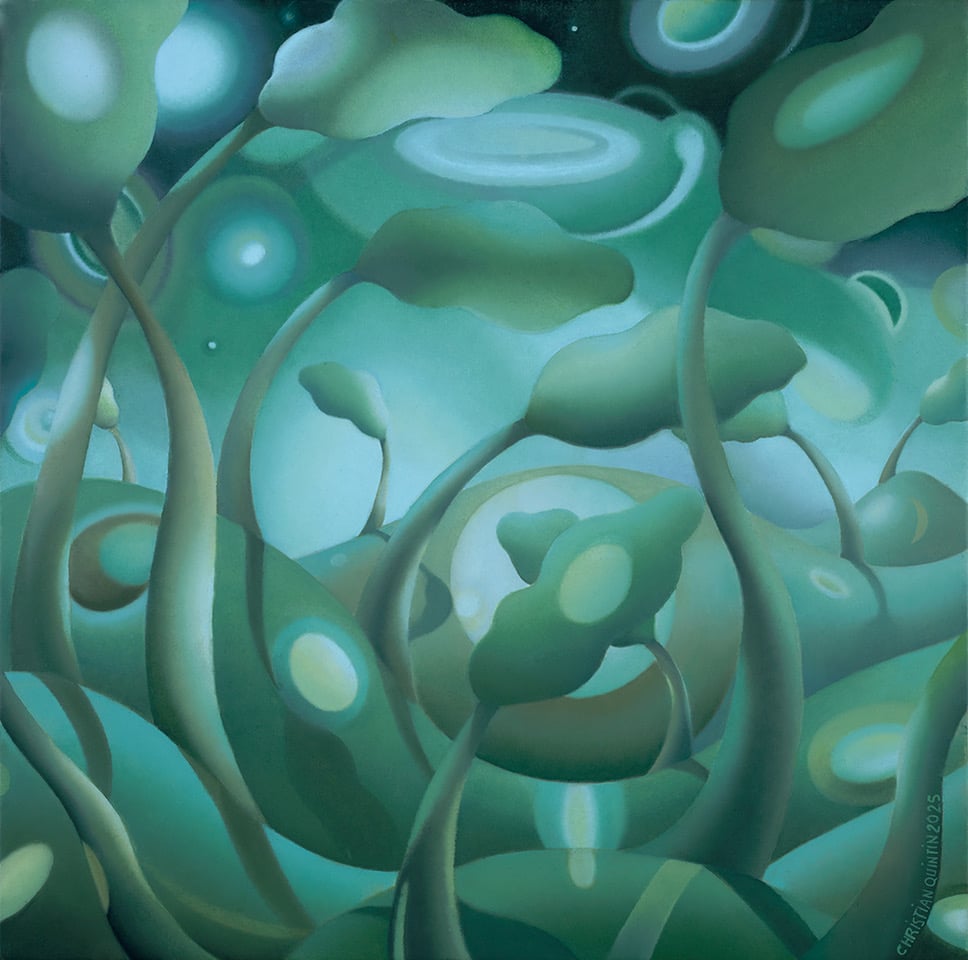
In the context of the 21st-century art market, Quintin’s rise suggests a fatigue with purely conceptual or "shock" art. His work implies that beauty is a form of resistance—a way to preserve human sensitivity in an increasingly mechanized and fast-paced world. By demanding "slowness" from the viewer, his art acts as a corrective to the culture of the "instant."
Global Resonance
The fact that his work is now being embraced in Seoul, Hong Kong, Paris, and New York indicates that his "symbolic language" is truly universal. The feelings he depicts—solitude, wonder, the connection to nature—are not bound by geography. As he continues to exhibit at prestigious venues like the Morrison Gallery in Connecticut and through his representation with Lorin Gallery, Quintin’s legacy appears secured as a master of the "inner/outer" world.
Conclusion: A Wondrous Sanctuary
Christian Quintin’s art is not a detour from reality, but a reentry into its hidden dimensions. Through his 40-year journey from the moody coasts of France to the sun-drenched valleys of California, he has remained a steadfast guardian of the "intimate mystery."
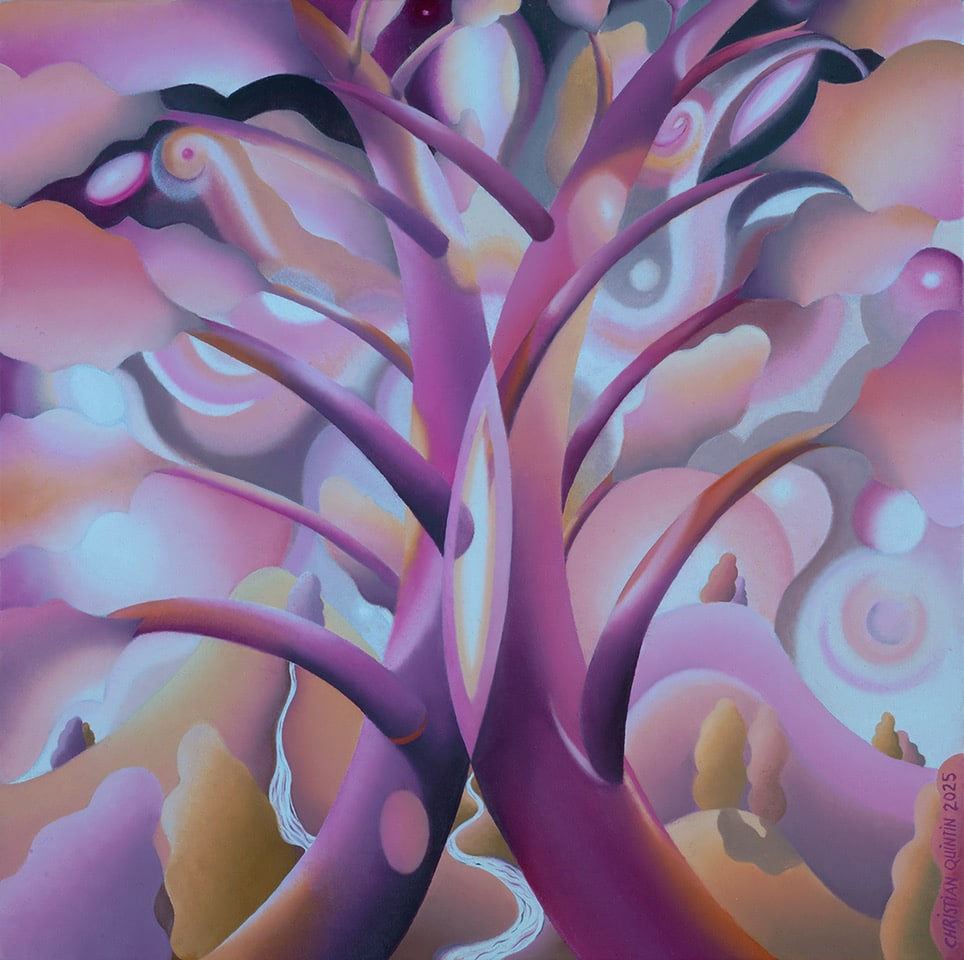
His work serves as a reminder that the psyche and the landscape are one. When he draws a tree, he draws a human soul; when he paints a face, he paints a world. In the end, Quintin provides more than just visual stimulation; he provides what curators have called a "wondrous sanctuary for the soul," proving that art, when made with profound attention and soul, remains our most powerful tool for understanding the invisible threads that connect us to the world.