The Evolution of the Ninja: N Plus Infinity Times Two Redefines Physics-Based Platforming at Gamescom
COLOGNE, Germany — In the landscape of independent gaming, few lineages carry as much weight or historical significance as the N series. Originally emerging during the golden era of Adobe Flash, the franchise has long been the gold standard for momentum-based platforming. At this year’s Gamescom, the next evolution of this minimalist saga, titled N Plus Infinity Times Two, was showcased to attendees, signaling a return to the high-octane, precision-heavy gameplay that defined a generation of indie titles.
N Plus Infinity Times Two is not merely a sequel but a comprehensive expansion of the "Ninja" philosophy. It balances a brutal single-player challenge with a suite of chaotic multiplayer modes that threaten to redefine the "friendship-ending" genre of party games. With its arrival on Steam wishlists, the title aims to bridge the gap between nostalgic veterans of the mid-2000s web-gaming scene and a new generation of players raised on high-frame-rate competitive titles.
Main Facts: A New Benchmark for Precision Platforming
At its core, N Plus Infinity Times Two remains a game about a ninja, a timer, and a seemingly insurmountable number of gold coins. However, the "Infinity Times Two" suffix denotes a massive scale-up in both content and technical execution. The game centers on a physics-based movement system that prioritizes momentum, friction, and gravity.
The primary features of the new title include:
- Physics-Centric Movement: A refined engine that allows for granular control over the ninja’s velocity, allowing for wall-jumps, slides, and air-braking that feel more responsive than any previous iteration.
- Multiplayer Ecosystem: The introduction of "Friendship-Ending Competitive" mode and a tactical team-based Co-op mode.
- Dynamic Level Hazards: A vast array of traps, ranging from classic heat-seeking missiles and laser turrets to new, environment-specific obstacles like cave-in triggers and gravity wells.
- The Rocket Mechanic: A post-finish gameplay loop where the winner of a race transforms into a projectile, allowing them to influence the remaining players’ scores.
The game’s presence at Gamescom allowed for hands-on demonstrations that highlighted the "pick-up-and-play" accessibility contrasted against a nearly infinite skill ceiling.
Chronology: From Flash Prototype to Modern Powerhouse
To understand the significance of N Plus Infinity Times Two, one must look at the two-decade timeline of the franchise.
2004–2008: The Flash Genesis
The original N (often called N-Game) was released as a free Flash game by Metanet Software. It became an overnight sensation due to its realistic physics—a rarity for browser games at the time—and its stark, minimalist aesthetic. It won the Audience Award at the 2005 Independent Games Festival, cementing its place in history.
2008–2015: Console Expansion
The series moved to consoles with N+, appearing on the Xbox 360, DS, and PSP. This era introduced local multiplayer and a level editor, proving that the minimalist ninja could thrive on high-definition hardware. This was followed years later by N++, which expanded the color palettes and soundtrack significantly, offering thousands of levels.
2024 and Beyond: The Gamescom Reveal
The announcement and subsequent demo of N Plus Infinity Times Two at Gamescom represents the "Infinity" phase of the franchise. Developers have taken the feedback from twenty years of community level-building and speedrunning to create a version of the game that feels "limitless." The current iteration focuses on the social aspect of gaming, moving away from the purely solitary experience of the original Flash game and leaning into the chaotic energy of modern multiplayer.

Supporting Data: Mechanics and Game Modes
The depth of N Plus Infinity Times Two is best understood through its specific gameplay modes, which were the focal point of the Gamescom showcase.
The Competitive Mode: "Friendship-Ending" Dynamics
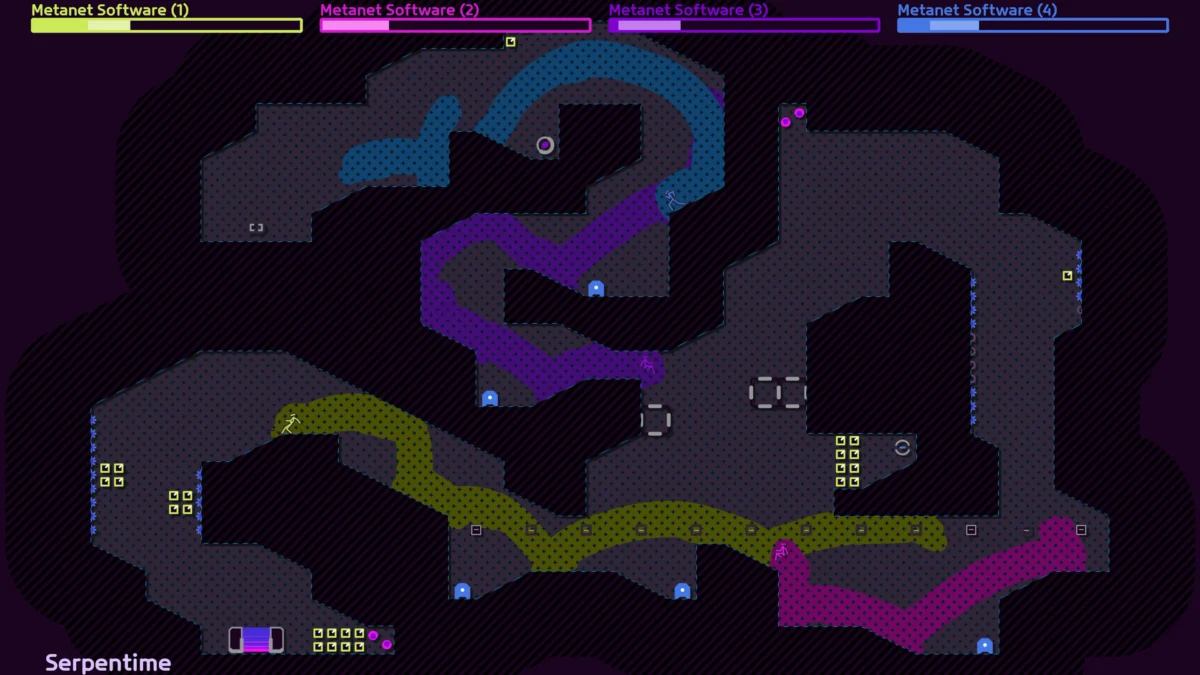
The "Friendship-Ending Competitive" mode supports up to four players in a frantic race to the exit. Unlike traditional racers, the goal isn’t just speed; it is survival and point accumulation.
- Scoring: Players collect coins to boost their score and extend their "lifetime."
- The Rocket Phase: In a brilliant twist on the winner-takes-all trope, the first player to reach the exit does not simply wait for the others. They are transformed into a controllable rocket. This player can then hunt down the remaining competitors. If they successfully strike another player, they can effectively reset that player’s progress or kill them instantly, leading to the "friendship-ending" moniker.
- Point Decay: Once the first player finishes, a countdown begins. The points of the remaining players begin to tick away rapidly, forcing a desperate, high-risk scramble to the finish line.
The Co-operative Mode: Tactical Symmetry
For those seeking a less aggressive experience, the Team-Based Co-op mode offers a unique "Cat and Mouse" structure.
- Phase One: Team A enters the level with a head start. Their objective is to collect as many coins as possible within a strict time limit.
- Phase Two: Team B spawns in with the sole objective of catching Team A.
- The Swap: Once Team A is caught or time expires, the roles reverse. Team B must then attempt to beat Team A’s coin count before being intercepted.
This mode emphasizes communication and pathfinding, as teammates must split up to cover the map efficiently while keeping an eye on the spawn points of their pursuers.
Technical Specifications
The game utilizes a vector-based rendering engine, ensuring that the visuals remain crisp at any resolution, from 1080p to 4K and beyond. This is crucial for a game where a single pixel of overlap with a laser can mean the difference between a successful run and a "Game Over."
Official Responses and Developer Philosophy
While the developers at Metanet Software have always been famously understated, the design of N Plus Infinity Times Two speaks to a specific philosophy of "perfection through reduction." At the Gamescom booth, representatives emphasized that the goal was not to clutter the screen with modern "fluff" but to hone the existing physics to a razor’s edge.
"The movement is physics-based, but on a micro-scale," noted testers during the event. This sentiment reflects the developer’s intent: to make the player feel the weight of the ninja. Every jump requires a calculation of arc and momentum.
Early feedback from the Steam community has been overwhelmingly positive, particularly regarding the multiplayer balance. "It feels fair," one veteran player noted. "In the co-op mode, the swapping of roles ensures that no one feels like they are stuck in a losing position. It’s about skill, not just who spawned in a better spot."
The decision to list the game on Steam rather than as a browser-based experience further signals a commitment to a stable, high-performance environment that can support the complex physics calculations required for four-player simultaneous play.

Implications: The Future of Minimalist Design
The emergence of N Plus Infinity Times Two carries several implications for the broader gaming industry and the indie development scene.
1. The Resurgence of the "Pure" Platformer
In an era where many indie games feel the need to incorporate RPG elements, crafting systems, or procedurally generated open worlds, N Plus Infinity Times Two is a defiant return to "purity." It suggests that there is still a massive market for games that do one thing—movement—perfectly.
2. The Influence of Speedrunning Culture
The design of the new levels and the inclusion of precise timers suggest that the developers are leaning into the speedrunning community. By providing tools for high-level competitive play and "friendship-ending" sabotage, the game is primed for visibility on streaming platforms like Twitch and YouTube, where high-stakes, high-skill gameplay thrives.
3. The "Flash-to-Premium" Pipeline
The success of this franchise serves as a blueprint for other classic Flash properties. It demonstrates how a simple concept from the early 2000s can be iterated upon for decades without losing its soul. As more "Flash era" developers look to modernize their portfolios, N Plus Infinity Times Two stands as the gold standard for how to respect the past while embracing the technical capabilities of the present.
4. Accessibility vs. Difficulty
The inclusion of a team-based mode and various difficulty tiers in single-player suggests a move toward broader accessibility. While the N series is known for being "Nintendo Hard," this latest iteration provides multiple "on-ramps" for players who may find the competitive mode too daunting.
Conclusion
N Plus Infinity Times Two is more than a trip down memory lane for those who spent their school IT labs playing Flash games. It is a sophisticated, highly-engineered piece of software that pushes the boundaries of 2D physics. Whether through the sheer adrenaline of the Competitive mode or the calculated strategy of Co-op, the game proves that the Ninja’s journey is far from over. As it moves toward a full release, the gaming world watches to see if this minimalist masterpiece can once again capture the lightning in a bottle that started it all twenty years ago.
For those eager to test their reflexes, N Plus Infinity Times Two is currently available for wishlisting on Steam, with further announcements regarding a firm release date expected following the conclusion of the Gamescom circuit.