The Architect of Clouds: Unveiling the Surreal Universe of Fran Rodriguez
In an era where digital saturation often leads to aesthetic fatigue, few artists manage to arrest the viewer’s gaze and transport it toward the infinite. Fran Rodriguez, the Spanish digital visionary known globally by his moniker "lacabezaenlasnubes" (head in the clouds), has emerged as a definitive voice in contemporary surrealism. By blending the organic textures of the natural world with the cold, vast expanses of the cosmos, Rodriguez does more than create images; he constructs portals into the subconscious.

This report explores the trajectory, technical mastery, and philosophical underpinnings of an artist whose work suggests that the reality we inhabit is merely the visible tip of a much larger, hidden iceberg.

I. Main Facts: The Visionary Behind the Moniker
Fran Rodriguez is a digital artist whose work has become synonymous with a modern revival of psychedelic and surrealist aesthetics. Born in Torrelavega, Cantabria, Rodriguez’s creative identity is deeply rooted in the Spanish phrase “tener la cabeza en las nubes.” While the idiom often carries a connotation of being distracted or impractical, Rodriguez has reclaimed it as a professional manifesto. For him, having one’s head in the clouds is a prerequisite for seeing the world’s hidden dimensions.

The Core Pillars of Rodriguez’s Style:
- Surreal Juxtaposition: The placement of mundane human activities—swinging on a playground, walking through a cornfield—into impossible cosmic or fantastical settings.
- Chromatic Vibrancy: A sophisticated use of psychedelic color palettes that evoke a sense of "wonder and exploration" rather than mere sensory overload.
- Vintage-Digital Synthesis: Many of his works utilize a "collage" aesthetic that blends vintage photographic textures with hyper-modern digital rendering, creating a sense of timelessness.
Rodriguez’s work has transcended the digital space, finding a home in high-end galleries, interior design via large-scale wall art, and a massive social media following that looks to his feed for a daily dose of "visual escapism."

II. Chronology: From the Verdant North to the Urban Hubs
The evolution of Fran Rodriguez’s artistic voice is a journey through the changing landscapes of Spain, each leaving a distinct mark on his visual vocabulary.

The Cantabrian Foundations (Early Years)
Born in Torrelavega, in Northern Spain, Rodriguez was raised in a region defined by dramatic natural beauty—verdant hills, misty mountains, and the rugged Atlantic coast. This early exposure to the power of nature is evident in his recurring use of lush landscapes, forests, and floral explosions. It was here that he first discovered the works of classic surrealists and the psychedelic art of the 1960s and 70s, forming the bedrock of his aesthetic.

The Madrid Transition (Development)
As Rodriguez moved toward a professional career, he spent a significant "stint" in Madrid. The Spanish capital, with its world-class museums like the Prado and the Reina Sofia, allowed Rodriguez to study the masters of surrealism (such as Salvador Dalí and Joan Miró) in person. Madrid’s fast-paced, urban environment provided the contrast necessary for him to begin experimenting with how "man-made" structures—buildings, bridges, and statues—could be subverted through digital manipulation.

The Barcelona Maturity (Current Era)
Currently based in Barcelona, Rodriguez has reached his creative zenith in a city world-renowned for its architectural surrealism (most notably the works of Antoni Gaudí). The Mediterranean light and the city’s status as a global design hub have refined his technical "digital mastery." In Barcelona, his work has transitioned from experimental hobbyism to a "life project," where he leverages cutting-edge digital tools to challenge the boundaries of conventional perception.

III. Supporting Data: The Anatomy of a Digital Masterpiece
To understand the impact of Rodriguez’s work, one must analyze the specific thematic categories that define his portfolio. His technical prowess is not merely about software proficiency but about the "meticulous digital craftsmanship" used to evoke specific psychological states.

1. The Cosmic Perspective
A recurring motif in Rodriguez’s work is the human figure dwarfed by the celestial. In the piece "Space Swing," a girl sits on a simple playground swing, yet her feet dangle over the curvature of planet Earth.

- The Data of Contrast: By placing a childhood object in a vacuum, Rodriguez triggers a sense of "cosmic nostalgia."
- Notable Work: "Astronaut in the Pantheon," which depicts a space-traveler floating within the ancient Roman temple, light streaming through the oculus. This piece represents the ultimate convergence of human history and future exploration.
2. Floral Explosions and Botanical Surrealism
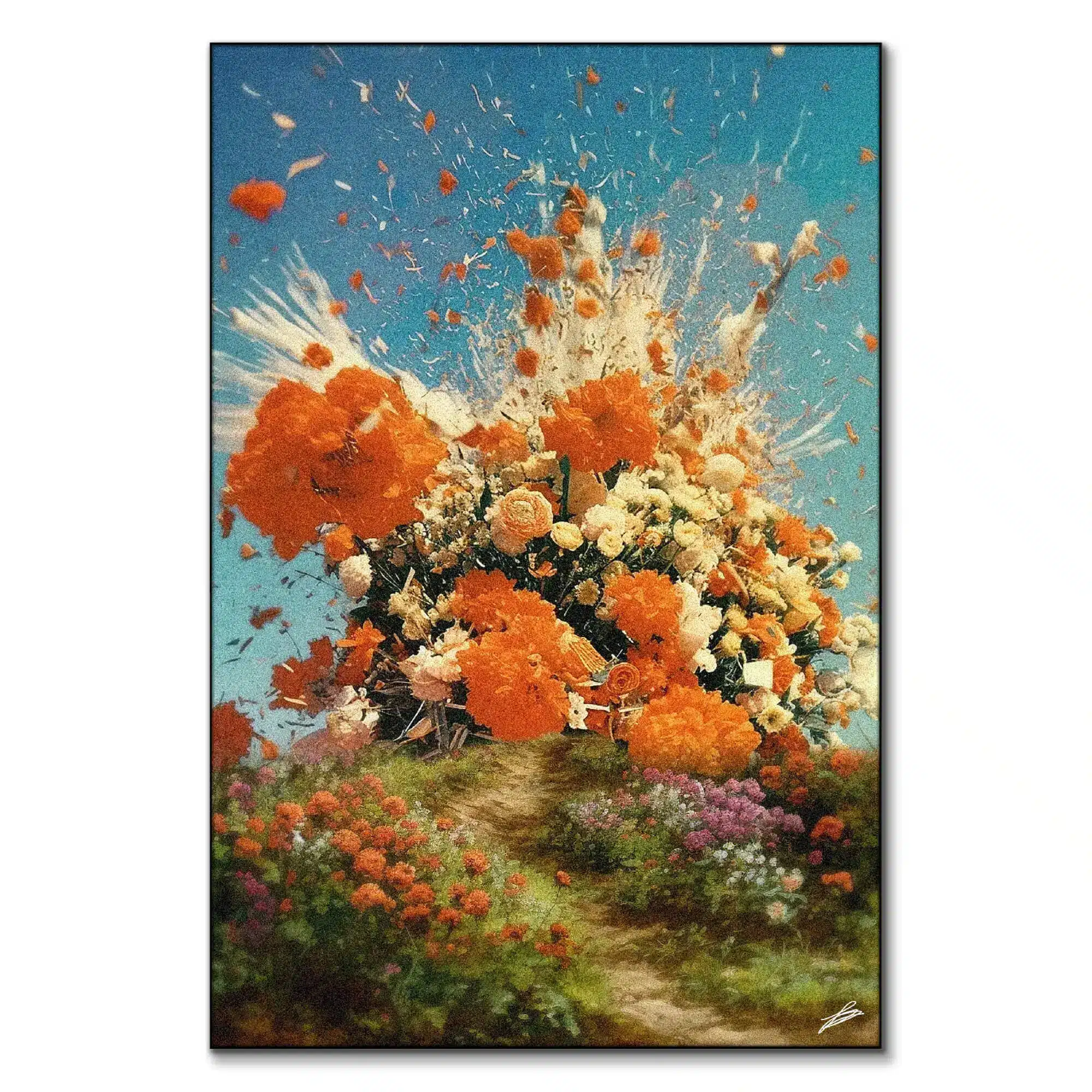
Rodriguez often uses nature as a medium for chaos and beauty. His piece "Bloom Boom" features a bouquet of flowers that isn’t merely sitting in a vase but is actively exploding against a serene blue sky.

- Technique: The artist uses high-resolution digital textures to ensure that every petal and stamen is visible, grounding the fantasy in a startling "hyper-reality."
- Implication: These works suggest that nature is not a static background but a dynamic, almost sentient force.
3. The Portal Motif
Many of Rodriguez’s compositions, such as "Ocean Space Planet Portal" or "Space Desert Portal," utilize geometric shapes (monoliths, circles, or doorways) that open into different dimensions.

- Visual Strategy: A child in a green field might look through a circular window to see a roiling cosmic ocean. This "frame-within-a-frame" technique forces the viewer to acknowledge two realities simultaneously, effectively "blurring the boundaries between imagination and reality."
IV. Official Responses: The "Iceberg Theory" of Reality
While Rodriguez’s work is often categorized as "psychedelic," the artist himself views his output through a more philosophical lens. In various statements and through the curation of his collections, Rodriguez has articulated a clear mission statement regarding the nature of existence.

The Artist’s Philosophy
Rodriguez posits that the "visible world represents merely a fraction of a greater, hidden reality." He frequently uses the metaphor of an iceberg’s tip breaking the surface of the water. Our daily lives, our sensory perceptions, and our logical structures are the small portion above the water. His art is intended to be the "portal" that allows the viewer to dive beneath the surface.

Critical Reception
Art critics have noted that Rodriguez’s work succeeds where other digital "dreamscapes" fail because of his restraint. He does not simply clutter a canvas with "trippy" imagery; he uses "meticulous digital craftsmanship" to create a sense of balance. As noted by observers in the surrealist community, his work prompts viewers to "contemplate the nature of existence and our place within the vast, mysterious universe" rather than just providing a temporary visual thrill.

V. Implications: Surrealism in the Age of Digital Alienation
The rise of Fran Rodriguez’s "lacabezaenlasnubes" project carries significant implications for the role of art in the 21st century. As society becomes increasingly tethered to screens and data, the "restless spirit" of Rodriguez’s work offers a necessary counter-narrative.

1. The Democratization of Visionary Art
Through platforms like Big Wall Decor and social media, Rodriguez has made high-concept surrealism accessible to a broad audience. By offering his work as "wall art," he allows individuals to turn their living spaces into "portals," effectively integrating the "subconscious landscape" into the home environment.

2. The Future of Exploration
Rodriguez’s imagination is fueled by dreams of "future adventures," ranging from the icy wilderness of Alaska to unexplored terrains of distant planets. His work suggests that as physical exploration becomes more difficult or commercialized, the "internal exploration" of the mind becomes the final frontier.

3. Challenging the "Status Quo" of Perception
The ultimate implication of Rodriguez’s body of work is a call to action for the viewer. He encourages a "constant quest to unveil the mysteries lurking beneath the surface of everyday reality." In a world of "fake news" and digital manipulation, Rodriguez uses "fake" (digital) imagery to point toward a "deeper truth"—that our imagination is the only tool capable of redefining the boundaries of reality.

Conclusion: Keeping the Mind Open to Infinite Possibilities
Fran Rodriguez remains a pivotal figure in the digital art movement, a "visionary" who refuses to let his feet stay on the ground if his head can be in the clouds. Through his journey from the green landscapes of Cantabria to the artistic heart of Barcelona, he has refined a style that is as technically impressive as it is emotionally resonant.

As he continues to explore the "depths of perception," Rodriguez invites us all to join him. His work serves as a reminder that the universe is vast, mysterious, and—above all—beautifully surreal. For those willing to look beyond the obvious, the "iceberg" of reality holds wonders that only an artist with his head in the clouds could truly capture.

How to Connect with the Artist
For those seeking to bring a piece of this hidden reality into their own world, Fran Rodriguez’s collections are available through major digital art platforms. He continues to engage with a global community of dreamers, challenging them to keep their "minds open to the infinite possibilities that lie just beyond our everyday view."