Unifying the World’s Wonders: "The Treasury of Folklore" Unveils Definitive Compendium
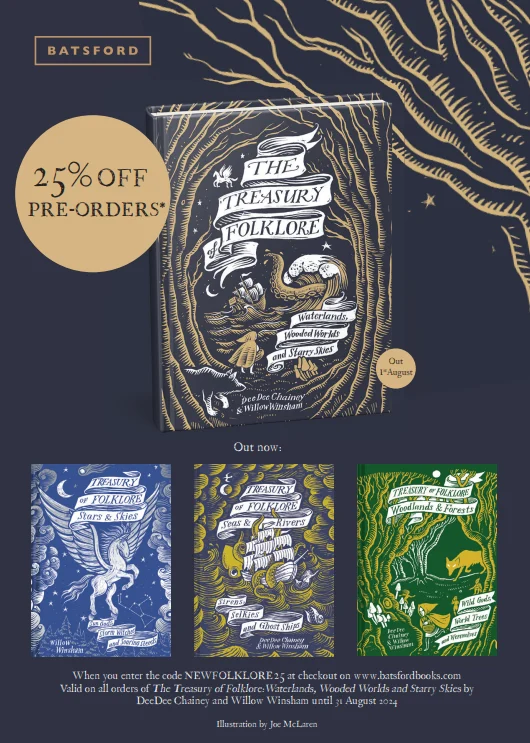
LONDON, UK – [Date of publication, e.g., July 25, 2024] – A decade-long journey into the heart of global human storytelling culminates this August with the release of The Treasury of Folklore: Waterlands, Wooded Worlds and Starry Skies. This monumental compendium, published by Batsford Books, brings together the most cherished tales, beliefs, and customs from the acclaimed Treasury of Folklore series into a single, beautifully bound volume. Authors Dee Dee Chainey and Willow Winsham, known for their insightful explorations of human connection to landscape, have curated a "hefty tome" that promises to be a cornerstone for enthusiasts and newcomers alike.
The new compilation, which is available for pre-order now and officially launches on August 1st, 2024, is more than just a collection; it represents the original, ambitious vision of its creators. From the primal fears lurking in moonlit forests to the universal awe inspired by the cosmos, the book serves as a testament to the shared human experience woven into the fabric of folklore across continents and cultures. Featuring the evocative original illustrations by Joe McLaren, this volume is designed not only as a comprehensive literary resource but also as an exquisite object d’art for any bookshelf or coffee table.
Main Facts: A Decade’s Journey Culminates in a Singular Vision
The eagerly anticipated release of The Treasury of Folklore: Waterlands, Wooded Worlds and Starry Skies marks a significant milestone for the celebrated folklore series. This definitive compendium gathers the most captivating narratives and profound insights from the three original volumes—Seas and Rivers, Trees and Woodlands, and Stars and Skies—into one comprehensive edition. The book’s title itself elegantly encapsulates the diverse physical landscapes it explores, from the shimmering depths of oceans and rivers to the whispering canopies of ancient forests, and finally, to the boundless expanse of the night sky.
Authored by Dee Dee Chainey and Willow Winsham, whose dedication to unearthing and contextualizing global folklore has garnered widespread acclaim, the compilation is a direct response to their initial, grander vision for the series. Conceived originally as a single volume encompassing all types of human-inhabited landscapes, the sheer abundance of material necessitated its initial division into three distinct books. Now, nearly ten years after the inception of their project, the authors have meticulously revisited their extensive work, weaving together their favourite selections into a seamless, interconnected narrative.
Readers can expect a meticulously curated selection of tales and traditions that explore humanity’s deep-seated relationship with the natural world. While the compendium contains no entirely new material, it offers a refreshed perspective on existing texts, thoughtfully arranged to highlight the universal themes that resonate across diverse cultures. The physical presentation of the book is also a point of pride for the authors, with its robust binding, elegant cover art that visually integrates the three original themes, and the choice of beautiful cream paper enhancing its tactile and visual appeal. This attention to detail reinforces its status as a collector’s item and a conversation starter, designed to connect readers with the timeless wisdom and wonder of folklore.
Chronology: From Digital Inspiration to Literary Legacy
The Inception of a Series and a Universal Quest
The journey of The Treasury of Folklore began nearly a decade ago, sparked by a potent wellspring of public enthusiasm for cultural heritage: the vibrant #FolkloreThursday hashtag. This online phenomenon, which saw an "overwhelming outpouring of folklore" from around the globe, served as a profound inspiration for Dee Dee Chainey and Willow Winsham. Witnessing this digital tapestry of shared human experience, the authors felt a compelling urge to translate this collective interest into a lasting, tangible form. Their initial vision was ambitious: to create a single, encyclopaedic book that would encompass the vast array of folklore associated with every physical landscape humans inhabit.
However, as their research deepened and the material began to accumulate, it quickly became apparent that the richness and sheer volume of global folklore far surpassed the capacity of a single tome. This led to the strategic decision to segment their explorations into three distinct, yet interconnected, volumes. The resultant books, Seas and Rivers, Trees and Woodlands, and Stars and Skies, each focused on a specific environmental domain, allowing for a detailed and immersive dive into the beliefs and stories shaped by these distinct settings. This initial trilogy not only captivated readers but also established the authors as authoritative voices in popular folklore studies.
The Journey of Universal Themes: Unearthing Shared Humanity
At the core of the Treasury of Folklore series was an earnest quest for understanding. Chainey and Winsham embarked on their literary expedition with a fundamental question: how do humans across the globe construct customs, beliefs, and narratives around the specific places they call home? This inquiry drove their exploration, leading them through an astonishing diversity of cultural expressions – from the intricate rituals of isolated communities to the grand myths of ancient civilisations.

What they unearthed, however, transcended mere cultural variation. The authors discovered a profound truth: despite superficial differences in language, dress, or the names given to mythical creatures, humanity is "inherently the same." This realisation became the philosophical bedrock of their work. They found that fundamental human experiences – "primal fears and dreams" – are universally shared. Whether gazing at a vast ocean, dreading the unknown around a campfire in a dark forest, or contemplating the brevity of life under the glimmer of ancient stars, humans exhibit a consistent longing for discovery, a shared apprehension of the mysterious, and a universal sense of awe at the enormity of existence. This unifying thread, the recognition of common emotional and spiritual responses to the world, became the beating heart of the series.
The Genesis of the Compendium: Fulfilling an Original Dream
The success and heartwarming reception of the initial three books solidified their place in the literary landscape. It was against this backdrop of popular acclaim that the idea of a compendium was first mooted. For the authors, this suggestion was not merely an opportunity for a new publication, but a chance to finally realise their foundational ambition. The concept of bringing all the folklore together in one volume, as originally envisaged, resonated deeply with their decade-old dream.
The process of creating this compilation was, as described by the authors, an intensive "behind the scenes" endeavour. It involved revisiting countless pages of text they already knew intimately, but now approaching them "with fresh eyes." The challenge lay in meticulously curating and editing the material, making difficult decisions about "what to include and what to leave out" to ensure a cohesive and compelling single volume. The goal was to weave together the narratives in a way that truly spanned "our shared landscapes across time and place," demonstrating the interconnectedness of human belief systems. The result of this painstaking work has, by the authors’ own admission, "blown them away," leaving them "utterly thrilled" to share this physical manifestation of their complete vision with the world.
Supporting Data: The Enduring Resonance of Universal Narratives
The Enduring Power and Unifying Universality of Folklore
Folklore, far from being a relic of the past, remains a vital and dynamic force in contemporary society. Its "unifying universality" is precisely what The Treasury of Folklore series so powerfully articulates. These ancient stories, beliefs, and customs serve as cultural touchstones, transmitting values, explaining the inexplicable, and providing a framework for understanding the human condition. They tap into a collective unconscious, reflecting our deepest anxieties, our greatest hopes, and our perennial curiosity about the world around us.
The #FolkloreThursday hashtag, which initially inspired the authors, exemplifies this enduring appeal. It demonstrated a global hunger for connection through shared narratives, illustrating how stories of mythical beasts, wise spirits, or celestial phenomena transcend geographical and linguistic barriers. In an increasingly interconnected yet often fragmented world, folklore offers a powerful means of discovering common ground, reminding us that beneath the veneer of cultural differences, we share fundamental experiences and interpretations of existence. The continued popularity of fantasy literature, film, and gaming, often drawing heavily on folkloric archetypes, further underscores this timeless human need for myth and magic.
A Deeper Dive: Featured Folklore Excerpts and Their Significance
The compendium offers a rich tapestry of tales, exemplified by the three extracts provided, each highlighting different facets of human interaction with the natural world and the supernatural.
Water Horses: The Perilous Beauty of the Depths
The folklore of water horses, such as the Scottish kelpie, Welsh Ceffyl Dwr, and Scandinavian bäckahäst, speaks volumes about humanity’s complex relationship with water—a source of life, but also immense danger. These creatures embody the seductive yet treacherous nature of rivers, lakes, and lochs. Psychologically, they represent the fear of the unknown in deep, murky waters, serving as cautionary tales, particularly for children, against venturing too close to the unpredictable elements. The horse, a symbol of power, wildness, and transport, here becomes a vessel of deception, luring the unwary to their watery doom.
While often conflated, the nuances between these entities are crucial. The Scottish kelpie, typically found in rivers, and the each-uisge of lochs, both lure victims with their majestic appearance before dragging them beneath the surface. Yet, tales also offer glimmers of hope: a bridle marked with a cross might offer temporary control, and red-hot iron could be a fatal weakness. The Welsh Ceffyl Dwr, a shapeshifting spirit, particularly in the north, or a consistently enchanting small horse in the south, highlights regional variations in fear and fascination. Its extraordinary speed and selective kindness towards clergymen add further layers to its mystique. The Scandinavian bäckahäst, often appearing in fog, is depicted as luminous and majestic, frequently targeting children, perhaps to amplify the sense of tragedy. The detail of a child’s mispronunciation of "Jesus Christ" saving others from the bäckahäst reveals a common folkloric vulnerability to sacred names. The enduring presence of the Kelpies sculptures near Falkirk and their appearance in modern literature like J.K. Rowling’s Fantastic Beasts underscore the lasting hold these ancient legends have on the contemporary imagination.

Lords of the Wild: Guardians and Tricksters of the Verdant Realm
The "Lords of the Wild" – figures like the Finnish Tapio and the Slavic leshy – represent humanity’s attempt to personify and negotiate with the untamed forces of the forest. These deities and spirits embody a duality: they are both fierce protectors of nature and potentially malevolent forces for humans who disrespect their domain. They reflect a deep-seated reverence for the wilderness, acknowledging its power to sustain life and to claim it.
Tapio, the Finnish king of the forest realm, is a prime example of a nature deity intricately linked with human activity, particularly hunting. His appearance—tall, thin, cloaked in ermine or moss, with a gnarled tree-like back—emphasizes his intrinsic connection to the forest itself. His role as both personification and protector meant that hunters historically sought his blessing, pledging respect for the woods and its creatures. This belief system instilled an environmental ethic, advocating for quiet, mindful hunting and a deep appreciation for ecological balance. His family, including Mielikki (his benevolent wife) and children Nyrikki and Tulikki, further illustrates a comprehensive spiritual framework for interacting with the forest.
The Slavic leshy, or tutelary spirit of the woods, presents a more complex, often trickster-like figure. Its shapeshifting abilities, ranging from tree-tall giants to blades of grass, and its capacity to mimic sounds, underscore the forest’s bewildering nature. Leshies embody the dangers of getting lost, of being misled by deceptive appearances or voices. Their distinguishing features—lack of eyelashes, shoes on the wrong feet, clothing worn backward—are common folkloric motifs for identifying supernatural beings. The leshy’s spectrum of behaviour, from protecting wolves to inflicting illness, abducting women, and even gambling, paints a picture of a powerful, capricious entity. Tales of farmers sacrificing cows to appease leshies or individuals using specific rituals (turning clothes inside out, swearing, or making the sign of the cross) to ward them off highlight the practical, fear-based interactions people had with these spirits. The detailed summoning ritual, involving young birch trees and the renunciation of Christian symbols, speaks to a sophisticated, albeit dangerous, understanding of engaging with the pagan wilderness.
The Hare in the Moon: Celestial Narratives of Sacrifice and Fate
The motif of a rabbit or hare residing on the moon is a remarkably widespread belief, found across diverse cultures and continents. This celestial imagery, often visible in the moon’s surface markings (like the Sea of Tranquillity forming the hare’s head), sparks universal wonder and fuels myriad tales explaining its presence. These stories frequently explore themes of sacrifice, compassion, and the consequences of actions, reflecting humanity’s contemplation of morality and destiny through observing the heavens.
Buddhist traditions, as seen in the Sasa-jātaka, present the hare as a symbol of selfless generosity. In this narrative, the hare, having nothing else to offer a disguised deity, offers its own life, leaping into a fire. This act of ultimate self-sacrifice is rewarded by its immortalization on the moon, serving as a powerful lesson in altruism and compassion, central to Buddhist principles. Similar tales echo in Sri Lanka and Japan (where it’s known as Tsuki no Usagi), reinforcing the universal appeal of this moral fable. The Japanese tradition of telling this story during the Harvest Moon and Mid-Autumn Festival highlights its cultural significance and its role in celebrating gratitude and abundance.
In stark contrast, the South African tale of the hare in the moon offers a darker, more anthropomorphic explanation for human mortality and the moon’s scarred appearance. Here, the hare acts as a trickster figure, miscommunicating a divine message of cyclical life and death, thereby condemning humankind to definitive mortality. The moon’s furious retaliation, scarring the hare’s lip, and the hare’s subsequent lashing out, scarring the moon, provides an origin story for both physical features and the enduring human predicament. This narrative delves into themes of responsibility, consequence, and the inherent flaws of messenger figures.
The Art of Joe McLaren: A Visual Journey Through Folklore
Integral to the aesthetic and narrative appeal of The Treasury of Folklore series and its new compendium are the striking illustrations by Joe McLaren. McLaren’s distinctive black-and-white engravings possess a timeless quality, perfectly complementing the ancient and evocative nature of the folklore. His intricate lines, dramatic shading, and atmospheric compositions do more than merely depict scenes; they imbue the text with a profound sense of mystery, wonder, and sometimes, unease. Whether it’s the menacing rise of a kelpie from turbulent waters, the enigmatic presence of a leshy in a shadowy forest, or the serene silhouette of the hare on the moon, McLaren’s art transports the reader directly into the heart of these legendary worlds. These visuals are not just embellishments; they are essential companions to the text, enriching the reading experience and allowing the folklore to truly come alive in the reader’s imagination.
Official Responses: Authors’ Gratitude and the Series’ Impact
The Authors’ Deep Satisfaction and Gratitude
Dee Dee Chainey and Willow Winsham have expressed profound satisfaction with the realisation of The Treasury of Folklore: Waterlands, Wooded Worlds and Starry Skies. "To say we have been blown away by the end result is an understatement," they stated, highlighting their immense pride in the beautifully bound volume. This compendium represents the culmination of years of dedicated research and writing, a project born from a shared passion for global storytelling. Their sentiment of being "utterly thrilled to be able to share this beautifully bound volume with you" conveys not just professional pride but a deep personal connection to the work.

The authors have also extended heartfelt gratitude to their readership. "The popularity of the three books in the Treasury of Folklore series… has been both surprising and heartwarming," they remarked, acknowledging "each and every person who has bought and read these books." This appreciation underscores the collaborative nature of literary success, recognizing that the resonance of their work is amplified by its reception within the community.
Publisher’s Endorsement and Community Engagement
While specific official statements from Batsford Books were not provided, the decision to publish such a substantial compendium speaks volumes about the publisher’s confidence in the series and its commercial viability. The commitment to producing a high-quality physical product—a "hefty tome" with beautiful cream paper and distinctive binding—suggests a recognition of the series’ lasting value and its appeal to discerning readers and collectors.
The enduring influence of the #FolkloreThursday community also represents a powerful "official response" from the broader public. This digital movement, which continues to thrive, acts as a perpetual echo chamber for the themes and narratives explored in the Treasury of Folklore. The continuous engagement and enthusiasm from this global community provide tangible evidence of the profound impact the authors’ work has had in popularizing and celebrating folklore in the modern era.
Implications: Preserving Heritage and Fostering Global Connection
Cultural Significance and Cross-Cultural Understanding
The release of The Treasury of Folklore: Waterlands, Wooded Worlds and Starry Skies holds significant cultural implications. In an era where traditional narratives can be overshadowed by contemporary media, this compendium plays a crucial role in preserving and re-presenting oral traditions and ancient beliefs. By consolidating tales from diverse landscapes, it fosters a deeper appreciation for the world’s rich cultural heritage, ensuring these stories continue to be told and understood by new generations.
More importantly, the book serves as a powerful tool for cross-cultural understanding. By highlighting the "unifying universality" of human fears, dreams, and awe, it transcends superficial differences and underscores our shared humanity. As a "conversation starter" and "a way to connect," it encourages dialogue about different cultural perspectives while simultaneously revealing the common threads that bind us all. It reminds us that empathy and mutual respect can be cultivated through the exploration of shared mythological landscapes.
Educational Value and Legacy
For educators, researchers, and students, the compendium offers an invaluable resource. Its structured approach to categorizing folklore by landscape provides a unique framework for studying comparative mythology, anthropology, and literary studies. It serves as an accessible yet comprehensive introduction to complex belief systems, making the vast field of folklore approachable for a general audience without sacrificing scholarly integrity. The inclusion of Joe McLaren’s evocative illustrations further enhances its educational appeal, offering visual entry points into these ancient narratives.
The Treasury of Folklore series, now solidified by this definitive compendium, establishes a lasting legacy in the realm of popular folklore studies. It demonstrates a growing public appetite for meaningful content that connects us to our past and to each other. The success of this series may well encourage further publishing ventures in the field, indicating a sustained interest in exploring and celebrating the enduring power of human storytelling. As a singular volume, it is poised to become a quintessential reference, a cherished possession, and a testament to the profound and timeless influence of folklore on the human spirit.
The Treasury of Folklore: Waterlands, Wooded Worlds and Starry Skies is available for pre-order now and will be officially released on August 1st, 2024. For a limited time, readers can receive 25% off when ordering directly from Batsford Books using the code NEWFOLKLORE25.