
Reassessing the Roots of Revival: A Critical Look at Alain de Benoist’s "On Being a Pagan"
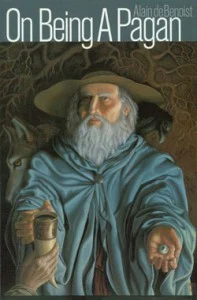
Paris, France – In a landscape increasingly characterized by spiritual searching and a reevaluation of foundational Western thought, the multidisciplinary French thinker Alain de Benoist offers a provocative challenge to conventional worldviews. His seminal work, On Being a Pagan, originally published in French as Vu de droite: Anthologie critique des idées contemporaines (1977) and translated into English in 2018, presents a radical critique of the Judeo-Christian paradigm and its modern secular offshoots, while simultaneously articulating a vision for a "new paganism" rooted in historical European traditions. This ambitious project, however, has not been without its critics, who commend its incisive observations while questioning the underlying philosophical framework.
The book, which has gained significant traction in circles interested in ancient spiritualities and critiques of modernity, invites readers to contemplate the theological underpinnings of paganism, polytheism, and animism. While lauded for its eloquent dismantling of certain monotheistic tenets, a deeper analysis reveals a complex philosophical tapestry that, for some, ultimately veers into a human-centric subjectivism that paradoxically echoes the very dualisms it seeks to overcome.
Main Facts: Unpacking Benoist’s Vision and Its Discontents
Alain de Benoist, a prominent figure often associated with the Nouvelle Droite intellectual movement in France, approaches the concept of paganism not merely as a historical curiosity but as a viable, indeed necessary, alternative to the prevailing Western ethos. In On Being a Pagan, he meticulously deconstructs what he perceives as the inherent flaws of the Judeo-Christian worldview, extending his critique beyond religious dogma to encompass its secular manifestations in liberalism, human rights discourse, and progressivism. His central argument posits that these modern ideologies are merely secularized versions of monotheistic dualisms, perpetuating a division between the sacred and profane, good and evil, spirit and matter.
Benoist advocates for a "new paganism" that draws inspiration from the pluralistic, immanent, and non-dualistic characteristics he identifies in ancient European paganism. He champions a return to a "mythological" understanding of the past, one that seeks enduring values and archetypes rather than a literal, chronological recreation of bygone eras. This perspective is celebrated by many as a sophisticated re-engagement with ancestral spiritualities, moving beyond superficial revivals.
However, the reviewer of On Being a Pagan on Norse-Mythology.org highlights a profound divergence in Benoist’s proposed philosophical foundation. While appreciating his critiques of monotheism, the reviewer contends that Benoist ultimately replaces one form of dualism with another, promoting a brand of humanism where "man is the law of the world and the measure of all things." This, the critique argues, reduces divinity to human creation and subjective caprice, thereby stripping paganism of its inherent numinous and trans-human dimensions. The reviewer ultimately characterizes Benoist’s offering, despite its intellectual merits, as another "puerile form" of paganism, albeit a sophisticated one, due to its dismissal of genuine spiritual experience and its anthropocentric bias.
Chronology: The Intellectual Context of a Pagan Revival
Alain de Benoist’s On Being a Pagan emerged from a rich and complex intellectual milieu, reflecting decades of philosophical inquiry and a broader cultural shift towards questioning dominant Western narratives. The book’s French origins in the late 1970s place it within a period marked by post-structuralist critiques of Enlightenment rationality and a growing disillusionment with both capitalist and communist ideologies. Benoist himself had been a key figure in the formation of the Groupement de recherche et d’études pour la civilisation européenne (GRECE), an influential think tank of the European New Right, which sought to redefine European identity and culture through a rejection of Americanization, egalitarianism, and what they perceived as the deleterious effects of Judeo-Christian universalism.
The concept of a "pagan revival" or "neo-paganism" has its own historical trajectory, predating Benoist’s work by centuries. From the Renaissance humanists rediscovering classical antiquity to the Romantic movements idealizing nature and ancient mythologies, there has been a recurring fascination with pre-Christian spiritualities. The late 19th and early 20th centuries saw the emergence of occult revivals and the formalization of movements like Theosophy and various esoteric societies that drew heavily on pagan imagery and philosophy. By the mid-20th century, particularly in the aftermath of two world wars and amidst the counter-cultural movements of the 1960s, a more explicit and diverse array of modern pagan religions began to take shape, including Wicca, Heathenry, Druidry, and various Goddess traditions.
Benoist’s contribution can be understood as an attempt to provide a robust philosophical and theological framework for such a revival, moving beyond eclectic syncretism or purely folkloric interest. His work consciously positions itself in a lineage of thinkers who have critiqued the Judeo-Christian legacy, notably Friedrich Nietzsche, whose influence on Benoist is profound and explicitly acknowledged. Nietzsche’s "death of God" proclamation and his call for a "revaluation of all values" resonate deeply with Benoist’s project, providing a philosophical foundation for discarding monotheistic morality and embracing a more vital, pluralistic, and immanent spirituality.
The translation of On Being a Pagan into English, decades after its initial publication, reflects a continued and perhaps intensified global interest in these themes. In an era grappling with ecological crises, identity politics, and a perceived decline in traditional religious adherence, Benoist’s arguments for a spirituality rooted in immanence, polytheism, and a non-dualistic relationship with the world find a receptive audience among those seeking alternatives to perceived spiritual and philosophical dead ends. This chronological context underscores that On Being a Pagan is not an isolated academic exercise but a significant intervention in an ongoing, centuries-old dialogue about the spiritual destiny of Western civilization.
Supporting Data: Deep Dive into Benoist’s Arguments and Their Refutations
Benoist’s central thesis hinges on a powerful critique of monotheistic dualism. He argues that the Judeo-Christian worldview fundamentally divides existence into incommensurable halves: God (uncreated being) versus the world (created being), good versus evil, sacred versus profane, spirit versus matter, and ultimately, man versus nature. This dualism, he contends, fosters an adversarial relationship with the world, leading to a relentless pursuit of domination and a moralistic judgment of difference.
In stark contrast, Benoist posits that historical European paganism embraced a non-dualistic reality. He eloquently states, "in ancient Europe the sacred was not conceived as opposed to the profane but rather encompassed the profane and gave it meaning," and that "[t]he divine is immanent in and consubstantial with the world." This immanence, where divinity permeates all existence, forms the bedrock of a pluralistic theology. This pluralism, expressed as "an antagonistic pluralism of values," leads to an attitude of tolerance and a rejection of absolute moralism, echoing Nietzsche’s "beyond good and evil."
Benoist extends this analysis to the treatment of enemies. In monotheistic frameworks, he argues, an enemy can be cast as the embodiment of absolute evil, justifying conversion or extermination. Paganism, with its multiplicity of norms, views conflict as a dispute of personal interests. An adversary is seen as a specific individual or group, whose cessation of hostility resolves the conflict, allowing them to resume their life. This perspective, where an enemy can even be "honored as a worthy adversary," is a recurring theme in ancient European heroic literature, reflecting a nuanced understanding of power and conflict. Furthermore, Benoist critiques the biblical notion that power is inherently evil, asserting that freedom and justice are not given but must be won, requiring agency and strength, not weakness for weakness’ sake.
However, the reviewer meticulously dissects the core weakness of Benoist’s framework: its pervasive humanism and subjectivism. Benoist frequently asserts that "man is the law of the world and the measure of all things," that "man… founds and creates the world by the meaning he gives to things," and critically, that "Gods are made in the image of men, for whom they offer a sublimated re-presentation." Most damningly, he suggests "there is no need to ‘believe’ in Jupiter or Wotan… gods and beliefs may pass away, but the values remain."
This anthropocentric stance, the reviewer argues, ultimately undermines Benoist’s own critique of dualism. While acknowledging a "pinch of truth" in the Nietzschean idea of perspectivism – that humans have some creative agency in shaping reality – the reviewer contends that Benoist pushes this to a "simplistic and crude subjectivism." This creates a new, ironic dualism: that between the human subject (the "uncreated being" of meaning-making) and the objective world (now merely a canvas for human projection). Drawing on the French phenomenologist Maurice Merleau-Ponty, the reviewer emphasizes the "intertwining between perceiver and perceived," asserting that any statement about gods or animals originates as much from them as from humans. Humans, in this view, are not sole creators but "co-creators" in the world’s continuous unfolding.
The reduction of divinity to mere human values is seen as particularly problematic. If "the sacred – that which cannot be questioned or debated – is ‘immanent in and consubstantial with the world,’" as Benoist himself states, then to claim it is only "immanent in and consubstantial with" human caprices contradicts the very essence of historical European paganism. It profanes the sacred, making it subject to human debate and rendering it superfluous. This, the reviewer contends, merely reintroduces a stale monotheistic dualism, with humanity usurping the role of the ultimate "uncreated being," and divinity relegated to a "created being" category – a reversal rather than a transcendence of the problem.
Finally, Benoist is criticized for establishing a false "nature" versus "culture" dichotomy, which the reviewer labels "quintessentially Christian." By equating the nonhuman world (animals, plants, mountains) with a biologically deterministic "nature," separate from human "culture," Benoist mirrors the very dualism he decries. Historical paganism, in contrast, saw no such rigid rift; mutable aspects existed in "nature" (e.g., shapeshifting) just as immutable, inherited elements existed in "culture." The nonhuman world possessed its own forms of "culture," and humanity its "nature." Benoist’s assertion that his pagan "does not deify [the world]… but makes it a place where the deity can emerge" is seen as further evidence of this subjectivism, placing the emergence of divinity solely within human perception rather than as an inherent quality of the cosmos.
Official Responses: Reception and Broader Intellectual Engagement
While a direct "official response" to this specific review is unlikely, On Being a Pagan has generated considerable discussion and varied reception within both academic circles and the broader contemporary pagan community. Benoist’s work is generally acknowledged for its intellectual rigor and its comprehensive critique of monotheistic thought. Scholars of religion and philosophy often cite his analysis of dualism and his historical insights into pre-Christian European worldviews as valuable contributions to the field. His ability to articulate complex philosophical arguments, drawing on figures like Nietzsche, Heidegger, and Schmitt, has earned him a reputation as a serious intellectual.
However, the very humanism that the Norse-Mythology.org reviewer highlights has been a point of contention for many contemporary pagans and polytheists. For those who experience the divine as an objective, numinous reality independent of human perception, Benoist’s assertion that "Gods are made in the image of men" and that "values remain" while "gods and beliefs may pass away" often rings hollow or even dismissive. Many practitioners of modern paganism are drawn to these traditions precisely for a direct, experiential connection to deities, spirits, and the sacredness of nature – experiences that transcend purely intellectual frameworks.
The critique of Benoist’s admitted lack of personal mystical experience — stating, "I have not personally had any experience of the divine (I am the opposite of a mystic)… the interest I bring to belief systems is of a purely intellectual order" — resonates with a significant segment of the pagan community. For many, spiritual experience is not merely an intellectual exercise but a profound, transformative engagement with the world. To write a theological treatise from a purely intellectual standpoint, while valuable in some academic contexts, is seen by some as akin to discussing the taste of food without ever having eaten. This perspective underscores a fundamental tension within contemporary paganism between academic, philosophical reconstruction and lived, spiritual practice.
Furthermore, Benoist’s association with the Nouvelle Droite has led to cautious engagement from some quarters, particularly those concerned with the political implications of identity-based spiritualities. While On Being a Pagan itself focuses on philosophical and theological arguments, the broader context of Benoist’s intellectual output prompts some to scrutinize his arguments for any underlying ideological tendencies that might contradict the inclusive and pluralistic ethos embraced by many contemporary pagan movements. This necessitates a careful parsing of his philosophical contributions from any potential political appropriations or interpretations.
In essence, On Being a Pagan serves as a crucial intellectual touchstone, prompting both admiration for its analytical depth and robust debate regarding the ultimate nature of divinity and humanity’s place within a "new pagan" cosmology. It forces practitioners and scholars alike to confront fundamental questions about the balance between intellectual reconstruction and lived spiritual experience in the modern revival of ancient traditions.
Implications: The Enduring Debate for Modern Paganism and Beyond
The ongoing critical engagement with Alain de Benoist’s On Being a Pagan carries significant implications for the trajectory of contemporary paganism, intellectual discourse, and our understanding of the relationship between humanity and the divine.
For modern paganism and polytheism, the debate surrounding Benoist’s work highlights a critical internal tension. On one hand, his rigorous critique of monotheistic dualism provides valuable intellectual ammunition for those seeking to articulate a coherent, non-Abrahamic worldview. His insights into the nature of pluralism, the immanence of the sacred, and the nuanced understanding of conflict in ancient traditions offer a sophisticated framework for understanding and defending pagan ethos. Such intellectual depth is vital for movements seeking to establish themselves as serious spiritual paths rather than mere counter-cultural fads.
On the other hand, the reviewer’s critique exposes a potential pitfall: the risk of reducing paganism to a mere intellectual exercise, a sophisticated humanism adorned with pagan aesthetics. If the gods are merely human constructs, if the sacred is only what humanity projects onto the world, then the unique power and transcendence often sought in pagan spiritualities are diminished. This raises a fundamental question for practitioners: can a truly meaningful and transformative paganism exist without a belief in an objective, numinous reality that transcends human subjectivity? The implication is that a "new paganism" that dismisses or devalues genuine spiritual experience, the inherent divinity of nature, and the agency of non-human entities, risks becoming a superficial, anthropocentric philosophy that ultimately fails to address the "primary and primal philosophical questions" it purports to answer.
For broader intellectual discourse, Benoist’s work and its critiques contribute to the ongoing conversation about the legacies of monotheism in Western thought. His argument that secular modernity still operates under the shadow of Judeo-Christian dualisms is a powerful one, prompting further examination of how concepts like progress, universal human rights, and the separation of man from nature are deeply embedded in this historical lineage. The debate over his proposed solutions, however, underscores the difficulty of truly transcending these frameworks without falling into new, equally problematic reductions.
The nature of truth and interpretation is also implicitly addressed. The reviewer’s invocation of Nietzschean perspectivism, contrasted with Benoist’s "crude subjectivism," points to the delicate balance between acknowledging human agency in shaping reality and maintaining a reverence for an objective world that exists independently of human will. This is crucial for any spiritual path that seeks to engage with the world as it is, rather than as a mere reflection of human desires.
Ultimately, the implications of On Being a Pagan and its critical reception lie in their capacity to stimulate deeper self-reflection within contemporary pagan movements and to provoke a more nuanced understanding of humanity’s place in the cosmos. It challenges adherents to articulate a paganism that is both intellectually robust and spiritually profound, one that can genuinely transcend the dualisms of the past without succumbing to the limitations of an exclusively human-centered future. The search for a spiritual path that honours "the intersection between the numinous and the flesh – all the flesh that comprises this outrageously greater-than-human world" remains an urgent and vital quest, one that requires continuous critical engagement with thinkers like Alain de Benoist, even as we evaluate the depths of their proposed solutions.



Leave a Comment