"The Treasury of Folklore" Unveils Definitive Compendium: A Journey Through Humanity’s Shared Myths
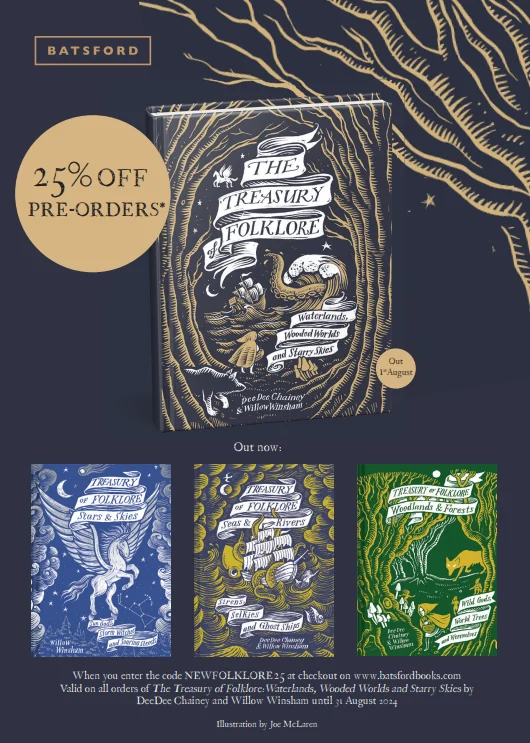
London, UK – July 25, 2024 – Nearly a decade after its inception, the celebrated "Treasury of Folklore" series is poised to release its most ambitious volume yet: a comprehensive compendium titled The Treasury of Folklore: Waterlands, Wooded Worlds and Starry Skies. This single, beautifully bound edition brings together the most cherished tales, customs, and beliefs previously explored across three individual books, fulfilling the authors’ original vision of a unified exploration of global human experience through the lens of folklore.
Scheduled for release on August 1st, 2024, the "hefty tome" promises to be a captivating journey through the myths and legends woven around the elemental landscapes of our world. Featuring extracts from Seas and Rivers, Trees and Woodlands, and Stars and Skies, the compendium reaffirms the universal threads connecting humanity’s primal fears, profound dreams, and enduring wonder. While containing no new material, this curated collection, enhanced by Joe McLaren’s distinctive original illustrations, offers an unparalleled opportunity for readers to delve into the collective human imagination.
The Genesis of a Grand Vision: From Hashtag to Global Series
The "Treasury of Folklore" series began its remarkable journey with an ambition grander than its initial manifestation. The authors, inspired by the overwhelming global engagement with the #FolkloreThursday hashtag – a vibrant online community dedicated to sharing and celebrating traditional tales – first conceived of a single, encompassing volume. This envisioned book would traverse the diverse physical landscapes inhabited by humankind, uncovering the rich tapestry of customs, beliefs, and narratives that define our relationship with the world around us.
However, the sheer volume and depth of material unearthed proved too vast for a singular publication. This wealth of discovery led to the strategic decision to segment the series into three thematic volumes, each dedicated to a fundamental aspect of the natural world: the mysteries of aquatic environments, the ancient wisdom of forests, and the celestial wonders above. Seas and Rivers, Trees and Woodlands, and Stars and Skies were born, each a testament to humanity’s intricate relationship with its surroundings.
The series quickly garnered widespread acclaim, captivating readers with its insightful exploration of how people across the globe construct meaning from their environments. The popularity of these initial three books was not only surprising but deeply heartwarming for the authors, Dee Dee Chainey and Willow Winsham, who expressed profound gratitude to every reader who embraced their work. The success underscored a profound truth they had set out to explore: despite geographical and cultural differences, humans share fundamental fears and aspirations. Whether gazing across a vast ocean, huddling around a campfire in a darkened forest, or contemplating the cosmos under ancient stars, the core human experience of wonder, dread, and longing remains constant, merely expressed through diverse mythologies and narratives.
The Compendium: A Return to the Original Dream
The idea of a compendium emerged as a natural evolution of the series’ success. This presented a unique opportunity to revisit and actualize the original vision of a single, comprehensive volume. The behind-the-scenes work involved a meticulous process of re-reading and re-evaluating the already familiar texts with fresh eyes. The challenge lay in judiciously selecting what to include and what to omit, ensuring that the essence and breadth of the series were distilled into a cohesive narrative that effectively spanned shared landscapes across both time and place.
The authors have articulated their sheer delight with the final product, describing themselves as "utterly thrilled" by the result. The compendium is lauded for its physical attributes: its substantial size, a cover that seamlessly integrates the themes of the original books, and the tactile pleasure of its beautiful cream paper. It is, by all accounts, a "hefty tome" designed to be both a substantial literary work and a visually appealing artifact for any bookshelf or coffee table.
Crucially, the authors wish to manage expectations regarding the content. The compendium is a direct compilation, featuring text taken verbatim from the existing three books. It does not introduce new material. Its value lies in its curated presentation and the convenience of having these rich narratives assembled in one definitive volume. The "Treasury" is structured into three distinct sections, mirroring the original themes of water, woodland, and sky, and is generously illustrated throughout with Joe McLaren’s evocative artwork, which has become a hallmark of the series.

Supporting Data: Unpacking Universal Archetypes
The extracts provided offer a tantalizing glimpse into the diverse yet interconnected world of folklore captured within the compendium. These examples underscore the series’ central thesis: that common human experiences manifest in unique, culturally specific narratives, yet reveal profound universal truths.
Water Horses: Echoes of Peril and Power
The compendium delves into the chilling lore of water horses, malevolent equine spirits that haunt the lakes and waterways of various cultures. These tales, whether viewed as literal beliefs or cautionary fables, speak to humanity’s deep-seated awe and fear of the untamed power of water.
The Scottish kelpie and each-uisge are prominent figures, often confused but distinct in their habitats (rivers vs. lochs). Kelpies are infamous for luring unwary travelers to watery graves, though some narratives suggest a fleeting possibility of taming them, usually with a cross-marked bridle. Such control, however, is invariably temporary, with the creature ultimately returning to its depths, often dragging its rider along. The rare possibility of a kelpie’s demise, as recounted with red-hot iron, highlights the human desire to master the uncontrollable. The enduring presence of kelpie lore is vividly demonstrated by the colossal 30-meter sculptures near Falkirk, a modern tribute to an ancient legend, and its appearances in contemporary literature by authors like Lari Don and J.K. Rowling. Interestingly, English folklore notably lacks such aquatic steeds, suggesting a geographical specificity to this particular fear.
Across the border, Welsh folklore presents the Ceffyl Dwr, a shapeshifting water spirit prevalent into the 19th century. In northern Wales, it could assume various forms, often violent, while in the south, it consistently appeared as an enchanting, small horse. These creatures were renowned for their impossible speed, covering vast distances before vanishing, leaving riders to drown. A curious exception to their malevolence was their treatment of clergymen of any creed, who could ride them unscathed – a fascinating detail reflecting societal respect for spiritual authority.
Scandinavian folklore offers the bäckahäst, or "brook horse," a luminous and majestic being often sighted in fog. Like its Scottish and Welsh counterparts, it entices riders, particularly children (perhaps to heighten the sense of tragic peril), only to plunge into the water, trapping its victims. Tales often feature narrow escapes, such as a group of boys saved when one mispronounces a rhyme, invoking the name of Christ, which the bäckahäst despises. Similar to the kelpie, the bäckahäst could also be put to work if tricked, showcasing a common theme of human cunning against supernatural power.
These tales collectively serve as powerful allegories for the dangers inherent in natural landscapes, particularly water. They reflect a primal human need to understand and personify the unpredictable forces of nature, providing both warnings and explanations for unexplained disappearances or misfortunes.
Lords of the Wild: Guardians and Tricksters of the Forest
Venturing into the "verdant greenery of the forest," the compendium introduces readers to the "Lords of the Wild," a diverse array of spirits and creatures that embody the dual nature of wilderness: its protective embrace and its inherent dangers. These figures are anthropomorphic representations of the forest itself, reflecting humanity’s complex relationship with untamed nature.
The Finnish forest god Tapio, also known as Metsähine or Hiisi, stands as a prime example of a benevolent yet demanding guardian. Described as tall and thin, cloaked in ermine or moss, with a mossy beard and tree-like back, Tapio is the personification and protector of the forest. Hunters traditionally sought his blessing, pledging respect for the woods and its creatures, in exchange for a successful hunt. His family, including his benevolent wife Mielikki (or malevolent Kuurikki), and children Nyrikki (who guides hunters) and Tulikki (who directs prey), further humanizes the forest’s spiritual ecosystem. This tradition highlights a deep ecological awareness and respect embedded in ancient cultures, where the well-being of the forest was inextricably linked to human prosperity.

In Slavic folklore, the leshy (or leshii, lyeshy) emerges as a more ambiguous and formidable figure. A tutelary spirit, protector of trees and animals (especially wolves or bears), the leshy hibernates like its favored bear. Known by myriad names, always linking it to the forest, this shapeshifting entity can alter its size and form at will, appearing as anything from a blade of grass to a towering tree, or even a familiar human. However, tell-tale signs betray its disguise: lack of eyelashes or brows, shoes worn on the wrong feet, clothing wrapped backward, or a single eye. Covered in wild hair, often with cloven feet, some even sport wings and a tail.
The leshy’s bellowing can whip up winds, terrifying forest creatures. It is a notorious trickster, confusing those who trespass, luring them off paths with mimicry, and even tickling victims to death. It can cause illness, abduct women for marriage, and snatch children cursed by their parents or found wandering. Farmers in regions like Olonetsky District, Russia, would even sacrifice a cow annually to appease a leshy threatening their herds. Yet, protection is possible: prayers, offerings of bread or tobacco, or common folkloric methods like turning clothes inside out and shoes on the wrong feet can avert its wrath or return one to the right path. Swearing or making the sign of the cross are also said to banish it. For the truly bold, a specific ritual involving cutting and arranging young birch trees in a circle can summon the "grandfather of the forest." Leshies are depicted as solitary or living with their families (lesovikha), prone to battles with their own kind, and even frequenting taverns or gambling with squirrels. These complex narratives reflect a nuanced understanding of the wilderness as a place of both sustenance and unpredictable danger, where respect and adherence to unspoken rules are paramount for survival.
The Hare on the Moon: Celestial Symbolism and Moral Tales
Finally, the compendium turns skyward, exploring the enduring motif of a rabbit or hare residing on the moon, a fascinating example of shared pareidolia and symbolic storytelling across diverse cultures. The dark maria of the moon, such as the Sea of Tranquility, are often interpreted as the creature’s head, with other features forming its ears.
One of the most profound iterations comes from the Buddhist Sasa-Jātaka, where a benevolent hare, along with its friends (otter, jackal, monkey), pledges to give alms on a fast day. When the deity Sakka, disguised as an old man, tests their generosity, the hare, having only grass, offers its own body as sustenance by leaping into a fire. For this ultimate act of faithfulness and self-sacrifice, Sakka spares the hare and immortalizes its image on the moon for all to witness, often by extracting its essence and drawing it onto the lunar surface. This tale profoundly illustrates the Buddhist principle of dana (generosity) and the virtue of selfless compassion.
Similar narratives appear in other traditions. In Sri Lanka, Buddha, lost and hungry, is offered the hare’s body as food, leading to its miraculous placement on the moon. Japan’s Tsuki no Usagi (Moon Rabbit) shares a parallel story, where a rabbit’s self-sacrifice for the Man in the Moon (a disguised beggar) results in its celestial abode. This Japanese tale is particularly popular, often recited to children during the September Harvest Moon and Mid-Autumn Festival, linking lunar cycles with themes of harvest, gratitude, and benevolence.
A contrasting narrative from South Africa offers a darker explanation for the hare’s lunar connection and, more significantly, for human mortality. Here, the Moon dispatches the Hare to inform humanity that, like the Moon’s monthly cycle of fading and returning, so too would humans experience death and rebirth. However, the "flighty creature" misdelivers the message, proclaiming only that humans would die permanently. Enraged by this catastrophic error, the Moon attacks the Hare with a hatchet, scarring its lip, while the retaliating Hare claws the Moon’s face, explaining the dark shapes visible today. This myth not only accounts for the lunar markings but also grapples with the profound mystery of human mortality, placing the blame on a flawed messenger and highlighting the irreversible consequences of miscommunication.
These lunar hare myths, despite their variations, speak to humanity’s innate desire to interpret celestial phenomena, imbue them with meaning, and connect the heavens with earthly morality, sacrifice, and the fundamental questions of life and death.
Official Responses: Authors’ Reflection and Publisher’s Endorsement
Dee Dee Chainey and Willow Winsham, the creative force behind the "Treasury of Folklore," articulated their journey with a blend of humility and profound satisfaction. "When we began writing together nearly a decade ago, we could never have dreamed where it would take us," they reflected, acknowledging the initial spark from the #FolkloreThursday community. Their aim was always to "create something meaningful, lasting, that reflected the unifying universality of folklore across the globe." The compendium, they believe, is the ultimate fulfillment of this ambition.

Regarding the meticulous process of curation, they shared, "Much work went on behind the scenes, reading through the words we already knew so well, with fresh eyes, as we worked out what to include and what to leave out, in the best way to bring it all together in one volume that spans our shared landscapes across time and place." Their enthusiasm for the physical manifestation of the book is palpable: "To say we have been blown away by the end result is an understatement, and we are utterly thrilled to be able to share this beautifully bound volume with you. We love the size and the cover combining everything and the beautiful cream paper: it is a ‘hefty tome’ indeed."
While an explicit statement from the publisher, Batsford Books, was not provided in the original text, the decision to produce such a significant compendium undoubtedly reflects their confidence in the series’ enduring appeal and academic value. The investment in a high-quality physical product – a "beautifully bound volume" – underscores a belief that The Treasury of Folklore: Waterlands, Wooded Worlds and Starry Skies will be a cornerstone publication, appealing to both existing fans and new readers seeking a definitive collection.
Implications: Bridging Cultures and Preserving Our Shared Heritage
The release of The Treasury of Folklore: Waterlands, Wooded Worlds and Starry Skies carries significant implications for both folklore enthusiasts and a broader audience.
Firstly, it serves as a powerful tool for cultural preservation. In an increasingly globalized and digitized world, traditional oral narratives and local beliefs risk being forgotten. By meticulously documenting and compiling these tales, the authors contribute to safeguarding humanity’s rich, diverse cultural heritage, ensuring these stories remain accessible for future generations.
Secondly, the compendium reinforces the concept of shared human experience. By presenting diverse folklore side-by-side, it highlights the remarkable commonalities in human fears, hopes, and interpretive frameworks across vastly different cultures and geographical locations. This fosters a deeper understanding of our collective identity, demonstrating that despite superficial differences, our core psychological and existential concerns are profoundly similar. The book becomes a testament to the idea that "in so many ways, we are all inherently the same."
Thirdly, its format as a single, curated volume enhances its accessibility and scholarly value. For educators, researchers, and general readers, having these narratives consolidated in one place offers a more holistic and convenient resource for exploring comparative mythology, anthropology, and cultural studies. It encourages cross-cultural comparisons and a broader appreciation of the intricate ways humans make sense of their world.
Finally, the compendium’s aesthetic appeal and comprehensive nature position it as more than just a book; it is a conversation starter and a gateway to connection. Placed on a coffee table or bookshelf, it invites curiosity, sparking discussions about local legends, universal archetypes, and the power of storytelling. In a world often characterized by division, the shared tapestry of folklore offers a potent reminder of our interconnectedness.
The Treasury of Folklore: Waterlands, Wooded Worlds and Starry Skies is now available for pre-order and will be released on August 1st, 2024. Readers can secure their copy via Amazon UK [link provided in original article] or enjoy a 25% discount when ordering directly from Batsford Books using the code NEWFOLKLORE25 [link provided in original article]. This definitive volume promises to be an indispensable addition to the library of anyone fascinated by the enduring magic and profound wisdom of folklore.