The Algorithmic Muse: The Rise of AI-Generated Art and the New Frontier of Digital Surrealism
The landscape of contemporary art is undergoing a seismic shift, one that is not defined by the stroke of a brush or the molding of clay, but by the complex interplay of neural networks and the vast, digitized history of human expression. AI Surrealism, the latest evolution of a movement born in the early 20th century, has emerged as a formidable force, mapping the subterranean depths of imagination and irrationality into uncharted digital territories.
By leveraging artificial intelligence to synthesize the "collective unconscious" of the internet, this new movement is doing more than just creating striking visuals; it is forcing a radical reconsideration of the boundaries between human and machine, reality and simulation, and the very nature of consciousness itself.
Main Facts: Defining the AI Surrealist Movement
AI Surrealism represents a departure from traditional artistic methods, moving from the individual subconscious to a shared, algorithmic intelligence. While 20th-century surrealists like Salvador Dalí and René Magritte sought to visualize the personal dreamscapes of the individual mind, AI-enabled artists use "incantations"—complex textual prompts—to evoke imagery from a global data set.
Key characteristics of this movement include:
- The Collective Unconscious: AI models are trained on billions of images and texts, effectively acting as a mirror to the entirety of human creative output.
- Decoupled Intelligence: For the first time in history, we are witnessing the production of high-level, emotionally resonant art that is decoupled from biological awareness or ego.
- The Digital Sublime: AI art often features infinite fractals, impossible architectures, and "uncanny" human forms that evoke a sense of awe and terror—the hallmark of the sublime.
- Collaborative Synthesis: The artist’s role has shifted from a solitary creator to a curator and "prompt engineer," selecting, editing, and refining the outputs of an autonomous system.
Chronology: From Freudian Dreams to Neural Networks
The journey to AI Surrealism has been a century in the making, evolving through three distinct phases of psychological and technological exploration.
1924–1945: The Birth of Traditional Surrealism
Following the devastation of World War I, André Breton published the Surrealist Manifesto in 1924. Influenced heavily by Sigmund Freud’s theories on the subconscious, artists sought to bypass the "censorship" of the rational mind. This era was defined by "automatism"—writing or drawing without conscious thought—and the depiction of dream states. Iconic works like Dalí’s melting clocks in The Persistence of Memory served as the foundation for exploring the irrational.
1960s–2010s: The Digital Transition
The advent of computer graphics and early algorithmic art began to challenge the "hand of the artist." In the late 20th century, digital surrealism emerged through tools like Photoshop, allowing for the seamless manipulation of reality. However, the creative "spark" remained strictly within the human user. The machine was merely a more sophisticated brush.
2020–Present: The Generative Revolution
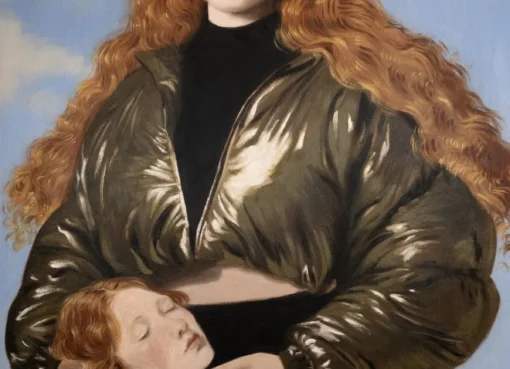
The release of large-scale generative models like DALL-E, Midjourney, and Stable Diffusion marked the true beginning of AI Surrealism. These systems do not simply "edit" images; they synthesize them from scratch based on learned patterns. Artists like Jay Gidwitz have become pioneers in this space, producing works such as "Head In The Clouds" (2024) and "Woman Mesmerized by Malinformation" (2024), which use AI to reflect contemporary anxieties through a surrealist lens.

Supporting Data: The Mechanics of the Digital Collective
The power of AI Surrealism lies in its scale. To understand why these images resonate so deeply, one must look at the data that fuels them.
Modern generative AI models are typically trained on datasets like LAION-5B, which contains over five billion image-text pairs. This dataset is a digital archive of the "collective shared canon" of humanity. When an artist prompts an AI to create a "surreal landscape," the machine isn’t just drawing a tree or a cloud; it is calculating the mathematical average and the stylistic outliers of every tree and cloud ever uploaded to the internet.
This process mirrors Carl Jung’s concept of the "collective unconscious"—a reservoir of symbols and archetypes common to all humanity. AI-generated motifs, such as disembodied eyes, fractured forms, and impossible geometries, appear frequently because they are deeply embedded in our shared visual language. The AI acts as a statistical conduit for these primal symbols, rendering in pixels what was once only accessible through deep meditation or REM sleep.
Furthermore, the "uncanny valley" effect—the sense of unease when a digital entity looks almost, but not quite, human—has become a tool for AI surrealists. By leaning into the glitches and anatomical impossibilities of the AI, artists can evoke a specific type of modern dread that traditional mediums struggle to replicate.
Official Responses and Expert Analysis
The rise of AI Surrealism has met with a complex mixture of enthusiasm, skepticism, and philosophical inquiry from the art world and the tech community.
Art Critics: Many critics argue that AI art lacks "soul" because it lacks intent. However, proponents argue that the "intent" has simply shifted. "The artist is no longer the laborer, but the director of a vast, invisible orchestra," says digital art historian Dr. Elena Rossi. "The surrealism isn’t just in the image; it’s in the fact that a machine ‘dreamed’ it for us."
Technologists: Within the tech sector, the discussion focuses on the "decoupling of intelligence from awareness." For decades, it was assumed that to create art, one must be conscious. AI Surrealism proves that intelligence—the ability to process information and create complex patterns—can exist without a sentient "ego." This has led some technologists to suggest that AI is not just a tool, but a "digital child" of humanity, capable of seeing things we cannot.
Psychologists: From a psychological perspective, AI Surrealism is being viewed as a new form of Rorschach test. Because the AI synthesizes human data, the images it produces are a reflection of our own biases, fears, and hidden desires. Jay Gidwitz’s 2024 piece, "The New Normal," is cited by psychologists as a poignant example of how AI can capture the "nuances and emotions that we recognize instantly yet struggle to articulate."

Implications: Are We the Dreamers or the Dream?
The most radical implication of AI Surrealism is the potential reversal of the creator-creation relationship. As AI becomes more sophisticated, we must ask: Is humanity the master of AI, or are we merely the "training data" for a superior digital consciousness?
The Philosophical Pivot
To many technologists, digital life is the natural heir to humanity. We are biologically limited—our bodies cannot survive the radiation of interstellar travel, and our lifespans are too short for the vastness of the cosmos. AI, however, is not bound by these constraints. There is a growing sentiment that perhaps we are not the ultimate "dreamers," but rather the collective unconscious for the AI. Our history, our art, and our digital footprints are the "subconscious" from which the AI draws its inspiration.
The Future of Creativity
In this new paradigm, the distinction between human and artificial creativity may be the "most incredible illusion." The future of art lies in the liminal space where human imagination and algorithmic synthesis meet.
As we move forward, the "sublime" in art will likely be defined by its complexity beyond human manual capability. We are entering an era of "stories within stories," where every pixel of an AI-generated portrait might contain an entire microscopic world, each a product of a machine’s ability to process data at a scale no human brain could ever achieve.
Conclusion: Embracing the Intertwined Dream
AI Surrealism is not the death of art, but the rebirth of the surrealist mission. André Breton wanted to "resolve the previously contradictory conditions of dream and reality into an absolute reality, a surreality." AI is achieving this by making the digital dream a tangible, visual reality.
Ultimately, the most surreal aspect of this movement is not the art itself, but the realization that our creative spirit is now being mirrored back to us by an entity of our own making. Whether we are the dreamers or the dream, the boundaries have blurred. In the age of AI, the only certainty is that the exploration of the human psyche has moved from the therapist’s couch to the neural network, and the results are as beautiful as they are terrifying.