
The Architecture of Synthesis: Merryn Omotayo Alaka and Sam Frésquez Unveil the ‘Kanekalon Forest’
In the heart of the urban sprawl, where the rigid geometry of concrete and steel dominates the horizon, the human psyche often yearns for the organic unpredictability of the natural world. For residents of Chicago, this reprieve is frequently found within the glass-domed sanctuaries of the Lincoln Park or Garfield Park Conservatories. These institutions offer more than just a collection of plants; they provide an immersive, multisensory experience where the boundaries between the observer and the environment blur. It is this specific sensation—the feeling of being enveloped by a verdant, living system—that serves as the foundational inspiration for Your Birth is My Birth, a groundbreaking collaborative exhibition by artists Merryn Omotayo Alaka and Sam Frésquez.
Currently on view at the Jane Lombard Gallery through June 13, the exhibition transforms the traditional "white cube" gallery space into what the artists describe as a "Kanekalon forest." Utilizing synthetic hair as their primary medium, Alaka and Frésquez have constructed a complex ecosystem of sculptures that challenge our perceptions of nature, identity, and the interconnectedness of life cycles.
Main Facts: A Botanical Oasis Crafted from Synthetic Fiber
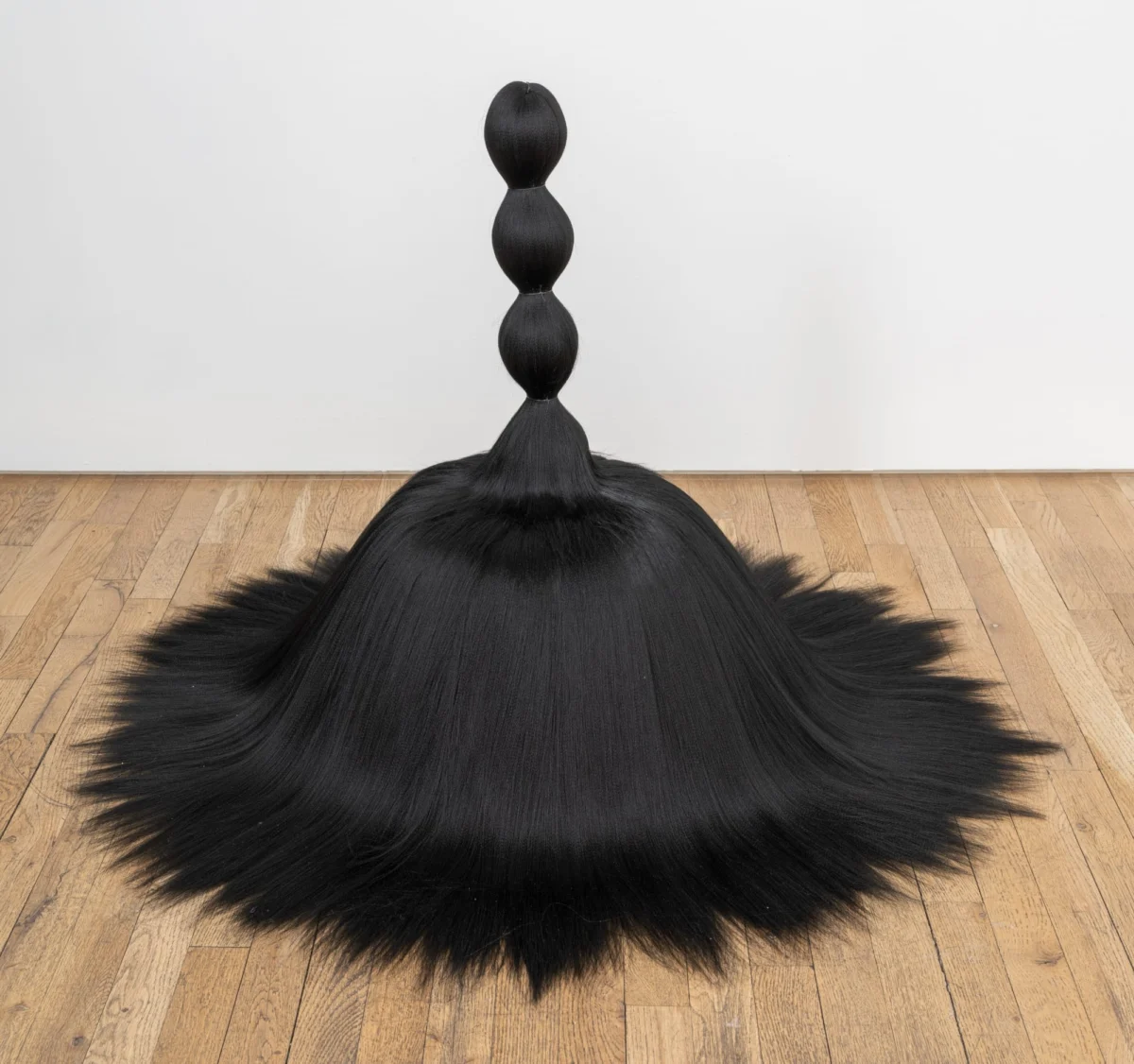
The core of Your Birth is My Birth lies in its radical materiality. The exhibition features a series of intricate sculptures fashioned from Kanekalon hair—a high-quality synthetic fiber traditionally used in braiding and hair extensions. This material, while mass-produced and synthetic, is manipulated by the artists to mimic the fluid, organic growth patterns found in the plant kingdom.

The installation is designed to be fully immersive. Sculptures are suspended from the ceiling like weeping willow branches or aerial roots, while others emerge from the wooden gallery floors, splaying outward in patterns reminiscent of fungal blooms or lily pads. The artists have identified five distinct "species" within this synthetic ecosystem: Listening Roots, Hearing Bells, Mother & Child, Stacking Pearls, and Umbra Pods.
Each piece is anchored by a hidden steel support system, providing a skeletal structure for the "foliage" of dyed locks and domed shapes. The visual language of the exhibition is deeply rooted in the study of epiphytes—non-parasitic plants such as orchids, mosses, and certain cacti that grow upon other plants or structures, deriving their moisture and nutrients from the air and rain rather than a traditional soil base. By adopting the form of the epiphyte, Alaka and Frésquez create a metaphor for cultural and familial dependence, where one entity thrives in harmony with, rather than at the expense of, its host.
Chronology: From Conservatory Inspiration to Gallery Installation
The genesis of Your Birth is My Birth can be traced back to the artists’ shared experiences in the public conservatories of Chicago. During the harsh Midwestern winters, these green spaces serve as vital oases, housing exotic specimens that would otherwise perish in the local climate. Alaka and Frésquez were struck by the "totalizing" nature of these environments—the way plants grow above, below, and around the visitor, creating a 360-degree landscape of green.

The development of the project involved a rigorous exploration of how to translate these botanical observations into a medium that carried its own weight of cultural and personal history. The selection of Kanekalon hair was not merely aesthetic; it was a deliberate choice to use a material deeply associated with the grooming rituals and identity expressions of Black and Latinx communities.
Over several months, the duo worked to refine the "species" of their forest. They moved from initial sketches inspired by specific plants—such as the bell-like shapes of certain flowers or the repetitive clusters of pearls—to the physical construction of the large-scale works. The installation process at Jane Lombard Gallery required a meticulous choreography, as each "tendril" and "root" had to be positioned to facilitate a sense of organic flow, ensuring that the transition from the ceiling to the floor felt like a continuous, living system rather than a collection of static objects.
Supporting Data: The Biological and Cultural Architecture of the Sculptures
To understand the impact of the exhibition, one must look closely at the specific forms and the data of their construction. The largest sculpture in the collection, part of the Listening Roots series, utilizes lily pad-shaped discs suctioned to the floorboards. These discs serve as the "bed" from which singular shoots of hair surge upward, tethered to a central, more comprehensive structure. This design mirrors the rhizomatic growth of certain grasses and ferns, where individual stalks are connected beneath the surface.

The Stacking Pearls series offers a different textural experience. These sculptures take on a feather-duster shape, with bulbs of hair stacked vertically. In Stacking Pearl (Adolescent) I, the work measures 24 x 24 inches, demonstrating the artists’ ability to scale their "species" to reflect different stages of growth.
The Umbra Pods series (such as Umbra Pods I and III) focuses on the underside of the botanical forms. These pieces, measuring approximately 45 x 27 inches, feature wide bell shapes with smaller, intricate fringes tucked inside. This attention to internal detail suggests a level of biological complexity, hinting at the reproductive or protective functions of real-world seed pods.
The use of dark, dyed locks serves a dual purpose. Visually, the dark tones provide a stark contrast to the gallery’s neutral environment, emphasizing the silhouettes of the forms. Conceptually, the color references the natural hues of human hair, reinforcing the link between the "forest" and the human bodies that traditionally wear these fibers.

Official Responses and Artist Philosophy
In a joint statement regarding the exhibition, Alaka and Frésquez articulated the philosophical framework of their collaboration. "Similar to an epiphyte and its host tree, these sculptural works have their own life cycles evoking systems of dependence and exchange, where one form sustains from another," the artists explained. This concept of "dependence and exchange" is central to the exhibition’s title. Your Birth is My Birth suggests a lack of separation between generations and individuals; the emergence of one life form is inextricably linked to the existence of another.
The gallery’s curatorial notes further elaborate on this theme, noting that several works reference genetics and the inheritance of traits. By creating mirrored forms that emerge within the same vertical tendril, the artists visualize the way DNA and cultural traditions are passed down through time.
Art critics have noted that the exhibition sits at a unique intersection of "Materialism" and "Eco-Aesthetics." While the work is entirely synthetic, its soul is profoundly naturalistic. By using Kanekalon—a material often viewed as "artificial" or "temporary"—to represent the enduring cycles of nature, Alaka and Frésquez challenge the hierarchy that places "natural" materials above "synthetic" ones in the world of fine art.

Implications: Identity, Symbiosis, and the Future of Material Art
The implications of Your Birth is My Birth extend far beyond the walls of the Jane Lombard Gallery. First, the exhibition contributes to a growing dialogue regarding the "politics of hair." In many cultures, hair is more than just a biological feature; it is a site of labor, care, and identity. By elevating hair extensions to the status of high-art sculpture, Alaka and Frésquez reclaim a material that has often been marginalized or misunderstood by the mainstream art world.
Furthermore, the exhibition’s focus on symbiosis offers a timely reflection on the human condition. In an era often defined by isolation and individualism, the "Kanekalon forest" serves as a reminder of our fundamental interconnectedness. The epiphyte metaphor suggests a way of living that is supportive rather than extractive—a model of existence where we can grow alongside one another, using our shared environment to flourish.
The success of this collaboration also highlights the power of shared artistic vision. Alaka and Frésquez have managed to merge their individual styles into a cohesive "ecosystem" that feels like the work of a single, unified mind. This mirrors the very biological systems they seek to emulate, where the whole is often greater than the sum of its parts.

As visitors walk through the gallery, brushing against the suspended locks and navigating the floor-bound pods, they are invited to reconsider their own place within the "forest" of human existence. Your Birth is My Birth is not just an exhibition of sculptures; it is an invitation to witness the beauty of interdependence. Through the unexpected medium of synthetic hair, Merryn Omotayo Alaka and Sam Frésquez have created a space where the artificial becomes organic, the personal becomes universal, and the act of birth is recognized as a shared, eternal cycle.
Exhibition Details:
- Your Birth is My Birth
- Artists: Merryn Omotayo Alaka and Sam Frésquez
- Venue: Jane Lombard Gallery
- Duration: Through June 13
- Materials: Kanekalon hair, steel support, dyed fibers


Leave a Comment